
Pulp Fiction, 1881 · page 7 of 24
Beadle's New York Dime Library No. 124 — page 7: what you’re looking at
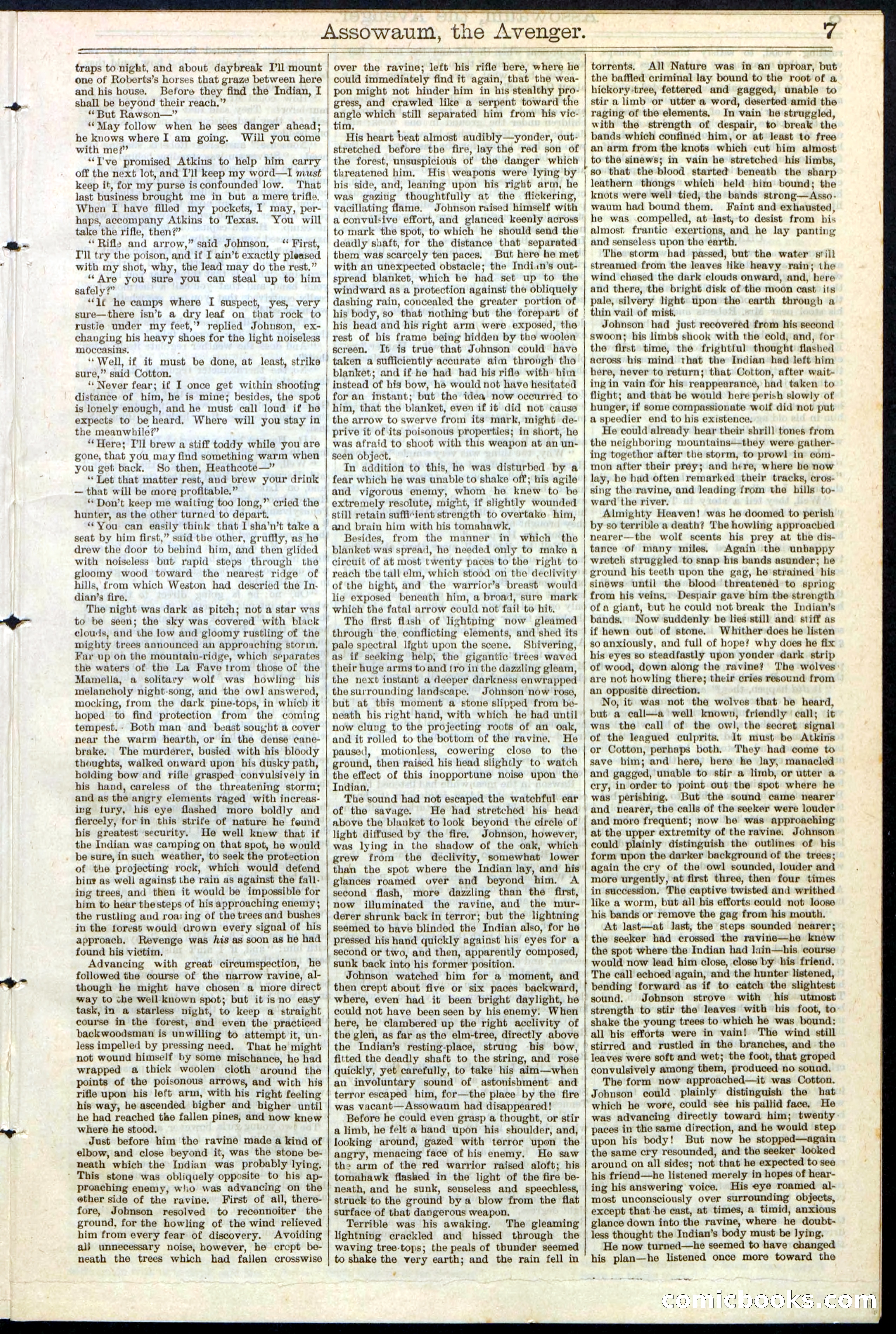
A restored page from Pulp Fiction, 1881. Page through the whole issue in the reader above.
📄 Transcribed text from this page (OCR, searchable)
Machine-transcribed from the original scan — historical spelling and the odd misread are preserved.
a 2a traps to-night, and about daybreak Tl mount one of Roberts’s horses that graze between here and his house. Before they find the Indian, I shall be beyond their reach,” “But Rawson—” ‘May follow when he sees danger ahead; he knows where I am going. Will you come with me?’ “I've promised Atkins to help him carry off the next lot, and I’l] keep my word—I must keep it, for my purse is confounded low. That last business brought me in but a mere trifle. When I have filled my pockets, I may, per- haps, accompany Atkins to Texas. You will take the rifle, then?” ‘“Rifls and arrow,” said Johnson, “ First, I'll try the poison, and if I ain’t exactly pleased with my shot, why, the lead may do the rest.” ‘“‘Are you sure you can steal up to him safely?” ‘‘1¢ he camps where I suspect, yes, very sure—there isn’t a dry leaf on that rock to rustie under my feet,’? replied Johnson, ex- changing his heavy shoes for the light noiseless moccasins. ‘Well, if if must be done, at least, strike sure,” said Cotton. ‘‘ Never fear; if I once get within shooting distance of him, he is mine; besides, the spot is lonely enough, and he must call loud if he expects to be heard, Where will you stay in the meanwhile?’ “‘Here; Tl brew a stiff toddy while you are gone, that you, may find something warm when you gefi back. So then, Heathcote—” ‘Let that matter rest, and brew your drink — that will be more profitable.” **Don’t keep me wailing too long,” cried the hunter, as the other turned to depart. ‘““You can easily think that I sha’n’t take a seat by him first,” said tbe other, gruffly, as he drew the door to bebind him, and then glided with noiseless but rapid steps through the gloomy wood toward the nearest ridge of hills, from which Weston had descried the In. dian’s fire. The night was dark as pitch; not a star was to be seen; the sky was covered with black clouds, and the low and gloomy rustling of the mighty trees announced an approaching storm, Far up on the mountain-ridge, which separates the waters of the La Fave trom those of the Mamella, a solitary wolf was howling his melancholy night-song, and the owl answered, mocking, from the dark pine-tops, in which it hoped to find protection from the coming tempest.- Both man and beast sougbt a cover near the warm hearth, or in the dense cane- brake. The murderer, busied with his bloody thoughts, walked onward upon his dusky path, holding bow and rifle grasped convulsively in his hand, careless of the threatening storm; and as the angry elements raged with increas- ing tury, his eye flashed moro boldly and fiercely, for in this strife of nature he feund his greatest security. He well knew that if the Indian was camping on that spot, he would be sure, in such weather, to seek the protection of the projecting rock, which would defend hint as well against the rain as against the fall- ing trees, and then it would be impossible for him to hear thesteps of his approaching enemy ; the rustling and roaring of the trees and bushes in the forest would drown every signal of his approach. Revenge was his as soon as he had found his victim. Advancing with great circumspection, he followed the course of the narrow ravine, al- though he might have chosen a more direct way to che well known spot; but it is no easy task, in a starless night, to keep a straight course in the forest, and even the practiced backwoodsman is unwilling to attempt it, un- less impelled by pressing need. That he might not wound himself by some mischance, he had wrapped a thick woolen cloth around the points of the poisonous arrows, and with his rifle upon his left arm, with his right feeling his way, he ascended bigher and bigher until he had reached the fallen pines, and now knew where he stood. Just before him the ravine made a kind of elbow, and close beyond it, was the stone be- neath which the Indian was probably lying. ' This stone was obliquely opposite to his ap- proaching enemy, who was advancing on the ether side of the ravine. First of all, there- fore, Johnson resolved to reconnoiter the ground, for the howling of the wind relieved him from every fear of discovery. Avoiding al} unnecessary noise, however, he crept be- neath the trees which had fallen crosswise | vacillating flame. —~ ee we ~ Se —_ arr over the ravine; left his rifle here, where he could immediately find it again, that the wea- pon might not hinder him in his stealthy pro- gress, and crawled like a serpent toward the angle which still separated him from his vic- tim, His heart beat almost audibly—yonder, out- stretched before the fire, lay the red son of the forest, unsuspicious of the danger which threatened him. His weapons were lying by his side, and, leaning upon his right arm, he was gazing thoughtfully at the flickering, Johnson raised himself with a convulsive effort, and glanced keenly across to mark the spot, to which he should send the deadly shaft, for the distance that separated them was scarcely ten paces. But here he met with an unexpected obstacle; the Indi«n’s out- spread blanket, which he had set up to the windward as a protection against the obliquely dashing rain, concealed the greater portion of his body, so that nothing but the forepart of his head and his right arm were exposed, the rest of his frame being hidden by the woolen screen. It is true that Juhnson could have taken a sufficiently accurate aim throvgb tho blanket; and if he had had his rifle with him instead of his bow, he would not have hesitated for an instant; but the idea now occurred to him, that the blanket, even if it did not cause the arrow to swerve from its mark, might de- prive it of its poisonous properties; in short, he was afraid to shoot with this weapon at an un- seen object. In addition to this, ho was disturbed by a fear which he was unable to shake off; his agile and vigorous enemy, whom he knew to be extremely resolute, might, if slightly wounded still retain sufficient strength to overtake him, and brain him with his tomahawk. Besides, from the manner in which the blanket was spread, he needed only to make a circuit of at most twenty paces to the right to reach the tall elm, which stood on the declivity of the bight, and the warrior’s breast would lie exposed beneath him, a broad, sure mark which the fatal arrow could not fail to hit. The first flash of lightning now gleamed through the. conflicting elements, and shed its pale spectral Ifght upon the scene. Shivering, as if seeking help, the gigantic trees waved their huge arms to and tro in the dazzling gleam, the next instant a deeper darkness enwrapped the surrounding landscape. Johnson now rose, but at this moment a stone slipped from be- neath his right hand, with which he had until now clung to the projecting roots of an oak, and it rolled to the bottom of the ravine. He paused, motionless, cowering close to the ground, then raised his head slightly to watch the effect of this inopportune noise upon the Indian, The sound had not escaped the watchful ear of the savage. He had stretched his head above the blanket to look beyond the circle of light diffused by the fire. Johnson, however, was lying in the shadow of the oak, which grew from the declivity, somewhat lower than the spot where the Indian lay, and his glances roamed over and beyond him. A second flash, more dazzling than the first, now illuminated the ravine, and the mur- derer shrunk back in terror; but the lightning seemed to have blinded the Indian also, for he pressed his hand quickly against his eyes for a second or two, and then, apparently composed, sunk back into his former position. Johnson watched bim for a moment, and then crept about five or six paces backward, where, even had it been bright daylight, he could not have been seen by his enemy: When here, he clambered up the right acclivity of the glen, as far as the elm-tree, directly above the Indian’s resting-place, strung his bow, fitted the deadly shaft to the string, and rose quickly, yet carefully, to take his aim—when an involuntary sound of astonishment and terror escaped him, for—the place by the fire was vacant—Assowaum had disappeared! Before he could even grasp a thought, or stir a limb, he felt a hand upon his shoulder, and, looking around, gazed with terror upon the angry, menacing face of his enemy. He saw the arm of the red warrior raised aloft; his tomahawk flashed in the light of the fire be- neath, and he sunk, senseless and speechless, struck to the ground by a blow from the flat surface of that dangerous weapon. Terrible was his awaking. The gleaming lightning crackled and hissed through the waving tree-tops; the peals of thunder seemed to shake the very earth; and the rain fell in os Assowaum, the Avenger. ee a torrents. All Nature was in an uproar, but the baffled criminal lay bound to the root of a hickory tree, fettered and gagged, unable to stir a limb or utter a word, deserted amid the raging of the elements. In vain he struggled, with the strength of despair, to break the bands which confined him, or at least to free an arm from the knots which cut bim almost to the sinews; in vain he stretched his limbs, so that the blood started beneath the sharp leathern thongs which held him bound; the knots were well tied, the bands strong—Asso- waum had bound them. Faint and exhausted, he was compelled, at last, to desist from bis almost frantic exertions, and he lay panting and senseless upon the earth. The storm had passed, but the water still streamed from the leaves like heavy rain; the wind chased the dark clouds onward, and, here and there, the bright disk of the moon cast its pale, silvery light upon the earth through a thin vail of mist. Johnson had just recovered from his second swoon; bis limbs shook with the cold, and, for the first time, the frightful thought flashed across his mind that the Indian had left him here, never to return; that Cotton, after wait- ing in vain for his reappearance, had taken to flight; and that be would here perish slowly of hunger, if some compassionate wolf did not put a speedier end to his existence. He could already hear their shrill tones from the neighboring mountains—they were gather- ing togethor after the storm, to prowl in com- mon after their prey; and here, where he now lay, he had often remarked their tracks, cros- sing the ravine, and leading from the bills to- wari the river. Almighty Heaven! was he doomed to perish by so terrible a death? The howling approached nearer—the wolf scents his prey at the dis- tance of many miles, Again the unhappy wretch struggled to snap his bands asunder; he ground his teeth upon the gag, he strained his sinews until the blood threatened to spring from his veins. Despair gave him the strength ofa giant, but he could not break the Indian’s bands. Now suddenly be lies still and stiff as if hewn out of stone. Whither does he listen so anxiously, and full of hope? why does he fix his eyes so steadfastly upon yonder dark strip a of wood, down along the ravine? The wolves: are not howling there; their cries resound from an opposite direction. No, it was not the wolves that be heard, but a call—a well known, friendly call; it was the call of the owl, the secret signal of the leagued culprits. It must be Atkins or Cotton, perhaps both. They had come to save him; and here, bere he lay, manacled and gagged, unable to stir a limb, or utter a cry, in order to point out the spot where he was perishing. But the sound came nearer and nearer, the calls of the seeker were louder and more frequent; now he was approaching at the upper extremity of the ravine. Johnson could plainly distinguish the outlines of his form upon the darker background of the trees; again the cry of the owl sounded, louder and more urgently, at first three, then four times in succession. The captive twisted and writhed like a worm, but all bis efforts could not loose his bands or remove the gag from his mouth. At last—at last, the steps sounded nearer; the seeker had crossed the ravine—he knew the spot where the Indian had lain—his course would now lead him close, close by his friend. The call echoed again, and the hunter listened, bending forward as if to catch the slightest sound. Jobnson strove with his utmost strength to stir the leaves with his foot, to shake the young trees to which he was bound; all his efforts were in vain! The wind still stirred and rustled in the branches, and the leaves were soft and wet; the foot, that groped convulsively among them, produced no sound, The form now approached—it was Cotton. Johnson could. plainly distinguish the hat which he wore, could see his pallid face, He was advancing directly toward him; twenty: paces in the same direction, and he would step upon his body! But now he stopped—again the same cry resounded, and the seeker looked around on all sides; not that he expected to see his friend—he listened merely in hopes of hear- ing his answering voice. His eye roamed al- most unconsciously over surrounding objects, except that he cast, at times, a timid, anxious glance down into the ravine, where he doubt- less thought the Indian’s body must be lying. He now turned—he seemed to have changed his plan—he listened once more toward the ~ ~e CORNIELOOOKS (E() “l