
Pulp Fiction, 1881 · page 6 of 24
Beadle's New York Dime Library No. 124 — page 6: what you’re looking at
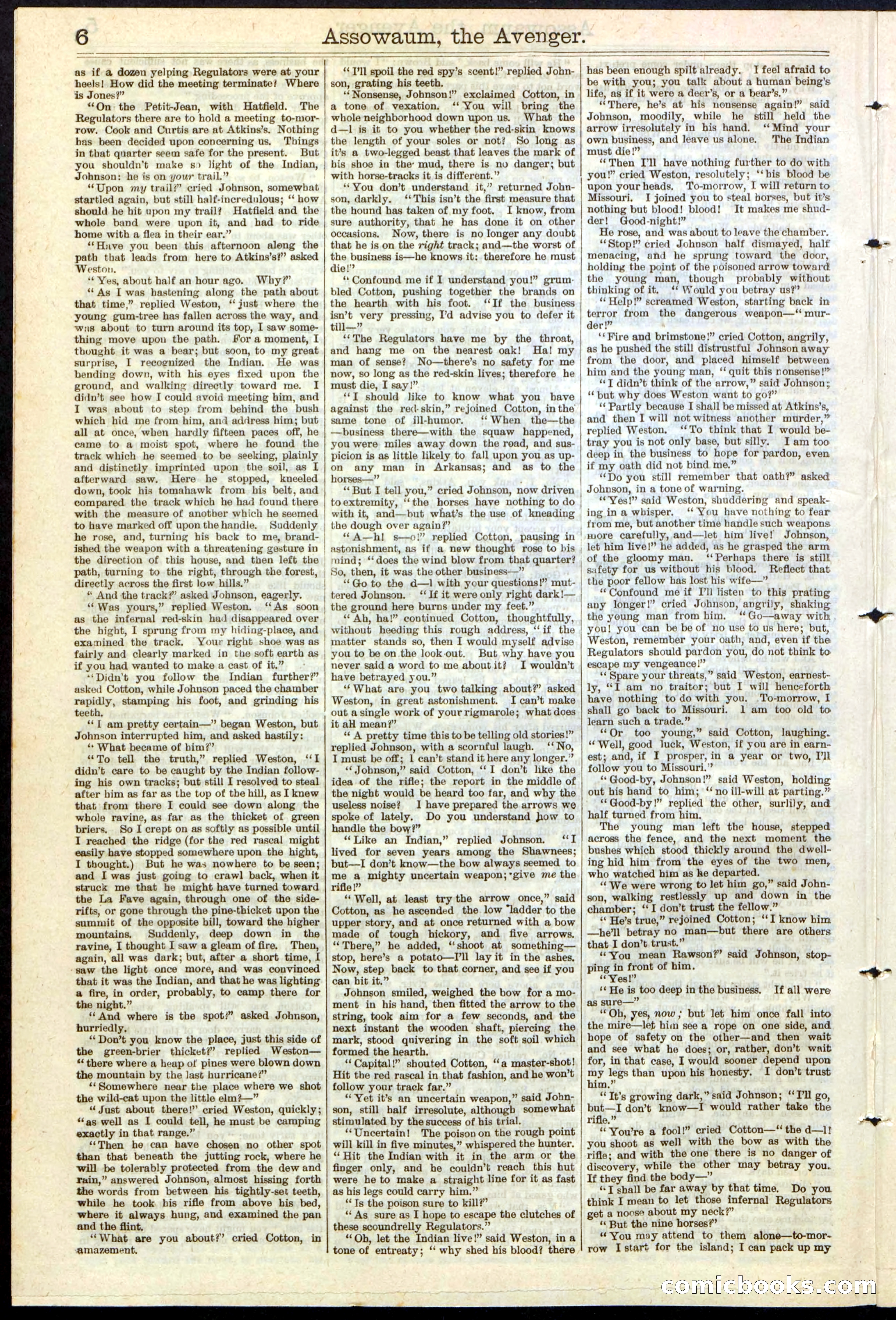
A restored page from Pulp Fiction, 1881. Page through the whole issue in the reader above.
📄 Transcribed text from this page (OCR, searchable)
Machine-transcribed from the original scan — historical spelling and the odd misread are preserved.
SS eS oe = = 6 a — as if a dozen yelping Regulators were at your heels! How did the meeting terminate? Where is Jones?” “On the Petit-Jean, with Hatfield. The Regulators there are to hold a meeting to-mor- row. Cook and Curtis are at Atkins’s. Nothing has been decided upon concerning us, Things in that quarter seem safe for the present. But you shouldn't make s» light of the Indian, Johnson: he is on your trail.” ‘Upon my trail?’ cried Johnson, somewhat startled again, but still half-incredulous; ‘‘ how should he hit upon my trail? Hatfield and the whole band were upon it, and had to ride home with a flea in their ear.” ‘‘Huve you been this afternoon aleng the path that leads from here to Atkins’s?’”’ asked Weston, ‘* Yes, about half an hour ago. Why?’ ‘As I was hastening along the path about that time,” replied Weston, ‘just where the young gum-tree has fallen across the way, and wis about to turn around its top, I saw some- thing move upon the path. for a moment, I thought it was a bear; but soon, to my great surprise, I recognized the Indian. He was bending down, with his eyes fixed upon the ground, and walking directly toward me. I didn’t see how I could avoid meeting bim, and I was about to step from behind the bush which hid me from him, and address him; but all at once, when hardly fifteen paces off, he came to a moist spot, where he found the track which he seemed to be seeking, plainly and distinctly imprinted upon the soil, as I afterward saw. Here he stopped, kneeled down, took his tomahawk from his belt, and compared the track which he had found there with the measure of another which he seemed to have marked off upon the handle. Suddenly he rose, and, turning his back to me, brand- ished the weapon with a threatening gesture in the direction of this house, and then left the Assowaum, the Avenger. | ‘‘T'll spoil the red spy’s scent!” replied John- son, grating his teeth. ‘Nonsense, Johnson!’ exclaimed Cotton, in a tone of vexation. ‘‘ You will bring the whole neighborhood down upon us. What the d—l is it to you whether the red-skin knows the length of your soles or not? So long as it’s a two-legged beast that leaves the mark of bis shoe in the: mud, there is no danger; but with horse-tracks it is different.” ‘*You don’t understand it,” returned John- son, darkly. ‘‘This isn’t the first measure that the hound has taken of my foot, I know, from sure authority, that he has done it on other occasions. Now, there is no longer any doubt that he is on the right track; and—the worst of the business is—he knows it: therefore he must die!” ‘*Confound me if I understand you!” grum- | the young man, though bled Cotton, pushing together the brands on | thinking of it. the hearth with his foot. “If the business isn’t very pressing, I’d advise you to defer it till—” ‘‘The Regulators have me by the throat, and hang me on the nearest oak! Ha! my man of sense? No—there’s no safety for me now, so long as the red-skin lives; therefore he must die, I say!” **T should like to know what you bave against the rec-skin,” rejoined Cotton, in the same tone of ill-humor. ‘‘ When the—the ——business there—with the squaw happened, you were miles away down the road, and sus- picion is as little likely to fall upon you as up- on any man in Arkansas; and as to the horses—” ; “But I tell you,” cried Johnson, now driven toextremity, ‘“‘the horses have nothing to do with it, and—but what’s the use of kneading the dough over again?” ‘“‘A—h!] s—o!” replied Cotton, pausing in astonishment, as if a new thought rose to bis mind; ‘‘does the wind blow from that quarter? path, turning to the right, through the forest, | So, then, it was the other business—” directly across the first low hills.” * And the track?’ asked Jobnson, eagerly. ‘‘Was yours,” replied Weston. as the infernal red-skin had disappeared over the hight, I sprung from my hiding-place, and examined the track, Your right shoe was as fairly and clearly marked in the soft earth as if you had wanted to make a cast of it,” ‘‘Didn’t you follow the Indian further?’ asked Cotton, while Johnson paced the chamber rapidly, stamping his foot, and grinding his teeth, ‘‘T am pretty certain—” began Weston, but Johnson interrupted him, and asked hastily: ** What became of bim?” “To tell the truth,” replied Weston, ‘‘I didn’t care to be caught by the Indian follow- ing his own tracks; but still I resolved to steal after bim as far as the top of the hill, as I knew that from there I could see down along the whole ravine, as far as the thicket of green briers. So I crept on as softly as possible until I reached the ridge (for the red rascal might easily have stopped somewhere upon the hight, I thought.) But he was nowhere to be seen; and I was just going to crawl back, when it struck me that he might have turned toward the La Fave again, through one of the side- rifts, or gone through the pine-thicket upon the summit of the opposite bill, toward the higher mountains, Suddenly, deep down in the ravine, I thought I saw a gleam of fire. Then, again, all was dark; but, after a short time, | ‘saw the light once more, and was convinced that it was the Indian, and that he was lighting a fire, in order, probably, to camp there for the night.” ‘And where is the spot/” asked Johnson, hurriedly, “Don’t you know the place, just this side of the green-brier thicket?’ replied Weston— “there where a heap of pines were blown down the mountain by the last hurricane?’ ‘*Somewhere near the place where we shot the wild-cat upon the little elm?—” “ Just about there!” cried Weston, quickly; ‘as well as I could tell, he must be camping exactly in that range.” ‘‘Then he can have chosen no other spot than that beneath the jutting rock, where he will be tolerably protected from the dew and rain,” answered Johnson, almost hissing forth the words from between his tightly-set teeth, while he took his rifle from above his bed, where it always hung, and examined the pan and the flint. ‘““What are you about?’ cried Cotton, in amazement. ' i ‘“Go to the d—1 with your questions!” mut- tered Johnson. ‘If it were only right dark!— *‘As soon | the ground here burns under my feet.” ‘‘ Ah, ha!” continued Cotton, thoughtfully, without heeding this rough address, ‘‘if the matter stands so, then I would myself advise you to be on the look out. But why have you never said a word to me aboutit? I wouldn’t have betrayed you.” ‘* What are you two talking about?’ asked Weston, in great astonishment. I can’t make out asingle work of yourrigmarole; what does it aH mean?’ “A pretty time this to be telling old stories!” replied Johnson, with a scornful laugh. ‘‘ No, I must be off; 1 can’t stand it here any longer.” ‘¢ Johnson,” said Cotton, ‘‘I don’t like the idea of the rifle; the report in the middle of the night would be heard too far, and why the useless noise? I have prepared the arrows we spoke of lately. Do you understand how to handle the bow?” “Like an Indian,” replied Johnson. “I lived for seven years among the Shawnees; but—I don’t know—the bow always seemed to me a mighty uncertain weapon;*give me the rifle!” “Well, at least try the arrow once,” said Cotton, as he ascended the low “ladder to the upper story, and at once returned with a bow made of tough hickory, and five arrows. “There,” he added, “shoot at something— stop, here’s a potato—I’ll lay it in the ashes, Now, step back to that corner, and see if you can bit it.” Johnson smiled, weighed the bow for a mo- ment in his hand, then fitted the arrow to the string, took aim for a few seconds, and the next instant the wooden shaft, piercing the mark, stood quivering in the soft soil which formed the hearth. “‘ Capital!” shouted Cotton, ‘a master-shot! Hit the red rascal in that fashion, and he won't follow your track far.” “Yet it’s an uncertain weapon,” said John- son, still half irresolute, although somewhat stimulated by the success of bis trial. ‘‘Uncertain! The poison on the rough point will kill in five minutes,” whispered the hunter. “Hit the Indian with it in the arm or the finger only, and he couldn’t reach this hut were he to make a straight line for it as fast as his legs could carry him.” “Ts the poison sure to kill?” ‘‘ As sure as I hope to escape the clutches of these scoundrelly Regulators.” ‘Oh, let the Indian live!” said Weston, in a tone of entreaty; ‘“‘ why shed his blood? there has been enough spilt already. I feel afraid to be with you; you talk about a human being’s life, as if it were a deer’s, or a bear’s,” ‘There, he’s at his nonsense again!” said Jobnson, moodily, while he still held the arrow irresolutely in his hand. ‘‘Mind your own business, and leave us alone. The Indian must die!” ‘“‘Then Ill have nothing further to do with you!” cried Weston, resolutely; ‘‘his blood be upon your heads, To-morrow, I will return to Missouri, I joined you to steal borses, but it’s nothing but blood! blood! It makes me shud- der! Good-night!” He rose, and was about to leave the chamber. **Stop!” cried Johnson half dismayed, half menacing, and he sprung toward the door, | holding the point of the poisoned arrow toward | | probably without ** Would you betray us?” “Help!” screamed Weston, starting back in terror from the dangerous weapon—‘ mur- der!” ‘¢Fire and brimstone!” cried Cotton, angrily, as he pushed the still distrustful Johnson away from the door, and placed himself between him and the young man, ‘“ quit this nonsense!” “‘T didn’t think of the arrow,” said Johnson; “but why does Weston want to go?” ‘Partly because I shall be missed at Atkins’s, and then I will not witness another murder,” replied Weston. ‘*To think that I would be- tray you is not only base, but silly. Iam too deep in the business to hope for pardon, even if my oath did not bind me.” “Do you still remember that oath?’ asked Johnson, in a tone of warning. ‘Yes! said Weston, shuddering and speak- ing ina whisper. ‘‘ You have nothing to fear from me, but another time handle such weapons wore carefully, and—let him live! Johnson, let him live!’ he added, as he grasped the arm of the gloomy man. ‘Perhaps there is still safety for us without his blood. Reflect that the poor fellow bas lost his wife—” ‘“Confound me if I'll listen to this prating -apy longer!” cried Johnson, angrily, shaking the young man from him. ‘“‘Go—away with you! you can be be of no use to us here; but wy = ’ ? Weston, remember your oath, and, even if the Regulators should pardon you, do not think to escape my vengeance!” ‘‘ Spare your threats,” said Weston, earnest- ly, “I am no traitor; but I will henceforth have nothing to do with you. .To-morrow, I shall go back to Missouri. 1 am too old to learn such a trade.” “Or too young,” said Cotton, laughing. “Well, good luck, Weston, if you are in earn- est; and, if I prosper,in a year or two, I'll follow you to Missouri.” ‘** Good-by, Johnson!” said Weston, holding out his hand to him; “ no ill-will at parting.” **Good-by!” replied the other, surlily, and half turned from him. The young man left the house, stepped across the fence, and the next moment the bushes which stood thickly around the dwell- ing hid him from the eyes of the two men, who watched him as he departed. , “We were wrong to let him go,” said John- son, walking restlessly up and down in the chamber; ‘I don’t trust the fellow.” ““ He’s true,” rejoined Cotton; “I know him —he’ll betray no man—but there are others that I don’t trust.” ‘You mean Rawson?” said Johnson, stop- ping in front of him. “Yes!” ‘¢ He is too deep in the business. as sure—” “Oh, yes, now ; but let him once fall into the mire—lef him see a rope on one side, and hope of safety on the other—and then wait and see what he does; or, rather, don’t wait for, in that case, I would sooner depend upon my legs than upon his honesty. I don’t trust him,” “Tt's growing dark,” said Johnson; ‘Tl go, but—I don’t know—I would rather take the rifle.” ‘You're a fool!” cried Cotton— the d—1! you shoot as well with the bow as with the rifle; and with the one there is no danger of discovery, while the other may betray you. If they find the body—’” | ‘JT shall be far away by that time. Do you think I mean to let those infernal Regulators get a noose about my neck?” ‘« But the nine horses?’ “You may attend to them alone—to-mor- row I start for the island; I can pack up my If all were oe EORMIE KOOKS (E()|