
Pulp Fiction, 1881 · page 5 of 24
Beadle's New York Dime Library No. 124 — page 5: what you’re looking at
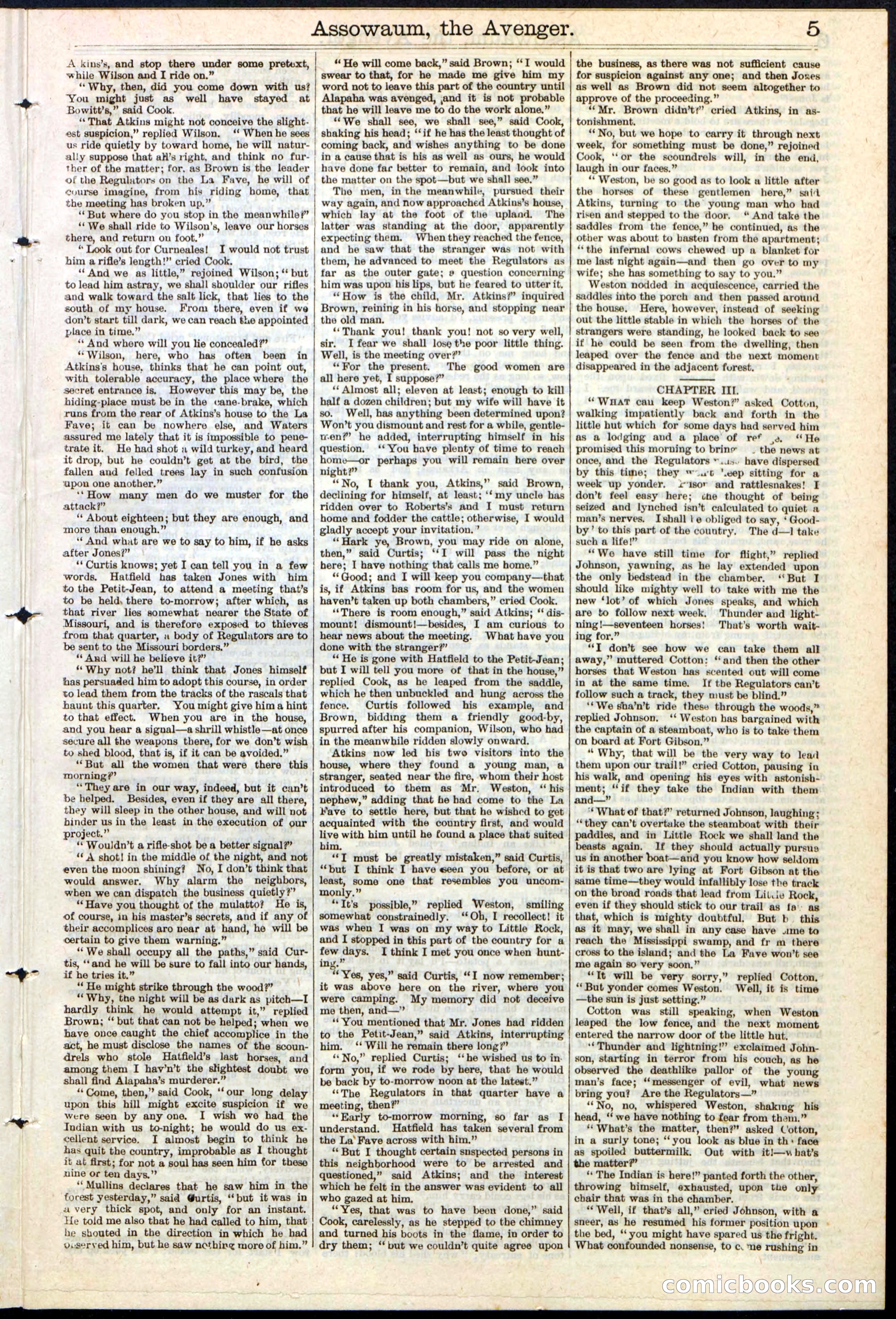
A restored page from Pulp Fiction, 1881. Page through the whole issue in the reader above.
📄 Transcribed text from this page (OCR, searchable)
Machine-transcribed from the original scan — historical spelling and the odd misread are preserved.
a eee ~ A kins’s, and stop there under some pretext, while Wilson and I ride on.” “Why, then, did you come down with us? You might just as well have stayed at Bowitt’s,” said Cook. “That Atkins might not conceive the slight- est suspicion,” replied Wilson. ‘‘ When he sees us ride quietly by toward home, he will natur- ally suppose that all’s right, and think no fur- | ther of the matter; for, as Brown is the leader of the Regulators on the La Fave, he will of course imagine, from his riding home, that the meeting has broken up,” ‘‘ But where do you stop in the meanwhile?” ‘‘ We shall ride to Wilson's, leave our horses there, and return on foot,” “ Look out for Curneales! I would not trust him a rifle’s length!” cried Cook, ‘‘ And we as little,” rejoined Wilson; ‘ but to lead him astray, we shall shoulder our rifles and walk toward the salt lick, that lies to the south of my house. From there, even if we don’t start till dark, we can reach the appointed place in time.” ‘* And where will you lie concealed?” * Wilson, here, who has often been in Atkins's house, thinks that he can point out, with tolerable accuracy, the place where the secret entrance is, However this may be, the hiding-place must be in the cane-brake, which runs from the rear of Atkins’s house to the La Fave; it can be nowhere else, and Waters assured me lately that it is impossible to pene- trate it. He had shot u wild turkey, and heard it drop, but he couldn’t get at the bird, the fallen and felled trees lay in such confusion upon one another.” ‘‘How many men do we muster for the attack?” ‘* About eighteen; but they are enough, and more than enough.” ‘‘ And what are we to say to him, if he asks after Jones?” ‘* Curtis knows; yet I can tell you in a few words. Hatfield has taken Jones with him to the Petit-Jean, to attend a meeting that’s to be held, there to-morrow; after which, as that river lies somewhat nearer the State of Missouri, and is therefore exposed to thieves from that quarter, « body of Regulators are to be sent to the Missouri borders,” ‘* And will he believe it?” ‘Why not? he’ll think that Jones himself as persuaded him to adopt this course, in order to lead them from the tracks of the rascals that haunt this quarter. You might give him a hint to that effect. When you are in the house, and you hear a sigual—a shrill whistle—at once secure all the weapons there, for we don’t wish to shed blood, that is, if it can be avoided.” ‘‘But all the women that were there this morning?’ “They are in our way, indeed, but it can’t be helped. Besides, even if they are all there, they will sleep in the other house, and will not binder us in the least in the execution of our project.” ‘* Wouldn’t a rifle-shot be a better signal?” ‘¢ A shot! in the middle of the night, and not even the moon shining? No, I don’t think that would answer. Why alarm the neighbors, when we can dispatch the business quietly?’ “Have you thought of the mulatto? He is, of course, in his master’s secrets, and if any of their accomplices aro near at hand, he will be certain to give them warning.” ‘We shall occupy all the paths,” said Cur- tis, ‘‘and he will be sure to fall into our hands, if he tries it.” “He might strike through the wood?” “Why, the night will be as dark as pitch—I hardly think he would attempt it,” replied Brown; “but that can not be helped; when we have once caught the chief accomplice in the act, he must disclose the names of the scoun- drels who stole Hatfield’s last horses, and among them I hay’n’t the slightest doubt we shall find Alapaha’s murderer.” ‘Come, then,” said Cook, ‘‘our long delay upon this hill might excite suspicion if we were seen by any one. I wish we had the Indian with us to-night; be would do us ex- cellent service. I almost begin to think he has quit the country, improbable as I thought it at first; for not a soul has seen him for these nine or ten days.” “Mullins declares that he saw him in the forest yesterday,” said @urtis, “but it was in avery thick spot, and only for an instant. He told me also that he had called to him, that he shouted in the direction in which he had sss meme eg ee EEE ooo EOEOEE—E—E—E—EeEeEeEeEeEeEeEeEeEeEeEeEe — ——_——— a “ He will come back,” said Brown; ‘I would swear to that, for he made me give him my word not to leave this part of the country until Alapaha was avenged, jand it is not probable that he will leave me to do the work alone.” ‘‘We shall see, we shall see,” said Cook, shaking his head; ‘‘if he has the least thought of coming back, and wishes anything to be done in a cause that is his as well as ours, he would have done far better to remain, and look into the matter on the spot—but we shall see.” The men, in the meanwhile, pursued their way again, and now approached Atkins’s house, which lay at the foot of the upland. The latter was standing at the door, apparently expecting them. When they reached the fence, and he saw that the stranger was not with them, he advanced to meet the Regulators as far as the outer gate; e question concerning him was upon his lips, but he feared to utter it, “How is the child, Mr. Atkins?’ inquired Brown, reining in his horse, and stopping near the old man. ‘‘Thank you! thank you! not so very well, sir. I fear we shall lose the poor little thing. Well, is the meeting over?’ “For the present. The good women are all here yet, I suppose?” ‘* Almost all; eleven at least; enough to kill half a dozen children; but my wife will have it so. Well, has anything been determined upon? Won’t you dismount and rest for a while, gentle- men?” he added, interrupting himself in his question. ‘* You have plenty of time to reach home—or perhaps you will remain here over night?” ‘““No, I thank you, Atkins,’ said Brown, declining for himself, at least; ‘‘my uncle has ridden over to Roberts’s and I must return home and fodder the cattle; otherwise, I would gladly accept your invitation. ’ “Hark ye, Brown, you may ride on alone, then,” said Curtis; ‘‘I will pass the night here; I have nothing that calls me home.” “Good; and I will keep you company—that is, if Atkins bas room for us, and the women haven’t taken up both chambers,” cried Cook. ‘‘There is room enough,” said Atkins; * dis- mount! dismount!—besides, I am curious to hear news about the meeting. What have you done with the stranger?’ “‘ He is gone with Hatfield to the Petit-Jean; but I will tell you more of that in the house,” replied Cook, as he leaped from the saddle, which he then unbuckled and hung across the fence. Curtis followed his example, and Brown, bidding them a friendly good-by, spurred after his companion, Wilson, who had in the meanwhile ridden slowly onward. Atkins now led his two visitors into the house, where they found a young man, a stranger, seated near the fire, whom their host introduced to them as Mr. Weston, “ his nephew,” adding that he had come to the La Fave to settle here, but that he wished to get acquainted with the country first, and would live with him until he found a place that suited him. ‘‘T must be greatly mistaken,” said Curtis, “but I think I have seen you before, or at least, some one that resembles you uncom- monly.” “It’s possible,” replied Weston, smiling somewhat constrainedly. ‘‘Oh, I recollect! it was when I was on my way to Little Rock, and I stopped in this part of the country for a few days. I think I met you once when hunt- iny.” Mi Yes, yes,” said Curtis, “I now remember; it was above here on the river, where you were camping. My memory did not deceive me then, and—” ‘*You mentioned that Mr. Jones had ridden to the Petit-Jean,” said Atkins, interrupting him. ‘‘ Will he remain there long?’ ‘*No,” replied Curtis; ‘‘he wished us to in. form you, if we rode by here, that he would be back by to-morrow noon at the latest.” ‘‘The Regulators in that quarter have a meeting, then?” “Early to-morrow morning, so far as I understand. Hatfield has taken several from the La’ Fave across with him.” ‘But I thought certain snspected persons in this neighborhood were to be arrested and questioned,” said Atkins; and the interest which he felt in the answer was evident to all who gazed at him. “Yes, that was to have been done,” said Cook, carelessly, as he stepped to the chimney and turned his boots in the flame, in order to ovserved him, but he saw ncthirng more of him.” ! dry them; ‘ but we couldn’t quite agree upon Assowaum, the Avenger. A mm er a i the business, as there was not sufficient cause for suspicion against any one; and then Jones as well as Brown did not seem altogether to approve of the proceeding.” “Mr. Brown didn’t?” cried Atkins, in as- tonishment. ** No, but we hope to carry it through next week, for something must be done,” rejoined Cook, ‘“‘or the scoundrels will, in the end, laugh in our faces.” ‘* Weston, be so good as to look a little after the horses of these gentlemen here,” said Atkins, turning to the young man who had risen and stepped to the door. “ And take the saddles from the fence,” he continued, as the other was about to basten from the apartment; “the infernal cows chewed up a blanket for me last night again—and then go over to my wife; she has something to say to you.” Weston nodded in acquiescence, carried the saddles into the porch and then passed around the house. Here, however, instead of seeking out the little stable in which the horses of the strangers were standing, he looked back to see if he could be seen from the dwelling, then leaped over the fence and the next moment disappeared in the adjacent furest. CHAPTER III. “WHat can keep Weston?” asked Cotton, walking impatiently back and forth in the little hut which for some days had served him as a lodging and a place of ref 4, “He promised this morning to brine _ the news at once, and the Regulators ».45. have dispersed by this time; they ~~. ‘wep sitting for a week up yonder. <c‘isor and rattlesnakes! I don’t feel easy here; che thought of being seized and lynched isn’t calculated to quiet a man’s nerves. Ishall |e obliged to say, ‘ Good- by’ to this part of the country. The d—] take such a life!” ““We have still time for flight,” replied Johnson, yawning, as he lay extended upon the only bedstead in the chamber. ‘But I should like mighty well to take with me the new ‘lot’ of which Jones speaks, and which are to follow next week. Thunder and light- ning !—seventeen horses! That’s worth wait- ing for.” “I don’t see how we can take them all away,” muttered Cotton: “and then the other horses that Weston has scented out will come in at the same time. If tbe Regulators can’t follow such a track, they must be blind.” ‘* We sha’n’t ride these through the woods,” replied Johnson. ‘‘ Weston has bargained with the captain of a steamboat, who is to take them on board at Fort Gibson.” “Why, that will be the very way to lead them upon our trail!” cried Cotton, pausing in his walk, and opening his eyes with astonisb- ment; “if they take the Indian with them and—” ‘What of that?’ returned Johnson, laughing; ‘they can’t overtake the steamboat with their paddles, and in Little Rock we shall land the beasts again. If they should actually pursus us in another boat—and you know how seldom it is that two are lying at Fort Gibson at the same time—they would infallibly lose the track on the broad roads that lead from Lilie Rock, even if they should stick to our trail as fa as that, which is mighty doubtful. But b_ this as it may, we shall in any case have .ime to reach the Mississippi swamp, and fr m there cross to the island; and the La Fave won’t see me again 80 very soon,” “It will be very sorry,” replied Cotton. “But yonder comes Weston. Well, it is time —the sun is just setting.” Cotton was still speaking, when Weston leaped the low fence, and the next moment entered the narrow door of the little hut. ‘*Thunder and lightning!” exclaimed John- son, starting in terror from his couch, as he observed the deathlike pallor of the young man’s face; “messenger of evil, what news bring you? Are the Regulators—” ‘“No, no, whispered Weston, shaking his head, ‘‘ we have nothing to fear from them.” **What’s the matter, then?” asked Cotton, in a surly tone; *“‘ you look as blue in th: face as spoiled buttermilk. Out witb it!—w hat’s the matter?’ “The Indian is here!” panted forth the other, throwing himself, exhausted, upon the only chair that was in the chamber. “Well, if that’s all,” cried Johnson, with a sneer, as he resumed his former position upon the bed, ‘you might have spared us the fright. What confounded nonsense, to c. ne rushing in MICLOOC) (E(@) (C S (C (0)