
Pulp Fiction, 1881 · page 4 of 24
Beadle's New York Dime Library No. 124 — page 4: what you’re looking at
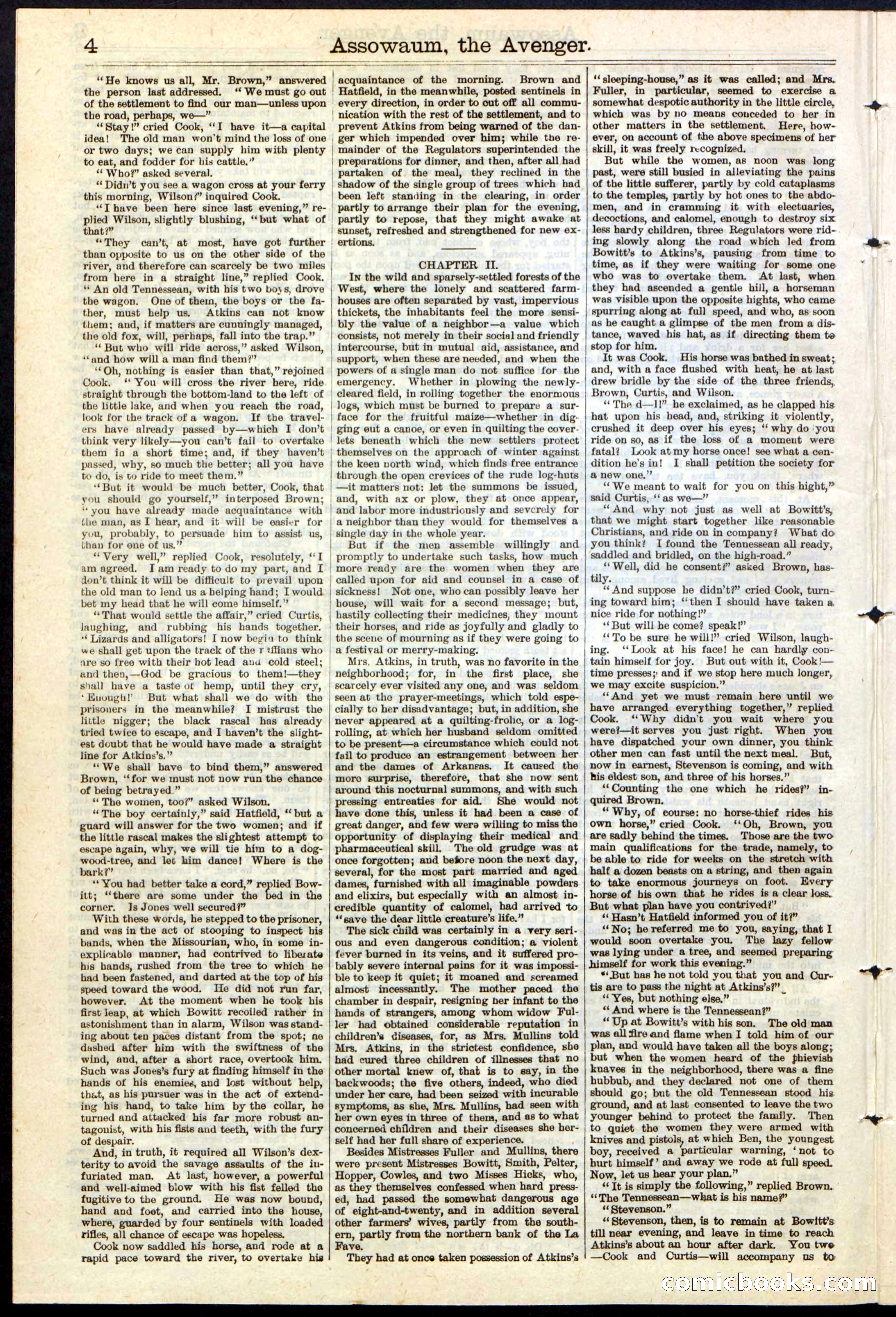
A restored page from Pulp Fiction, 1881. Page through the whole issue in the reader above.
📄 Transcribed text from this page (OCR, searchable)
Machine-transcribed from the original scan — historical spelling and the odd misread are preserved.
< _Assowaum, the Avenger. - _ ee ~~ mn ee ee | Se —— —— - “He knows us all, Mr. Brown,” answered ' acquaintance of the morning. Brown and the person last addressed. of the settlement to find our man—unless upon the road, perhaps, we—” ‘Stay!’ cried Cook, ‘‘I have it—a capital idea! or two days; we can supply him with plenty to eat, and fodder for bis cattle.” “Who?” asked several. ** Didn’t you see a wagon cross at your ferry this morning, Wilson?” inquired Cook. ‘“‘T have been here since last evening,” re- plied Wilson, slightly blushing, “but what of that?” “They can’t, at most, have got further than opposite to us on the other side of the river, and therefore can scarcely be two miles from here in a straight line,” replied Cook. * An old Tennessean, with his two boys, drove the wagon. One of them, the boys or the fa- ther, must help us. Atkins can not know them; and, if matters are cunningly managed, the old fox, will, perhaps, fall into the trap.” ‘‘ But who will ride across,” asked Wilson, ‘‘and how will a man find them?” “Oh, nothing is easier than that,” rejoined Cook. ‘ You will cross the river here, ride straight through the bottom-land to the left of the little lake, and when you reach the road, look for the track of a wagon. If the travel- ers have already passed by—which I don’t think very likely—you can’t fail to overtake them io a short time; and, if they haven’t passed, why, so much the better; all you have to do, is to ride to meet them.” ‘*But it would be much better, Cook, that you should go yourself,” interposed Brown; ‘you have already made acquaintance with the man, as I hear, and it will be easier for you, probably, to persuade him to assist us, than for one of us.” “Very well,” replied Cook, resolutely, ‘I am agreed. I am ready to do my part, and I don’t think it will be difficult to prevail upon the old man to lend us a belping hand; I would bet my head that he will come himself.” “That would settle the affair,” cried Curtis, laughing, and rubbing his hands together. “* Lizards and alligators! I now begin to think we shall get upon the track of the r tffians who are so free with their hot lead anu cold steel; and then,—God be gracious to them!—they shall have a taste ot hemp, until they cry, ‘Euough!’ But what shall we do with the prisouers in the meanwhile? I mistrust the little nigger; the black rascal has already tried twice to escape, and I haven’t the slight- est doubt that he would have made a straight line for Atkins’s.” ‘**We shall have to bind them,” answered Brown, ‘‘for we must not now run the chance of being betrayed.” “The women, too?” asked Wilson. “The boy certainly,” said Hatfield, ‘ but a guard will answer for the two women; and if the little rascal makes the slightest attempt to escape again, why, we will tie him to a dog- wood-tree, and let him dance! Where is the bark?” ‘*You had better take a cord,” replied Bow- itt; “there are some under the in the corner. Is Jones well secured?” With these words, he stepped to the prisoner, and was in the act of stooping to inspect his bands, when the Missourian, who, in some in- explicable manner, had contrived to liberate his hands, rushed from the tree to which he had been fastened, and darted at the top of his speed toward the wood. He did not run far, however, At the moment when he took his first leap, at which Bowitt recoiled rather in astonishment than in alarm, Wilson was stand- ing about ten paces distant from the spot; ne dashed after him with the swiftness of the wind, and, after a short race, overtook him. Such was Jones’s fury at finding himself in the hands of his enemies, and lost without help, that, as his pursuer was in the act of extend- ing his hand, to take him by the collar, he turned and attacked his far more robust an- tagonist, with his fists and teeth, with the fury of despair. And, in truth, it required all Wilson’s dex- terity to avoid the savage assaults of the iu- furiated man. At last, however, a powerful and well-aimed blow with his fist felled the fugitive to the ground. He was now bound, hand and foet, and carried into the house, where, guarded by four sentinels with loaded rifles, a)l chance of escape was hopeless. Cook now saddled his horse, and rode at a rapid pace toward the river, to overtake his “We must go out | Hatfield, in the meanwhile, posted sentinels in every direction, in order to out off all commu- nication with the rest of the settlement, and to prevent Atkins from being warned of the dan- The old man won't mind the loss of one , ger which impended over him; while the re- mainder of the Regulators superintended the preparations for dinner, and then, after all had _partaken of the meal, they reclined in the | shadow of the single group of trees which had | been left standing in the clearing, in order partly to arrange their plan for the evening, partly to repose, that they might awake at | sunset, refreshed and strengthened for new ex- _ ertions. CHAPTER II. In the wild and sparsely-settled forests of the West, where the lonely and scattered farm- houses are often separated by vast, impervious thickets, the inhabitants feel the more sensi- | bly the value of a neighbor—a value which | consists, not merely in their social and friendly _ intercourse, but in mutual aid, assistance, and _ support, when these are needed, and when the powers of a single man do not suffice for the emergency. Whether in plowing the newly- cleared field, in rolling together the enormous logs, which must be burned to prepare a sur- face for the fruitful maize—whether in dig- ging eut a canoe, or even in quilting the cover- lets beneath which the new settlers protect themselves on the approach of winter against the keen north wind, which finds free entrance | through the open crevices of the rude log-huts —it matters not: let the summons be issued, and, with ax or plow, they at once appear, and labor more industriously and sevcrely for a neighbor than they would for themselves a | single day in the whole year. | sickness! But if the men assemble willingly and promptly to undertake such tasks, how much more ready are the women when they are called upon for aid and counsel in a case of Not one, who can possibly leave her /house, will wait for a second message; but, hastily collecting their medicines, they mount their horses, and ride as joyfully and gladly to the scene of mourning as if they were going to a festival or merry-making. Mrs. Atkins, in truth, was no favorite in the neighborhood; for, in the first place, she scarcely ever visited any one, and was seldom seen at the prayer-meetings, which told espe- cially to her disadvantage; but, in addition, she never appeared at a quilting-frolic, or a log- rolling, at which her husband seldom omitted to be present—a circumstance which could not fail to produce an estrangement between her and the dames of Arkansas. It caused the more surprise, therefore, that she now sent around this nocturnal summons, and with such pressing entreaties for aid. She would not have done this, unless it had been a case of great danger, and few were willing to miss the opportunity of displaying their medical and pharmaceutical skill. The old grudge was at once forgotten; and before noon the next day, several, for the most part married and aged dames, furnished with all imaginable powders and elixirs, but especially with an almost in- credible quantity of calomel, had arrived to ‘save the dear little creature’s life.” The sick child was certainly in a very seri- ous and even dangerous condition; a violent fever burned in its veins, and it suffered pro- bably severe internal pains for it was impossi- ble to keep it quiet; it moaned and screamed almost incessantly. The mother paced the chamber in despair, resigning her infant to the hands of strangers, among whom widow Ful- ler had obtained considerable reputation in children’s diseases, for, as Mrs, Mullins told Mrs. Atkins, in the strictest confidence, sbe had cured three children of illnesses that no other mortal knew of, that is to say, in the backwoods; the five others, indeed, who died under her care, had been seized with incurable symptoms, as she, Mrs. Mullins, had seen with her own eyes in three of them, and as to what concerned children and their diseases she her- self had her full share of experience. Besides Mistresses Fuller and Mullins, there were present Mistresses Bowitt, Smith, Pelter, Hopper, Cowles, and two Misses Hicks, who, as they themselves confessed when hard press- ed, had the somewhat dangerous age of eight-and-twenty, and in addition several other farmers’ wives, partly from the south- ern, partly from the northern bank of the La Fave. They had at once taken possession of Atkins’s ‘‘ sleeping-house,” as it was called; and Mrs. Fuller, in particular, seemed to exercise a somewhat despotic authority in the little circle, which was by no means conceded to her in other matters in the settlement. Here, how- ever, on account of the above specimens of her skill, it was freely recognized, But while the women, as noon was long past, were still busied in alleviating the pains of the little sufferer, partly by cold cataplasms to the temples, partly by hot ones to the abdo- men, and in cramming it with electuaries, decoctions, and calomel, enough to destroy six less hardy children, three Regulators were rid- ing slowly along the road which led from Bowitt’s to Atkins’s, pausing from time to time, as if they were waiting for some one who was to overtake them. At last, when they had ascended a gentle hill, a horseman was Visible upon the opposite hights, who came spurring along at full speed, and who, as soon as he caught a glimpse of the men from a dis- tance, waved his hat, as if directing them te stop for him. It was Cook. His horse was bathed in sweat; and, with a face flushed with heat, he at last drew bridle by the side of the three friends, Brown, Curtis, and Wilson, ‘The d—l!” he exclaimed, as he clapped his hat upon his head, and, striking it violently, crushed it deep over his eyes; ‘‘ why do you ride on so, as if the loss of a moment were fatal? Look at my horse once! see what a cen- dition he's in! I shall petition the society for a@ new one,” “We meant to wait for you on this hight,” said Curtis, ‘‘as we—” “And why not just as well at Bowitt’s, that we might start together like reasonable Christians, and ride on in company? What do you think? I found the Tennessean all ready, saddled and bridled, on the high-road.” ‘** Well, did he consent?’ asked Brown, has- tily. ** And suppose he didn’t?’ cried Cook, turn- ing toward him; ‘‘then I should have taken a. nice ride for nothing!” ‘* But will he come? speak!” ‘*To be sure he will!” cried Wilson, laugh- ing. ‘‘ Look at his face! he can hardly con- tain himself for joy. But out with it, Cook!— time presses; and if we stop here much longer, we may excite suspicion.” ‘‘And yet we must remain here until we have arranged everything together,” replied Cook. ‘‘Why didn’t you wait where you weref—it serves you just right. When you have dispatched your own dinner, you think other men can fast until the next meal. But, now in earnest, Stevenson is coming, and with his eldest son, and three of his horses.” ‘Counting the one which he rides?” in- quired Brown. “Why, of course: no horse-thief rides his own horse,” cried Cook. ‘‘Oh, Brown, you are sadly behind the times. Those are the two main qualifications for the trade, namely, to be able to ride for weeks on the stretch with half a dozen beasts on a string, and then again to take enormous journeys on foot. Every horse of his own that he rides is a clear loss. But what plan have you contrived?” ‘‘ Hasn’t Hatfield informed you of it?” ‘“No; he referred me to you, saying, that I would soon overtake you. The lazy fellow was lying under a tree, and seemed preparing himself for work this evening.” *‘ But has he not told you that you and Cur- tis are to pass the night at Atkins’s?”’ _ ‘Yes, but nothing else,” “* And where is the Tennessean?” “Up at Bowitt’s with his son. The old man was all fire and flame when I told him of our plan, and would have taken all the boys along; but when the women heard of the phievish knaves in the neighborhood, there was a fine hubbub, and they declared not one of them should go; but the old Tennessean stood his ground, and at last consented to leave the two younger behind to protect the family. Then to quiet the women they were armed with knives and pistols, at which Ben, the youngest boy, received a particular warning, ‘not to hurt bimself’ and away we rode at full speed. Now, let us hear your plan.” ‘¢ It is simply the following,” replied Brown. ‘The Tennessean—what is his name?” “Stevenson.” ‘Stevenson, then, is to remain at Bowitt’s till near evening, and leave in time to reach Atkins’s about an hour after dark. You twe —Cook and Curtis—will accompany us to 6S EGOmicdoo (E(@)