
Pulp Fiction, 1880 · page 9 of 32
Beadle's Dime Library No. 111 — page 9: what you’re looking at
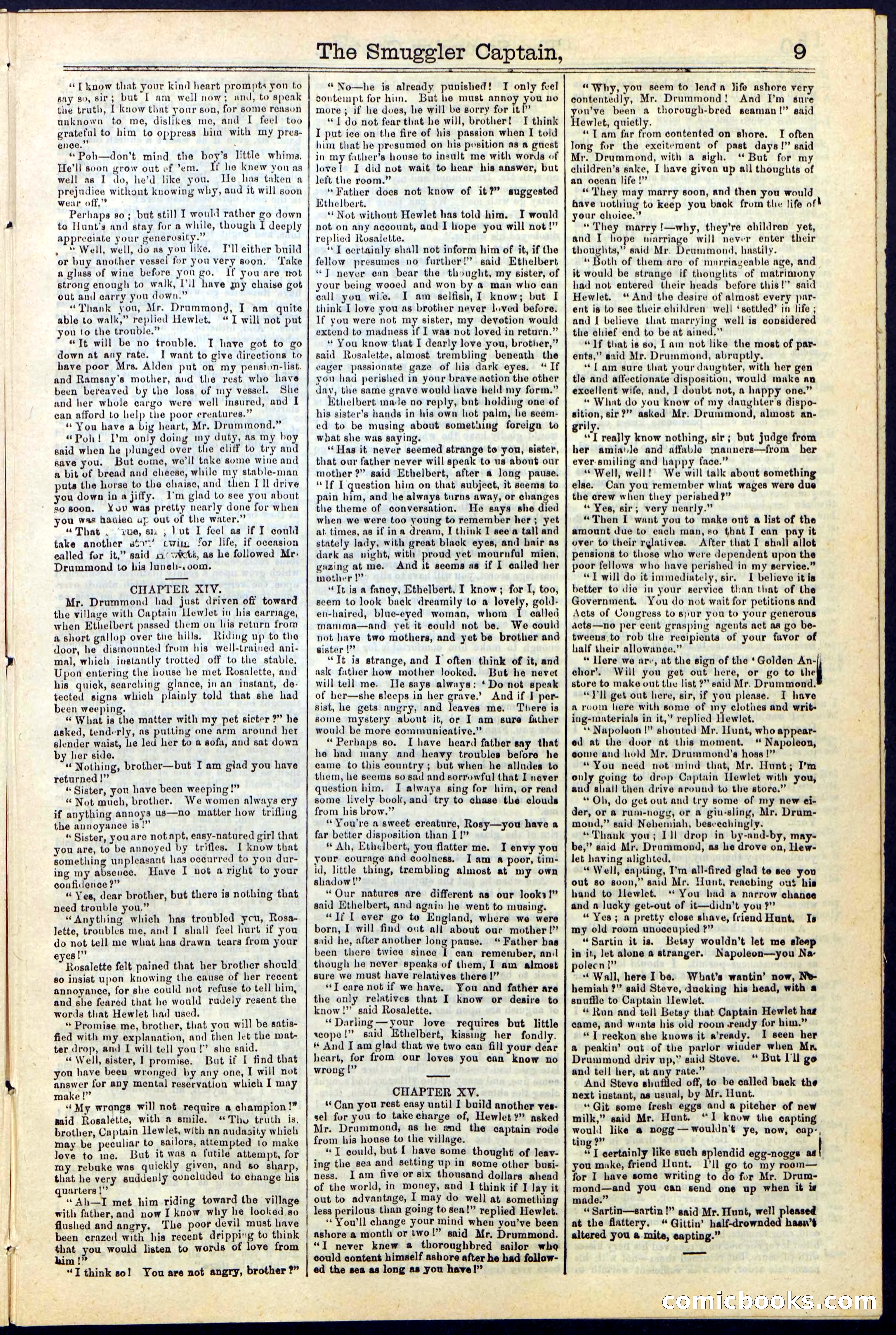
A restored page from Pulp Fiction, 1880. Page through the whole issue in the reader above.
📄 Transcribed text from this page (OCR, searchable)
Machine-transcribed from the original scan — historical spelling and the odd misread are preserved.
The Smuggler Captain, 9 0 A ES “T know that your kind heart prompts yon to say so, sir; but I am well now, and, to speak the truth, I know that your son, for some reason unknown to me, dislikes me, and I feel too grateful to him to oppress him with my pres- ence.” ; “ Poh—don’t mind the boy’s little whims. He'll soon grow out ef ’em. If he knew you as well as I do, he'd like you. He has taken a prejudice without knowing why, and it will soon wear off,” Perhaps so; but still I would rather go down to Hunt's and stay fora while, though I deeply appreciate your generosity.” “Well, well, do as you like. I'll either build or buy another vessel for you very soon. ‘Take a glass of wine before you go. If you are rot strong enough to walk, I'll have my chaise got out and garry you down,” “Thank you, Mr. Drummond, I am quite able to walk,” replied Hewlet. “I will not put ou to the trouble.” “Tt will be no trouble. T have got to go down at ip gg I want to give directions to have poor Mrs. Alden put on my pensiun-list. and Ramsay's mother, aud the rest who have been bereaved by the loss of my vessel. She and her whole cargo were well insured, and I ean afford to help the poor creatures.” “ You have a big heart, Mr. Drummond.” “Poh! I’m only doing my duty, as my boy said when he plunged over the cliff to try and save you. But come, we'll take some wine and a bit of bread and cheese, while my stable-man puts the horse to the chaise, and then I Il drive you down in a jiffy. I'm glad to see you about so goon. Xvv was pretty nearly done for when you was hauiea up out of the water.” “That. rue, su ; }ut I feel as if I could take another sto’ cwim for life, if occasion ealled for it,’? said s4¢ wets, as he followed Mr: Drummond to his Juneh-.oom, CHAPTER XTV. Mr. Drummond had just driven off toward the village with Captain Lewlet in his carnage, when Ethelbert passed them on his return from a short gallop over the hills. Riding up to the door, he dismounted from his well-trained ani- mal, which instantly trotted off to the stable. Upon entering the house he met Rosalette, and his quick, searching glance, in an instant, de- tected signs which plainly told that she had been weeping. “ What is the matter with my pet sicter ?” he asked, tenderly, as putting one arm around her slender waist, he led her to a sofa, and sat down by her side. “Nothing, brother—but I am glad you have returned!” “Sister, you have been weeping!” “ Not much, brother. We women always cry if anything annoys us—no matter how trifling the annoyance is!” «“ Sister, youare not apt, easy-natured girl that you are, to be annoyed by trifles. I know that something unpleasant has occurred to you dur- ing my absence. Have I not aright to your confidence ?” , “ Yes, dear brother, but there is nothing that need trouble you.” “Anything which has troubled ycu, Rosa- Jette, troubles me, and I shall feel hurt if you do not tell me what has drawn tears from your eyes!” Rosalette felt pained that her brother should so insist upon knowing the cause of her recent annoyance, for she could not refuse to tell him, and she feared that he would rudely resent the words that Hewlet had used. “ Promise me, brother, that you will be satis- fied with my explanation, and then Jet the mat- ter drop, and I will tell you !? she said. “ Well, sister, I promise. But if | find that you have been wronged by any one, I will not answer for apy mental reservation which I may make !” “My wrongs will not require a champion!” paid Rosalette, with a smile. “Tho truth is, brother, Captain Hewlet, with an audasity which may be peculiar to sailors, attempted to make love to ime. But it was a futile attempt, for my rebuke was quickly given, and so sharp, that he very suddenly concluded to change his quarters |” ; “Ah—I met him riding toward the village with father, and now I know why he looked so flushed and angry. ‘The poor devil must have been crazed with his recent dripping to think that you would listen to words of love from him !” “I think so! You are not angry, brother ?” ‘ No—he is already punished! T only feel contempt for him. But he must annoy you no more ; if he does, he will be sorry for it!” “1 do not fear that he will, brother! TI think I put ice on the fire of his passion when I told him that he presumed on his position as a guest in my father’s house to insult me with words of love! JI did not wait to hear his answer, but left the room.” “Father does not know of it?” suggested Ethelbert. “Not without Hewlet has told him. I would not on any account, and I hope you will not!” replied Rosalette. ‘I certainly shall not inform him of it, if the fellow presumes no further!’ said Ethelbert “J never ean bear the thought, my sister, of your being wooed and won by & man who can eall you wie. I am selfish, I know; but I think I love you as brother never loved before. If you were not my sister, my devotion would extend to madness if I was not loved in return.” “ You know that I dearly love you, brother,” said Rosalette, almost trembling beneath the eager passionate gaze of his dark eyes. “If you had perished in your brave action the other day, the same grave would have held my form.” Ethelbert made no reply, but holding one of his sister’s hands in his own hot palm, he seem- ed to be musing about something foreign to what she was saying. ‘Hag it never seemed strange to yon, sister, that our father never will speak to us about our mother ?” said Ethelbert, after a long pause. ‘Tf I question him on that subject, it seems to pain him, and he always turns away, or changes the theme of conversation. He says she died when we were too young to remember her; yet at, times, as if ina dream, I think I see a tall and stately lady, with great black eyes, and hair as dark as night, with proud yet mournfal mien, gizing at me. And it seems as if I called her mother !” “Tt is a fancy, Ethelbert, I know; for I, too, seem to look back dreamily to a lovely, gold- en-haired, blue-eyed woman, whom i called manma—and yet it could not be. We could not have two mothers, and yet be brother and sister !” “Tt is strange, and I often think of it, and ask futher how mother looked. But he nevet will tell me. He says always: ‘Do not speak of her—she sleeps in her grave.’ And if I per- sist, he gets angry, and leaves me. There is some mystery about it, or I am sure father would be more communicative.” “Perhaps so. Ihave heard father say that he had many and heavy troubles before he came to this country; but when he alludes to tliem, he seems so sad and sorrowful that I never question him. I always sing for him, or read some lively book, and try to chase the clouds from his brow.” “You're a sweet creature, Rosy—you have a far better disposition than I!” “Ah, Ethelbert, you flatter me. I envy you your courage and coolness. Iam a poor, tim- ld, little thing, trembling almost at my own shadow!” “Our natures are different as our looks!” said Ethelbert, and again he went to musing. “Tf [ ever go to England, where we were born, I will find out all about our mother!” suid he, after another long pause. “ Father bas been there twice since [ can remember, ani though he never speaks of them, I am almost sure we must have relatives there !” “T care not if we have. You and father are the only relatives that I know or desire to know!” said Rosalette. “Darling —your love requires but little scope |” said Ethelbert, kissing her fondly. And I am glad that we two can fill your dear heart, for from our loves you can know no wrong !”’ CHAPTER XV. “Can you rest easy until I build another ves- sel fur you to take charge of, Hewlet” asked Mr. Drummond, as he and the captain rode from his house to the village. “T could, but I have some thought of leav- ing the sea and setting up in some other busi- ness. Jam five or six thousand dollars ahead of the world, in money, and I think if I Jay it out to advantage, I may do well at something less perilous than going to sea!” replied Hewlet. ch Vou'll change your mind when you’ve been ashore a month or wo!” said Mr. Drummond. “I never knew a thoroughbred sailor wha could content himself ashore after he had follow- ed the sea as long as you have!” “Why, you seem to lead a jife ashore very contentedly, Mr. Drummond! And I’m sure owyve been a thorough-bred seaman!” said ewlet, quietly. “Tam far from contented on shore. I often long for the excitement of past days!” said Mr. Drummond, with a sigh. “ But for my children’s sake, I have given up all thoughts of an ocean life !” “They may marry soon, and then you would have nothing to keep you back from the life of your chwuice.” “They marry !—why, they’re children yet, and I hope marriage will never enter their thoughts,” eaid Mr. Paint id: hastily. " Both of them are of mnrriayeable age, and it would be strange if thoughts of matrimony had not entered their heads before this!” said Hewlet. “ And the desire of almost every par- ent is to see their children well ‘settled’ in life ; and [ believe that marrying well is considered the chief end to be at ained.” “If that is so, Lam not like the most of par- ents,” said Mr. Drummond, abruptly. “fam sure that your daughter, with her gen tle and affectionate disposition, would make an excellent wife, and, I doubt not, a happy one.” * What do you know of my daughter's dispo- sition, sir?” asked Mr. Drummond, almost an- rily. . w really know nothing, sir; but judge from her amiatvle and affable manuners—from her ever-smiling and happy face.” “Well, well! We will talk about something else. Can you remember what wages were due the crew when they perished?” “ Yes, sir; very nearly.” “Then I want you to make out a list of the amount due to each man, so that I can pay it over to their relatives. After that I shall allot pensions to those who were dependent upon the poor fellows who have perished in my service.” “T will do it immediately, sir. 1 believe it is better to die in your service than that of the Government. You do not wait for petitions and Acts of Congress to spur you to your generous acts—no per cent grasping agents act as go be- tweens to rob the recipients of your favor of half their allowance.” : chor’. Will you get out here, or go to the sture to make out the list ?” said Mr. Drummond. “Pl get out here, sir, if you please. I have a room here with some of my clothes and writ- ing-materials in it,” replied Hewlet. ** Napoleon !” shouted Mr. Hunt, who appear- ed at the door at this moment. “ Napoleon, come and hold Mr. Drummond's hoss !” “You need not mind that, Mr. Hunt; I'm only yuing to drop Captain ewlet with you, aud shall then drive around to the store.” “Oh, do get out and try some of my new ei- der, or a rum-nogy, or a gin-sling, Mr. Drum- mond,” said Nehemiah, beseechingly. “Thank you; Il drop in by-and-by, may- be,” said Mr. Drummond, as he drove on, Hew- let having alighted, “Well, eapting, I’m all-fired glad te see you out so soon,” said Mr. Hunt, reaching out his hand to llewlet. ‘You had a narrow chance and a lucky get-out of it—didn’t you ?” “Yes; a pretty close shave, friend Hunt, Is my old room unoccupied ?” “Sartin it is. Betsy wouldn't let me sleep in it, let alone a stranger. Napoleon—you Na- polecn {” “Wall, here I be. What’s wantin’ now, Ne hemiah ?” said Steve, ducking his head, with a snuffie to Captain Lewlet. “ Kun and tell Betsy that Captain Hewlet has came, and wants his old room ready for him.” “T reckon she knows it a’ready. I seen her a peakin’ out of the parlor wiuder when Mr Drummond driv up,” said Steve. “ But I'll go and tell her, at any rate.” And Steve shufiled off, to be called back the next instant, as usual, by Mr. Hunt. “Git some fresh eggs and a pitcher of new milk,” said Mr. Hunt. “I know the capting | would like @ nogg—wouldn't ye, now, oap-, ting ?” oy certainly like such splendid ege-noggs as you make, friend Hunt. I'll go to my room— for I have some writing to do for Mr. Drum- mond—and you can send one up when it is made.” “ Sartin—eartin !” said Mr. Hunt, well pleased at the flattery. “Giitin’ half-drownded hasn't altered you a mite, eapting.” “ Llere we arv, at the sign of the ‘Golden tnef EE — = = - =e OO or Gomilchboo ‘Ss (Eco)