
Pulp Fiction, 1880 · page 8 of 32
Beadle's Dime Library No. 111 — page 8: what you’re looking at
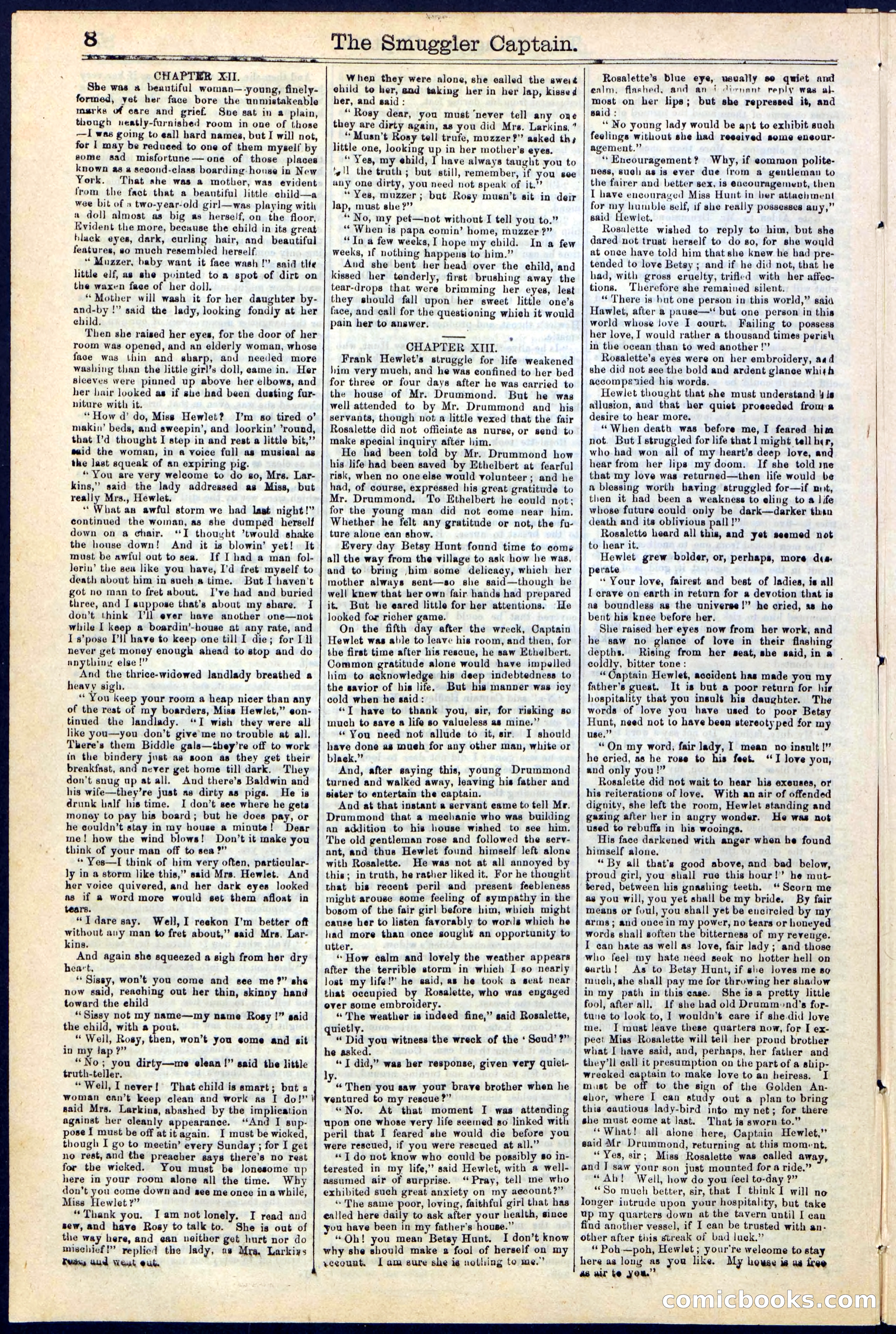
A restored page from Pulp Fiction, 1880. Page through the whole issue in the reader above.
📄 Transcribed text from this page (OCR, searchable)
Machine-transcribed from the original scan — historical spelling and the odd misread are preserved.
8 .o 7F = SRE CTS) SPN oT Te .. ae raw ey a CHAPTER XII. She was a beautiful woman—-young, finely- formed, yet her face bore the nnmistakeable murks of care and grief. Spe sat in a plain, though neatly-furnished room in one of those —I was going to eal) hard names, but I will not, for | may be redueed to one of them myself by some sad misfortune—one of those places known as @ second-class boarding: house in New York. That she was a mother, was evident from the fact that a beautiful little ehild—a wee bit of » two-year-old girl—was playing with a doll almost as big as herself, on the floor, Kvident the more, because the child in its great hlack eyes, dark, curling hair, and beautiful features, eo much resembled herself “ Muzzer, baby want it face wash!” said tite little elf, as she pvinted toa spot of dirt on the waxen face of her doll. “Mother will wash it for her daughter by- and-by !" said the lady, looking fondly at her ehild, Then she raised her eyes, for the door of her room was opened, and an elderly woman, whose face was thin and sharp, and needed more washing than the little girl’s doll, eame in. Her siceves were pinned up above her elbows, and her hair looked as if she had been dusting fur- niture with it. ‘* How d’ do, Mise Hewlet? I’m so tired o’ makin’ beds, and sweepin’, and loorkin’ ’round, that [’d thought I step in and rest a little bit,’ said the woman, in a voice full as musieal as the last squeak of an expiring pig. “You are very welcome to do so, Mrs. Lar- kins,” said the lady addressed as Miss, but really Mrs., Hewlet. “What an awful storm we had last night!” continued the woman, as she dumped herself down on a chair. “I thouvht ’twould shake the house down! And it is blowin’ yet! It must be awful out to sea. If I had a man fol- Jerin’ the sea like you have, I'd fret myself to death about him in such atime. But I haven't got no man to fret about. I’ve had and buried three, and I suppose that’s about my share. I don’t think Vll ever have another one—not while I keep a boardin’-house at any rate, and I s’pose Pll have to keep one till I die; for I il never get money enough ahead to stop and do anything else!” And the thrice-widowed landlady breathed a heavy sigh. ‘You keep your room a heap nicer than any of the rest of my boarders, Miss Hewlet,” eon- tinued the landlady. “I wish they were all like you—you don’t give'me no trouble at all. There's them Biddle gals—shey’re off to work in the bindery just as soon as they get their breakfast, and never get home till dark. They don’t snug up at all. And there’s Baldwin and his wife—they’re just as dirty as pigs. He is drunk half his time. I don’t see where he gets money to pay his board; but he does pay, or he couldn’t stay in my house a minute! Dear me! how the wind blows! Don’t it make you think of your man off to sea?” “* Yes—I think of him very often, particular- ly in a storm like this,” said Mrs. Hewlet. And her voice quivered, and her dark eyes looked as if a word more would set them afloat in tears. “IT dare say. Well, I reekon I’m better oft —s auy man to fret about,” said Mrs. Lar- ing. And again she squeezed a sigh from her dry heart, ‘* Sissy, won’t you come and see me?” she now said, reaching out her thin, skinny hand toward the ehild ‘Sissy not my name—my name Rosy !” said the child, with a pout. “ Well, Rosy, then, won’t you eome and sit in my lap ?” ‘““No; you dirty—me elean !” said the little truth-teller. “Well, I never! That child is smart; but 1 woman ean’t keep clean and work as I do!’’} said Mrs. Larkins, abashed by the implication against her cleanly appearance. “And I sup- pose f must be off at it again. I must be wicked, though I go to meetin’ every Sunday ; for I get no rest, and the preacher says there’s no rest for the wicked. You must be lonesome up here in your room alone all the time. Why don’t you come down and see me once ina while, Miss Hewlet ?” “Thank you. I am not lonely. I read and sew, and have Rosy to talk to. She is out of the way here, and ean neither get hurt nor do mischief!” replied the Jady, o# Mra, Larkiys Tediny dud West ub. Neti The Smuggler Captain. When they were alone, she ealled the sweit ehild to her, and taking her in her Jap, kissed her, and paid: “Rosy dear, you must ‘never tell any one they are dirty again, as you did Mrs. Larkins, _* Musn’t Rosy tell trufe, muzzer?” asked th, little one, looking up in her mother’s eyes. “ Yes, my ebild, I have always taught you to ‘g'l the truth ; but still, remember, if you see uny one dirty, you need not speak of it.” “Yes, muzzer; but Rosy musn’t sit in deir Jap, must she ?” “No, my pet—not without I tell you to.” “ When is papa comin’ home, muzzer ?” “Tn a few weeks, I hope my ebild. In a few weeks, if nothing happens to him.” And she bent her head over the child, and kissed her tenderly, first brushing away the tear-drops that were brimming her eyes, lest they should fall upon her sweet little one’s face, and ¢all for the questioning whieh it would pain her to answer. CHAPTER XIII. Frank Hewlet’s struggle for life weakened him very much, and he was eonfined to her bed for three or four days after he was carried to the house of Mr. Drummond. But he was well attended to by Mr. Drummond and his servants, though not a little vexed that the fair Rosalette did not officiate as nurse, or send to make special inquiry after him. He had been told by Mr. Drummond how his life had been saved by Ethelbert at fearful risk, when no one else would volunteer; and he had, of course, expressed his great gratitude to Mr. Drummond. To Ethelbert he could not; for the young man did not come near him. Whether he felt any gratitude or not, the fu- ture alone ean show. Every day Betsy Hunt found time to come all the way from the village to ask how he was, and to bring him some delicacy, which her mother always sent—so she said—though he well knew that her own fair hands had prepared it. But he eared little for her attentions. He looked for richer game. On the fifth day after the wreck, Captain Hewlet was able to leave his room, and then, for the first time after his rescue, he saw Ethelbert. Common gratitude alone would have impelled him to acknowledge his deep indebtedness to the savior of his life. But his manver was icy cold when he said: “T have to thank you, sir, for risking so much to save a life so valueless as mine.” “ You need not allude to it, sir. I should have done as wueh for any other man, white or blaek.”’ And, after saying this, young Drummond turned and walked away, leaving his father and sister to entertain the captain. And at that instant a servant eame to tell Mr. Drummond that a mechanie who was building an addition to his house wished to see him, The old gentleman rose and followed the serv- ant, and thus Hewlet found himeelf left alone with Rosalette. He was not at all annoyed by this; in truth, he rather liked it. For he thought that bis recent peril and present feebleness might arouse some feeling of sympathy in the bosom of the fair girl before him, which might cause her to listen favorably to words which he had more than once sought an opportunity to utter. ‘How calm and lovely the weather appears after the terrible storm in which I so nearly lost my life!” he eaid, as he took a seat near that oceupied by Rosalette, who was engaged over some embroidery. “The weather is indeed fine,’ said Rosalette, quietly. “ Did you witness the wreck of the ‘ Scud’ ?” he asked. “I did,” was her response, given very quiet- Ma Then you saw your brave brother when he ventured to my rescue?” é “No. At that moment I was attending upon one whose very life seemed so linked with peril that I feared she would die before you were rescued, if you were rescued at all.” ‘J do not know who could be possibly so in- terested in my life,’ said Hewlet, with a well- assumed air of surprise. “ Pray, tell me who exhibited such great anxiety on my aecount?” «“ The same poor, loving, faithful girl that has ealled here daily to ask after your health, since you have been in my father’s house.” “Oh! you mean Betsy Hunt. I don’t know why she should make a fool of herself on my recount. Jam eure she ie nothing to me.” Rosalette’s blue eye, usually se qwiet and enlm. flashed, and an i Girnant reply was al- most on her lips; but she repressed it, and paid : ‘““ No young lady would be apt to exhibit auch feelings without she had reeeived some eneour- agement.” ‘‘ Encouragement? Why, if eommon polite- ness, such as is ever due from a gentleman to the fairer and better sex, is encouragement, then I have encouraged Miss Hunt in ber attachment for my humble self, if she really possesses any,” said Llewlet. Rosalette wished to reply to him, but she dared not trust herself to do so, for she would at once have told him that she knew he had pre- tended to love Betsy ; and if he did not, that he had, with gross eruelty, trifled with her affee- tions. ‘Therefore she remained silent. “There is but one person in this world,” said Hawlet, after a pause— but one person in this world whose love I court. Failing to possess her love, I would rather a thousand times perish in the ocean than to wed another !”’ Rosalette’s eyes were on her embroidery, aad she did not see the bold and ardent glance whith accompanied his words. Hewlet thought that she must understand | js allusion, and that her quiet proeeeded from a desire to hear more. “When death was before me, I feared him not. But I struggled for life that 1 might tell har, who had won all of my heart’s deep love, and hear from her lips my doom. If she told ine that my love was returned—then life would be a blessing worth having struggled for—if nyt, then it had been a weakness to eling to a] ife whose future could only be dark—darker than death and its oblivious pall !” Rosalette heard all this, and yet seemed not to hear it. Hewlet grew bolder, or, perhaps, more d«as perate ‘* Your love, fairest and best of ladies, is all [ crave on earth in return for a devotion that is as boundless as the universe!” he cried, as he bent his knee before her. She raised her eyes now from her work, and he saw no glance of love in their flashing depths. Rising from her seat, she said, in a | coldly, bitter tone: - Captein Hewlet, accident has made you m father’s guest. It is but a poor return for hig hospitality that you insult his daughter. The words of love you have used to poor Betsy Hunt, need not to have been stereotyped for my use,” “On my word, fair lady, I mean no insult !” he cried, as he rose to his feet. “I Jove you, and only you!” Rosalette did not wait to hear hia exeuses, or his reiterations of love. With an air of offended dignity, she left the room, Hewlet standing and gazing after her in angry wonder. He was not used to rebuffs in his wooings. His face darkened with anger when he found himself alone, “ By all that’s good above, and bad below, proud girl, you shall rue this hour!” he mut- tered, between his gnashing teeth. “ Scorn me as you will, you yet shall be my bride. By fair means or foul, you shall yet be encircled by my arms; and once in my power, no tears or honeyed words shall soften the bitterness of my revenge. I can hate as well as love, fair lady; and those who feel my hate need seek no hotter hell on earth! As to Betsy Hunt, if sie loves me sg mugh, she shall pay me for throwing her shadow in my path in this case. She isa pretty little fool, after all. Jf she had old Dramm»nd's for- tune to look to, I wouldn't eare if she.did love me. I must leave these quarters now, for I ex- pect Miss Rosalette will tell her proud brother what I have said, and, perhaps, her father and they’ll eall it presumption on the part of a ship- wrecked captain to make love to an heiress. I must be off to the sign of the Golden An- elor, where I can study out a plan to bring this eautious lady-bird into my net; for there she must come at last. That is sworn to.” ‘What! all alone here, Captain Hewlet,”’ said Mr Drummond, returning at this moment, ‘Yes, sir; Miss Rosalette was called away, and I saw your son just mounted for a ride.” “Ah! Well, how do you feel to-day ?” “So much better, sir, that I think I will no longer intrude upon your hospitality, but take up my quarters down at the tavern until I can find another vessel, if I can be trusted with an- other after this streak of bad luck.” ‘Poh —poh, Hewlet ; your're weleome to stay here as long as you like. My hovuse ia aa iree as air te you.” (E(0) Gomicbooks ;