
Pulp Fiction, 1880 · page 10 of 32
Beadle's Dime Library No. 111 — page 10: what you’re looking at
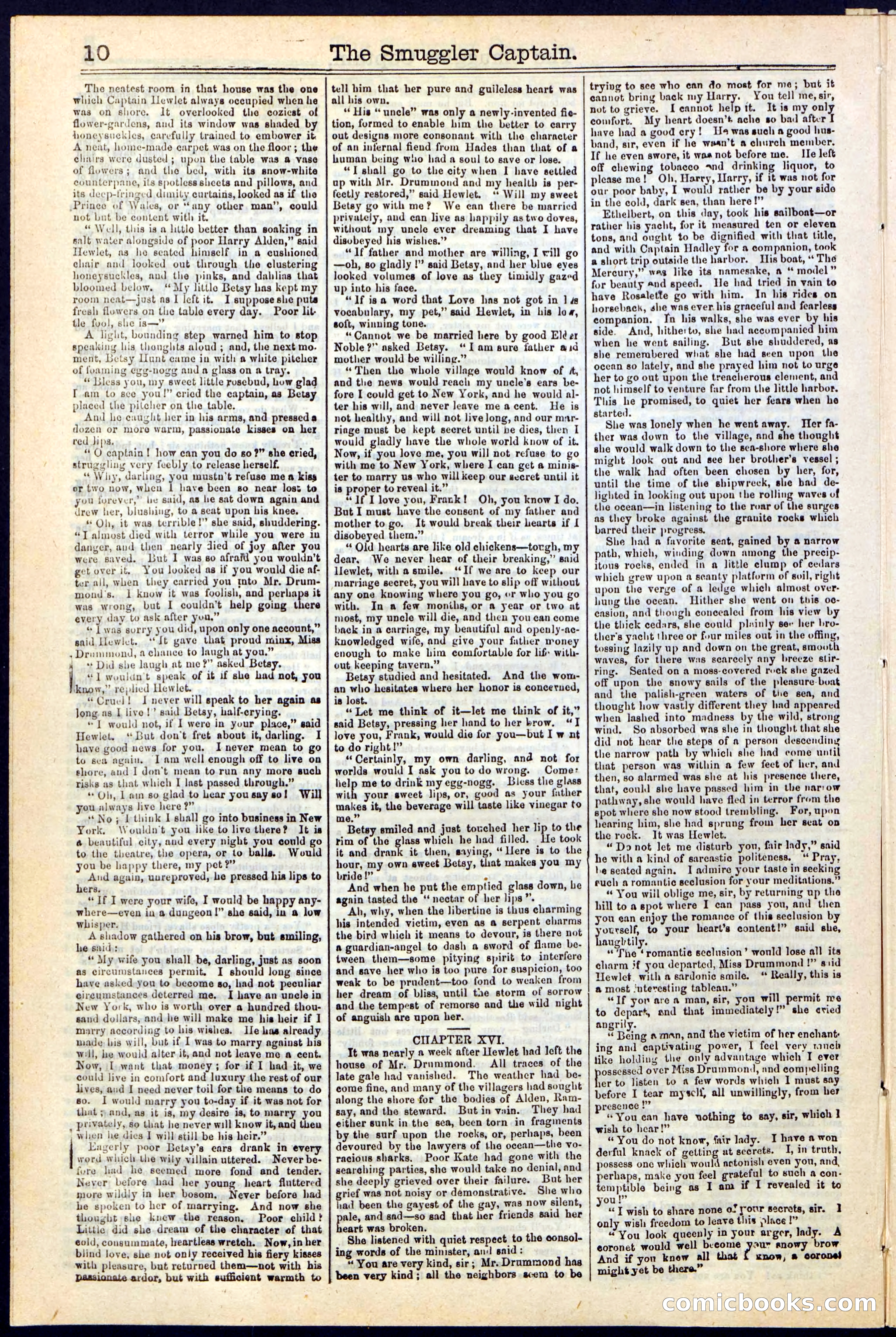
A restored page from Pulp Fiction, 1880. Page through the whole issue in the reader above.
📄 Transcribed text from this page (OCR, searchable)
Machine-transcribed from the original scan — historical spelling and the odd misread are preserved.
10 The neatest room in that house was the one which Captain Llewlet always occupied when he was on sliore. 1t overlooked the cozicst of flower-gardens, and its window was shaded by honeysuckles, carefully trained to embower it A neat, home-made carpet was on the floor; the elinirs were dusted ; upon the table was a vase of flowers; and the ed, with its snow-white eounterpane, ils spotless sheets and pillows, and its decp-fringed dimity curtains, looked as if the Prinee of Wales, or “any other man”, could not but be content with it. “ Well, this is a liltle better than soaking in salt waver alongside of poor Harry Alden,” said Hewlet, as he seated himself in a cushioned eliair and looked out through the clustering honeysuckles, and the pinks, and dahlias that bloomed below. “My little Betsy has kept my room neat—just ns I left it. I suppose she puts fresh flowers on the table every day. Poor lit tle fuol, she is—” A light, bounding step warned him to stop speaking his thoughts aloud; and, the next mo. ment, betsy Lunt came in with a white piteher of foaming egg-nogg and a glass on a tray. “ Dless you, my sweet little rosebud, how glad [ am to sce you!” cried the captain, as Betsy placed the pitcher on the table. And he eaught her in his arms, and pressed a dozen or more warm, passionate kisses on her red Jips. “ © captain! how can you do so?” she cried, struggling very feebly to release herself. “ Wiy, darling, you mustn’t refuse me a kiag or two now, when | have been go near loss to you forever,” le said, as he sat down again and drew her, blushing, to a seat upon his knee. * Oh, it was terrible!” she said, shuddering. “T almost died with terror while you were in danyer, and then nearly died of joy after you were saved. Lut I was so afrafd you wouldn't get over it, You looked as if you would die af- ter all, when they carried you mto Mr. Drum- mond's. 1 know it was foolish, and perhaps it was wrong, but I couldn’t help going there every day to ask after yuu,” « ] was sorry you did, upon only one account,” gnid Liewlet. ‘Jt gave that proud minx, Miss ~Drommond, a chance to laugh at you.” “ Did she laugh at me?” asked Betsy. “]T wouldn't speak of it if she had not, you know,” replied Llewlet. “Cruci! J never will speak to her again as Jong as I live!’ said Betsy, half-erying. «J would not, if I were in your place,” said IIewlet. ‘But don't fret about it, darling. I have good news for you. Inever mean to go to sea again. Iam well enough off to live on shore, aud I don't mean to run any more such risks as that which I last passed through.” “Oh, lain so glad to Lear yousay so! Will you always live here ?” ‘No; I think I shall go into business in New York. Wouldn't you like to live there? It is @ beautiful city, and every night you could go to the theatre, the opera, or to balls. Would you be happy there, my pet?” A And again, unreproved, he pressed his lips to ers. “If I were your wife, I would be happy any- where—even in a dungeon!” she said, in a low Whisper. A shadow gathered on his brow, but smiling, he said: “ My wife you shall be, darling, just as soon as circumstances permit. I should long since have asked you to become so, had not peculiar circumstances deterred me. I have an uncle in New York, who is worth over a hundred thou- sand dollars, and he will make me his heir if I marry according to his wishes. Le has alread made bis will, but if I was to marry against his will, he would alter it, and not leave me a cent. Now, I want that money; for if I had it, we could live in comfort and luxury the rest of our lives, aud I need never toil for the means to do 60. 1 would marry you to-day if it was not for that and, as it is, my desire is, to marry you <> - =e: _ privately, 80 that he never will know it, and then when he dies I will still be his heir.” Lagerly poor Betsy’s ears drank in every word which the wily villain uttered. Never be- fure had he seemed more fond and tender. Never before had her young. heart fluttered more wildly in her bosom, Never before had he spoken to her of marrying. And now she thought she knew the reason, Poor child! Little did she dream of the character of that eold, consummate, beartleas wretch. Now, inher blind love, she not only received his fiery kisses with pleasure, but returned them—not with his passionate ardor, but with sufficient warmth to The Smuggler Captain. tell him that her pure and guileless heart was all his own, “His “uncle” was only a newly-invented fie- tion, furmed to enable him the better to carry out designs more consonant with the character of an infernal fiend from Hades than that of a human being who had a soul to save or lose. “JT shall go to the city when I have settled up with Mr. Drummond and my health is per- feetly restored,” said Hewlet. ‘* Will my sweet Betsy go with me? We ean there be marricd privately, and can Jive as happily as two doves, without my uncle ever dreaming that I have disobeyed his wishes.” | “Tf father and mother are willing, I will go —oh, so gladly !’’ said Betsy, and her blue eyes looked volumes of love as they timidly gazed up into his face. “If isa word that Love has not got in ls vocabulary, my pet,” said Hewlet, in his log, soft, winning tone. “Cannot we be married here by good Eld er Noble?” asked Betsy. “Iam sure father aid mother would be willing.” “Then the whole village would know of 4, and the news would reach my uncle's ears be- fore I could get to New York, and he would al- ter his will, and never leave me acent. He is not healthy, and will not Jive long, and our mar- ringe must be kept secret until be dies, then I would gladly have the whole world know of it. Now, it you love me, you will not refuse to go with me to New York, where I can get @ minis- ter to marry us who will keep our secret until it is proper to reveal it.” “If I love you, Frank! Oh, you know I do. But I must have the consent of my father and mother to go. It would break their hearts if [ disobeyed them.” “ Old hearts are like old chickens—torgh, my dear, We never hear of their breaking,” said Hewlet, with a smile. ‘If we are to keep our marriage secret, you will have to slip off without any one knowing where you go, or who you go with. In a few monibs, or year or two at most, my uncle will die, and then you can come back in a carriage, my beautiful and openly-ac- knowledged wife, and give your father money enough to make him comfortable for lif with- out keeping tavern.” Betsy studied and hesitated. And the wom- an who hesitates where her honor is concerned, is lost. “Let me think of it—let me think of it,” said Betsy, pressing her hand to her brow. “I love you, Frank, would die for you—but I w nt to do right!” “Certainly, my own darling, and not for worlds would I ask you todo wrong. Come: lielp me to drink my egg-nogg. Liess the glass with your sweet lips, or, good as your father makes it, the beverage will taste like vinegar to me.” : Betsy smiled and just touched her upytc the rim of the glass which he had filled. LHe took it and drank it then, saying, “Llere is to the hour, my own eweet Betsy, that makes you my bride!” ° And when he put the emptied glass down, le agnin tasted the ‘ nectar of her lips”. Ah, why, when the libertine is thus charming his intended victim, even as a serpent charms the bird which it means to devour, is there not a guardian-angel to dash a sword of flame be- tween them—some pitying spirit to interfere and save her who is too pure for suspicion, too weak to be prudent—too fond to weaken from her dream of bliss, until the storm of sorrow and the tempest of remorse and the wild night of anguish are upon her. CITAPTER XVI. It was nearly a week after Llewlet had left the house of Mr. Drummond. All traces of the late gale had vanished. The weather had be- come fine, and many of the villagers had sought along the shore for the bodies of Alden, Ram- say, and the steward. Butin vain. They had either sunk in the sea, been torn in fragments by the surf upon the rocks, or, perhaps, been devoured by the lawyers of the ocean—the vo- racious sharks, Poor Kate had gone with the searching parties, she would take no denial, and she deeply grieved over their failure. But her grief was not noisy or demonstrative. She who had been the gayest of the gay, was now silent, ale, and sad—so sad that her friends said her ams was broken. She listened with quiet respect to the consol- ing words of the minister, an: enid : “ You are very kind, sir; Mr.Drammond has been very kind; all the neighbors acem to be / trying to see who can do most for me; but it cannot bring back my Harry. You tell me, sir, not to grieve. Lecannot help tt. It is my only comfort. My heart doesn’t ache so bad after I have had a good ery! I4 was such a good hus- band, sir, even if he waan’t a church member. If he even swore, it waa not before me. Ie left off chewing tobacco «nd drinking liquor, to please me! Oh, Horry, Uarry, if it was not for our poor baby, I would rather be by your side in the cold, dark sea, than here!” Ethelbert, on this day, took his sailboat—or rather his yacht, for it measured ten or eleven tons, and ought to be dignified with that title, and with Captain Hadley for a companion, took a short trip outside the harbor. Tis boat, “ The Mercury,” was like its namesake, a “ model” for beauty and speed. He had tried in vain to have Rosalette go with him. In his rides on horseback, she was ever his graceful and fearless companion. In his walks, she was ever by his side. And, hitherto, she had accompanied him when he went sailing. But she shuddered, as she remerobered what she had seen upon the ocean so lately, and she prayed him not to urge her to go out upon the treacherous element, and not himself to venture far from the little harbor, This he promised, to quiet her fears when he started. She was lonely when he went away. Ter fa- ther was down to the village, and she thought she would walk down to the sea-shore where she might look out and see her brother's vessel ; the walk had often been chosen by her, for, until the time of the shipwreck, she bad de- lighted in looking out upon the rolling waves of the ocean—in listening to the roar of the surges as they broke against the granite rocks which barred their progress, She had a favorite seat, gained by a narrow path, which, winding down among the precip- itous rocks, ended in a little clump of cedars which grew upon a seanty platform of soil, right upon the verge of a ledge which almost over- lung the ocean. Hither she went on this oc- easion, and though concealed from his view by the thick cedars, she could plainly see her bro- ther’s yacht three or four miles out in the offing, tossing lazily up and down on the great, smooth waves, for there ws searecly any breeze stir- ring. Seated on a moss-covered rock she gazed off upon the snowy sails of the pleasure-boat and the palish-green waters of the sea, and thought how vastly different they had appeared when lashed into madness by the wild, strong wind. So absorbed was she in thought that she did not hear the steps of a person descending the narrow path by which she had come until that person was within a few feet of her, and then, so alarmed was she at his presence there, that, could she have passed him in the narow pathway,she would have fled in terror from the spot where she now stood trembling. For, upon hearing him, she had sprung from her seat on the rock. It was Hewlet. “Do not let me disturb you, fair Indy,” said he with a kind of sarcastic politeness. “ Pray, le seated again. I admire your taste in seeking euch a romantic seclusion for your meditations.” “ You will oblige me, sir, by returning up the hill to a spot where I can pass you, and then you ¢an enjoy the romance of this seclusion by ‘ourself, to your heart’s content!” suid she, Viaciahtity: “The ‘romantie scelusion’ wonld lose all its charm 3f you departed, Miss Drummond !” sid Mewlet. with a sardonic smile. “ Really, this is a most ‘uteresting tableau.” 4 . “If yor are a man, sir, you will permit me to depart, snd that immediately!” she cvied angrily. ee : “ Being a man, and the victim of her enchant: ing and captivating power, I feel very roneh like holding the only advantage which I ever ossessed over Miss Drummond, and compelling ee to listen to a few words which 1 must say before I tear myself, all unwillingly, from her resence !”” . “You can have vothing to say, sir, which } wish to hear!” “You do not know, fair lady. I have a won derful knack of getting at secrets. I, in truth, possess one which would actonish even you, and, perhaps, make you feel grateful to such a con- temptible being as I am if I revealed it to rou tg “T wish to share none of your secrets, sir. 1 only wish freedom to leave this place !” “You look queenly in your arger, lady. A eoronet would well become Pi snowy brow And if you knew all that { xnow, a might yet be there.” )\ / GOMIGHOOKS.co