
Pulp Fiction, 1880 · page 7 of 32
Beadle's Dime Library No. 111 — page 7: what you’re looking at
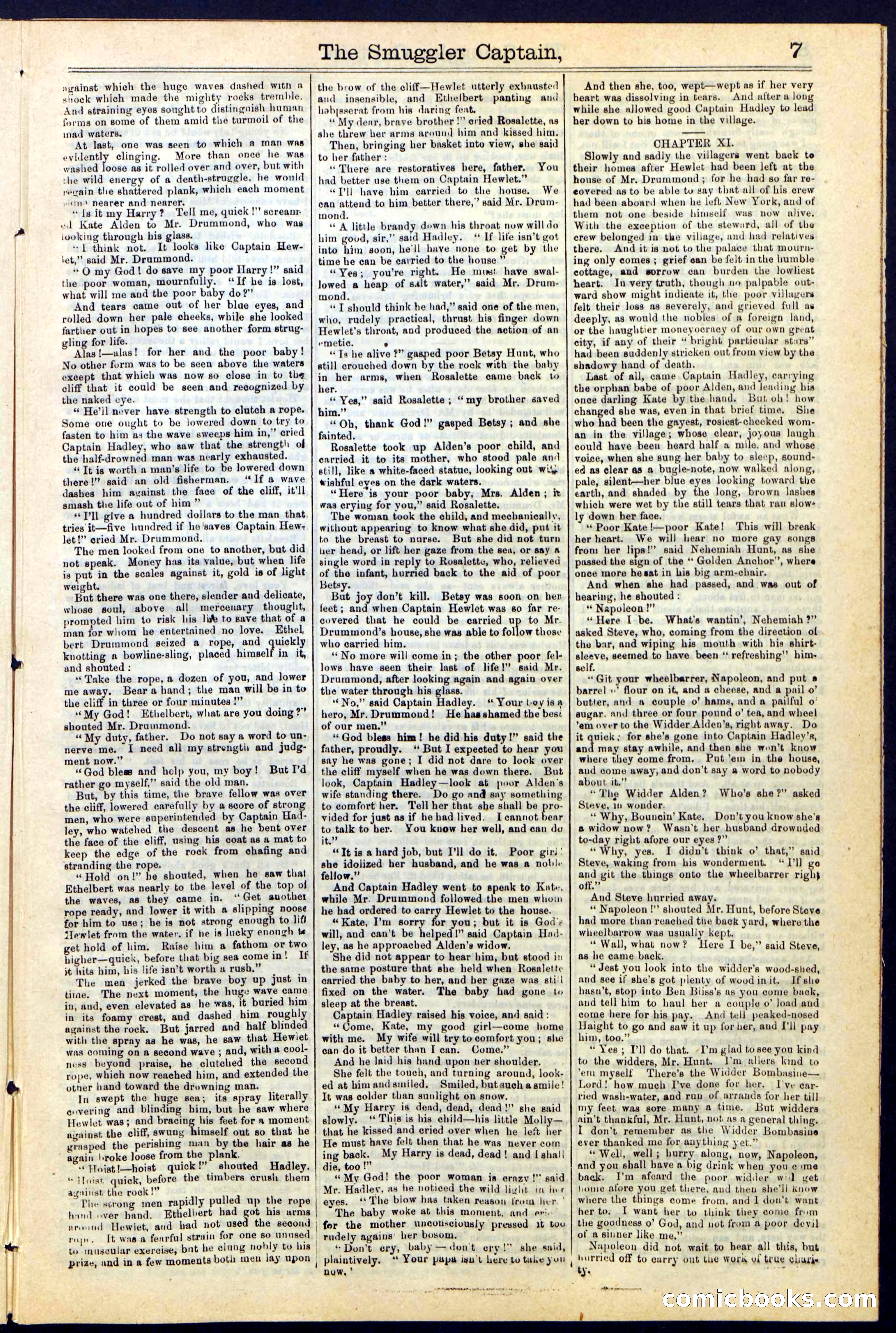
A restored page from Pulp Fiction, 1880. Page through the whole issue in the reader above.
📄 Transcribed text from this page (OCR, searchable)
Machine-transcribed from the original scan — historical spelling and the odd misread are preserved.
The Smuggler Captain, me Ce me a a ee eee @ against whieh the huge waves dashed with a shoek which made the mighty rocks tremble. And straining eyes soughtto distingoish human forms on some of them amid the turmoil of the inad waters. At last, one was seen to which a man was evidently clinging. More than once he was washed loose as it rolled over and over, but with the wild energy of a death-struggle, he wonld revain the shattered plank, which each moment im nearer and nearer. “fs it my Harry? Tell me, quick !”’ screanr ed Kate Alden to Mr. Drummond, who was ivoking through his glass. +I think not. It looks like Captain Hew- iet,” said Mr. Drammond. *O my God! do save my poor Ilarry !” said the poor woman, mournfully. “If he is lost, what will me and the poor baby do?” And tears came out of her blae eyes, and rolled down her pale cheeks, while she looked farther out in hopes to see another form strug- gling for life. Alas !—ualas! for her and the poor baby! No other furm was to be seen above the waters except that which was now so close in to th¢ cliff that it could be seen and recognized by the naked eye. ‘“ He’ll never have strength to clutch a rope. Some one ought to be lowered down to try to fasten to him as the wave sweeps him in,” cried Captain Hadley, who saw that the strength ol the half-drowned man was nearly exhausted. “It is worth a man’s life to be lowered down there !’? said an old fisherman. “If a wave dashes him avainst the face of the cliff, it'll smash the life out of him ” “Pll give a hundred dollars to the man that tries it—five hundred if he saves Captain Hew- let!” eried Mr. Drummond. The men looked from one to another, but did not speak. Money has its value, but when life is put in the scales against it, gold is of light weight. But there was one there, slender and delicate, whose soul, above all mercenary thought, prompted him to risk his lite to save that of a man for whom he entertained no love. Ethel, bert Drummond seized a rope, and quieky knotting a bowline-sling, placed himself in it, and shouted : “Take the rope, a dozen of you, and lower me away. Bear ahand; the man will be in to the cliff in three or four minutes !” “My God! Ethelbert, what are you doing?” shouted Mr. Drummond. “My duty, father. Do not say a word to un- nerve me. I need all my strength and judg- ment now.” ‘God bless and help you, my boy! But Id rather go myself,” said the old man, ) But, by this time, the brave fellow was over the cliff, lowered carefully by a score of strong men, who were superintended by Captain Had- ley, who watched the descent as he bent over the face of the cliff, using his coat as a mat to keep the edge of the rock from chafing and stranding the rope. “Hold on!” be shouted, when he saw that Ethelbert was nearly to tbe level of the top of the waves, as they came in. “Get auother rope ready, and lower it with a slipping noose for him to use; he is not strong enough to lif ‘Tewlet from the water. if he is lucky enongh ts get hold of him. Raise him a fathom or two higher—quick, before that big sea come 1D ae | it hits him, bis life isn’t worth a rush.” The men jerked the brave boy up Just in time. The next moment, the huge wave came in, and, even elevated as he was, it buried him in its foamy crest, and dashed him roughly against the rock. But jarred avd half blinded with the spray as he was, he saw that Hewlet was coming on a second wave ; and, with a cool- ness beyond praise, he clutched the second rope, Which now reached him, and extended the other hand toward the drowning man. In swept the huge sea; its spray literally envering and blinding bim, but ot saw where Hewlet was; and bracing his feet for » moment against the cliff, swung imself out so that he zrasped the perishing man by the hair as he again broke loose from the plank. “ Hoist!—hoist quick!’ shouted Hadley. “ Ifnist. quick, before the timbers crush them ayninst the rock!” Phe scrong men rapidly pulled up the rope hand over band. Ethelbert had go his arms yround Hewlet, and bad not use the second rape, Tt was a fenrful strain for one so unused to muscular exercise, bnt he clung nobly to his prize, and in a few moments both men lay upon | plaintively. “ Your papa iyu’t here to take you , the brow of the cliff—Hewlet utterly exhausted aud insensible, and Ethelbert panting and habysserat from his daring feat, ‘“ My dear, brave brother !” cried Rosalette, as she threw ber arms around him and kissed him. Then, bringing her basket into view, she said to ler father : “There are restoratives here, father. You had better use them on Captain Hewlet.” “T’ll have him earried to the house. We can attend to him better there,’ said Mr. Drum- mond. ‘A little brandy down his throat now will do him good, sir,”’ said Hadley. * If life isn’t got into him soon, he'll have none to get by the time he can be carried to the house” “Yes; you're right. He must have swal- lowed a heap of salt water,”’ said Mr. Drum- mond, “T should think he had,” said one of the men, who, rudely practical, thrust his finger down Hewlet’s throat, and produced the action of an emetic. ° “Ts he alive ?” gasped poor Betsy Hunt, who still crouched down by the rock with the baby in her arms, when Rosalette came back to her. “Yes,” said Rosalette ; “my brother saved him.” “Oh, thank God!” gasped Betsy ; and she fainted. Rosalette took up Alden’s poor child, and carried it to its mother, who stood pale and still, like a white-faced statue, looking out wit, wishful eyes on the dark waters. “Here is your poor baby, Mrs. Alden; ix was erying for you,” said Rosalette. The woman took the child, and mecbanically, without appearing to know what she did, put it to the breast to nurse. But she did not turn uer head, or lift her gaze from the sea, or say 4 single word in reply to Rosalette, who, relieved of the infant, hurried back to the aid of poor Betsy. But joy don’t kill. Betsey was soon on hen feet; and when Captain Hewlet was so far re- covered that he could be carried up to Mr. Drummond’s house, she was able to follow those who carried him. ‘*No more will come in; the other poor fel- lows have seen their last of life!’ said Mr. Drummond, after looking again and again over the water through his glass. “No,” said Captain hin, “Your Loy isa hero, Mr. Drummond! He hasshamed the best of our men.” “God bless him! he did his duty!” said the father, proudly. ‘ But I expected to hear you say he was gone; I did not dare to look over the cliff myself when he was down there. But look, Captain Hadley—look at poor Alden’s wife standing there. Do go and say something to eomfort her. Tell her that she shall be pro- vided for just as if he had lived. I cannot bear to talk to her. You know her well, and can dv it.?? “Tt is a hard job, but I’ll do it, Poor girl! she idolized ber husband, and he was a noll« fellow.” And Captain Hadley went to speak to Kate, while Mr. Drummond followed the men who he bad ordered to carry Hewlet to the house. “Kate, I’m sorry for you; but it is God's will, and can’t be helped!” said Captain Had- ley, as he approached Alden’s widow. She did not appear to hear him, but stood in the same posture that she held when Rosalett¢ carried the baby to her, and ber gaze was sti!| fixed on the water. The baby had gone tw sleep at the breast. Captain Hadley raised his voice, and said : “Come, Kate, my good girl—come home with me. My wife will try tocomfort you; she can do it better than I can. Come.” And he Jaid his hand upon ner shoulder. She felt the touch, and turning around, look- ed at himandsmiled, Smiled, but such asmile! It was colder than sunlight on snow. “My Harry is dead, dead, dead!” she said slowly. ‘* This is his child—his little Molly— that he kissed and eried over when he left her He must have felt then that he was never com ing back. My Harry is dead, dead! and I shal! die, too !” “My God! the poor woman is ernzv !" said Mr. Hadley, as he noticed the wild light in her eyes. ‘The blow has taken reason frou her. | The baby woke at this moment, and eri. for the mother uncousciously pressed it tov rudely agains’ her bosom. “Don't ery, baby —don't ery!" she said, now, ; OU IIFINER sre Rr TM fee) ; , ee . eed And then she, too, wept—wept as if her very heart was dissolving in tears. And after a long while she allowed good Captain Hadley to lead her down to his home in the village. CHAPTER XI. Slowly and sadly the villagers went back te their homes after Hewlet had been left at the house of Mr. Drummond; for he had so far re- eovered as to be able tu say that all of his crew had been aboard when he left New York, and of them not one beside himself was now alive. With the exception of the steward, all of the crew belonged in the village, and had relatives there. And it is not to the palace that mourn- ing only comes; grief ean be felt in the humble cottage, and sorrow can burden the lowliest heart. In very truth, though no palpable out- ward show might indicate it, the poor villagers felt their loss as severely, and grieved full as deeply, as would the nobles of a foreign land, or the haughtier moneyocracy of our own great city, if any of their “ bright particular stars” had been suddenly stricken out from view by the shadowy hand of death. Last of all, came Captain Hadley, carrying the orphan babe of poor Alden, and leading his once darling Kate by the hand. But oh! how changed she was, even in that brief time. She who had been the gayest, rosiest-cheeked wom- an in the village; whose clear, joyous laugh could have been heard half a ie and whose voice, when she sung her baby to sleep, sound- ed as clear as a bugle-note, now walked along, pale, silent—her blue eyes looking toward the earth, and shaded by the long, brown lashes which were wet by the still tears that ran slows ly down ber face. “ Poor Kate!—poor Kate! This will break her heart. We will hear no more gay songs from her lips!” said Nehemiah Hunt, as she passed the sign of the “* Golden Anchor”, where once more hesat in his big arm-chair. And when she had passed, and was out of hearing, he shouted : ‘Napoleon !” “Here I be. What's wantin’, Nehemiah ?” asked Steve, who, coming from the direction of the bar, and wiping his mouth with his shirt- sleeve, seemed to have been ‘ refreshing’’ him- self. “Git your wheelbarrer, Napoleon, and put barrel «’ flour on it, and a cheese, and a pail o’ butter, and a couple o' hama, and a pailful o’ sugar. and three or four panne o’ tea, and wheel ’em over to the Widder Alden’s, right away. Do it quick; for she’s gone into Captain Hadley’s, and may stay awhile, and then she won't know where they come from, Put’em in the house, aud come away, and don’t say a word to nobody about it.” “The Widder Alden? Steve, 1 wonder. “ Why, Bouncin’ Kate, Don’t you know she’s 8 widow now? Wasn't her husband drownded to-day right afore our eyes ?” “Why, yes. I didn’t think o’ that,” said Steve, waking from his wonderment. “I'll go “nd. git the things onto the wheelbarrer righs off.” And Steve hurried away. “ Napoleon !” shouted Mr. Hunt, before Steve had more than reached the back yard, where the wheelbarrow was usually kept. “ Wall, what now? Here I be,” said Steve, as he came back. “ Jest you look into the widder's wood-shed, and see if she’s got plenty of woodinit. If she hasu’t, stop into Ben Bliss’s as you come back, and tell him to haul her a couple o’ Joad and come here for his pay. And tell peaked-nosed Haight to go and saw it up for ber, and I'll pay him, too.” “Yes; I'll do that. -I’m glad to see you kind to the widders, Mr. Hunt. I'm allers kind to ‘em myself There's the Widder Bombasine— Lord! how much I’ve done for her. I ye ear- ried wash-water, and run of arrands for her till my feet was sore many a time. But widders ain't thankful, Mr. Hunt, not as a general thing. don't remember as the Widder Bombasine ever thanked me for anything yet.” “Well, well; burry alony, now, Napoleon, and you shall have a big drink when you e»me back. I'm afeard the poor widder wil get home afore you get there, and then she'll Know where the things come from, and 1 don’t want her to. I want her to think they come from the goodness o’ God, and not from a poor deyil of a sinner like me.” Napoleon did not wait to hear all this, but hurried off to carry out the wors yi true Cliatie ” Who’s she ?” asked » oS (G "Eomichbooks <> of ss