
Pulp Fiction, 1880 · page 19 of 32
Beadle's Dime Library No. 111 — page 19: what you’re looking at
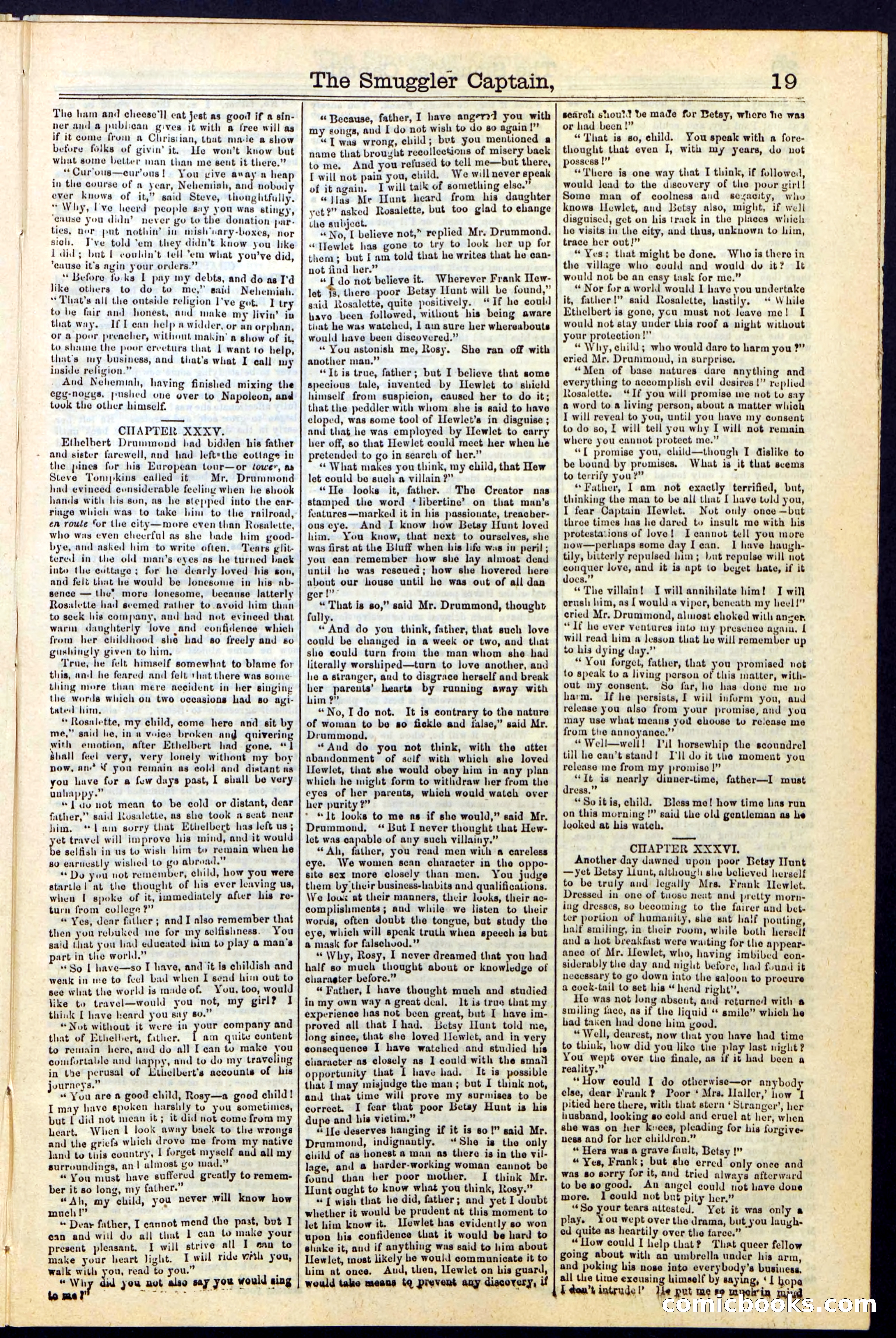
A restored page from Pulp Fiction, 1880. Page through the whole issue in the reader above.
📄 Transcribed text from this page (OCR, searchable)
Machine-transcribed from the original scan — historical spelling and the odd misread are preserved.
The ham and cheese'll cat jest as good if a sin- ner and a publican gives it with a free will as if it come from a Clirisiian, that made a show before folks of givin’ it. He won't know but What some better man than me sent it there.” “Cur'ous—eur'ous! You vive away na heap in the course of a year, Nehemiah, and nobod ever knows of it,” said Steve, thouglitfully, “Why, P've heerd people say you was stingy, ‘CnUuse you didn’ never go to the donation par fies, ber put nothin’ in mish svary-boxes, nor sich. J've told ‘em they didn't know you like Ldid; butt couldn't tell ’em what you’ve did, ‘cause it’s agin your orders.” ‘ Before to.ks I pay my debts, and do as I'd like others to do to me,” said Nehemiah. “That's all the outside religion I've get. 1 try to be fair and honest, and make my livin’ in that way. If T can help a widder, or an orphan, or a poor preacher, without makin’ a show of it. to shame the poor ereeturs that 1 want to help, that's my business, and that's what I eal! my inside religion.” And Nehemiah, having finished mixing the egy-nogys, pushed one over to Napoleon, and tuvk the other himself. CIAPTER XXXYV. Ethelbert Drummond had bidden his father and sister farewell, and had lJeftethe cottage iu the pines for his European tour—or lower, ns Steve Tompkins called it Mr. Drummond had evineed considerable feeling when he shook hands with his sun, as he stepped into the ear- ringe which was to take hin to the railroad, en roule for tle city—more even than Rogulette, who was even cheerful as she bade him good- bye, and asked him to write often. Tears glit- tered in the old man’s eyes as he turned back inte the evttage ; for he dearly loved his son, and felt that he would be Jonesome in his ab- sence — the’ more lonesome, because latterly Rosalette had seemed rather to aveid him than to seck his company, and had not evineed that warm daughterly Jove and confidenee which from her childhood she had so freely and so gushingly given to him, True, he felt himself somewhat to blame for this, andl he feared and felt that there was some: thing more than mere accident in her singing the words which ou two occasions had so ayi- tuted him, * Rosnlette, my child, come here and sit by me,” said he, in a voice broken ang quivering with emotion, after Ethelbert had gone. “j Shall feel very, very lonely withont my boy now, an’ ¥ you remain as eold and distant as you huve for a few days past, 1 shull be very unhappy.” . “J uo not mean to be cold or distant, dear father,” said Rusalette, as she took a seat near him. “tam sorry that Ethelbert has left us; ret travel will improve his mind, and it would e selfish in us to wish him te remain whea he go earnestly wished to go abroad.” * Do you not remember, ehild, how you were startle | at the thought of his ever leaving us, when | spoke of it, immediately afier his re- turn from college ?” “Yes, dear father; andI also remember that then you rebuked ine for my selfishness. You said that you lad edueated him to play @ man’s part in the world.” ‘ po “So L have—so I have, and it is childish and wenk in me to fecl bad when I send hii out to see what the world is made of. You, too, would like to travel—would you not, my girl? J think [ have keard you say 80.” “Not without it were in pe company and that of Ethelbert, father. am quite content to remain here, and do all [can to make you comfortable and happy, and to do my traveling in the perusal of Kthelbert’s accounts of his juurneys.” oes You are a good child, Rosy—a good child! I may have spoken harshly to you sometimes, but [ did not mean it; it did not come from my heart. When | look away back to the wrongs and the griefs which drove me from my native land to tuis country, | forget myself aud all my surroundings, an! almost go mad,” “ You must have suffered greatly to remem- i ng, my father.” a Ave ray Sula, you never will know how much!” * Dear father, I cannot mend the past, but I ean and will do all that 1 can lo make your present pleasant, I will strive all I ean to make your heart Jight. I will ride wih you, walk with you, read to you.” . “Why did you not also say you would sing The Smuggler Captain, “ Because, father, I have anger>] you with my songs, and I do not wish to do go again |” “Twas wrong, ebild; but you mentioned a name that brouyht recollections of misery back tome. And you refused to tell me—but there, [ will not pain you, ehild. We will never epeak of it again. I will talk of something else.’ “Jing Me Ilunt heard from his daughter vet?” asked Rosalette, but too glad to change the subject. "a N a believe not,” replied Mr. Drummond. “TIewlet has gone to try to look her up for them; but I am told that he writes that he can- not find her.” “{ do not believe it. Wherever Frank Iew- let 73, there poor Betsy Iunt will be found,” snid Rosalette, quite positively. “ if he could havo been followed, without his being aware tiiat he was watched, 1 ain sure her whereabouts would have been discovered.” “ You astonish me, Rosy. another man.” ‘It is true, father; but I believe that some specious tale, invented by Hewlet to shicld himself from suspicion, caused her to do it; that the peddler with whom she is said to have eloped, was some tool of Hewlet’s in disguise ; and that he was employed by Hewlet to carry her off, so that Hewlet could mect her when he pretended to go in search of her.” “ What makes you think, my ebild, that Hew let could be such a villain ?” “Tle looks it, father. The Creator nas stamped the word ‘libertine’ on that man’s features—marked it in his passionate, treacber- ous eye. And I know how Betsy Hunt loved him. You know, that next to ourselves, she was first at the Bluff when his life was in peril ; you can remember how she lay almost dead until he was rescued; how she hovered here about our house until he was out of all dan er!” “That is so,” said Mr. Drummond, thought fully. © Awa do you think, futher, that such love could be changed in a week or two, and that she could turn from the man whom she had literally worshiped—turn to love another, and he a stranger, and to disgrace herself and break her parents’ hearts by running away with lim ?” “No, Ido not. It is contrary to the nature of woman to be so fickle and false,” said Mr. Drummond, “And do you not think, with the atte: abandonment of scif with which she loved LUewlet, that she would obey him in any plan which he might form to withdraw her from the eyes of her parents, which would watch over her purity ?” * “Jt looks to me as if she would,” said Mr. Drummond, “ But I never thought that Hew- let was capable of any such villainy.” “Ah, futher, you read men with a careless eye. We women scan character in the oppo- site sex more closely than men. You judge them by their business-habits and qualifications. We lous at their manners, their looks, their ac- complishments; and while we listen to their words, often doubt the tongue, but study the eye, which will speak truth when speech is but a mask for falschvod.” “Why, Rosy, I never dreamed that you had half so much thought about or knowledge of charagter before.” “Father, I have thought much and studied She ran off with in my own way 4 great deal, It is true that my experience has not been great, but I have im- roved all that Thad. Betsy Hunt told me, ong since, that she loved Ilewlet, and in ver consequence I have watched and studied his character as closely as 1 could with the smail opportunity that I have had. It is possible that I may misjudge the man; but I think not, and that time will prove my surmises to be correct. I fear that poor Betsy Hunt is his dupe and his victim.” “Je deserves hanging if it is so!” said Mr. Drummond, indignantly. “She is the only child of as honest a man as there is in the vil- lage, and a harder-working woman cannot be found than her poor mother. I think Mr. Lunt ought to know what you think, Rosy.” “{ wish that he did, father; and yet I doubt whether it would be prudent at this moment to let him know it. LJewlet has evidently so won upon his confidence that it would be hard to ghiake it, aud if anything was said to him about Llewlet, most likely he would communicate it to Lim at once. Aud, then, Llewlet on his guard, would take means tq pievent any diacorery, if ‘ mie.: search stioul? De made for Betsy, where he was or had been!” “That is so, child. You speak with a fore- thought that even I, with my years, do not osscss |” “There is one way that I think, if followed, would lead to the discovery of the poor girl! Some man of coolness and sexacity, who knows Lewlet, and Betsy also, might, if well disguised, get on his track in the places which he visits in the city, and thus, unknown to him, trace her out!” “Yes; that might be done. Who is there in the village who could and would do it? It would not be an easy task for me.” “ Nor fora world would I have you undertake it, father!” said Rosalette, hastily. “ While Ethelbert is gon Fon must not leave me! I would not stay under this roof a night without your protection!” “Why, child; who would dare to harm you ?” eried Mr, Drummond, in surprise. “Men of base natures dare anything and everything to accomplish evil desires!” replied Rosalette. “If you will promise me not to ga a word to a living person, about a matter whic I will reveal to you, until you have my consent to do so, I will tell you why I will not remain where you cannot protect me.” “[ promise you, child—though I dislike to be bound by promises. What is it that scems to terrify you?” *Father, I am not exactly terrified, but, thinking the man to be all that I have tuld you, I fear Captain Iewlet. Not only once —but three times has he dared tv insult me with his protestations of love! I cannot tell you more now—perhaps some day Iean. 1 have haugh- tily, bitterly repulsed him; but repulse will not rah al luve, and it is apt to beyet hate, if it ocs.’ “The villain! I will annihilate him! I will crush him, as [ would a viper, beneath my heel!” cried Mr. Drummond, almost choked with anzer, “If he ever ventures into my presence again, I will read him @ lesson that he will remember up to his dying day.” “You forget, father, that you promised not to speak to a living person of this matter, with- oul my consent. So far, he has done me no harm. If he persists, I will inform you, aud release you also from your promise, and you may use what means you chouse to re!case me from the annoyance.” “ Well—well! L'il horsewhip the scoundrel till he can’t stand! I'll do it the moment you release me from my promise !” “It is nearly dinner-time, father—I must dress.” “So itis, child. Bless me! how time has run on this morning !” said the old gentleman as he looked at his watch. CIIAPTER XXXVI. Another day dawned upon poor Retsy ITunt —yet Betsy Liunt, althoug! she believed herself to be truly and legally Mrs. Frank Llewlet. Dressed in one of tuose neat and pretty morn- ing dresses, so becoming to the fairer und bet- ter portion of humanity, she sat half pouting, half smiling, in their room, while both herself and @ hot breakfast were waiting for the appear- ance of Mr. Llewlet, who, having imbibed con- siderably the day and night before, liad found it necessary to go down into the galoon to procure a cock-tail to set hia “head right”, He was not long absent, and returned with a smiling face, as if the liquid “ smile” which he bad taken had done him yood. “ Well, deurest, now thut you have had time to think, how did you like the play last night? You wept over the finale, as if it had been a apt a “How could I do otherwise—or anybody else, dear Krank ? Poor * Mra, Maller,’ how ‘I pitied here there, with that stern ‘ Stranger’, her husband, looking so cold and eruel at her, when she was on her knees, pleading for his forgive. ness and for her children.” “ Hers was a grave fault, Betsy !” “Yes, Frank; but she erred only once and was so sorry for it, and tried always afterward to be so good. An angel could not have done more. I could not but pity her.” “So your tears attested. Yet it was only a play. You wept over the drama, but you lauyh- ed quite as heartily over the farce.” “How could I help that? That queer fellow going about with an umbrella under his arm, and poking his nose into everybody's business, all the Lime excusing himself by saying, ‘I hope i don’t intrude I’ ihe at mae 99 ve ser to o 5) G on (¢ m (E 0, O}I ' c . 4