
Pulp Fiction, 1880 · page 18 of 32
Beadle's Dime Library No. 111 — page 18: what you’re looking at
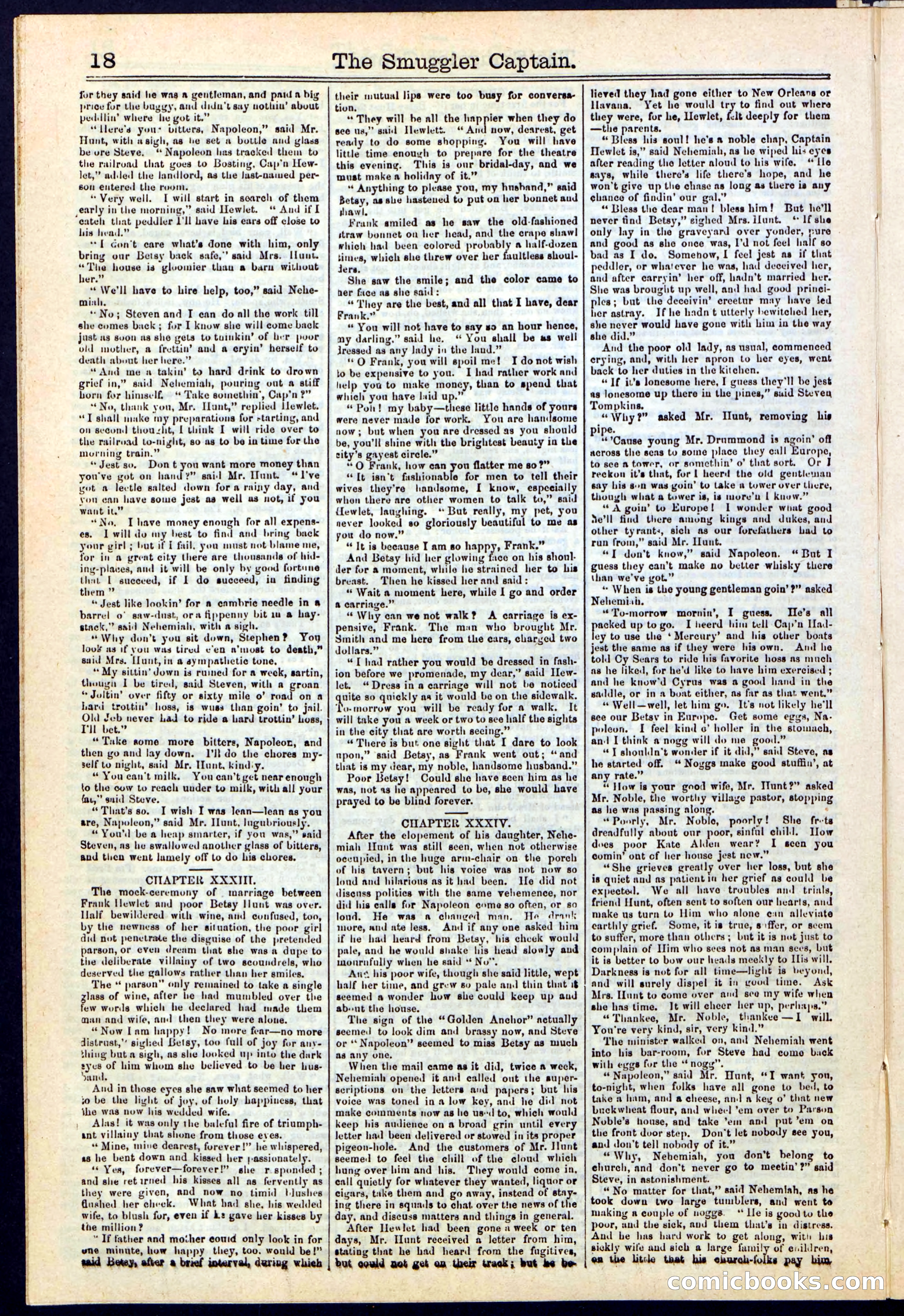
A restored page from Pulp Fiction, 1880. Page through the whole issue in the reader above.
📄 Transcribed text from this page (OCR, searchable)
Machine-transcribed from the original scan — historical spelling and the odd misread are preserved.
—_ a eee “= Seta * Se Se ee es SI SF Oe SS ee ; = fur they said he wag a gentleman, and paid a big price for the baggy, and didu't say nothin’ about peddlin’ where he got it.” ‘“Ilere’s yous bitters, Napoleon,” said Mr. Hunt, with asigh, as be set a bottle and glass be vre Steve. “ Napoleon has tracked them to the railroad that goes to Bosting, Cap'n Hew- let,” added the landlord, as the Jast-oamwed per- son entered the room. “Very well. I will start in search of them early in the morning,” snid Hewlet. “ And if I eateh that peddler 1'll Lave his ears off close to his head.” *[ Gon't care what’s done with him, only bring our Betsy back safe,’ said Mrs. [lunt “The house is gloomier thau a baru without her.” “We'll have to hire help, too,” said Nehe- mirth. ‘No; Steven and I ean do all the work till she comes back; for I know she will come back just us svon as she gets to tuinkin’ of her poor vid mother, a frettin’ and a eryin’ herself to death about her here.” “And me a takin’ to hard drink to drown grief in,” said Nehemiah, pouring out a stiff born for himself. * Take somethin’, Cap'n ?” “No, thank you, Mr. [unt,” replied Lewlet. “T shall make my preparations for starting, and on second thousht, | think I will ride over to the railroad to-night, so as to be in time for the morning train.” “Jest so, Dont you want more money than you've got on hand?” said Mr. Hunt. “I've vot a lectle salted down for a rainy day, and yon ean have some jest as well as not, if you want it.” “No, Ihave money enough for all expens- es. Iwill do my best to find and bring back your girl; but if [ fail, you must not blame me, for in a great city there are thousands of hid- ing-plaves, and it will be only by good fortune that L sueeeed, if I do succeed, in finding them ” « Jest like lookin’ for a eambrie needle in a barre! o° saw-dust, ora fippenny bit iu a hay- stack,” said Nehemiah, with a sigh. “Why don’t you sit down, Stephen? Yoy look as if you was tired c'en a’'most to death,” said Mrs. [lunt, in a sympathetic tone, * My sittin’ down is rumed for a week, sartin, thougi 1 be tired, said Steven, with a groan * Joltin’ over fifty or sixty mile o’ road on a hard trottin’ hoss, is wuss than goin’ to jail. Old Jeb never Lad to ride a bard trottin’ Loss, I'll bet.” “Tuke some more bitters, Napoleon, and then go and lay down. I'l! do the chores my- self to night, said Mr. unt, kind:y. “You can't milk. You can’t get near enough to the cow to reach uuder to milk, with all your fav,” snid Steve. “That's so. I wish I was lean—lean as you are, Napoleon,” said Mr. Ilunt, lugubriously. “You'd be a heap smarter, if you was,” said Steven, as he swallowed another glass of bitters, and then went lamely off to do his chores. 3 CIIAPTER XXXIIT. The mock-ceremony of marriage between Frank Hewlet and poor Betsy Ilunt was over. Half bewildered with wine, and confused, too, by the newness of her situation, the poor girl dil not penetrate the disguise of the pretended parson, or even dream that she was a dupe to the deliberate villainy of two seoundrels, who deserved the gallows rather than her smiles. The “ parson” only remained to take a single glass of wine, after he had mumbled over the few words which he declared had made them man and wile, and then they were alone. “Now [am happy! No more fear—no more distrust,” sighed Betsy, too full of joy for any- thing buta sigh, as she looked uy into the dark eyes of him whom she believed to be her hus- ona. Aud in those eyes she saw what seemed to her io be the light of joy, of holy Lappiness, that the was now his wedded wife. Alas! it was only the baleful fire of triamph- ant villainy that shone from those eves. “ Mine, mive dearest, furever!” he whispered, as he bent down and kissed her passionately. ‘* Yes, forever—forever!”’ ghe r apna : and she retirned his kisses all as fervently as they were given, and now no timid blushes flushed her cheek. What had she, his wedded wife, to blush for, even if he gave her kisses by the million? “ If father and mother eouid only look in for wne minute, how happy they, too. would be!” taid Botey, after a brief interval, daring “hich The Smuggler Captain. their mutual lips were too busy for conversa- tivn, * They will be all the happier when they do see us,” said Ilewlett. “ And now, dearest, get realy to do some shopping. You will have little time enough to prepare for the theatre this evening. This is our bridal-day, and we must make a holiday of it.” “ Anything to please you, my hnshand,” said Betey, as she hastened to put on her bonnet aud shawl, Frank amiled as he saw the old-fashioned straw bonnet on her head, and the crape shaw! which had been colored i ea a half-dozen times, which she threw over her faultless shoul- ders. She saw the smile; and the color came to ner fuce as she said: “They are the best, and all that I have, dear Frank.” “ You will not have to say so an hour hence, my darling.” said he. “ You shall be ss well jressed as any Jady in the land.” * O Frank, you will spoil me! I donot wish to be expensive to you. I had rather work and help you to make money, than to spend that which you have laid up.” “Poh! my baby—these little hands of yours were never made for work. You are handsome now; but when you are dressed as you should be, you'll shine with the brightest beauty in the city’s gayest circle.” “O Frank, how can you flatter me so?” “[t isn’t fashionable for men to tell their wives they’re handsome, I know, especially whon there are other women to talk to,” said {fewlet, laughing. * But really, my pet, you never looked so gloriously beautiful to me as yon do now.” “It is because I am 80 happy» Frank.” And Betsy hid her glowing face on his shonl- der for a moment, while he strained her to his breast. Then he kissed her and said: “ Wait a moment here, while I go and order & carriage.” “Why can we not walk? <A carriage is ex- pensive, Frank. The man who brought Mr. Smith and me here from the cars, charged two dollars.” “[ had rather you would be dressed in fash- ion before we promenade, my dear,” said ILew- let. “Dress in a carriage will not be noticed aa so quickly aa it would be on the sidewalk. ‘To-morrow you will be ready for a walk. It will take you a week or two to see half the sights in the city that are worth secing.” “There is but one sight that I dare to look npon,” said Betsy, as Frank went out; “and that is my dear, my noble, handsome husband.” Poor Betsy! Could she have seen him as he was, not ag he appeared to be, she would have prayed to be blind forever. CHAPTER XXXIV. After the elopement of his daughter, Nehe- miah Hunt was still seen, when not otherwise occupied, in the huge arm-chair on the porel of his tavern; but his voice was not now 80 loud and hilarious as it had been. We did not disenss polities with the same veliemence, nor did his calls for Napoleon come so often, or so loud. He was a changed man. He drank more, and ate less. And if any one asked bim if he had heard from Betsy, his cheek would pale, and be would shake his head slowly and mournfully when he said “ No”. Aus his poor wife, though she said little, wept half her time, and grew 60 pale and thin that i$ seemed a wonder how she could keep up aud abut the house. The sign of the “Golden Anchor” actually seemed to look dim and brassy now, and Steve or *‘ Napoleon” seemed to miss Betsy as much as any one, When the mail came as it did, twice a weck, Nehemiah opened it and ealled out the super- scriptions on the letters and papers; but his voice was toned in a low key, and he did not make comments now as he usd to, which would keep his audience on a broad grin until every letter had been delivered or stowed in its proper pigeon-hole. And the customers of Mr. Ilunt seemel to feel the chill of the cloud which hung over him and his. They would come in, call quietly for whatever they wanted, liquor or cigars, take them and go away, instead of stay- ing there in squads to chat. over the news of the day, and discuss matters and things in general. After Hewlet had been gone a week or ten days, Mr. Ilunt received a letter from him, stating that he had heard from the fuagitives, but cowld aot gei on their track; but be be lieved they had gone either to New Orleans or Havana. Yet he would try to find out where they were, for he, Llewlet, fclt deeply for them —the parents. “ Bless his soul! he’s» noble chap, Captain Tewlet is,” said Nehemiah, as he wiped his eyes after reading the letter aloud to his wife. “ Ile says, while there’s life there's hope, and he won't give up the chase as long as there ia any chance of findin’ our gal,” “ Bless the dear man! bless him! But he'll never tind Betsy,” eighed Mrs.ilunt. ‘ Ifshe only lay in the graveyard over yonder, pure and good as she once was, I'd not feel half so bad as I do. Somehow, I feel jest as if that peddler, or whatever he was, had deceived her, and after carryin’ her off, hadn't married her. She was brought up well, and had good prinei- ples; but the deceivin’ ereetur may have led her astray. If he hadnt utterly bewitehed her, she never would have gone with him in the way she did.” And the poor old lady, as usual, commenced erying, and, with her apron to her eyes, went back to her duties in the kitchen. “If it’s lonesome here, I guess they'll be jest as lonesome up there in the pines,” suid Steven Tompkins, “Why?” asked Mr. Ilunt, removing his ipe. MCanse young Mr. Drummond is agoin’ off across the seas tu some place they call Europe, to sce a tower, or somethin’ o’ that sort. Or J reckon it’s that, for | heerd the old gentleman say his gen was goin’ to Lake a tower over there, though what a tower is, is more’n | know.” “A goin’ to Europe! | wonder what good Ne’ll find there amunyg kings and dukes, and other tyrants, sich as our furefuthers had to run from,” said Mr. Lunt. “TI don't know,” said Napoleon. “But I guess they can't make no better whisky there than we've got.” “ When is the young gentleman goin’ ?” asked Nehemivh. “To-morrow mornin’, I guess. Tle’s all acked up to go. I heerd him tell Cap’n Iad- ey to use the ‘Mercury’ and his other bonats jest the same as if they were his own. And he told Cy Sears to ride his favorite hoss as much as he liked, for he’d like to have him exercised ; and he know'd Cyrus was a good hand in the sauldle, or in a boat either, as far as that went.” “ Well—well, let him go. It’s not likely he'll see our Betsy in Europe. Get some eggs, Na- poleon. I feel kind o’ holler in the stomach, an! I think a nogg will do me good.” “J shouldn't wonder if it did,” said Steve, as he started off. “ Noygs make good stuffin’, at any rate.” “How is your good wife, Mr. TTunt?” asked Mr. Noble, the worthy village pastor, stoppin as lie was passing along. . “Poorly, Mr. Noble, poorly! She frets dreadfully about our poor, sinful chill. Ilow dees poor Kate Alden wear? I seen you comin’ ont cf her house jest new.” “She grieves greatly over her loss, but she is quiet and as patientin her grief as could be expected, We all have troubles and trials, friend Hunt, often sent to soften our hearts, and make us turn to Him who alone en alleviate earthly grief. Some, it is true, siffer, or seem to suffer, more than others; but it is net just to complain of Him who sees not as man secs, but it is better to bow our heads meekly to Iis will. Darkness is not for all time—light is beyond, and will surely dispel it in good time. Ask Mrs, [unt to come over and sea my wife when she has time. It will eheer her up, perhaps.” “Thankee, Mr. Noble, thankee—I will You're very kind, sir, very kind.” The minister walked on, and Nehemiah went into his bar-room, for Steve had come back with eggs for the “nogg”. “ Nupoleon,” said Mr. Hunt, “I want you, to-night, when folks have all gone to bed, to take a ham, and a cheese, and a key o’ that new buckwheat flour, and whecl ‘em over to Parson Noble’s house, and take ’em and put’em on the front dvor step. Don't let nobody see you, and don't tell nobody of it.” “Why, Nebemiah, you don't belong to chureh, and don’t never go to meetin’ ?” said Steve, in astonishment. “No matter for that,’’ said Nehemiah, as he took down two large tumblers, and went to making a couple of noggs. *“ le is good to the poor, and the sick, and them that’s in distress. And he has hard work to get along, with his sickly wife and sich a Jarge family of evildren, ea the litcle tbat his esarel-folks pay bim, Eomicbooks (E(o) —~