
Pulp Fiction, 1880 · page 20 of 32
Beadle's Dime Library No. 111 — page 20: what you’re looking at
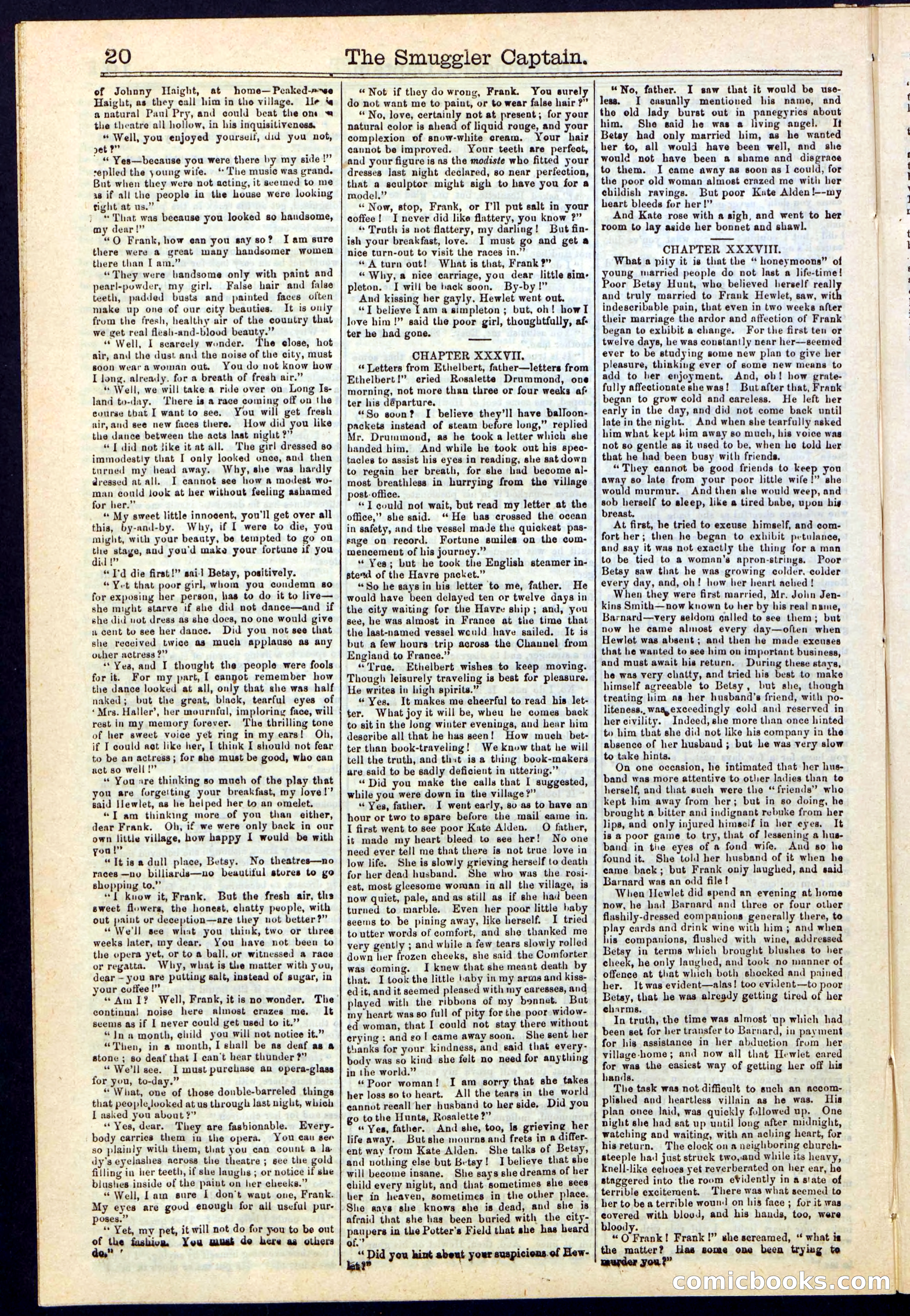
A restored page from Pulp Fiction, 1880. Page through the whole issue in the reader above.
📄 Transcribed text from this page (OCR, searchable)
Machine-transcribed from the original scan — historical spelling and the odd misread are preserved.
20 The Smuggler Captain. ooollllleeET—eeeeeeeeeeeeeTeeeeeeelllEEeEeEeeeeeeeeOQQQI™Q“QIUQQOI=EQOQ“EOQEIQ“=IOQI*™IE“OE_O__O_>Q“$RWN SS ef Johnny Haight, at home—Peaked-mr-se Haight, as they call him in tho village. Le % a natural Paul Pry, and could beat the on « the theatre all hollow, in his inquisitiveness, * Well, you enjoyed yourself, did you not, yet ?” ' Yes—because you were there by my side!” ‘eplied the young wife. ‘ The music was grand. But when they were not acting, it seemed to me ag if all the people in the house were looking fight at us.” “That was because you looked so handsome, my dear!” “O Frank, how ean you say so? I am sure there were a great many handsomer women there than [ am.” “They were handsome only with paint and pearl-powder, my girl. False hair and false teeth, padded busts and painted faces often make up one of our city beauties. It is ouly from the fresh, healthy air of the country that we get real flesh-and-blood mest, > ‘Well, I seareely wonder. The close, hot air, anil the dust and the noise of the city, must goon wear a woman out. You do not know how I jong. already. for a breath of fresh air.” * Well, we will take a ride over on Long Is- land to-day. ‘There is a race coming off on the course tbat I want to see. You will get fresh air, and see new faces there. How did you like the dance between the acts last niglit ?” “J did not jike it at all. The girl dressed so immodestly that I only looked once, and then turned my head away. Why, she was hardly dressed at all. I cannot see how a modest wo- man could Jjook at her without feeling ashamed for her.” “ My sweet little innocent, you'll get over all this, by-and-by. Why, if I were to die, you might, with your beauty, be tempted to go on - stage, aud you'd make your fortune if you idl 1” “I'd die first!’ sail Betsy, positively. “Yet that poor girl, whom you condemn so for exposing her person, has to do it to live— she might starve if she did not dance—and if she did uot dress as she does, no one would give u cent to see her dance. Did you not see that she received twice ag much applause as any ovher actress ?” ‘‘ Yea, and I thought the people were fools for it. For my part, I eangot remember how the dance looked at all, only that she was half naked; but the great, black, tearful eyes of ‘Mrs. Haller’, her mournfal, imploring face, will rest in my memory forever. The thrilling tone of her sweet voice yet ring in my ears! Oh, if I could agt like her, I think I should not fear to be an actress; for she must be good, who can act so well!” “ You are thinking so much of the play that ou are forgetting your breakfast, my love!’ said Ilewlet, as he helped her to an omelet. “T am thinking more of you than either, dear Frank. Oh, if we were only back in our own little village, how happy I would be with you!” “It is a dull place, Betsy. No theatres—no races —no billiards—uno beautiful stores to go shopping to.” “I kuow it, Frank. But the fresh air, ths sweet flowers, the honest, chatty people, with out paint or deception—are they not better?” “We'll see what you think, two or three weeks later, my dear, You have not been to the opera yet, or toa ball, or witnessed a race or regatta. Why, what is the matter with you, dear — you are putting salt, instead of sugar, in your coffee!” “AmI? Well, Frank, it is no wonder. The continua! noise here almost erazes me. It seems as if I never could get used to it.” “Ina month, ehild you will not notice it.” “Then, in a month, I shall be as deaf as a stone ; so deaf that I can’t hear thunder ?” “We'll see. I must purchase an opera-glass for you, to-day.” “What, one of those double-barreled things that people looked at us through last night, whieh I asked you about ?” “Yes, dear. They are fashionable. Every- body carries them in the opera. You cau ser so plainly with them, that you can count a la- dy’s eyelashes across the theatre ; see the gold filling in her teeth, if she laughs ; or notice if she blushes inside of the paint on her cheeks.” “ Well, [am sure 1 don't want one, Frank. My eyes are goud enough for all useful pur- poses.” “ Yet, my pet, it will not do for you to be out oe the fashiva. You uauak de here as others “Not if they do wrong, Frank. You surely do not want me to paint, or to wear false hair ?” “ No, love, certainly not at present; for your natural color is ahead of liquid rouge, and your complexion of snow-white cream. Your hair cannot be improved. Your teeth are perfect, _and your figure is ns the modiste who fitted your dresses Jast night declared, so near perfection, that a sculptor might sigh to have you for a model.” “ Now, stop, Frank, or I'll put salt in your coffee! I never did like flattery, you know ?” “ Truth is not flattery, my darling! But fin- ish your breakfast, love. I must go and get a nice turn-out to visit the races in.” ‘“ A turn out! What is that, Frank ?”’ “ Why, a nice carriage, you dear little sim- pleton. I will be back soon. By-by !” And kissing her gayly, Hewlet went out. “T believe [am a simpleton ; but, oh! howl love him !” said the poor girl, thoughtfully, af- ter he had gone. CHAPTER XXXVII. ‘‘ Letters from Ethelbert, father—letters from Ethelbert!” eried Rosalette Drummond, one morning, not more than three or four weeks af: ter his d@parture. “So soon? I believe they’ll have balloon- packets instead of steam before long,” replied Mr. Drummond, as he took a letter which she handed him, And while he took out his spec- tacles to assist his eyes in reading, she sat down to regain her breath, for she had become al- most breathless in hurrying from the village post-office. “I could not wait, but read my letter at the office,” she said. “He bas crossed the ocean in safety, and the vessel made the quickest pas- sage on record. Fortune smiles on the com- mencement of his journey.” “ Yes; but he took the English steamer in- sterd of the Havre packet.” “So he saysin his letter to me, father. He would have been delayed ten or twelve days in the city waiting for the Havre ship; and, you see, he was almost in France at the time that the last-named vessel weuld have sailed. It is but a few hours trip across the Channel from Engiand to France.” “True. Ethelbert wishes to keep moving. Though leisurely traveling is best for pleasure. He writes in high spirits.” “Yes. It makes me cheerful to read his let- ter. What joy it will be, wheu he comes back to sit in the long winter evenings, and hear him describe all that he has seen! How much bet- ter than book-traveling! We know that he will tell the truth, and that isa thing book-makers are said to be sadly deficient in uttering.” “Did you make the calls that I suggested, while you were down in the village?” “ Yes, father. I went early, sv as to have an hour or two to spare before the mail eame in. I first went to see poor Kate Alden, O father, it made my heart bleed to see her! No one need ever tell me that there is not true love in low life. She is slowly grieving herself to death for her dead husband. She who was the rosi- est, most gleesome woman in all the village, is now quiet, pale, and as still as if she had been turned to marble, Even her poor little baby seems to be pining away, like herself. I tried to utter words of comfort, and she thanked me very gently ; and while a few tears slowly rolled down her “ cheeks, she said the Comforter was coming. I knew that she meant death by that. I took the little baby in my arms and kiss- ed it, and it seemed pleased with my caresses, and played with the ribbons of my bonnet. — But my heart was so full of pity forthe poor widow- ed woman, that I could not stay there without erying : and eo! came away soon. She sent her thanks for your kindness, and said that every- body was so kind she felt no need for anything in the world.” “Poor woman! I am sorry that she takes her loss so to heart. All the tears in the world cannot reeall her husband to her side, Did you o tothe Hunts, Rosalette ?” “ Yes, father. And she, too, is grieving her life away. Butshe mournsand frets in a differ- ent way from Kate Alden. She talks of Betsy, and nothing else but Betsy! I believe that she will become insane. She says she dreams of her child every night, and that sometimes she sees her in heaven, sometimes in the other place. She aave she knows she is dead, and she is afraid that she has been buried with the city- paupers in the Potter's Field that she has beard of. “Did you hint abeut your suspicions.of Hew- “No, father. I saw that it would be use- Jess. I casually mentioned his name, and the old lady burst out in panegyrics about him. She said he was a living angel. It Betsy had only married him, as he wanted her to, all would have been well, and she would not have been o shame and disgrace to them. I came away as soon as | could, for the poor old woman almost crazed me with her childish ravings. But poor Kute Alden !--my heart bleeds for her!” And Kate rose with a sigh, and went to her room to lay aside her bonnet and shawl. CHAPTER XXXVIITI. What a pity it is that the “ honeymoons” of young married people do not last a life-time! oor Betsy Hunt, who believed herself reall and truly married to Frank Hewlet, saw, wit indescribable pain, that even in two weeks after their marriage the ardor and affection of Frank began to exbibit a change. For the first ten or twelve days, he was constantly near her—seemed ever to be studying some new plan to give her pleasure, thinking ever of some new means to add to her enjoyment. And, oh! how grate- fully affectionate she was! Butafter that, Frank began to grow cold and careless. He left her early in the day, and did not come back until late in the night. And when she tearfully asked him what kept him away so much, his voice was not so gentle as it used to be, when he told her that he had been busy with friends, “They cannot be good friends to keep you away so late from your poor little wife!” she would murmur. And then she would weep, and sob herself to sleep, like a tired babe, upon hig breast, At first, he tried to exeuse himself, and com- fort her; then he began to exhibit petulance, and say it was not exactly the thing for a man to be tied to a woman's apron-strings. Poor Betsy saw that he was growing colder, colder every day, and, oh! how her heart ached ! When they were first married, Mr. Jolin Jen- kins Smith—now known to her by his real name, Barnard—very seldom galled to see them; but now he came almost every day—ofien when Hewlet was absent; and then he made excuses that he wanted to see him on important business, and must await hia return. During these stays, he was very chatty, and tried his best to make himself agreeable to Betsy, but she, though treating him aa her husband's friend, with po- liteness., wag,exccedingly cold and reserved in her civility. Indeed, she more than once hinted to him that she did not like his company in the absence of her husband; but he was very slow to take hints. On one occasion, he intimated that her hus- band was more attentive to other ladies than to herself, and that such were the “ friends’ whe kept him away from her; but in so doing, he brought a bitter and indignant rebuke from her lips, and only injured himself in her eyes. It is a poor game to try, that of lessening a hus- band in the eyes of a fond wife. And so he found it. She told her husband of it when he came back; but Frank oniy laughed, and said Barnard was an odd file! When Hewlet did spend an evening at home now, he had Barnard and three or four other flushily-dressed companions generally there, to piay eards and drink wine with him; and when 1is companions, flushed with wine, addressed Betsy in terms which brought blushes to ber cheek, he only Jaughed, and took no manner of offence at that which both shocked and pained her. It was evident—alas! too evident—to poor Betsy, that he was already getting tired of her elarms. In truth, the time was almost up which had been set for her transfer to Barnard, in payment for his assistance in her abduction from her village-home; and now all that Hewlet eared for was the easiest way of getting her off his hands. The task was not difficult to such an accom- plished and heartless villain as he was. His plan once laid, was quickly followed up. One bight she had sat up until loud after midnight, watching and waiting, with an aching heart, for his return, The clock ona neighboring ehurch- steeple had just struck two,and while its heavy, knell-like echoes yet reverberated on her ear, he staggered into the room eVidently in a siate of terrible excitement. There was what seemed to her to bea terrible woun:! on his face ; for it was eovered with blovd, and his hands, too, were bloody. “© Frank! Frank!” she sereamed, “ what is the matter? Has some one been trying to -_— murder yout” | Eomicbooks (G (0)