
Pulp Fiction, 1880 · page 17 of 32
Beadle's Dime Library No. 111 — page 17: what you’re looking at
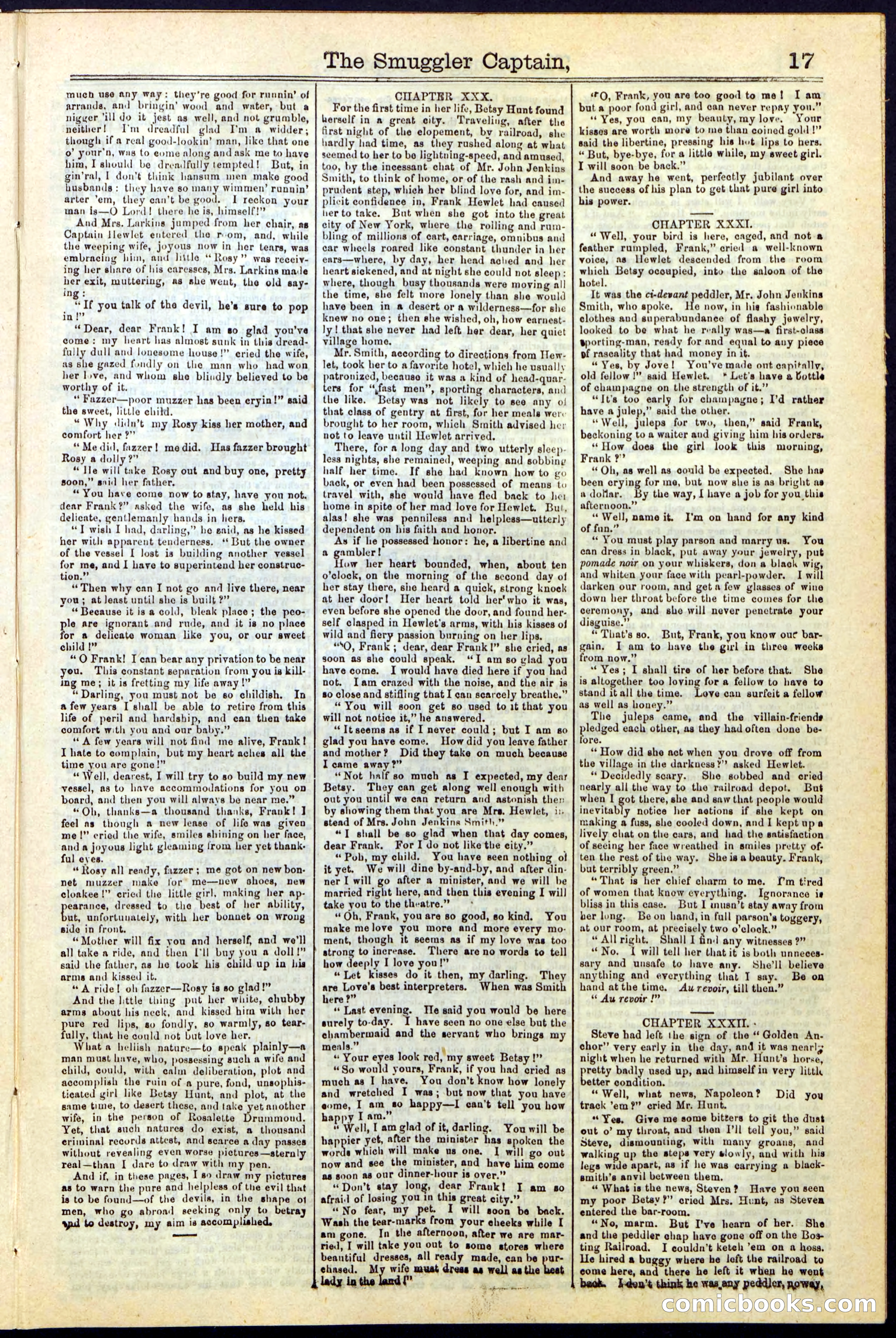
A restored page from Pulp Fiction, 1880. Page through the whole issue in the reader above.
📄 Transcribed text from this page (OCR, searchable)
Machine-transcribed from the original scan — historical spelling and the odd misread are preserved.
much use any way: they're good for runnin’ of arrands, and bringin’ wood and water, but a nigger ‘ill do it jest as well, and not grumble, neither! I'm dreadful glad I'm a widder, though if a real good-lookin’ man, like that one 0’ your’n, was to eome along and ask me to have him, I should be dreadfully tempted! But, in gin’ral, | don’t think hansum men make good husbands : they have so many wimmen’ runnin’ arter ’em, they can't be good. I reckon your man is—O Lord! there he is, himself!” And Mrs. Larkins jumped from her chair, as Captain Jlewlet entered the room, and, while the weeping wife, joyous now in her tears, was embracing him, and little “ Rosy” was receiv- ing her share of his caresses, Mrs. Larkins made her exit, muttering, as she weut, the old say- ing: “If you talk of the devil, he’s sure to pop in !”? “Dear, dear Frank! I am go glad you've come: my heart has almost sunk in this dread- fully dull and lonesome house!” eried the wife, as she gazed fondly on the man who had won her love, and whom she bliudly believed to be worthy of it. “ Fazzer—poor muzzer has been eryin!” said the sweet, Jiltle ehitd. “Why «didn’t my Rosy kiss her mother, and comfort her ?” “Me did, fuzzer! medid. Has fazzer brought Rosy a dolly?” “Ile will tuke Rosy out and buy one, pretty soon,” said her father. “You have come now to stay, have you not. dear Frank?” asked the wife, aa she held his delicate, gentlemanly hands in hers. “TY wish I had, darling,” he said, as he kissed her with apparent tenderness. ‘ But the owner of the vessel [ lost is building another vessel for me, and I have to superintend her construc- tion.”’ “Then why can I not go and live there, near you; at Jeast until she is built ?” “ Because it is a cold, bleak place; the peo- ple are ignorant and rude, and it is no place for a delicate woman like you, or our sweet ehild !” “O Frank! I can bear any privation to be near you. This constant separation from you is kill- ing me; it is fretting my life away !” “Darling, you must not be so ehildish. In a few years I shall be able to retire from this life of peril and hardship, and can then take comfort with you and our baby.” ‘A few years will not find me alive, Frank! I hate to complain, but my heart aches all the time you are gone!” “Well, dearest, I will try to so build my new vessel, as to lave accommodations for you op board, and then you will always be near me.” “Oh, thanks—a thousand thanks, Frank! J feel ns though a new lease of life was given me!" cried the wife, smiles shining on her face, and a joyous light gleaming from her yet thank- ful eves. “ Rosy all ready, fazzer; me got on new bon- net muzzer make for’ me—new shoes, new clorkee !” eried the little girl, making her ap- earance, dressed to the best of her ability, but, unfortuuately, with her bonnet on wrong side in front. “Mother will fix you and herself, and we'll all take a ride, and then [ll buy you a doll!” said the father, as he took his child up in his arms and kissed it. “A ride! ol fazzer—Rosy is so glad!” And the little thing put her white, chubby arms about his neck, and kissed him with her are red lips, so fondly, so warmly, so tear- ully, that he could not but love her. What a hellish nature—to speak plainly—a man must have, who, possessing such a wife and ehild, could, with ealm deliberation, plot and accomplish the ruin of a pure, fond, unsophis- ticated girl like Betsy Hunt, and plot, at the same time, to desert these, and take yet another wife, in the person of Rosalette Peaarbud. Yet, that auch natures do exist, a thousand criminal records attest, and searce a day passes Without revealing even worse pictures—sternly real—than [ dare to draw with my pen. And if, in these pages, I 80 draw my pictures as to warn the pure and helpless of the evil that is to be found—of the devils, in the shape of men, Who go abroad seeking only to betray apd to destroy, my aim is accomplished, The Smuggler Captain, CIIAPTER XXX. For the first time in her life, Betsy Hunt found herself in a great city. Traveling, after the first night of the elopement, by railroad, she hardly had time, as they rushed along at what seemed to her to be lightuing-speed, and amused, too, by the incessant chat of Mr. John Jenkins Smith, to think of home, or of the rash and im- prudent ALA» which her blind love for, and im- plicit confidence in, Frank Hewlet had caused herto take. But when she got into the great city of New York, where the roiling and rum- bling of millions of cart, carriage, omnibus and car wheels roared like constant thunder in her ears—where, by day, her head ached and her heart sickened, and at night she could not sleep: where, though busy thousands were moving all the time, she felt more lonely than she would have been in a desert or a wilderness—for she knew no one; then she wished, oh, how earnest- ly! that she never had left her dear, her quiet village home, Mr. Smith, according to directions from Hew- let, took her to a favorite hotel, which he usual! patronized, because it was a kind of head-quar- ters for “(fast men”, sporting characters, and the like. Betsy was not likely to see any o! that class of gentry at first, for her meals were brought to her room, which Smith advised hey not to leave until Hewlet arrived. There, for a long day and two utterly sleep- less nights, she remained, weeping and sobbiny half her time. If she had known how to go back, or even had been possessed of means tu travel with, she would have fled back to hei home in spite of her mad love for Hewlet. Bui, alas! she was penniless and helpless—utterly dependent on his faith and honor. As if he possessed honor: he, a libertine and a gambler! {ow her heart bounded, when, about ten o’clock, on the morning of the second day of her stay there, sie heard a quick, strong knock at her door! Her heart told her'who it was, even before she opened the door, and found her- self clasped in Hewlet’s arms, with his kisses of wild and fiery passion burning on her lips. “SO, Frank ; dear, dear Frank!” she cried, as soon as she could speak. “I am so vlad you have come. I would have died here if you had not. Iam crazed with the noise, and the air is so close and stifling that I can scarcely breathe.” “You will soon get so used to it that you will not notice it,” he answered. “Tt seems as if I never could; but I am so glad you have come. How did you leave father and mother? Did they take on much because I came away?” “Not half so much as I expected, my dear Betsy. They can get along well enough with out you until we ean return and astonish ther by showing them that you are Mrs. Hewlet, i:. stead of Mrs. John Jenkins Smith.” “T shall be so glad when that day comes, dear Frank. For I do not like the eity.” / “Pob, my child. You have seen nothing of it yet. We will dine by-and-by, and after din- ner I will go after a minister, and we will be married right here, and then this evening I will take you to the theatre.” “Oh, Frank, you are so good, so kind. You make melove you more and more every mo- ment, though it seems as if my love was too strong to increase. There are no words to tell how deeply I love you!” “Let kisses do it then, my darling. They are Love's best interpreters. When was Smith here ?” “ Last evening. Tle said you would be here surely to-day. have seen no one else but the chambermaid and the servant who brings my meals.” « Your eyes look red, my sweet Betsy!” “So would yours, Frank, if you had cried as much as I have, You don’t know how lonely and wretched I was; but now that you have eome, I am so happy—I can't tell you how happy I am.” “ Well, I am glad of it, darling. You will be happier yet, after the minister has spoken the worda which will make us one. I will go out now and see the minister, and have him come as soon ag our dinner-hour is over,” “Don’t stay long, dear Frank! I am so afraid of losing you in this great city,” “No fear, my pet. I will soon be back. Wash the tear-marks from your eheeks while I am gone. In the afternoon, after we are mar- ried, I will take you out to some stores where beantiful dresses, all ready made, can be a chased. M wife must dress as well as the Jndy in the land pies wiih ‘'O, Frank, you are too good to me! I am but a poor fond girl, and can never repay you.” “Yes, you can, my beauty, my love. Your kisses are worth more to me than coined gold !” said the libertine, pressing his hut lips to hers. “ But, bye-bye, for a little while, my sweet girl. I will soon be back.” And away he went, perfectly jubilant over the success of his plan to get that pure girl into his power. OE A CEE em a CHAPTER XXXII. “Well, your bird is here, caged, and nots feather rumpled, Frank,” cried a well-known voice, a8 Hewlet descended from the room which Betsy ocoupied, into the saloon of the hotel. It was the ct-devant peddler, Mr. John Jenkins Smith, who spoke. He now, in hia fashionable clothes and superabundance of flashy jewelry, looked to be what he really was—a first-olass sporting-man, ready for and equal to any piece pf raseality that had money in it. “ Yes, by Jove! You've made ont capitally, old fellow!” said Hewlet. * Let's have a Bottle of champagne on the strength of it.” “It’s too early for champagne; I’d rather have a julep,” said the other. “Well, juleps for two, then,” said Frank, beckoning to a waiter and giving him his orders. “How does the girl look this morning, Frank ?” “Oh, as well as could be expected. She has been crying for me, but now she is as bright as a dofar. By the way, I have a job for you this afternoon.” “Well, name it. I'm on hand for any kind of fun.” “You must play parson and marry us. You can dress in black, put away your jewelry, put pomade noir on your whiskers, don a black wig, and whiten your face with pearl-powder. I will darken our room, and get a few glasses of wine down her throat before the time comes for the ceremony, and she will never penctrate your disguise.” “That's so. But, Frank, you know oue bar- gain. I am to have the guwl in three weeks from now.” “Yes; I shall tire of her before that. She is altogether too loving for a fellow to have to stand itall the time. Love can surfeit a fellow as well as honey.” The juleps came, and the villain-friende pledged each other, as they had often done be- fore. “* How did she act when you drove off from the village in the darkness?” asked Hewlet. “ Decidedly scary. She sobbed and cried nearly all the way to the railroad depot. But when I got there, she and saw that people would inavitably notice her actions if she kept on making a fuss, she cooled down, and I kept upa lively chat on the cars, and had the satisfaction of seeing her face wreathed in smiles pretty of- ten the rest of the way, She is a beauty. Frank, but terribly green.” “That is her chief charm tome. Im tired of women that know everything. Ignorance ie bliss in this case. But I iusn’t stay away from ber long. Be on hand, in full parson's toygery, at our room, at precisely two o'clock.” “Allright. Shall I find any witnesses ?” “No, I will tell her that it is both unneces- sary and unsafe to have any. She'll believe anything and everything that I say. Be on hand atthe time. Au revoir, till then.” “ Au revowr !” CHAPTER XXXII. : Steve had left the sign of the ‘ Golden An. chor” very early in the day, and it was nearl; night when he returned with Mr. Hunt’s horse, pretty badly used up, and himself in very littl etter condition. “ Well, what news, Napoleon? Did yoy track ’em ?”’ cried Mr. Hunt. “Yes. Give me some bitters to git the dust out o’ my throat, and then I'll tell you,” said Steve, dismounting, with many groans, and walking up the steps very slowly, and with his legs wide apart, as if he was carrying a black- smith’s anvil between them, “ What is the news, Steven? Have you seen my poor Betsy?” cried Mrs. Hunt, as Steven entered the bar-room. “No, marm. But I’ve hearn of her. She and the peddler chap have gone off on the Bos- ting Railroad. I couldn't keteh ’em on a hoss, Ue hired a buggy where he loft the railroad to come here, and there he left it when he went Kedou's think be was,eny peddler, noway, 7 —_—~ > ee et eS ES ee comicbooks.co