
Pulp Fiction, 1880 · page 16 of 32
Beadle's Dime Library No. 111 — page 16: what you’re looking at
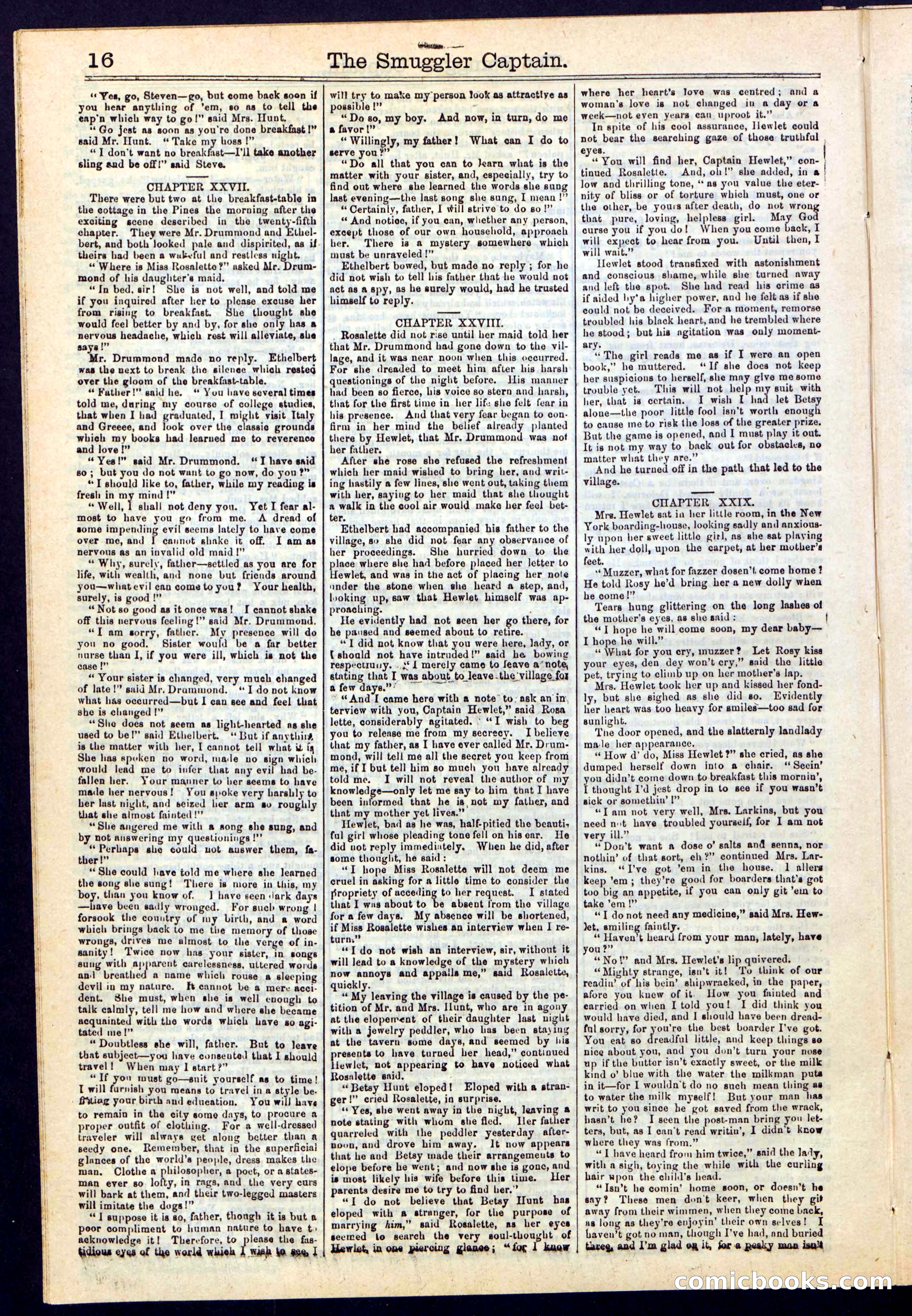
A restored page from Pulp Fiction, 1880. Page through the whole issue in the reader above.
📄 Transcribed text from this page (OCR, searchable)
Machine-transcribed from the original scan — historical spelling and the odd misread are preserved.
16 “Yes, go, Steven—go, but come back soon if you hear anything of ‘em, so as to tell the eap'n which way to go!” said Mrs. Iunt, ‘Go jest as soon as you're done breakfast |” said Mr. Hunt. “Take my loss !” “7 don't want no breakfast—lI'll take another sling and be off!” said Steve. CHAPTER XXVII. There were but two at the breakfast-table in the cottage in the Pines the morning after the exciting scene deseribed in the twenty-fifth chapter. They were Mr. Drummond and Ethel- bert, and both looked pale and dispirited, as if theirs had been a wukeful and restless night. “Where is Miss Rosalette?” asked Mr. Drum- mond of his daugliter’s maid. “In bed, sir! She is not well, and told me if you inquired after her to please excuse her from rising to breakfast. She thought she would feel better by and by, for she only has a nervous headache, which rest will alleviate, she Mr. Drummond made no reply. Ethelbert was the next to break the eilenee which rested over the gloom of the breakfast-table. “ Father!” eaid he. “ You have several times told me, during my course of college studies, that when I had graduated, I might visit Italy and Greeee, and look over the classie grounds which my books had learned me to reverence and love !” “ Yes!” said Mr. Drummond. “TI have said so; but you do not want to go now, do you ?” “TI should like to, father, while my reading is fresh in my mind !” “Well, | shall not deny you. Yet I fear al- most to have you go from me. A dread of some impending evil seems lately to have come over me, and | cannot shake it off. I am as nervous as an invalid old maid!” “Why, surely, father—settled as you are for life, with wealth, and none but friends around you—whatevil ean cometo you? Your health, surely, is good !” “Not so good as itonce was! I cannot shake off this nervous feeling!’ said Mr. Drummond. “T am sorry, father. My presence will do you no good, Sister would be a far better nurse than I, if you were ill, which is not the ease |” “ Your sister is changed, very much changed of late!” said Mr. Drammond. “I do not know what has oceurred—but | can see and feel that she is changed !”” ““She does not seem as light-hearted as she used to be!” said Ethelbert. “But if anythiw is the matter with her, I cannot tell what it is She has spoken no word, made no sign which would lead me to infer that any evil had be- fallen her. Your manner to her seems to have made her nervous! You spoke very harshly to her last night, and seized her arm so roughly that she almost fainted!” “She angered me with a song she sung, and by not answering my questionings !”’ “Perhaps she could not auswer them, fa- ther!” “She could have told me where she Jearned the song she sung! There is more in this, my bey: than you know of. J have seen :lark days —have been sadly wronged. For such wrong | forsook the couutry of my birth, and a word which brings back to me the memory of those wrongs, drives me almost to the verge of in- sanity! Twice now has your sister, in songs sung with apparent carelessness, ultered words an! breathed a name which rouse a sleeping devil in my nature. Ke cannot be a mere acci- dent. She must, when she is well cnough to talk calmly, tell me how and where she became acquainted with the words which have so agi- tated me!” “ Doubtless she will, father. But to leave that subject—you have consented that I should travel! When may I start?” 2 gt must go—suit yourself as to time! I will furnish you means to travel in a style be. . ftiag your birth and education. You will have to remain in the city some days, to procure a proper outfit of clothing, For a well-dressed traveler will always get along better than a seedy one. Remember, that in the superficial glances of the world’s people, dress makes the man. Clothe a paioone neh & poet, or a states- man ever so lofty, in rags, and the very curs will bark at them, and their two-legged masters will imitate the dogs!” “| suppose it is so, father, though it is but a peor compliment to human nature to have t» acknowledge it! Therefore, to on the fus- tidiows eyes of the world whie 1 wish (0 Sse 1. The Smuggler Captain. will try to make my person look as attractlye as possible !” “Do so, my boy. And now, in turn, do me a favor |” ¢ Willingly, my father! What can I do to serve you?” “Do all that you can to Jearn what is the matter with your sister, and, especially, try to find out where she learned the words she sung last evening—the last song she sung, [ mean!” “ Certainly, father, I will strive to do so!” * And notioe, if you can, whether any person, except those of our own household, approach her. There is a mystery somewhere which must be unraveled !” Ethelbert bowed, but made no reply ; for he did not wish to tell his father that he would not act as a spy, as he surely would, had he trusted himself to reply. CHAPTER XXVIII. Rosalette did not rise until her maid told her that Mr. Drummond had gone down to the vil- lage, and it was near noon when this occurred. For she dreaded to meet him after his harsh questionings of the night before. His manner had been so fierce, his voice so stern and harsh, that for the first time in her life she felt fear in his presence. And that very fear began to con- firm in her mind the belief already planted there by Hewlet, that Mr. Drummond was not her father. After she rose she refused the refreshment which her maid wished to bring her, and writ- ing hastily a few lines, she went out, taking them with her, saying to her maid that she thought a walk in the cool air would make her feel bet- ter. Ethelbert had accompanied his father to the village, s0 she did not fear any observance of her proceedings. She hurried down to the lace where she had before placed her letter to ewlet, and was in the act of placing her note under the stone when she heard a step, and, looking up, saw that Hewlet himself was ap- proaching. He evidently had not seen her go there, for he paused and seemed about to retire. “I did not know that you were here, lady, or (shoald not have intruded!” said he bowing respectruuy. 3‘ 1 merely came to leave a“ note, stating that I was about to leave.the ‘village fox a few days.” salt ' « And I came here with a note to: ask an in, terview with you, Captain Hewlet,” said Rosa lette, considerably agitated. © “I wish to beg you to release me from my secrecy. I believe that my father, as I have ever called Mr. Drum- mond, will tell me all the secret you keep from me, if I but tell him so much you have already told me. I will not reveal the author of my knowledge—only let me say to him that I have been informed that he is not my father, and that my mother yet lives.” Hewlet, bad as he was, half-pitied the beauti, ful girl whose pleading tone fell on hisear. He did not reply immediately, When he did, after some thought, he said : “T hope Miss Rosalette will not deem me cruel in asking for a little time to consider the propriety of cele | to her request. I stated that I was about to be absent from the village for a few days. My absence will be shortened, if Miss Rosalette wishes an interview when I re- turn.” “I do not wish an interview, sir, without it will lead to a knowledge of the mystery which now annoys and appails me,” said Rosalette, quickly. “My leaving the village is caused by the pe- tition of Mr, and Mrs. Ilunt, who are in agony at the eloperent of their daughter last night with a jewelry peddler, who has been staying at the tavern some days, and seemed by his presents to have turned her head,” continued Hiewlet, not appearing to have noticed what Rosnlette said, : “Betsy Hunt eloped! Eloped with a stran- ger!” cried Rosalette, in surprise. “Yes, she went away in the night, leaving & note stating with whom she fled. Iler father quarreled with the peddler yesterday after- poon, and drove him away. It now appears that he and Betsy made their arrangemeuts to elope before he went; and now she is gone, and is most likely his wife before this time. Her parents desire me to try to find her.” “I do not believe that Betsy Hunt has eloped with a stranger, for the purpose of marrying him,” said Rosalette, as her eycs seemed to search the very a dg of Hewlet, in one piercing glanee; “foc 1 kuow where her heart’s love was centred; and a woman's love is not changed in a day ora week—not even years can uproot it.” In spite of his cool assurance, Ilewlet eould not bear the searching gaze of those truthful . eyes. ee You will find her, Captain Hewlet,” con- | tinued Rosaletite. And, oh!” she added, in a} low and thrilling tone, “as you value the eter- ° nity of bliss or of torture which must, one or the other, be yours after death, do not wrong that pure, loving, helpless girl. May God curse you if youdo! When you come back, I will expect to hear from you. Until then, I will wait.” Hewlet stood transfixed with astonishment and conscious shame, while she turned away and left the spot. She had read his crime as if aided hy’a higher power, and he felt as if she could not be deceived. For a moment, remorse troubled his black heart, and he trembled where he stood; but his agitation was only moment- ary. “The girl reads me as if I were an open book,” he muttered. “If she does not keep her suspicions to herself, she may give me some trouble yet. This will not help my suit with her, that is certain. I wish I had let Betsy aloue—the poor little fool isn’t worth enough to cause me to risk the Joss of the greater prize. But the game is opened, and I must play it out. It is not my way to back out for obstacles, no matter what they are.” And he turned off in the path that led to the village. CHAPTER XXIX. Mrea. Hewlet sat ia her little room, in the New York boarding-house, looking sadly and anxious- ly upon her sweet little girl, as she sat playing with her doll, upon the carpet, at ber mother’s feet. “Muzzer, what for fazzer dosen't, come home ? He told Rosy he’d bring her a new dolly when he come!” Tears hung glittering on the long lashes of the mother’s eyes, as she said : “T hope he will come soon, my dear baby— I hope he will.” “What for you ery, muzzer? Let Rosy kiss your eyes, den dey won’t ery,” said the little pet, trying to climb up on her mother’s lap. Mrs. Hewlet took her up and kissed her fond- ly, but she sighed as she did so, Evidently her heart was too heavy for smiles—too sad for sunlight. Tne door opened, and the slatternly landlady male her appearance. “ How d’ do, Miss Hewlet ?” she cried, as she dumped herself down into a chair, “ Secin’ you didn’t come down to breakfast this mornin’, I thought I’d jest drop in to see if you wasn’t sick or somethin’ !” “Tam not very well, Mrs. Larkins, but you need nt have troubled yourself, for I am not very ill.” “Don’t want a dose o’ salts and senna, nor nothin’ of that sort, eh?’ continued Mrs, Lar- kins. “I’ve got ’em in the house. 1 allers keep em; they’re good for boarders that's got tuo big an appetite, if you can only git ’em to take ’em !” “IT donot need any medicine,” said Mrs. Hew- det, smiling faintly. “‘ Haven't heard from your man, lately, have you?” “Nol” and Mrs. Hewlet’s lip quivered. “Mighty strange, isn’t it! To think of our readin’ of his bein’ shipwracked, in the paper, afore you knew of it. How you fainted and carried on when I told you! I did think you would have died, and I should have been dread- fal sorry, for you're the best boarder I’ve got. You eat so dreadful little, and keep things so nice about you, and you don’t turn your nose up if the butter isn’t exactly sweet, or the milk kind o’ blue with the water the milkman puts in it—for I wouldn't do no such mean thing as to water the milk myself! But your man has writ to you since he got saved from the wrack, hasn’t he? TI seen the post-man bring you let- ters, but, as I can't read writin’, I didn’t know where they was from.” “I have heard from him twice,” said the lady, with a sigh, toying the while with the curling hair wpon the child's head. “Isn't he comin’ home soon, or doesn’t he say? These men don't keer, when they git away from their wimmen, when they come back, as long as they’re enjoyin’ their own selves! I haven’t got no man, though I’ve had, and buried bareg, and I’m glad og it, fora peaky man isn a a a 4 On VJOO'K