
Pulp Fiction, 1880 · page 3 of 24
Beadle's Dime Library No. 109 — page 3: what you’re looking at
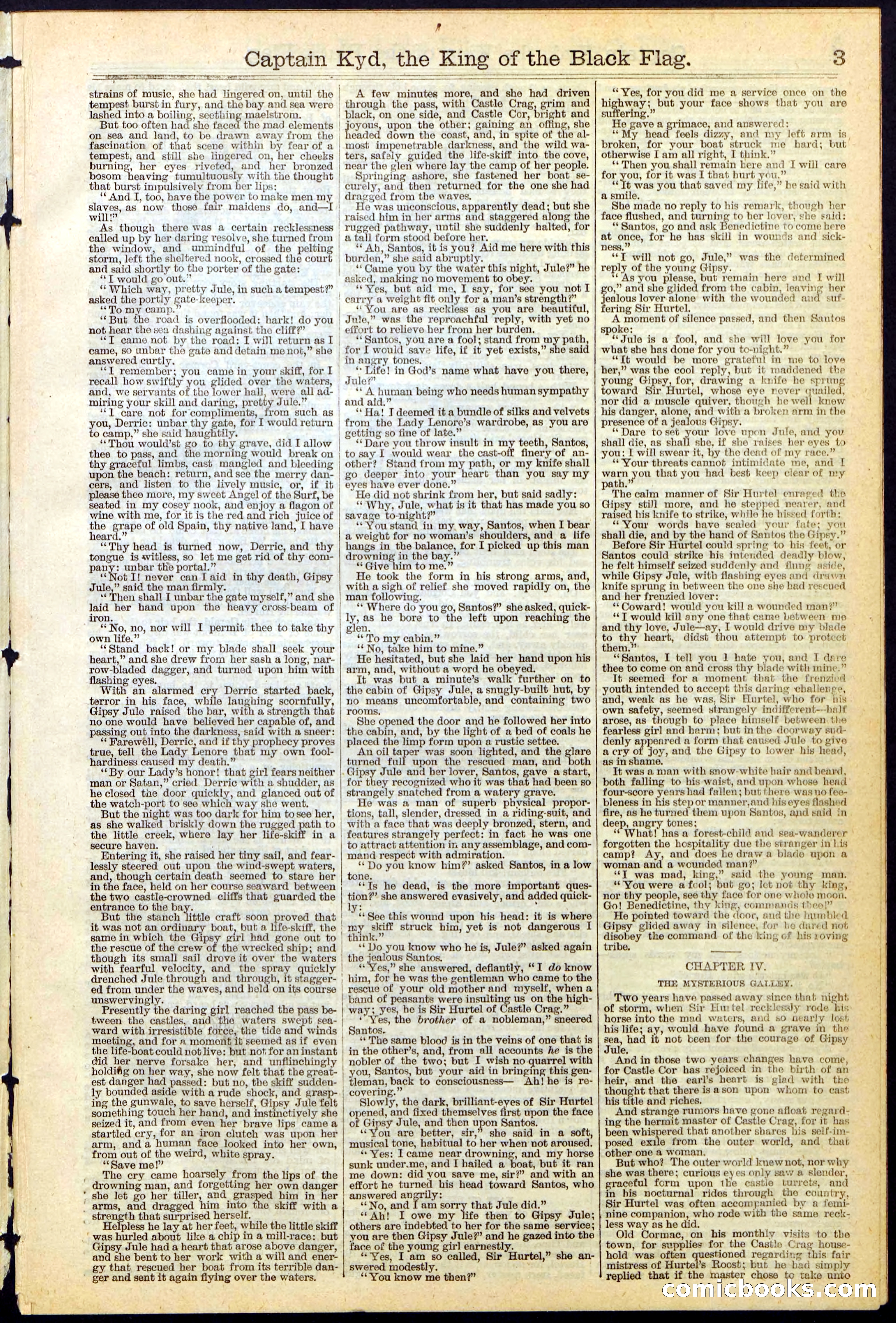
A restored page from Pulp Fiction, 1880. Page through the whole issue in the reader above.
📄 Transcribed text from this page (OCR, searchable)
Machine-transcribed from the original scan — historical spelling and the odd misread are preserved.
’ strains of music, she had lingered on, until the | tempest burst in fury, and the bay and sea wero lashed into a boiling, seething maelstrom. But too often had she faced the mad elements | on sea and land, to be drawn away from the fascination of that scene within by fear of a tempest, and still she lingered on, her cheeks burning, her eyes riveted, and her bronzed bosom heaving tumultuously with the thought | that burst impulsively from ber lips: ‘* And I, too, have the power to make men my slaves, as now those fair maidens do, and—I will!” As though there was a certain recklessness called up by her daring resolve, she turned from the window, and unmindful of the pelting storm, left the sheltered nook, crossed the court and said shortly to the porter of the gate: “T would go out.” ** Which way, pretty Jule, in such a tempest?” asked the portly gate-keeper. “To my camp.” ‘*But the road is overflooded: hark! do you not hear the sea dashing against the cliff?’ ‘IT came not by the road: I will return as I | came, sO unbar the gate and detain me not,” she answered curtly. ‘‘I remember; you came in your skiff, for I | recall how swiftly you glided over the waters, and, we servants of the lower hall, were all ad- miring your skill and daring, pretty Jule.” ‘1 care not for compliments, from such as you, Derric: unbar thy gate, for I would return to camp,” she said haughtily. ‘““Thou would’st go to thy grave, did I allow thee to pass, and the morning would break on thy graceful limbs, cast mangled and bleeding upon the beach: return, and see the merry dan- cers, and listen to the lively music, or, if it please thee more, my sweet Angel of the Surf, be seated in my cosey nook, and enjoy a flagon of wine with me, for it is the red and rich juice of the grape of old Spain, thy native land, I have heard.” ‘““Thy head is turned now, Derric, and thy tongue is avitless, so let me get rid of thy com- pany: unbar the portal.” “Not I! never can [ aid in thy death, Gipsy Jule,” said the man firmly. ‘Then shall I unbar the gate myself,” and she laid her hand upon the heavy cross-beam of iron. ‘No, no, nor will I permit thee to take thy own life.” ‘‘Stand back! or my blade shall seek your heart,” and she drew from her sash a long, nar- row-bladed dagger, and turned upon him with flashing eyes. : With an alarmed cry Derric started back, terror in his face, while laughing scornfully, Gipsy Jule raised the bar, with a strength that no one would have believed her capable of, and passing out into the darkness, said with a sneer: ‘‘ Farewell, Derric, and if thy prophecy proves true, tell the Lady Lenore that my own fool- hardiness caused my death.” ‘*By our Lady’s honor! that girl fears neither man or Satan,” cried Derric with a shudder, as he closed tae door quickly, and glanced out of the watch-port to see which way she went. But the night was too dark for him tosee her, as she walked briskly down the rugged path to the little creek, where lay her life-skiff in a secure haven. Entering it, she raised her tiny sail, and fear- lessly steered out upon the wind-swept waters, and, though certain death seemed to stare her in the face, held on her course seaward between | the two castle-crowned cliffs that guarded the entrance to the bay. But the stanch ‘itl craft soon proved that it was not an ordinary boat, but a life-skiff, the same in which the Gipsy girl had gone out to | the rescue of the crew of the wrecked ship; and though its small sail drove it over the waters | with fearful velocity, and the spray quickly | drenched Jule through and through, it stagger- | ed from under the waves, and held on its course unswervingly. Presently the daring girl reached the pass be- | tween the castles, and the waters swept sea- | ward with irresistible force, the tide and winds | meeting, and for a moment it seemed as if even | the life-boat could not live: but not for an instant | did her nerve forsake her, and unflinchingly holdifig on her way, she now felt that the great- | est danger had passed: but no, the skiff sudden- ly bounded aside with a rude shock, and gr ing the gunwale, to save herself, Gipsy Jule felt something touch her hand, and instinctively she seized it, and from even her brave lips came a startled cry, for an iron clutch was upon her arm, anda human face looked into her own, from out of the weird, white spray. **Save me!” The cry came hoarsely from the lips of the | drowning man, and forgetting her own danger * she let go her ea gee gra and d him in her arms, and dragged him into the skiff with a strength that surprised herself. Helpless he lay at her feet, while the little skiff _‘ was hurled about like a chip in a mill-race: but _ Gipsy Jule had a heart that arose above danger, and she bent to her work with a will and ener- gy that rescued her boat from its terrible dan- ' ger and sent it again flying over the waters. ‘. ’ Par _ Captain Kyd, the aE A few minutes more, and she had driven through the pass, with Castle Crag, grim and black, on one side, and Castle Cor, bright and joyous, upon the other; gaining an offing, she headed down the coast, and, in spite of the al- most impenetrable darkness, and the wild wa- ters, safely guided the life-skiff into the cove, near the glen where lay the camp of her people. Springing ashore, she fastened her boat se- curely, and then returned for the one she had | dragged from the waves, He was unconscious, apparently dead; but she raised him in her arms and staggered along the rugged pathway, until she suddenly halted, for a tall form stood before her. ** Ab, Santos, it is you? Aid me here with this burden,” she said abruptly. ‘‘Came you by the water this night, Jule?” he asked, making no movement to obey. ‘“Yes, but aid me, I say, for see you not I carry a weight fit only for a man’s strength?” “You are as reckless as you are beautiful, Junie,” was the reproachful reply, with yet no | effort to relieve her from her burden. ‘*Santos, you are a fool; stand from my path, for I would save life, if it yet exists,” she said in angry tones. ‘Life! in God’s name what have you there, | Jule?” ‘* A human being who needs human sympathy and aid.” ‘* Ha! T deemed it a bundle of silks and velvets from the Lady Lenore’s wardrobe, as you are getting so fine of late.” ‘“Dare you throw insult in my teeth, Santos, to say I would wear the cast-off finery of an- other? Stand from my path, or my knife shall go deeper into your heart than you say my eyes have ever done.” He did not shrink from her, but said sadly: ‘‘ Why, Jule, what is it that has made you so savage to-night?” ‘You stand in my, way, Santos, when I bear a weight for no woman’s shoulders, and a life hangs in the balance, for I picked up this man drowning in the bay.” ‘Give him to me.” He took the form in his strong arms, and, with a sigh of relief she moved rapidly on, the man followiug. ** Where do you go, Santos?” she asked, quick- ly, as he bore to the left upon reaching the glen. ‘To my cabin.” ‘* No, take him to mine.” He hesitated, but she laid her hand upon his arm, and, without a word he obeyed. It was but a minute’s walk further on to the cabin of Gipsy Jule, a snugly-built hut, by no means uncomfortable, and containing two rooms, She opened the door and he followed her into the cabin, and, by the light of a bed of coals he placed the limp form upon a rustic settee. An oil yd was soon lighted, and the glare turned full upon the rescued man, and both Gipsy Jule and her lover, Santos, gave a start, for they recognized who it was that had been so strangely snatched from a watery grave. He was a man of superb pbhvsical propor- tions, tall, slender, dressed in a riding-suit, and with a face that was deeply bronzed, stern, and features strangely perfect: in fact he was one to attract attention in any assemblage, and com- mand respect with admiration. ** Do you know him?’ asked Santos, in a low ne. ‘*Ts he dead, is the more important ques- tion?’ she answered evasively, and added quick- Mi See this wonnd upon his head: it is where my ae struck him, yet is not dangerous I think.’ ‘* Do you know who he is, Jule?” asked again the jealous Santos. “Yes,” she answered, defiantly, ‘I do know him, for he was the gentleman who came to the rescue of your old mother and myself, when a band of peasants were insulting us on the high- way; yes, he is Sir Hurtel of Castle Crag.” ‘Yes, the brother of a nobleman,” sneered Santos. ‘The same blood is in the veins of one that is in the other’s, and, from all accounts he is the nobler of the two; but I wish no quarrel with you, Santos, but your aid in bringing this gen- tleman, back to consciousness— Ah! he is re- covering.” Slowly, the dark, brilliant-eyes of Sir Hurtel opened, and fixed themselves upon the face oF Gipsy Jule, and then upon Santos. ‘“You are better, sir,” she said in a soft, musical tone, habitual to her when not aroused. ‘* Yes: Lcame near drowning, and my horse sunk under.me, and I hailed a boat, but it ran me down: did you save me, sir?’ and with an effort he turned his head toward Santos, who answered angrily: ‘“No, and | am sorry that Jule did.” ‘““Ah! I owe my life then to Gipsy Jule; others are indebted to her for the same service; you are then Gipsy Jule?” and he gazed into the face of the young girl earnestly. “Yes, I am so called, Sir Hurtel,” she an- swered modestly. ayy ‘“You know me then?” ' : . ‘ King of the Black Flag. 3 ee oe ee Mtn a ee ee mre ee yp Se ee — EE / symone = ne ee -—---- —— ey . . * “Yes, for you did me a service once on the highway’ but your face shows that you are ering.” He gave a grimace, and answered: ‘““My head feels dizzy, and my left arm is, broken, for your boat struck me hard; but otherwise I am all right, I think.” ‘* Then you shall remain here and I will care for you, for it was I that burt you.” “Tt was you that saved my life,” he said with a smile. She made no reply to his remark, though her | face flushed, and turning to ber lover, she said: ‘Santos, go and ask Benedictine to come here at once, for he has skill in wounds and sick- ness,” ‘4 **T will not go, Jule,” was the determined reply of the young Gipsy. ! ‘** As you please, but remain here and I will jet and she glided from the cabin, leaving her ealous lover alone with the wounded and. suf- ering Sir Hurtel. A moment of silence passed, and then Santos ke: “Jule is a fool, and she will love you for what she has done for you to-night.” . “Tt would be more grateful in me to love | her,” was the cool reply, but it maddened the young Gipsy, for, drawing a Inife he sprun toward Sir Hurtel, whose eye rever ¢ eta nor did a muscle quiver, though he will knew his danger, alone, and with a broken arm in the presence of a jealous Gipsy. **Dare toset your love upon Jule, and you shall die, as shall she, if she raises her eyes to you: I will swear it, by the dead of my race.” ‘‘Your threats cannot intimidate me, and | warn you that you had best keep clear of my Wt path.’ | The calm manner of Sir Hurtel enraged the | Gipsy stiJl more, and he stepped nearer, and yl raised his knife to strike, while he hissed forth: | “Your words have sealed your fate; you ) shall die, and by the hand of Santos the Gipsy.” . Before Sir Hurtel could spring to his feet,or = | Santos could strike his intended deadly blow, he felt himself seized suddenly and flung aside, while Gipsy Jule, with flashing eyes and drawn knife sprung in between the one she had rescued and her frenzied lover: oan “Coward! would you kill a wounded man?’ | “T would kill any one that came between me “ and thy love, Jule—ay, I would drive my blade to thy heart, didst thou attempt to protcet them.” | “Santos, I tell you 1 hate you, and I dare thee to come on and cross thy blade with mine.” It seemed for a moment that the frenzicd | youth intended to accept this daring challenge, and, weak as he was, Sir Hurtel, who for his own safety, seemed strangely indifferent-—half = arose, as though to place himself between the = fearless girl and herm; but inthe doorway sud- 4 denly 0 ew Be a form that caused Jule togive acry of joy, and the Gipsy to lower his head, | as in shame. rs f It was a man with snow-white hairandbeard, both falling to his waist, and upon whose head’ four-score years had fallen; butthere wasnofee- | bleness in his step or manner,and hiseyes flashed = = | fire, as he turned them upon Santos, andsaid in | deep, angry tones; ' ‘¢ What! has a forest-child and sea-wanderer’) forgotten the hospitality due the stranger in his _ camp? Ay, and does he drawa blade upon a woman and a wounded man?” . “T was mad, king,” said the young man “You were afcol; but go; let not thy king, . nor thy people, see thy face for one whole moon, | Go! Benedictine, thy king, commands thee!” ei He pointed toward the door, andthe humbled Gipsy glided away in silence, for he dared not — r | farses A the command of the king of hisxoving i tri q ag CHAPTER IV. THE MYSTERIOUS GALLEY. Two years have passed away since that night : of storm, when Sir Hurtel recklesaly rode his horse into the mad waters, and so Hearly lost — his life; ay, would have found a grave in the sea, had it not been for the courage of Gipsy _- ™ = e. And in those two years changes have come, for Castle Cor has rejoiced in the birth of an heir, and the earl’s heart is glad with the thought that there isason upon whom to cast his title and riches. And strange rumors have gone afloat regard- ing the hermit master of Castle Crea; for it has been whispered that another shares his self-im- posed exile from the outer world, and that other one a woman, ; But who? The outer world knew not, nor why she was there; curious eyes only saw a slender, -_ ceful form upon the castie turrets, and in his nocturnal rides through the country, Sir Hurtel was often accompanied by a femi- nine companion, who rode with the same reck- less way as he did. é; oo, % » _ all ed & « - i 4 Bid o™, —_ Old Cormac, on his monthly visits to the \ town, for supplies for the Castle Crag house- hold was often questioned pegarding this fair =| | mistress of H ’s Roost; but he bad simply | replied that if the ter chose take unio F — Com Eboo <S)GCOr ne none — —— 4 i —-s