
Pulp Fiction, 1880 · page 2 of 24
Beadle's Dime Library No. 109 — page 2: what you’re looking at
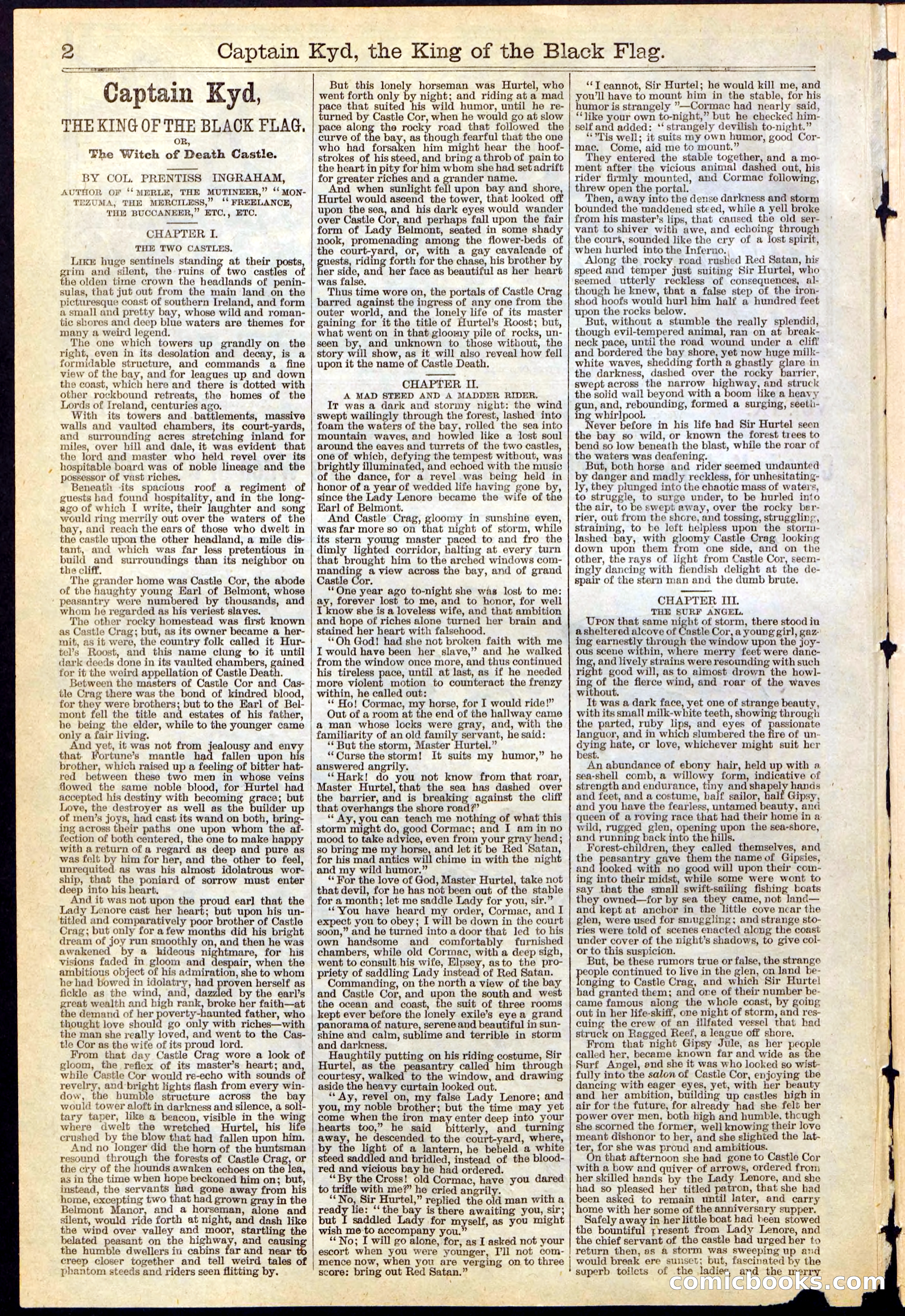
A restored page from Pulp Fiction, 1880. Page through the whole issue in the reader above.
📄 Transcribed text from this page (OCR, searchable)
Machine-transcribed from the original scan — historical spelling and the odd misread are preserved.
2 er —EE—E—————— a Captain Kyd, THE KING OF THE BLAOK PFLAG. OR, The Witch of Death Castle. BY COL. PRENTISS INGRAHAM, AUTHOR OF ‘‘ MERLE, THE MUTINEER,” ‘‘ MON- TEZUMA, THE MERCILESS,” ‘* FREELANCE, THE BUCCANEER,” ETC,, ETC. CHAPTER I. THE TWO CASTLES. Lik huge sentinels standing at their 8 rim and silent, the ruins of two castles o he olden time crown the headlands of penin- sulas, that jut out from the main land on the picturesque coast of southern [reland, and form a small and pretty bay, whose wild and roman- tic shores and deep blue waters are themes for many a weird legend. The one which towers up grandly on the right, even in its desolation and decay, is a formidable structure, and commands a fine view of the bay, and for leagues up and down the coast, which here and there is dotted with other rockbound retreats, the homes of the Lords of Ireland, centuries ago. With its towers and battlements, massive walls and vaulted chambers, its court-yards, and surrounding acres stretching inland for miles, over hill and dale, it was evident that the lord and master who held revel over its hospitable board was of noble lineage and the possessor of vast riches. Beneath -its spacious roof a regiment of guests had found hospitality, and in the long- ago of which [ write, their laughter and song would ring merrily out over the waters of the bay, and reach the ears of those who dwelt in the castle upon the other headland, a mile dis- tant, and which was far less pretentious in build and surroundings than its neighbor on the cliff. The grander home was Castle Cor, the abode of the haughty young Earl of Belmont, whose ‘ peasantry were numbered by thousands, and whom he regarded as his veriest slaves. The other rocky homestead was first known as Castle Crag; but, as its owner became a her- mit, as it were, the country folk called it Hur- tel’s Roost, and this name clung to it until dark deeds done in its vaulted chambers, gained for it the weird appellation of Castle Death. Between the masters of Castle Cor and Cas- tle Crag there was the bond of kindred blood, for they were brothers; but to the Earl of Bel- mont fell the title and estates of his father, he being the elder, while to the younger came only a fair living. And yet, if was not from that. Fortune’s mantle had fallen upon his brother, which raised up a feeling of bitter hat- red between these two men in whose veins flowed the same noble blood, for Hurtel had accepted his destiny with becoming grace; but Love, the destroyer as well as the builder up of men’s joys, had cast its wand on both, bring- ing across their paths one upon whom the af- fection of both centered, the one to make happy with a return of a regard as deep and pure as was felt by him for her, and the other to feel, unrequited as was his almost idolatrous wor- ship, that the poniard of sorrow must enter deep into his heart. And it was not upon the proud ear] that the Lady Lenore cast her heart; but upon his un- titled and comparatively poor brother of Castle Crag; but only for afew months did his bright dream of joy run smoothly on, and then he was awakened by a hideous nightmare, for his visions faded in gloom and aeapair. when the ambitious object of his admiration, she to whom he had bowed in idolatry, ed on a herself as fickle as the wind, and, dazzled by the earl’s great wealth and high rank, broke her faith—at the demand of her Ste i pe father, who thought love should go only with riches—with the man she really loved, and went to the Cas- tle Cor as the wife of its proud lord. From that day Castle Crag wore a look of gloom, the reflex of its master’s heart; and, while Castle Cor would re-echo with sounds of revelry, and bright lights flash from every win- dow, the humble structure across the ba would tower aloft in darkness and silence, a soli- tary taper, like a beacon, visible in the wing ealousy and env where dwelt the wretched Hurtel, his life | hearts too,” he said ——— O_O | r But this lonely horseman was Hurtel, who went forth only by night; and riding at a mad pace that suited his wild humor, until he re- turned by Castle Cor, when he would go at slow pace along the rocky road that followed the curve of the bay, as though fearful that the one who had forsaken him might hear the hoof- strokes of his steed, and bring a throb of pain to the heart in pity for him whom she had set adrift for greater riches and a graneer name. And when sunlight fell upon bay and shore, Hurtel would aseend the tower, that looked off upon the sea, and his dark eyes would wander over Castle Cor, and perhaps fall upon the fair form of Lady Belmont, seated in some shady nook, promenading among the flower-beds of the court-yard, or, with a gay cavalcade of Fgh riding forth for the chase, his brother by er side, and her face as beautiful as her heart was false. Thus time wore on, the portals of Castle Crag barred against the ingress of any one from the outer world, and the lonely life of its master gaining for it the title of Hurtel’s Roost; but, what went on in that gloomy pile of rocks, un- seen by, and unknown to those without, the story will show, as it will also reveal how fell upon it the name of Castle Death. CHAPTER II. A MAD STEED AND A MADDER RIDER. Ir was a dark and stormy night: the wind swept wailingly through the forest, lashed into foam the waters of the bay, rolled the sea into mountain waves, and howled like a lost soul around the eaves and turrets of the two castles, one of whicb, defying the tempest without, was brightly illuminated, and echoed with the music of the dance, for a revel was being held in honor of a year of wedded life having gone by, since the Lady Lenore became the wife of the Earl of Belmont. And Castle Crag, gloomy in sunshine even, was far more so on that night of storm, while its stern youug master paced to and fro the dimly lighted corridor, halting at every turn that brought him to the arched windows com- manding a view across the bay, and of grand Castile Cor. ‘One year ago to-night she was lost to me: ay, forever lost to me, and to honor, for well I know she is a loveless wife, and that ambition and hope of riches alone turned her brain and stained her heart with falsehood. **Oh God! had she not broken faith with me I would have been her slave,” and he walked from the window once more, and thus continued his tireless pace, until at last, as if he needed more vidlent motion to counteract the frenzy within, he called out: ; ‘* Ho! Cormac, my horse, for I would ride!” Out of a room at the end of the hallway came a man whose locks were gray, and, with the familiarity of an old family servant, he said: ‘¢ But the storm, Master Hurtel.” ‘Curse the storm! It suits my humor,” he answered angrily. “Hark! do you not know from that roar, Master Hurtel, that the sea has dashed over the barrier, and is breaking against the cliff that overhangs the shore road?” * Ay, you can teach me nothing of what this storm might do, good Cormac; and I am in no mood to take advice, even from your gray head; so bring me my horse, and let it be Red Satan, for his mad antics will chime in with the night and my wild humor.” ‘** For the love of God, Master Hurtel, take not that devil, for he has not been out of the stable for a month; let me saddle Lady for you, sir.” ‘‘You have heard my order, Cormac, and I expect you to obey; I will be down in the court soon,” and he turned into a door that led to his own handsome and comfortably furnished chambers, while old Cormac, with a deep sigh, went to consult bis wife, Elpsey, asto the pro- priety of saddling Lady instead of Red Satan. Commanding, on the north a view of the bay and Castle Cor, and upon the south and west the ocean and coast, the suit of three rooms kept ever before the lonely exile’s eye a grand panorama of nature, serene and beautiful in sun- shine and calm, sublime and terrible in storm and darkness, : Haughtily putting on his riding costume, Sir Hurtel, as the peasantry called him through courtesy, walked to the window, and drawing aside the heavy curtain looked out. ‘“‘ Ay, revel on, my false Lady Lenore; and you, my noble brother; but the time may yet come when the iron may enter deep into your bittele, and turning crushed by the blow that had fallen upon him. | away, he descended to the court-yard, where, And no longer did the horn of the huntsman | by the light of a lantern, he beheld a white resound through the forests of Castle Crag, or the cry of the hounds awaken echoes on the lea, as in the time when hope beckoned him on; but, instead, the servants had gone away from his home, excepting two that had grown gray in the Belmont Manor, and a horseman, alone and silent, would ride forth at night, and dash like the wind over valley and moor, startling the belated ei on the highway, and causin the humble dwellers in cabins far and near creep closer together and tell weird tales of phantom steeds and riders seen flitting by. | steed saddled and bridled, instead of the blood- red and vicious bay he had ordered. ‘By the Cross! old Cormac, have you dared to trifle with me?” he cried engrtl ‘No, Sir Hurtel,” replied the old man with a “a lie: ‘the ba is there awaiting you, Sir; but I saddled y for myself, as you might wish me to accompany you.” ‘No; I will go alone, for, as I asked not your escort when you were younger, Ill not com- mence now, when you are verging on to three score: bring out Red Satan.” : Captain Kyd, the King of the Black Flag. ‘*T cannot, Sir Hurtel; he would kill me, and you'll have to mount him in the stable, for his humor is strangely ”"—Cormac had nearly said, “like your own to-night,” but he checked him- self and added: ‘strangely devilish to-night.” “Tis well; it suits my own humor, good Cor- mac. Come, aid me to mount.” They entered the stable together, and a mo- ment after the vicious animal dashed out, his rider firmly mounted, and Cormac following, threw open the portal. Then, away into the dense darkness and storm bounded the maddened steed, while a yell broke from his master’s lips, that caused the old ser- vant to shiver with awe, and echoing through the cours, sounded like the cry of a lost spirit, when hurled into the Inferno. , Along the rocky road rushed Red Satan, his speed and temper just suiting Sir Hurtel, who seemed utterly reckless of consequences, al- though he knew, that a false step of the iron- shod hoofs would hurl him half a hundred feet upon the rocks below. But, without a stumble the really splendid, though evil-tempered animal, ran on at break- neck pace, until the road wound under a cliff and bordered the bay shore, yet now huge milk- white waves, shedding forth a ghastly glare in the darkness, dashed over the rocky barrier, swept across the narrow highway, and struck the solid wall beyond with a boom like a heavy gun, and, rebounding, formed a surging, seetli- in whirlpool. ‘ Naver before in his life had Sir Hurtel seen the bay so wild, or known the forest trees to bend so low beneath the blast, while the roar of the waters was deafening. But, both horse and rider seemed undaunted by danger and madly reckless, for unhesitating- ly, they plunged into the chaotic mass of waters, to struggle, to surge under, to be hurled into the air, to be swept away, over the rocky bar- rier, out from the shore, and tossing, struggling, straining, to be left helpless upon the storm- lashed bay, with gloomy Castle Crag looking down upon them from one side, and on the other, the rays of light from Castle Cor, seem- ingly dancing with fiendish delight at the de- spair of the stern man and the dumb brute. CHAPTER III. THE SURF ANGEL. UPON that same night of storm, there stood iu a sheltered alcove of Castle Cor, a young girl, gaz- ing earnestly through the window upon the joy- ous scene within, where merry feet were danc- ing, and lively strains were resounding with such right good will, as to almost drown the howl- ing of the fierce wind, and roar of the waves without. | It was a dark face, yet one of strange beauty, with its small milk-white teeth, showing through the parted, ruby lips, and eyes of passionate languor, and in which slumbered the fire of un- dying hate, or love, whichever might suit her est. An abundance of ebony hair, held up with a sea-shell comb, a willowy form, indicative of strength and endurance, tiny and shapely hands and feet, and a costume, balf sailor, half Gipsy, and you have the fearless, untamed beauty, and queen of a roving race that had their home in a. wild, rugged glen, vi aeroeg Bie the sea-shore, and running back into the hills. Forest-children, they called themselves, and the peasantry gave them the name of Gipsies, and looked with no good will upon their com- ing into their midst, while some were wont to say that the small swift-sailing fishing boats they owned—for by sea ey came, not land— and kept at anchor in the little cove ncar the glen, were used for smuggling; and strange sto- ries were told of scenes enacted along the coast under cover of the night’s shadows, to give col- or to this suspicion. But, be these rumors true or false, the strange pecrie continued to live in the glen, on land be- onging to Castle Crag, and which Sir Hurtel had granted them; and one of their number be- came famous along the whole coast, by going out in her life-skiff, one night of storm, and res- cuing the crew of an illfated vessel that had struck on Ragged Reef, a league off shore. From that night Gipsy Jule, as her people called her, became known far and wide as the Surf Angel, end she it was who looked so wist- fully into the salon of Castle Cor, enjoying the dancing with eager eyes, yet, with her beauty and her ambition, building up castles high in air for the future, for already had she felt her power over men, both high and humble, thcugh she scorned the former, well knowing their love meant dishonor to her, and she slighted the lat- ter, for she was proud and ambitious. On that afternoon she had gone to Castle Cor with a bow and quiver of arrows, ordered from her skilled hands by the Lady Lenore, and she had so pleased her titled patron, that she had been asked to remain until later, and carry home with her some of the anniversary supper. Safely away in her little boat had heen stowed the bountiful present from Lady Lenore, and the chief servant of the castle had urged her to return then, as a storm was sweeping up and would break ere sunset; but, fascinated by the superb toilets of the mi a (€ (€ om s books)