
Pulp Fiction, 1880 · page 4 of 24
Beadle's Dime Library No. 109 — page 4: what you’re looking at
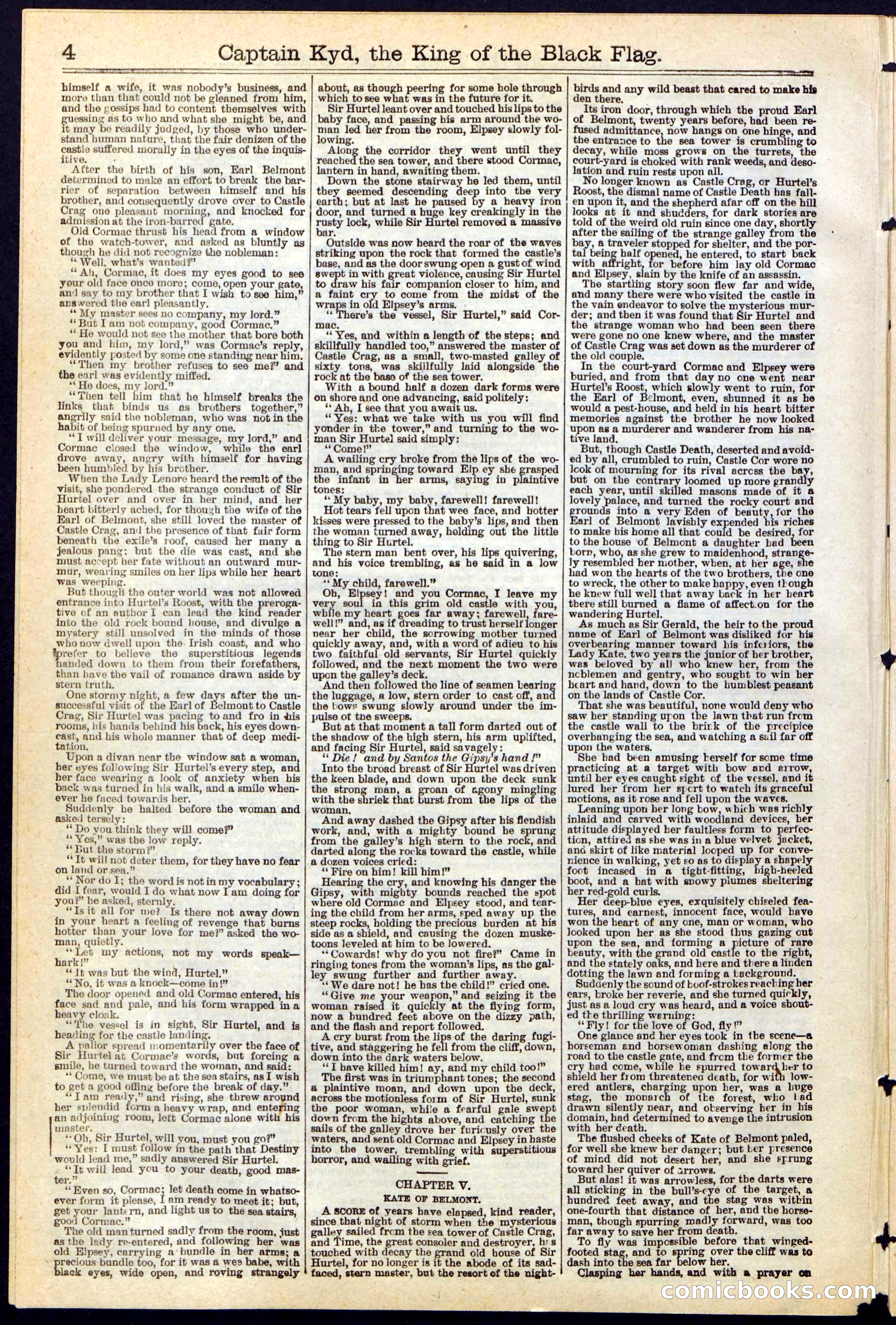
A restored page from Pulp Fiction, 1880. Page through the whole issue in the reader above.
📄 Transcribed text from this page (OCR, searchable)
Machine-transcribed from the original scan — historical spelling and the odd misread are preserved.
» himself a wife, it was nobody’s business, and more than that could not be gleaned from him, and the gossips had to content themselves with guessing as to who and what she might be, and it may be readily judged, by those who under- stand human nature, that the fair denizen of the castle suffered morally in the eyes of the inquis- itive. ' After the birth of his son, Earl Belmont determined to make an effort to break the bar- rier of separation between himself and his brother, and consequently drove over to Castle Crag one pleasant morning, and knocked for admission at the iron-barred gate. Old Cormac thrust his head from a window of the watch-tower, and asked as bluntly as though he did not recognize the nobleman: ** Well, what’s wanted?’ “Ah, Cormac, it does my eyes good to see your old face once more; come, open your gate, and say to my brother that I wish to see him,” answered the earl pleasantly. “* My master sees no company, my lord.” “But Iam not company, good Cormac,” “‘ He would not see the mother that bore both you and him, my lord,” was Cormac’s reply, evidently posted by some one standing near him. ““Then my brother refuses to see me?’ and the earl was evidently miffed. ** He does, my lord.” _““Then tell him that he himself breaks the links that binds us as brothers together,” angrily said the nobleman, who was not in the habit of being spurned by any one. " ‘“*T will deliver your message, my lord,” and Cormac closed the window, while the earl drove away, angry with himself for having been humbled by his brother. When the Lady Lenore heard the result of the visit, she pondered the strange conduct of Sir Hurtel over and over in her mind, and her heart bitterly ached, for thouch tne wife of the Earl of Belmont, she still loved the master of Castle Crag, an the presence of that fuir form beneath the exile’s roof, caused her many a jealous pang: but the die was cast, and she must accept her fate without an outward mur- mur, wearing smiles on her lips while her heart was weepiriz. But though the outer world was not allowed entrance into Hurtel’s Roost, with the preroga- tive of an author I can lead the kind reader into the old rock bound house, and divulge a mystery still unsolved in the minds of those who now dwell upon the. [Trish coast, and who eke to believe the superstitious legends 1anded down to them from their forefathers, than have the vail of romance drawn aside by stern truth, One stormy night, a few days after the un- successful visit of the Earl of Belmont to Castle Crag, Sir Hurtel was pacing to and fro in dis rooms, his hands behind his back, his eyes down- cast, and his whole manner that of deep medi- tation. Upon a divan near the window sat a woman her eyes following Sir Hurtel’s every step, an her face wearing a look of anxiety when his back was turned in his walk, and a smile when- ever he faced towards her. Suddenly he halted before the woman and asked tersely: ** Do you think they will come?” ** Yes,” was the low reply. ** But the storm?” “It will not deter them, for they have no fear on land or sea.” “Nor do I; the word is not in my vocabulary ; did I fear, would I do what now Iam doing for you?” he asked, sternly. “Ts it all for me? Is there not away down in your heart a feeling of revenge that burns hotter than your love for me?’ asked the wo- man, quietly. **Let my actions, not my words speak— hark!” “It was but the wind, Hurtel,” ‘No, it was a knock—come in!” The door opened and old Cormac entered, his face sad and pale, and his form wrapped ina heavy cloak. “The vessel is in sight, Sir Hurtel, and is heading for the castle landing. A fe lor spread aeagp ones over the face of Sir Hurtel at Cormac’s words, but forcing a smile, he turned toward the woman, and said: ‘*Come, We must be at the sea stairs, asI wish to get a good offing before the break of day.” **Tam ready,” and rising, she threw aroynd her splendid form a heavy wrap, and entering an adjoining room, left Cormac alone with his master. ‘Ob, Sir Hurtel, will you, must you go?” “Yes: L must follow in the path that Destiny would lead me,” sadly answered Sir Hurtel. a will lead you to your death, good mas- igs ““Byven so, Cormac; let death come in whatso- ever form it please, | am ready to meet it; but, get your lant«rn, and light us to the sea stairs, good Cormac.” The old man turned sadly from the room, just as the lady re-entered, and following her was old Elpsey, carrying a’ bundle in her arms; a recious bundle too, for it was a wes babe, with lack eyes, wide open, and roving strangely Captain Kyd, the King of the Black Flag. about, as though peering for some hole through which to see what was in the future for it. Sir Hurtel leant over and touched bis lips to the baby face, and passing bis arm around the wo- ee led her from the room, Elpsey slowly fol- owing. Along the corridor they went until they reached the sea tower, and there stood Cormac, lantern in hand, awaiting them. Down the stone stairway he led them, until they seemed descending deep into the very earth; but at last he paused by a heavy iron door, and turned a huge key creakingly in the ran lock, while Sir Hurtel removed a massive r. Outside was now heard the roar of the waves striking upon the rock that formed the castle’s base, and as the doorswung open a gust of wind swept in with great violence, causing Sir Hurtel to draw his fair companion closer to him, and a faint ery to come from the midst of the wraps in old Elpsey’s arms. ‘“* 'There’s the vessel, Sir Hurtel,” said Cor- mac. ‘Yes, and within a length of the steps; and skillfully handled too,” answered the master of Castle Crag, as a small, two-masted galley of sixty tons, was skillfully laid alongside the rock at the base of the sea tower, With a bound half a dozen dark forms were on shore and one advancing, said politely: ** Ah, I see that you await us. “Yes: what we take with us you will find yonder in the tower,” and turning to the wo- man Sir Hurte} said simply: ‘*Come!” A wailing cry broke from the lips of the wo- man, and springing toward Elp ey she grasped he infant in her arms, sayiug in plaintive nes: ** My baby, my baby, farewell! farewell! Hot tears fell upon that wee face, and hotter kisses were pressed to the baby’s lips, and then the woman turned away, holding out the little thing to Sir Hurtel. The stern man bent over, his lips quivering, and his voice trembling, as he said in a low tone: ‘* My child, farewell.” Oh, agg and you Cormac, I leave my very soul ia this grim old castle with you, while my heart goes far away; farewell, fare- well!” and, as if dreading to trust herself longer near her child, the sorrowing mother turned quickly away, and, with a word of adieu to his two faithful old servants, Sir Hurtel quickly followed, and the next moment the two were upon the galley’s deck. And then followed the line of seamen bearin the luggage, a low, stern order to cast off, an the bows swung slowly around under the im- pulse ot the sweeps. But at that moment a tall form darted out of the shadow of the big stern, his arm uplifted, and facing Sir Hurtel, said savagely ; ** Die! and by Santos the Gipsy’s hand !” Into the broad breast of Sir Hurtel was driven the keen blade, and down upon the deck sunk the strong man, a groan of agony a gt with the shriek that burst from the lips of the woman, And away dashed the Gipsy after his fiendish work, and, with a mighty bound he sprung from the galley’s high stern to the rock, and darted along the rocks toward the castle, while a dozen voices cried: “Fire on him! kill him!” Hearing the cry, and knowing his danger the Gipsy, with mighty bounds reached the spot where old Cormac and Elpsey stood, and tear- ing the child from her arms, sped away up the steep rocks, esgpr| the precious burden at bis side as a shield, and causing the dozen muske- toons leveled at him to be lowered. ; ‘*Cowards! why do you not fire?’ Came in ringing tones from the woman’s lips, as the gal- ley swung further and further away. ‘* We dare not! he bas the child!” cried one. ‘‘Give me your weapon,” and seizing it the woman rai it quickly at the flying form, now a bundred feet above on the dizzy path, and the flash and report followed, A cry burst from the si of the daring fugi- tive, and staggering he fell from the cliff, down, down into the dark waters below. ‘‘T bave killed him! ay, and my child too!” The first was in triumphant tones; the second a plaintive moan, and down upon the deck, across the motionless form of Sir Hurtel, sunk the poor woman, while a fearful gale swept down from the hights above, and catching the sails of the galley drove her furicusly over tbe waters, and sent old Cormac and Elpsey in haste into the tower, trembling with superstitious horror, and wailing with grief. CHAPTER V. KATE OF BELMONT. A SCORE of years have elapsed, kind reader, since that night of storm when the mysterious galley sailed from the sea tower of Castle Crag, and Time, the great consoler and destroyer, his touched with decay the grand old house of Sir Hurtel, for no longer is it the abode of its sad- faced, stern master, but the resort of the night- “45 birds and any wild beast that cared to make his den there, Its iron door, through which the proud Earl of Belmont, twenty years before, had been re- fused admittance, now hangs on one hinge, and the entrance to the sea tower is crumbling to decay, while moss grows on the turrets, the court-yard is choked with rank weeds, and deso- lation and ruin rests upon all. No longer known as Castle Crag, or Hurtel’s Roost, the dismal name of Castle Death has fall- en upon it, and the shepherd afar off on the hill looks at it and shudders, for dark stories are told of the weird old ruin since one day, shortly after the sailing of the strange galley from the bay, a traveler stopped for shelter, and the por- tal one half opened, he entered, to start back with affright, for before him lay old Cormac and Elpsey, slain by the knife of an assassin. The startling story soon flew far and wide, and many there were who visited the castle in the vain endeavor to solve the mysterious mur- der; and then it was found that Sir Hurtel and the strange woman who had been seen there were gone no one knew where, and the master of Castle Crag was set down as the murderer of the old couple. In the court-yard Cormac and Elpsey were buried, and from that day no one went near Hurtel’s Roost, which slowly went to ruin, for the Earl of Belmont, even, shunned it as he would a pest-house, and held in his heart bitter memories against the brother he now looked upon as a murderer and wanderer from his na- tive land. But, though Castle Death, deserted and avoid- ed by all, crumbled to ruin, Castle Cor wore no Icok of mourning for its rival across the bay, but on the contrary loomed up more grandly each year, until skilled masons made of it a lovely palace, and turned the rocky court and pees into a very Eden of beauty, for the arl of Belmont lavishly expended his riches to make bis home all that could be desired, for to the house of Belmont a daughter had n born, who, as she grew to maidenhond, strange- ly resembled her mother, when, at her age, she had won the hearts of the two brothers, the one to wreck, the other to make happy, even though he knew full well that away back in her heart there still burned a flame of affect.on for the wandering Hurtel. As much as Sir Gerald, the heir to the proud name of Earl of Belmont was disliked for his overbearing manner toward his inferiors, the Lady Kate, two yeers the junior of her brother, was beloved by all who knew her, from the ncblemen and gentry, who sought to win her heart and hand, down to the humblest peasant on the lands of Castle Cor. That she was beautiful, none would deny who saw her standing upon the lawn that run from the castle wall to the brirk of the precipice overhanging the sea, and watching a suil far off upon the waters. She had been amusing herself for some time practicing at a target with bow and arrow, until her eyes caught sight of tbe vessel, and it lured her from her spcrt to watch its graceful motions, as it rose and fell upon the waves. Leaning upon her long bow, which was richly inlaid and carved with woodland devices, her attitude ina a her faultless form to perfec- tion, attired as she was in a blue velvet jacket, ana skirt of like material looped up for conve- nience in walking, yet so as to disp fh. shapely foct incased in a tight-fitting, bigh-heeled boot, and a hat with snowy plumes sheltering her red-gold curls. : Her cdeep-blue eyes, exquisitely chiseled fea- tures, and earnest, innocent face, would have won the heart of any one, Man or woman, who Jooked upon her as she stood thus gazing out upon the sea, and forming a picture of rare beauty, with the grand old castle to the right, and the stately oaks, and here and there a linden dotting the lawn and forming a Lackground. Suddenly the sound of buof-strokes reaching her — ears, broke her reverie, and she turned quickly, just as a loud cry was heard, and a voice shout- ed the thrilling werning: ** Fly! for the love of God, fly’ One glance and her eyes took in the scene—a horseman end horsewoman dashing along the road to the castle gate, and from the former the cry had come, while he spurred toward her to shield her from threatenea death, for with low- ered antlers, charging upon her, was a huge stag, the monarch of tke forest, who lad drawn silently near, and observing her in bis domain, had cetermined to avenge the intrusion with her death. The flushed cheeks of Kate of Belmont paled, for well she knew her danger; but ber presence of mind did not desert her, and she sprung toward her quiver of arrows. But alas! it was arrowless, for the darts were all sticking in the bull’s-cye of the target, a hundred feet away, and the stag was within one-fourth that distance of her, and the horse- man, though spurring madly forward, was too far away to save her from death. To fly was impossible before that winged- footed stag, and ring over the cliff was to dash into the sea far below her. Clasping her hands, and with a prayer on (¢ Ss (E(0) Eomichoo