
Pulp Fiction, 1895 · page 4 of 16
Beadle's Half Dime Library No. 960 — page 4: what you’re looking at
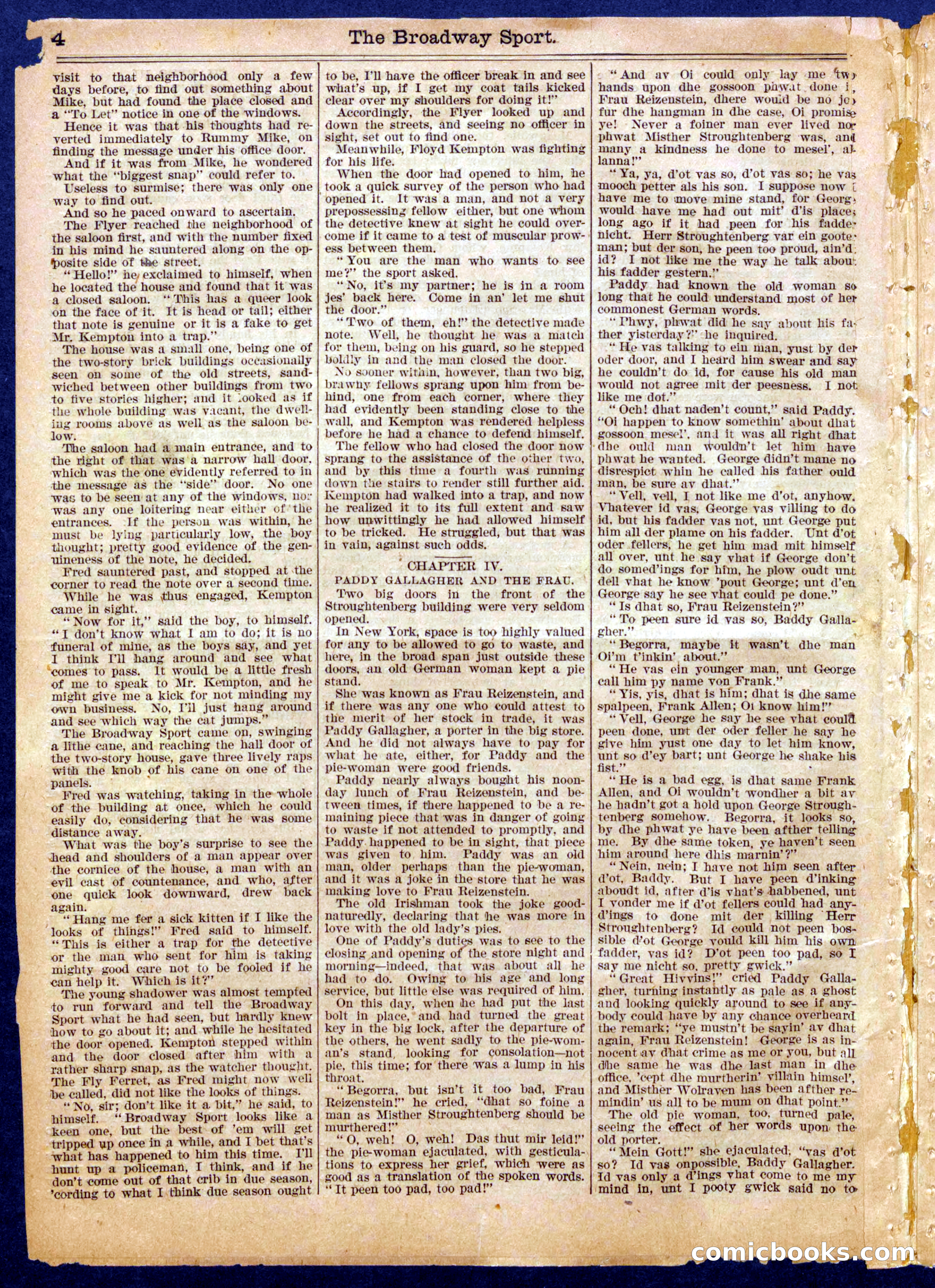
A restored page from Pulp Fiction, 1895. Page through the whole issue in the reader above.
📄 Transcribed text from this page (OCR, searchable)
Machine-transcribed from the original scan — historical spelling and the odd misread are preserved.
“4 S>- = fm : M a é - a 3 ~ alli — a - re ~¢ wae oP ——— Ber 2 - ieee “Ena 7 oe za ¢ a 2. _ ey - [2 — er a, ah himself. — keen one, but —— ‘ie 2 RI OS ea * we re % : > v ‘ 7 " iS '¥ ‘ - , se ‘ . sae ¢ d . : : . 4 é Se a y : : a : 4 ’ ~. Z ' 3 > fs . <} . duit : . oo “° visit to that neighborhood only a few days before, to find out something about Mike, but had found the place closed and a “To Let” notice in one of the windows. Hence it was that his thoughts had re- verted immediately to Rummy Mike, on finding the message under his office door. And if it was from Mike, he wondered what the “biggest snap” could refer to. Useless to surmise; there was only one way to find out. And so he paced onward to ascertain, The Flyer reached the neighborhood of the saloon first, and with the number fixed in his mind he sauntered along on the op- posite side of the street. “ Hello!’ he exclaimed to himself, when he located the house and found that it was a closed saloon. “ This has a queer look on the face of it. It is head or tail; either that note is genuine or it is a fake to get Mr. Kempton into a trap.” The house was 4 small one, being one of the two-story brick buildings occasionaily seen on some of the old streets, sand- wiched between other buildings from two to five stories higher; and it .ooked as if the whole building was vacant, the dwell- iug rooms above as well as the saloon be- low. . The saloon had a main entrance, and to the right of that was a narrow hall door, which was the one evidently referred to in the message as the “side” door. No one was to be seen at any of the windows, hor was any one loitering near either of the entrances. If the person was within, he must be lying particularly low, the boy thought; pretty good evidence of the gen- uineness of the note, he decided. ; Fred sauntered past, and stopped at the corner to read the note over a second time, While he was thus engaged, Kempton came in sight. “Now for it,’ said the boy, to himself. “T don’t know what I am to do; it is no funeral of mine, as the boys say, and yet I think I'll hang around and see what ~‘eomes to pass. It would be a little fresh of me to speak to Mr. Kempton, and he might give me a kick for not minding my own business. No, Ill just hang around and see which way the cat jumps.” The Broadway Sport came on, swinging a lithe cane, and reaching the hall door of the two-story house, gave three lively raps - with the knob of his cane on one of the panels. — Fred was watching, taking in the whole of the building at once, which he could easily do, considering that he was some distance away. | What was the boy’s surprise to see the shead and shoulders of a Man appear over the cornice of the house, a man with an -eyil cast of countenance, and who, after one quick look downward, drew back again. ; | ‘Hang me fer a sick kitten if I like the ‘looks of things!” Fred said to himself. “This is either a trap for the detective or the man who sent for him is taking mighty good care not to be fooled if he - ¢an help it. Which is it?’ | The young shadower was almost tempted to run forward and tell the Broadway Sport what he had seen, but hardly knew ‘how to go about it; and while he hesitated - the door opened. Kempton stepped within and the door closed after him with a - yather sharp snap, as the watcher thought. The Fly Ferret, as Fred might now well ‘be called, did not like the looks of things. _ -* No, sir; don’t like it a bit,” he said, to tripped up once in a while, and I be 's Sha has happened to him this time. I'll _ hunt up a policeman, I think, and if he don’t come out of that crib in due season, a ac rding to what I think due season ought ha “f oA oY ‘ ; * . its . - ® 7 iD i? Aik om: ss, 1) ‘eae Jy, es ‘ ri - SS. ‘ ct. - we? bh “gs . ake * vis py ye tall 44 Kas a . ‘ el % i rs ead 4 ~ ak ~é a OF ie r ° . wag Wag f \ 4 a6 + be - ar ") - ie ; 7 i at: ‘W ~ s - ie i "> . ~t at M4 2 et Ta : Cia ‘ Me > A ; | ‘flies ¢. ae at - < ei . VOuUPT es > J ~ ® we: d \ ~ < > oh Lae . ’ . , s ’ vi x 7 J Ma? Ss -* Te Chg Wray ad ‘ : - ta ~~ +4 f ’ ae we, vj ne i ee ee ee SP ER = NS ae eee Oe ‘“ Broadway Sport looks like a ~~” ad a, . - ~~ LL » « re a 4 Z m? P ¢ “= ° A me T é « ra SAT eh v. Se Pees Oe ok ae ih Sead & .* tu ut 1 x * - - 7 +487 . . «be wee Bh! She te Ve a ttt tah . The Broadway Sport. — to be, I'll have the officer break in and see what’s up, if I get my coat tails kicked clear over my shoulders for doing it!’ Accordingly, the Flyer looked up and down the streets, and seeing no officer in sight, set out to find one. Meanwhile, Floyd Kempton was fighting for his life. When the door had opened to him, he took a quick survey of the person who had opened it. It was a man, and not a very prepossessing fellow either, but one whom the detective knew at sight he could over- come if it came to a test of muscular prow- ess between them. “You are the man who wants to see me?’’ the sport asked. “No, its my partner; he is in a room jes’ back here. Come in an’ let me shut the door.” “Two of them, eh!’ the detective made note. Well, he thought he was a match for them, being on his guard, so he stepped boldly in and the man closed the door. No sooner within, however, than two big, brawhy fellows sprang upon him from be- hind, one from each corner, where they had evidently been standing close to the wall, and Kempton was rendered helpless before he had a chance to defend himself. The felow who had closed the door now sprang to the assistance of the other two, and by this time a fourth was running down the stairs to render still further aid. Ixempton had walked into a trap, and now he realized it to its full extent and saw how unwittingly he had allowed himself to be tricked. He struggled, but that was in vain, against such odds, CHAPTER IV. . PADDY GALLAGHER AND THE FRAU, — Two big doors in the front of the Stroughtenberg building were very seldom opened, In New York, space is too highly valued for any to be allowed to go to waste, and here, in the broad span just outside these doors, an old German woman kept a pie stand. She was known as Frau Reizenstein, and if there was any one who eould attest to the merit of her stock in trade, it was Paddy Gallagher, a porter in the big store. And he did not always have to pay for what he ate, either, for Paddy and the pie-woman were good friends. Paddy nearly always bought his noon- day lunch of Frau Reizenstein, and be- tween times, if there happened to be a re- maining piece that was in danger of going to waste if not attended to promptly, and Paddy. happened to be in sight, that piece was given to him. Paddy was an old man, older perhaps than the pie-woman, and it was a joke in the store that he was making love to Frau Reizenstein. ‘dhe ould - “And av Oi could only lay me tw» hands upon dhe gossoon phwat done i, Frau Reizenstein, dhere would be no je» fur dhe hangman in dhe case, Oi promise ye! Never a foiner man ever lived nor phwat Misther Stroughtenberg was, and many a kindness he done to mesel’, al- lanna!”’ : “Ya, ya, d’ot vas so, d’ot vas so; he vas mooch petter als his son. I suppose now { have me to move mine stand, for Georg: would haye me had out mit’ d’is place; long ago if it had peen for his fadde- nicht. Herr Stroughtenberg var ein goote: man; but der son, he peen too proud, ain’d; id? I not like me the way he talk abou: his fadder gestern.” Paddy had known the old woman so long that he could understand most of her commonest German words. “ Phwy, plwat did he say about his fa- ther yisterday?”’ -he inquired, | “ He vas talking to ein man, yust by der oder door, and I heard him swear and say he couldn’t do id, for cause his old man would not agree mit der peesness. I not like me dot.” 3 “Och! dhat naden’t count,” said Paddy. “Oi happen to know somethin’ about dhat gossoon mesel’, and it was all right dhat man wouldn’t let him have phwat he wanted. George didn’t mane no disrespict whin he called his father ould man, be sure ay dhat.”’ : * Vell, vell, I not like me d’ot, anyhow. Vhatever id yas, George yas villing to do id, but his fadder vas not, unt George put him all der plame on his fadder. Unt d’ot oder .fellers, he get him mad mit himself all over, unt he say yhat if George don’t do somed’ings for him, he plow oudt unt dell vhat he know ’pout George; unt d’en George say he see vhat could pe done.” “Is dhat so, Frau Reizenstein?”’ 4 To peen sure id yas so, Baddy Galla- gher.”’ wee * Begorra, maybe it wasn’t dhe man Oi’m tinkin’ about.’’ Rene. “He vas ein younger man, unt George call him py name von Frank.” “Vis, yis, dhat is him; dhat is dhe same spalpeen, Frank Allen; Oi know him!’ “Vell, George he say he see vhat coulf peen done, unt der oder feller he say he give him yust one day to let him know, wit so d’ey bart; unt George he shake his st.”’ ; ‘He is a bad egg, is dhat same Frank Allen, and Oi wouldn’t wondher a bit av he hadn’t got a hold upon George Strough- tenberg somehow. Begorra, it looks so, by dhe phwat ye have been afther telling me. By dhe same token, ye haven’t seen him around here dhis marnin’?” | “Nein, nein; I have not him seen after | dot, Baddy. But I have peen d’inking aboudt id, after d’is vhat’s habbened, unt The old Irishman took the joke good-| I vonder me if d’ot fellers could had any- naturedly, declaring that he was more in| d’ings to done mit der killing “Herr love with the old lady’s pies. One of Paddy’s duties was to see to the closing and opening of the store night and morning—indeed, that was about all he had to do. Owing to his age and long service, but little else was required of him, On this day, when he had put the last bolt in place,’ and. had turned the great key in the big lock, after the departure of | the remark; ‘ye mustn’t be say: again, Frau Reizenstein! George is asin- the others, he went sadly to the pie-wom- an’s stand, looking for consolation—not pie, this time; for there Was a lump in his throat. | ‘* Begorra, but isn’t it too bad, Frau Reizenstein!” he cried, “dhat so foine a man as Misther Stroughtenberg should be murthered!” ; “QO, weh! O, weh! Das thut mir leid!” the pie-woman ejaculated, with gesticula-. tions to express her grief, which were as|so? Id good as a translation of the spoken words. | Id vas only a « y x : ' im OO les | ‘ AS Se Stroughtenberg? Id could not peen bos- sible d’ot George yould kill him his own fadder, vas id? D’ot peen too pad, so I say me nicht so, pretty gwick.” «| “Great Hivvins!” cried Paddy Galla- cher, turning instantly 4s pale as a ghost and looking quickly around to see if any- body could have by any chance overheard pach av dhat ~ nocent ay dhat crime as me or you, but all dhe same he was dhe last man in dhe office, *cept dhe murtherin’ villain himsel’, and Misther Wolrayen has been afther re~ | mindin’ us all to be mum on dhat point.” The old pie woman, too, turned pale, | seeing the effect of her words upon, the old porter. weve ae a ‘Mein Gott!” she ejaculated, “vas d’ot on ossible, Baddy Gallag ings vhat come to me .. 9 : ‘ wa ; : sd re Wey »% A t / J ‘Tt peen too pad, too pad! ‘mind in, unt I pooty gwick said no tow os . my Xr NG t - ; * ; wt GN y “ fi : vi) fi . ' Ng Me ? » 4 ‘ » 5 y~ 2 2 ‘ : : 7 : - kan - —- Sify , > ~ 4 = > 2 < nhs 5 m , he M ‘ s Fg th Md /*. a2 ° 5 r E ; » 2. ‘ 7 y Bw 7 . ’ _*, ‘ a , nll i Ps ry an r ~ _* . F ~ s a, 4 j : ’ <7. f * | — +3) F » - ia ad ‘ i it, i , > { ‘ ye . a L\ . 7 5 . $ ih pe wt mney. a