
Pulp Fiction, 1895 · page 3 of 16
Beadle's Half Dime Library No. 960 — page 3: what you’re looking at
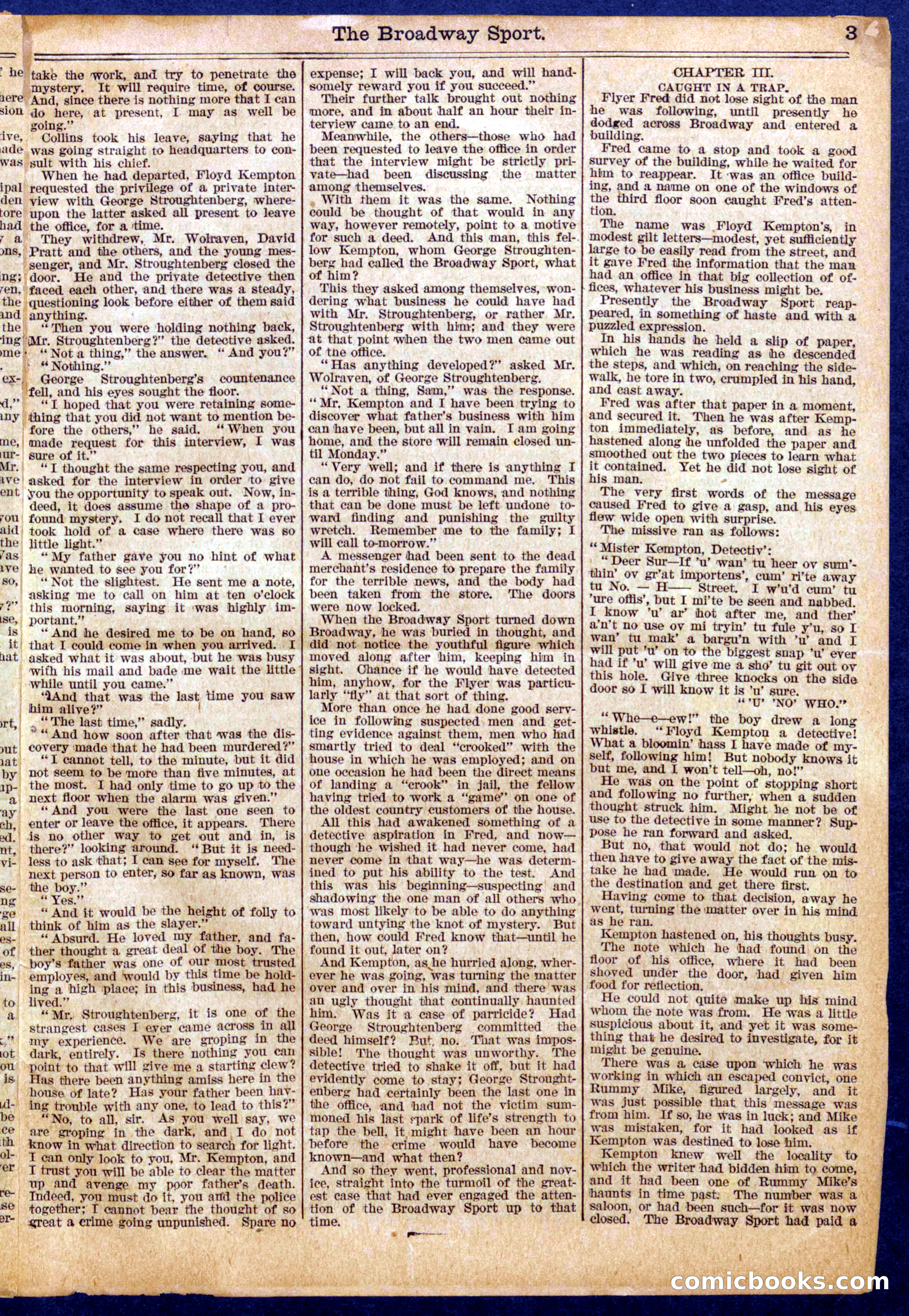
A restored page from Pulp Fiction, 1895. Page through the whole issue in the reader above.
📄 Transcribed text from this page (OCR, searchable)
Machine-transcribed from the original scan — historical spelling and the odd misread are preserved.
—~ —— *s - he take the work, and try to penetrate the mystery. It will require time, of course. ere And, since there is nothing more that I can sion do here, at present, I may as well be going.” Collins took his leave, saying that he was going straight to headquarters to con- sult with his chief. When he had departed, Floyd Kempton requested the privilege of a private inter- view with George Stroughtenberg, where- upon the latter asked all present to leave the office, for a ‘time. They withdrew, Mr. Wolrayen, David Pratt and the others, and the young mes- senger, and Mr. Stroughtenberg closed the ng;' door. He and the private detective then ren,’ faced. each other, and there was a steady, the questioning look before either of them said und anything. , the. ‘Phen you were holding nothing back, ing’ (Mr. Stroughtenberg?” the detective asked. ive, ade was ipal den tore had ae ons, me ‘ Nota thing,’ the answer. “ And you?” * Nothing.” ex-| George Stroughtenberg’s countenance fell, and his eyes sought the floor. ‘‘T hoped that you were retaining some- thing that you did not want to mention be- fore the others,” he said. “*‘ When you made request for this interview, I was sure of it.” Mr. “T thought the same respecting you, and ive’ asked for the interview in order ‘to give ent you the opportunity to speak out. Now, in- deed, it does assume the shape of a pro- found mystery. I do not recall that I ever took hold of a case where there was so little light.” “My father gave you no hint of what he wanted to see you for?” ‘‘Not the slightest. He sent me a note, asking me to call on him at ten o’clock this morning, saying it ‘was highly im- portant.” is ‘And he desired me to be on hand, so it that I could come in when you arrived. I asked what it was about, but he was busy with his mail and bade me wait the little while until you came.” ‘4And that was the last time you saw him alive?’ _ “The last time,’’ sadly, ““ And how soon after that was the dis- covery ‘made that he had been murdered?” “IT cannot tell, to the minute, but it did by not seem to be more than five minutes, at ip-. the most. I had only time to go up to the a next floor when the alarm was given.” “And you were the last one seen to eas ny me, ur- yOu aid the yas ive SO, Ae rt yut ay ch, enter or leave the office, it appears. There al, is no other way to get out and in, is there?’ looking around. ‘* But it is need- less to ask that; I cam see for myself. The next person to enter, So far as known, was nt, vi- se- the boy.” ng * Yes.”’ Ze “ And it would be the height of folly to all think of him as the slayer.” eS- ‘‘ Absurd. He loved my father, and fa- of ther thought a great deal of the boy. The es, _boy’s father was one of our most trusted employes, and would by this time be hold- ing a high ‘place; in this business, had he to lived.’ ) a “Mr, Stroughtenberg, it is one of the strangest cases T ever came across in all ¢ my experience. We are groping in the ot dark, entirely. Is there nothing you can ou point to that will give me a starting clew? is| Has there been anything amiss here in the house of late? Has your father been hav- “l- ing trouble with any one, to lead to this?” be “No, to all, sir. As you well say, we ce are groping in the dark, and I do not th know in what direction to search for light. ol- T can only look to you, Mr. Kempton, and er T trust you will be able to clear the matter up and avenge my poor father’s death. fe Tndeed, you must do it, you ard the police ni together; T cannot bear the thought of so great a erime going unpunished. Spare no The Broadway Sport. expense; I will back you, and will hand- somely reward you if you succeed.” Their further talk brought out nothing more, and in about half an hour their in- terview came to an end. Meanwhile, the others—those who had been requested to leave the office in order that the interview might be strictly pri- vate—had been discussing the matter among themselves. With them it was the same. Nothing could be thought of that would in any way, however remotely, point to a motive for such a deed. And this man, this fel- low Kempton, whom George Stroughten- berg had ealled the Broadway Sport, what of him? This they asked among themselves, won- dering what business he could have had with Mr. Stroughtenberg, or rather Mr. Stroughtenberg with him; and they were at that point when the two men came out Of the office. “Has anything developed?” asked Mr. Wolraven, of George Stroughtenberg. “Not a thing, Sam,’ was the response. ‘*Mr, Kempton and I have been trying to discover what father’s business with him can ‘have been, but all in vain. I am going home, and the store will remain closed un- til Monday.” “Very well; and if there is anything I can do, do not fail to command me. This is a terrible thing, God knows, and nothing that can be done must be left undone to- ward finding and punishing the guilty wretch. Remember me to the family; I will call to-morrow.” A messenger had been sent to the dead merchant’s residence to prepare the family for the terrible news, and the body had been taken from the store. The doors were now locked. When the Broadway Sport turned down Broadway, he was buried in thought, and did not notice the youthful figwre which moved along after him, keeping him in sight. Chance if he would have detected him, anyhow, for the Flyer was particu- larly “‘fly’’ at that sort of thing. More than once he had done good serv- ice in following suspected. men and get- ting evidence against them, men who had smartly tried to deal “crooked” with the house in which he was employed; and on one occasion he had been the direct means of landing a “erook” in jail, the fellow having tried to work a “game” on one of the oldest country customers of the house. All this had awakened something of a detective aspiration in Fred, and now— though ‘he wished it had never come, had never come in that way—he was determ- ined to put his ability to the test. And this was his beginning—suspecting and shadowing the one man of all others who was most likely to be able to do anything toward untying the knot of mystery. But then, how could Fred know that—until he found it out, later on? And Kempton, ashe hurried along, wher- ever he was going, was turning the matter over and over in his mind, and there was an ugly thought that continually haunted him. Was it a ease of parricide? Had George Stroughtenberg committed the deed himself? But, no. That was impos- sible! The thought was unworthy. The detective tried to shake it off, but it had evidently come to stay; George Strought- enberg had certainly been the last one in the office, and had not the victim sum- moned his last spark of life’s strength to tap the bell, it. might have been an hour before the crime would have become known—and what then? And so they went, professional and noy- ice, straight into the turmoil of the great- est case that had ever engaged the atten- tion of the Broadway Sport up to that time. CHAPTER ITI. CAUGHT IN A TRAP, Flyer Fred did not lose sight of the man he was following, until presently he dodged across Broadway and entered a building. Fred came to a stop and took a good survey of the building, while he waited for him to reappear. It was an office build- ing, and a name on one of the windows of ro third floor soon caught Fred’s atten- on. The name was Floyd Kempton’s, in modest gilt letters—modest, yet sufficiently large to be easily read from the street, and it gave Fred the information that the man had an office in that big collection of of- fices, whatever his business might be. Presently the Broadway Sport reap- peared, in something of haste and with a puzzled expression. In his hands he held a slip of paper, which he was reading as he descended the steps, and which, on reaching the side- walk, he tore in two, crumpled in his hand, and cast away. Fred was after that paper in a moment, and secured it. Then he was after Kemp- ton immediately, as before, and as he hastened along he unfolded the paper and smoothed out the two pieces to learn what it contained. Yet he did not lose sight of his man. The very first words of the message caused Fred to give a gasp, and his eyes flew wide open with surprise. The missive ran as follows: “Mister Kempton, Detectiv’: “ Deer Sur—If ’u’ wan’ tu heer oy sum’- thin’ ov gr’at importens’, cum’ ri’te away tu No. — H— Street. I w'u’d cum’ tu ‘ure offis’, but I mi’te be seen and nabbed. t know ’u’ ar’ hot after me, and ther’ a'n’t no use ov mi tryin’ tu fule yu, sol wan’ tu mak’ a bargu’n with ’u’ and I will put *u’ on to the biggest snap ’u’ ever had if ’u’ will give me a sho’ tu git out ov this hole. Give three knocks on the side door so I will know it is ’u’ sure. “"0? '"NO’ WHO.” ‘“ Whe—e—ew!” the boy drew a long whistle. ‘Floyd Kempton a detective! What a bloomin’ hass I have made of my- self, following him! But nobody knows it but me, and L won’t tell—oh, no!” He was on the point of stopping short and following no further, when a sudden thought struck him. Might he not be of use to the detective in some manner? Sup- pose he ran forward and asked, But no, that would not do; he would then have to give away the fact of the mis- take he had ‘made. He would run on to the destination and get there first. Having come to that decision, away he went, turning the matter over in his mind as he ran. Kempton hastened on, his thoughts busy. The note which he had found on the floor of his office, where it had been shoved under the door, had given him food for reflection, He could not quite make up his mind whom the note was from. He was a little suspicious about it, and yet it was some- thing that he desired to investigate, for it might be genuine. There was a case upon ‘which he was working in which an escaped convict, one Rummy Mike, figured largely, and it was just possible that this message was from him. If so, he was in luck; and Mike was mistaken, for it had looked as if Kempton was destined to lose him. Kempton knew well the locality to which the writer had bidden him to come, and it had been one of Rummy Mike’s haunts in time past) The number was a saloon, or had been such—for it was now closed, The Broadway Sport had paid a : comicbooks C cor