
Pulp Fiction, 1895 · page 5 of 16
Beadle's Half Dime Library No. 960 — page 5: what you’re looking at
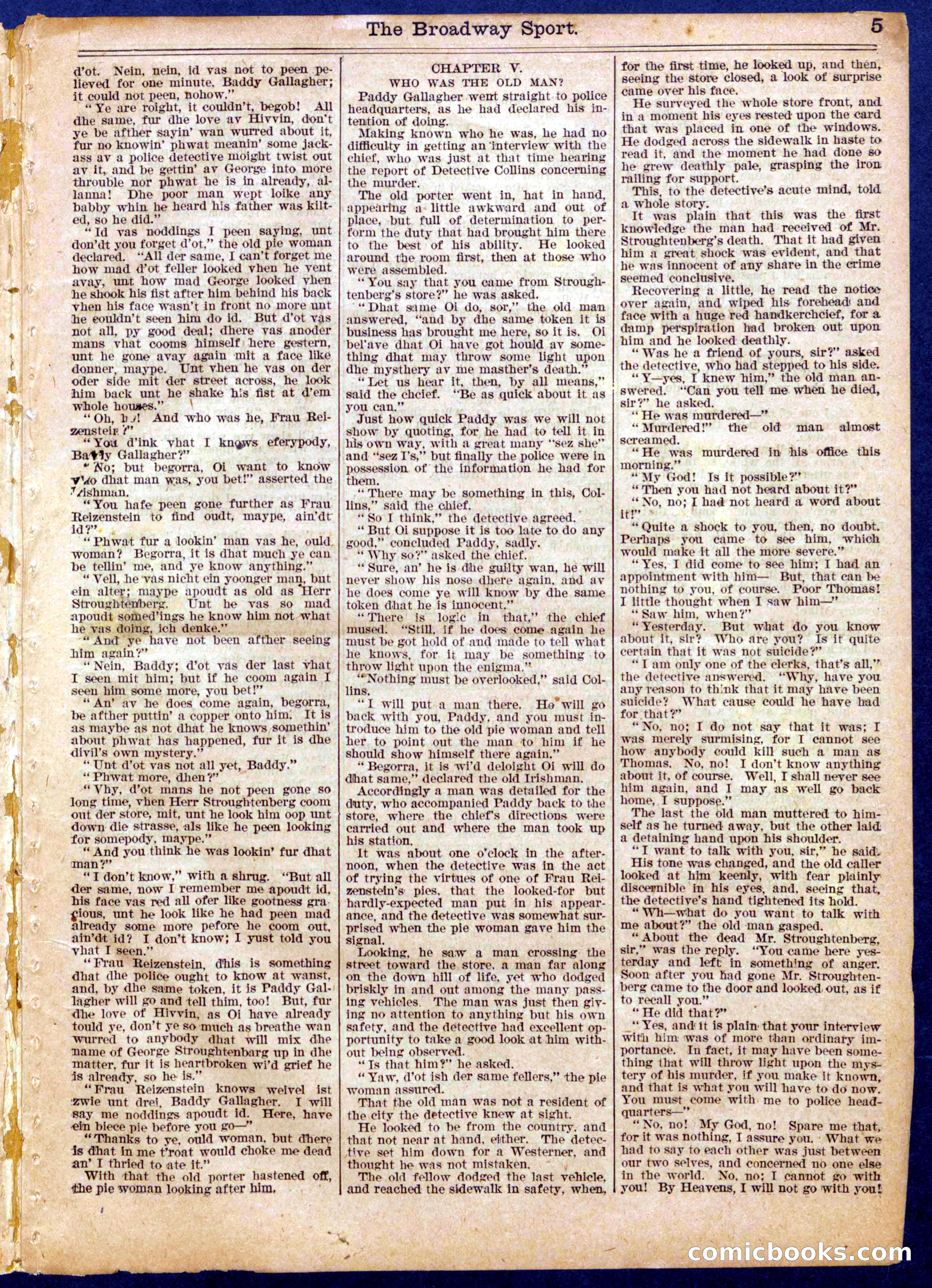
A restored page from Pulp Fiction, 1895. Page through the whole issue in the reader above.
📄 Transcribed text from this page (OCR, searchable)
Machine-transcribed from the original scan — historical spelling and the odd misread are preserved.
wane * f The Broadway Sport. _ _, _ . : . ° . - we : ’ . - cd 7 ° . ; - - - dot. Nein, nein, id vas not to peen pe- lieved for one minute, Baddy Gallagher; it could not peen, nohow,” “Ye are roight, it couldn’t, begob! All dhe same, fur dhe love av Hivvin, don't ye be afther sayin’ wan wurred about it, fur no knowin’ phwat meanin’ some jack- ass av a police detective moight twist out av it, and be gettin’ av George into more throuble nor phwat he is in already, al- lanna! Dhe poor man wept loike any babby whin he heard his father was kilt- ed, so he did.” “Td vas noddings I peen saying, unt don’dt you forget d’ot,” the old pie woman ~ declared. “All der same, I can’t forget me how mad d’ot feller looked vhen he vent avay, unt how mad George looked yhen he shook his fist after him behind his back vhen his face wasn’t in front no more unt he eouldn’t seen him do id, But d’ot vas not all, py good deal; dhere yas anoder mans vhat cooms himself here gestern, unt he gone avay again mit a face like donner, maype. Unt vhen he yas on der oder side mit der street across, he look him back unt he shake his fist at d’em whole houses.” ' “Oh, bs! And who was he, Frau Rei- zensteir 2’ “You d’ink vhat I knows eferypody, Batty Gallagher?’ “No; but begorra, Oi want to know vido dhat man was, you bet!” asserted the 7 Zishman. You hafe peen gone further as Frau Reizenstein to find oudt, maype, ain’dt id?’ . | “ Phwat fur a lookin’ man yas he, ould. woman? Begorra, it is dhat much ye can be tellin’ me, and ye know anything.” * Vell, he ‘vas nicht ein yoonger man, but ein alter; maype apoudt as old as Herr Stroughtemberg, Unt he vas so mad apoudt somed’ings he know him not what he vas doing, ich denke.” =. i sts gon Amdt ye have not been afther seeing him again?’ “Nein, Baddy; d’ot vas der last vhat I seen mit him; but if he coom again I seen him some more, you bet!’ * An’ av he does come again, begorra, be afther puttin’ a copper onto him, It is as Maybe as not dhat he knows somethin’ about phwat has happened, fur it is dhe divil’s own mystery.” “Unt d’ot vas not all yet, Baddy.” “Phwat more, dhen?” “Vhy, d’ot mans he not peen gone so long time, vhen Herr Stroughtenberg coom out der store, mit, unt he look him oop unt down die strasse, als like he peen looking for somepody, maype.” And you think he was lookin’ fur dhat ' man?” “T don’t know,” with a shrug. “But all der same, now I remember me apoudt id, his face vas red all ofer like gootness gra. gious, unt he look like he had peen mad already some more pefore he coom out, ain’dt id? I don’t know; I yust told you vhat T seen,” “Frau Reizenstein, dhis is something dhat dhe police ought to know at wanst, and, by dhe same token, it is Paddy Gal-: lagher will go and tell thim, too! But, fur dhe love of Hivvin, as Oi have already tould ye, don’t ye so much as breathe wan wurred to anybody dhat will mix dhe name of George Stroughtenbarg up in dhe matter, fur it is heartbroken wi'd grief he ds already, so he is.” “Frau Reizenstein knows weivel ist ‘zwie unt drei, Baddy Gallagher. I will Say me noddings apoudt id. Here, have “4 mused. CHAPTER V. WHO WAS THE OLD MAN? Paddy Gallagher went straight to police headquarters, as he had declared his in- tention of doing. Making known who he was, he had no difficulty in getting an ‘interview with the chief, who was just at that time hearing the report of Detective Collins concerning the murder. The old porter went in, hat in hand, appearing alittle awkward and out of place, but full of determination to per- form the duty that had brought him there to the best of his ability. He looked around the room first, then at those who were assembled. “You say that you came from Strough- tenberg’s store?” he was asked. *Dhat same Oi do, sor,’ the old man answered, “and by dhe same token it is business has brought me here, soitis. Oi bel'ave dhat Oi have got hould avy some- thing dhat may throw some light upon dhe mysthery av me masther’s death.” “Let us hear it, then, by all means,” ! said the chcief. you can.” Just how quick Paddy was we will not show by quoting, for he had to tell it in his own Way, with a great many “sez she” and ‘sez I’s,’’ but finally the police were in possession. of the information he had for them. “There may be something in this, Col- lins,” said the chief, ‘So I think,” the detective agreed. “But Oi suppose it is too late to do any good,” concluded Paddy, sadly. “Why so?” asked the chief. ‘Sure, an’ he is dhe guilty wan, he will never show his nose dhere again, and av he does come ye will know by dhe same token dhat he is innocent.” “There is logic in that,’ the chief “Still, if he does come again he must be got hold of and made to tell what he knows, for it may be something to throw light upon the enigma.” ‘i ‘““Nothing must be overlooked,” said Col- ns, “T will put a man there. He’ will go back with you, Paddy, and you must in- “Be as quick about it as troduce him to the old pie woman and tell - her to point out the man to him if he should show himself there again.” “ Begorra, it is wi'd deloight Oi will do dhat same,” declared the old Irishman. Accordingly a man was detailed for the duty, who accompanied Paddy back to the store, where the chief's directions were carried out and where the man took up his station, It was about one o’clock in the after- noon, when the detective was in the act of trying the virtues of one of Frau Rei- zenstein’s' pies, that the looked-for but hardly-expected man put in his appear- ance, and the detective was somewhat sur- prised when the pie woman gave him the signal. ; street toward the store, a man far along on the down hill of life, yet who dodged briskly in and out among the many pass- ing vehicles. The man was just then giy- ing no attention to anything but his own safety, and the detective had excellent op- portunity to take a good look at him with- out being observed. — “Ts that him?” he asked. “Yaw, d’ot ish der same fellers,” the pie woman assured. . That the old man was not a resident of the city the detective Knew at sight. Looking, he saw a man crossing the for the first time, he looked up, and then seeing the store closed, a look of surprise came over his face. He surveyed the whole store front, and in a moment his eyes rested upon the card that was placed in one of the windows. He dodged across the sidewalk in haste to read it, and the moment he had done 80 he grew deathly pale, grasping the iron railing for support. This, to the detective’s acute mind, told a Whole story. It was plain that this was the first knowledge the man had received of Mr. Stroughtenberg’s death. That it had given him a great shock was evident, and that he was innocent of any share in the crime seemed conclusive. : Recovering a little, he read the notice over again, and wiped his forehead and face with a huge red handkerchcief, for a damp perspiration had broken out upon him and he looked deathly. “Was he a friend of yours, sir?’ asked the detective, who had stepped to his side. “ Y—yes, I knew him,” the old man an- swered. “Can you tell me when he died, sir?” he asked. “He was murdered—” “Murdered!” the old man almost screamed. “He was murdered in his office this morning.” : “My God! Is it possible?’ “Then you had not heard about it?” ‘* No, no; I had not heard a word about pice» “Quite a shock to you, then, no doubt. Perhaps you came to see him, which would make it all the more severe.” “Yes, I did come to see him; I had an appointment with him— But, that can be nothing to you, of course. Poor Thomas! I little thought when I saw him—” ‘Saw him, when?” “Yesterday. But what do you know about it, sir? Who are you? Is it quite certain that it was not suicide?’ “Tam only one of the clerks, that’s all,” the detective answered. “Why, have you any reason to think that it may have been suicide? What cause could he have had for that?” “No, no; I do not say that it was; I Was merely surmising, for I cannot see how anybody could kill such a man as Thomas. No, no! I don’t know anything about it, of course. Well, I shall never see him again, and I may as well go back home, I suppose.” . | The last the old man muttered to him- self as he turned away, but the other laid a detaining hand upon his shoulder. “JT want to talk with you, sir,” he said. His tone was changed, and the old caller | looked at him keenly, with fear plainly discernible in his eyes, and, seeing that, the detective’s hand tightened its hold. “Wh—what do you want to talk : me about?” the old man gasped. sir,” was the reply. “You came here yes- terday and left in something of anger. Soon after you had gone Mr. Stroughten- berg came to the door and looked out, as if to recall you.” “ He did that?” | Yes, and it is plain that your interview and that is what you will have to do now. quarters—" on You must come with. me to police head-. With him was of more than ordinary im- a portance. In fact, it may have been some- — thing that will throw light upon the mys- | tery of his murder, if you make it known, — 4 “About the dead Mr. Stroughtenberg, , ‘ : si; od : v>s aa - He looked to be from the country, and x that not near at hand, either. The detec- itive set him down for a Westerner, and “No, no!) My God, no! Spare me that, | for it was hothing I assure you. « tren had to say to each other was just between | our two selves, and concerned no one else an_T thried to ate it.” thought he was not mistaken, ~ , | F in the world. No, no; I cannot go with = | ba With that the old porter hastened off, | The old fellow dodged the last vehicle, : ith _ the pie woman looking after him, ' | and reached the sidewalk in safety, when, | you! By Heavens, I will not go with yout — a - : . s 4 ; t . ; y , : = x : ST! “v5 ay 9 | a o 4 . ’ 4 - o, a ‘- J # + % 7 ; ‘ ar : : | f free Sat $5" 7) 4 ‘ . » My 5 " ae i-2 we “5 .* 1 4 - ‘ . “ " ‘ a “ ‘ P ‘ -*« * a ¢ A Prete. Lee - . MS ¢. iT - ' . % nd : > — lr, mew Oe > o ‘ ‘ a , ry Alte ao 2% + % a ? / Ps eo, . / 4 t . ‘ ‘ . ‘ ; * —..| ye ¥ os ~— Ne hat aE ee Fn a. . , he 5 9 bs ot ‘ rat Ys a! i i, ; : ; * ois : 3 te ed — as fy we Piaget ' ; ¢ 4 ge, ee | Be" ie « . ar. é > ," ee 4 4 . fh a LM SEE get a ote a | hav ia My xd a ORR ALO mata a ‘da Fa 4 +) J me 7 od fe a : s . ‘ , a’ _* ce Te ihn bes i¥« 4 : 4a 4 r. : . * a ¢* ; Atk Y F ye =} . ; es - — * ‘<2 : oe * ne tore iY ey te ‘,. >” , ¥ > & 4 ae bd - #3 09 hes on i; - Pe t. e\ g s ¥ . » -* oe 1. : ° » vy" : ~% my ws —. . * oe * .° r par +. a 'ft- in ; . * — . A, ae ee Vand yy +. «4 + = n ‘=~ _ ein biece pie before you go—” | 1» . “Thanks to ye, ould woman, but ae “ 4s dhat in me t’roat would choke me dea / ~ . / a4 Fi ¥ | at ee AE 1 dee? a le le ‘ @ . eee ; + = 4; — Ss * a . ae: . be} A ; A eal = a ¥ @ 7 oS be od Pas = . aes, Oe bo ie — - J Aged g% * f SV arate il