
Pulp Fiction, 1895 · page 2 of 16
Beadle's Half Dime Library No. 960 — page 2: what you’re looking at
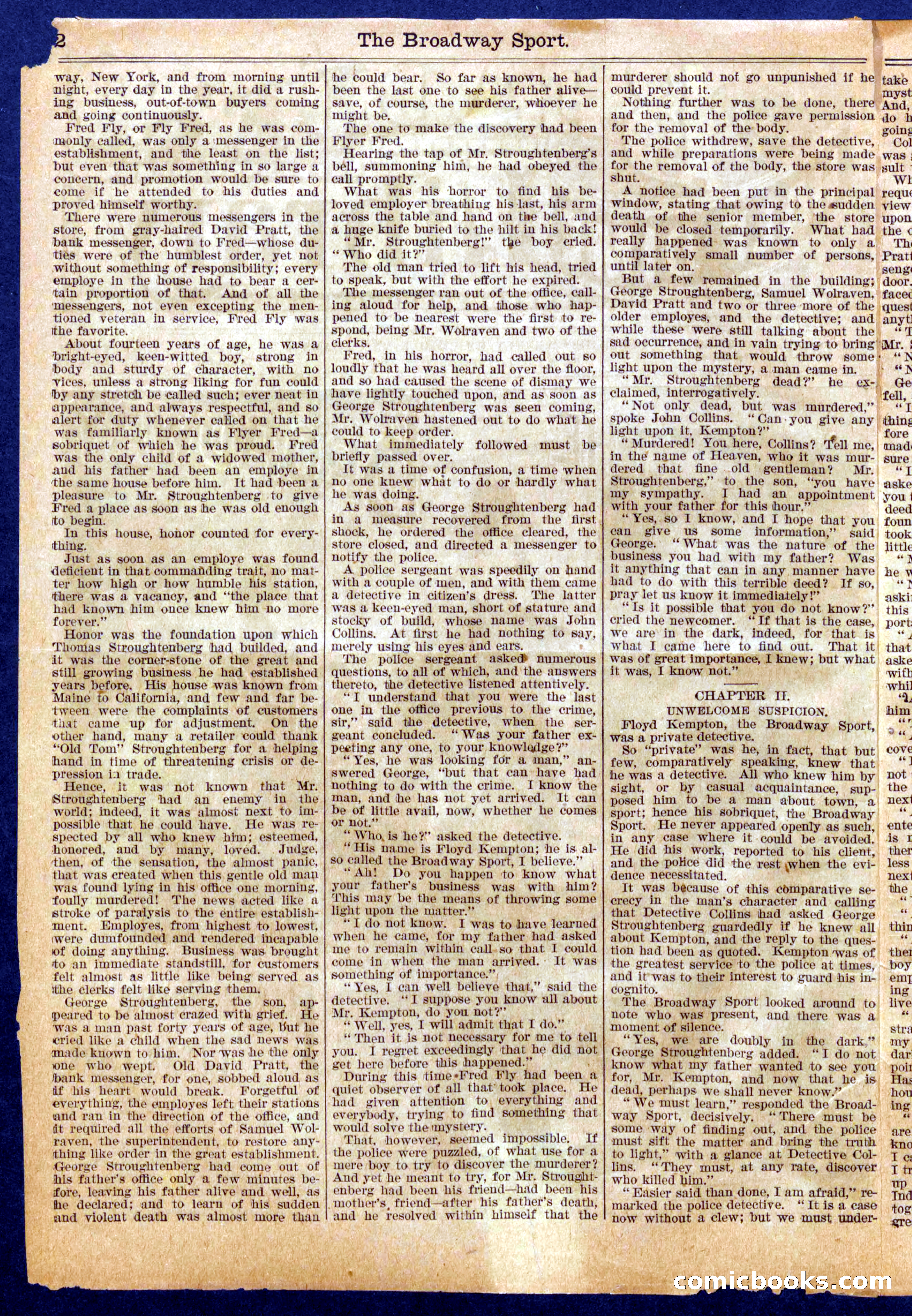
A restored page from Pulp Fiction, 1895. Page through the whole issue in the reader above.
📄 Transcribed text from this page (OCR, searchable)
Machine-transcribed from the original scan — historical spelling and the odd misread are preserved.
ee vente te fore, Maine to California, and few and far be- | possible that he could have. gpected by all way, New York, and from morning until night, every day in the year, it did a rush- ing business, out-of-town buyers coming and going continuously. Fred Fly, or Fly Fred, as he was com- monly called, was only a:messenger in the establishment, and the least on the list; but even that was something in so large a concern, and promotion would be sure to come if he attended to his duties and proved himself worthy. There were numerous messengers in the store, from gray-haired David Pratt, the bank messenger, down to 'red—whose du- ties were of the humblest order, yet not without something of responsibility; every ermploye in the house had to bear a cer- tain proportion of that. And of all the ‘Messengers, not even excepting the men- tioned veteran in service, Fred Fly was ithe favorite. About fourteen years of age, he was a ‘bright-eyed, keen-witted boy, strong in body and sturdy of character, with no vices, unless a strong liking for fun could ‘by any stretch be called such; ever neat in appearance, and always respectful, and so alert for duty whenever called on that he was familiarly known as Flyer Fred—a sobriquet of which he was proud. Fred was the only child of a widowed mother, aud his father had been an employe in the same house before him. It had been a pleasure to Mr. Stroughtenberg to give Fred a place as soon as he was old enough ito begin. In this house, honor counted for every- thing. — Just as soon as an employe was found deficient in that commanding orate no mat- ter how high or how humble his station, there was a vacancy, and “the place that had known him once knew him no more forever.” Honor was the foundation upon which - Thonias Stroughtenberg ‘had builded, and Pega: fy was the corner-stone of the great and still growing business he had established is house was known from tween were the complaints of customers that came up for adjustment. On the other hand, many a retailer could thank “Old Tom” Stroughtenberg for a helping hand in time of threatening canta de- pression ia trade. amen. it was not known that Nee. ghtenberg had an enemy in the world: indeed, it was almost next to im honered, and by many, loved. . Judge, then, of the denkation, the almost panic, By, that was ereated when ‘this gentle old man ment. ~ wwere dumfounded and rendered ineapable of doing anything. Business was brought 2) tto an immediate standstill, for customers if ‘ { « 7> Be aciete tla “ 2 ue van i a oe RL Le ige d ‘ieee a ee hey ay yr: ee i mAs hey Vaal es + RY i yt hia sh ay (f Sa ‘fond ToL a ’ OF, YAM tlt , : Nd 4 8% . ; _ tthe clerks felt like serving them, vi LF known his father’s o Be =, ba sine his "falthhes alive and. well, fhe ‘ed; and to learn of ‘his sudden |, 4 o BS G ¥ # ‘ ° ‘trig’ Pi a i ~ - ¥ | wo 4 ‘ f ir Fis Wey AF ta 7 ~ hy ' ‘pea 4 + TF ? fe vi dp, was found lying in his oftice one morning, -foully murdered! The news acted like a stroke of paralysis to the éntire establish- Employes, from highest to lowest, felt almost as little like being seryed as George Str oughtenberg, the son, ap- A tip to be almost crazed with grief. ‘He _ ‘Was a man past forty years of age, But he cried like a child when the sad news was to him. Nor was he the only who wept. Old David Pratt, the messenger, for one, sobbed aloud as if his heart. would break. Forgetful of Depaentine the employes left their stations is and ran in the direction of the office, and b vat required all the efforts of Samuel Wol- raven, the superintendent, to restore any- e thing like order in the great establishment. orge ce Cae had eome out of ya few . utes be- as my. ‘death was "abd parnie ae : geant concluded. nothing to do with the crime. He was re- who knew him; esteemed, 80 called the had —<e T “SER ME e The Broadway Sport. eee ee $$ — he could bear. So far as PRES, he had been the last one to see his father alive— save, of course, the murder er, whoever he might be. The one to make the discovery | had been Flyer Fred. Hearing the t béll, summoning him, tap of Mr. Stroughtenberg’s he had obeyed the call promptly. What was his horror to find his be- loved employer breathing his last, his arm across the table and hand on the bell, and a huge knife buried to the hilt in his back! “Mr. Stroughtenberg!” the boy cried. “Who did it?’ The old man tried to lift his head, tried to speak, but with the effort he expired. — The messenger ran out of the office, call- ing aloud for help, and those who hap- pened to be nearest were the first to re- da being Mr. Wolraven and two of the clerks. Fred, in his horror, had called out so loudly that he was heard all over the floor, and so had caused the scene of dismay we have lightly touched upon, and as soon as George Stroughtenberg was seen coming Mr. Wolraven hastened out to do what he could to keep order. What immediately followed must be briefly passed over. It was a time of confusion, a time when no one knew what to do or hardly what he was doing. As soon as George Stroughtenberg had in a measure recovered from the shock, he ordered the office cleared, the | store ‘closed, and directed a messenger to. notify the police, A police sergeant was speedily on hand with a couple of men, and with them came a detective in citizen’s dress. The latter was a keen-eyed man, short of stature and stocky of build, whose name was John Collins. At first he had nothing to say, merely using his eyes and ears. The police sergeant aske@ fumerous questions, to all of which, and the answers thereto, the detective listened attentively. “T understand that you were the last one in the office previous to the crime, sir,” said the detective, when the “Was your father ex- peeting any one, to your knowledge?” “Yes, he was looking for a man,” veri “but that can- have had. I know the swered George, man, and he has not yet arrived. It can be of little avail, now, whether he comes— or not.” “Who, is he?” asked the detective. “His name is Floyd Kempton; he is al- oadway Sport, I believe.” “Ah! Do you happen to know what your father’s business was with him? This may be the means of throwing btn light upon the matter.” “I do not know, I was ta Seva Wine when he came, for my father had asked me to remain within call.so that I could come in when the man arrived.: It was something of importance.”’, “Yes, 1 can well believe that, ” said the detective. ‘* 1 suppose you know all about Mr. Kempton, do you. not?” | “Well, yes, I will admit that T ao.” | “Then it is not necessary for me to tell you. I regret exceedingly that he did abe George get here before this happened.” During this timesFred Fly had been ‘al quiet observer of all that’ took — lace. given attention to. every g everybody, trying to find something that would solve the mystery. _. That, however, seemed impossible, If the police were puzzled, of what use for a mere boy to try to discover the murderer? And yet he meant to try, for Mr. Strought- enberg had been his friend—had been his mother's, friend—after his father’s death, '* first | ser-_ | know what my father and i ae td ‘resolved within himself that the ‘now saithot bs clew; Ree we discal under be wt * murderer should not go unpunished if bell ca could prevent it. yst Nothing further was to be done, thereny And, and then, and the police gave permission do h for the removal of the body. The police withdrew, save the detective, | and while preparations were being made going Gol was | for the removal of the Pony the store was. sult | shut. Wi A notice had been put in the principal requ window, stating that owing to the sudden yiew death of the senior member, would be closed temporarily. What had really happened’ was known to only a ‘the store upon the « Th comparatively — ‘small number of persons, Prat until later on, But a few eniAined in the building; George Stroughtenberg, Samuel Wolraven, Dayid Pratt and two or three more of the older employes, and the detective; and while these were still talking about the sen x door. facec quest sad occurrence, and in vain trying to bring!(Mr. | out something that would throw some + light upon the mystery, a man came in. “Mr. Stroughtenberg dead? claimed, interrogatively. “Not only dead, but was murdered.” spoke John Collins. “ Can-you give any light upon it, Kempton?’ “i Murdered! You here, Collins? Tell me, in the name of Heaven, who it was mur- dered that fine old gent eman ? Mr. | Stroughtenberg,’ to the son, “you have wil sympathy. i had an appointment. with your father for this hour,” _ “Yes,.so I know, and I hope that you. ean give us some information,” said George. “What was the nature of the } business you had with my father? Was it anything that can in any manner have had to do with this terrible deed? If so, pray let us know it immediately!” | “Is it possible that you do not know?” cried the newcomer. “If that is the case, we are in the dark, indeed, for that is what I came here to find out. That it | was of great eS Sigal but what it was, I know not.” sh buae i CHAPTER I. i UNWELCOMBE SUSPICION, Floyd Kempton, the Broadw Sport, a a private detective. — pe, 8 So “private” was he, in fact, that but few, comparatively speaking, knew that ‘he was a detective. All who knew him by sight, or by casual acquaintance, sup- | posed him to be a man about town, a sport; hence his sobriquet, the Broadway Sport. He never appeared openty. as gent, 7 in any case where it could be avoided. He did his work, reported to ‘his client, and the police did the rest when the evi- dence necessitated. It was because of this comparative se- -erecy in the man’s character and calling pe ae \ that Detective Collins had asked George | Stroughtenberg guardedly if he knew all about Kempton, and the reply to the ques-. tion had been ag quoted. Kempton was of. the greatest service to the police at times, » and it-was to thelr interest to suard his in- cognito. | The. Bromley Sport looked around to note who y a" and there was a | moment “Yes, w “are doubly in ‘the dark,” | enberg added. do not wanted to see you for, Mr. Kempton, and now that he is dea perhaps we shall never know.” e must learn,” responded the Broad- way Sport, decisively. - “There must be — some way of finding out, and the police must sift the mat a and bring the to light,” with a e at Detective lins. “They must, at any rate, ISCO who killed him.’ oa “ Hasier sai than done, Iam afraid * é ss marked t ce detective. “Itisa ARK , f NPR * i) S i" Vi, ny tee iy aa ty : ~ Khe c i) « . oll * ' {i . d ; ; the | AL Pat | ; Wins . By ; v [, 1 j yj t Wve yo . ; j (oy ‘ AP y le i vg Ws : 4 « 4 nt reat Al op Se niet { y , ‘a . ye . ye Tits WE aaa Mada He GN arb te uate ay in DW vileatd SANA a 2 IE TOs Jae ny cael Metagies CmPR IY a, at : " “ \ 4 ‘ wre 4 i » 4) y 7 by x f ~.--E€omicbooks.cor Re rte sor SS ee he ex-, thing fore mad sure sé I aske you 1 deed foun took little es } he ¥ sé I abkt: this port sé J that aske with whi ‘4, ‘er 66. bg cove at not the next sé ente is I ther ye ext the thin ther boy Yat ing live “ stra my dar Pa ho ing 4 eee