
Pulp Fiction, 1877 · page 6 of 16
Beadle's Half Dime Library, No. 9 — page 6: what you’re looking at
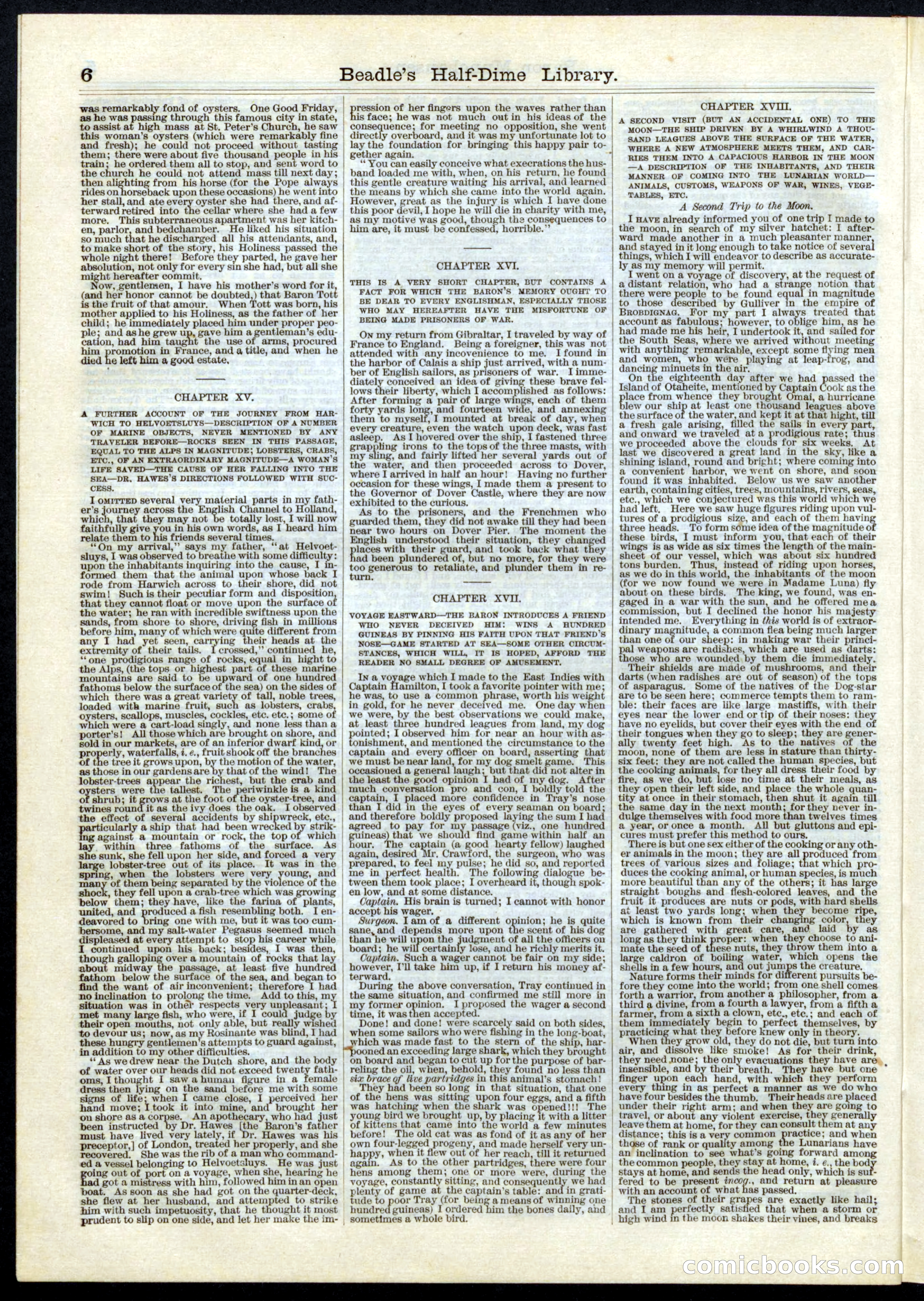
A restored page from Pulp Fiction, 1877. Page through the whole issue in the reader above.
📄 Transcribed text from this page (OCR, searchable)
Machine-transcribed from the original scan — historical spelling and the odd misread are preserved.
a . oo ae was pape By of oysters. One Good Friday, as he was pass through this famous city in state, | to assist at high mass at St. Peter’s Church, he saw | this woman’s oysters (which were remarkably fine | and fresh); he could not proceed without tasting them; there were about five thousand people in his ; he ordered them all to stop, and sent word to train the church he could not attend mass till next day; | then ee from his horse (for the Pope always rides on horseback upon these occasions) he went into her stall, and ate every oyster she had there, and af- terward retired into the cellar where she had a few more. This subterraneous apartment was her kitch- en, parlor, and bedchamber. He liked his situation so much that he discharged all his attendants, and, to make short of the story, his Holiness passed the whole night there! Before they parted, he gave her absolution, not only for every sin she had, but all she might hereafter commit. ow, gentlemen, I have his mother’s word for it (and her honor cannot be doubted,) that Baron Tott is the fruit of that amour. When Tott was born, his mother applied to his Holiness, as the father of her child; he immediately placed him under proper peo- ple; and as he grew up, gave him a gentleman's edu- cation, had him taught the use of arms, procured him promotion in France, and a title, and when he died he left him a good estate, CHAPTER XV. A FURTHER ACCOUNT OF THE JOURNEY FROM HAR- WICH TO HELVOETSLUYS—DESCRIPTION OF A NUMBER OF MARINE OBJECTS, NEVER MENTIONED BY ANY TRAVELER BEFORE—ROCKS SEEN IN THIS PASSAGE, EQUAL TO THE ALPS IN MAGNITUDE; LOBSTERS, CRABS, ETC., OF AN EXTRAORDINARY MAGNITUDE—A WOMAN'S LIFE SAVED—THE CAUSE OF HER FALLING INTO THE SEA—DR, HAWES’S DIRECTIONS FOLLOWED WITH SUC- CESS. I omITTED several very material parts in my fath- er’s journey across the English Channel to Holland, which, that they may not totally lost, I will now faithfully give you in his own words, as I heard him relate them to friends several times. “On my arrival,’’ says my father, “at Helvoet- sluys, I was observed to breathe with some difficulty: upon the inhabitants inquiring into the cause, I in- formed them that the animal upon whose back I rode from Harwich across to their shore, did not swim! Suchis their peculiar form and disposition that they cannot float or move upon the surface of the water; he ran with incredible swiftness upon the sands, from shore to shore, driving fish in millions before him, many of which were q te different from any I had yet seen, carrying their heads at the extremity of their tails. 1 crossed,” continued he, ‘one prodigious range of rocks, equal in hight to the Alps, (the tops or highest part of these marine mountains are said to be upward of one hundred fathoms below the surface of the sea) on the sides of which there was a great variety of tall, noble trees, loaded with marine fruit, such as lobsters, crabs oysters, scallops, muscles, cockles, etc. etc.; some of | which were a cart-load singly, and none less than a porter’s! All those which are brought on shore, and sold in our markets, are of an inferior dwarf kind, or properly, waterfalls, i. ¢., fruit shook off the branches of the tree it grows upon, by the motion of the water, as those in our gardens are by that of the wind! The lobster-trees eynear the richest, but the crab and oysters were the tallest. The periwinkle is a kind of shrub; it grows at the foot of the oyster-tree, and twines round it as the ivy does the oak. I observed the effect of several accidents by shipwreck, etc., cularly a ship that had been wrecked by strik- against a mountain or rock, the top of which STEER os — 6 Beadle’s Half-Dime Library. pees of her fingers upon the waves rather than | face; he was not much outin his ideas of the consequence; for meeting no opposition, she went directly overboard, and it was my unfortunate lot to lay the foundation for bringing this happy pair to- gether again. ‘You can easily conceive what execrations the hus- band loaded me with, when, on his return, he found this gentle creature waiting his arrival, and learned the means by which she came into the world again. However, great as the injury is which I have done this poor devil, I hope he will die in charity with me, as my motive was good, though the consequences to him are, it must be confessed, horrible.” CHAPTER XVI. THIS IS A VERY SHORT CHAPTER, BUT CONTAINS A FACT FOR WHICH THE BARON’S MEMORY OUGHT TO BE DEAR TO EVERY ENGLISHMAN, ESPECIALLY THOSE WHO MAY HEREAFTER HAVE THE MISFORTUNE OF BEING MADE PRISONERS OF WAR, On my return from Gibraltar, I traveled by way of France to England. Being a foreigner, this was not attended with any incovenience to me. I found in the harbor of Calais a ship just arrived, with a num- ber of English sailors, as prisoners of war. I imme- diately conceived an idea of giving these brave fel- lows their liberty, which I accomplished as follows: After forming a pair of large wings, each of them forty yards — and fourteen wide, and annexing them to myself, I mounted at break of day, when every creature, even the watch upon deck, was fast asleep. As I hovered over the ship, I fastened three grappling irons to the tops of the three masts, with my sling, and fairly lifted her several yards out of the water, and then proceeded across to Dover, where I arrived in half an hour! Having no further occasion for these wings, I made them a present to the Governor of Dover Castle, where they are now exhibited to the curious, As to the prisoners, and the Frenchmen who guarded them, they did not awake till they had been near two hours on Dover Pier. The moment the English understood their situation, they changed — with their guard, and took back what they ad been plundered of, but no more, for they were ee generous to retaliate, and plunder them in re- urn. CHAPTER XVII. VOYAGE EASTWARD—THE BARON INTRODUCES A FRIEND WHO NEVER DECEIVED HIM: WINS A HUNDRED GUINEAS BY PINNING HIS FAITH UPON THAT FRIEND'S NOSE—GAME STARTED AT SEA—SOME OTHER CIRCUM- STANCES, WHICH WILL, IT IS HOPED, AFFORD THE READER NO SMALL DEGREE OF AMUSEMENT. In a voyage which I made to the East Indies with Captain Hamilton, I took a favorite pointer with me; _ he was, to use a common phrase, worth bis weight lay within three fathoms of the surface. As_ she sunk, she fell upon her side, and forced a very e lobster-tree out of its place. It was in the ane. when the lobsters were very young, and many of them being separated by the violence of the shook, they fell upon a crab-tree which was growing below them; they have, like the farina of plants, united, and produced a fish resembling both. I en- deavored to bring one with me, but it was too cum- bersome, and my salt-water Pegasus seemed much displeased at every attempt to stop his career while I continued upon his back; besides, I was then, ae galloping over a mountain of rocks that lay about midway the passage, at least five hundred fathom below the surface of the sea, and began to find the want of air inconvenient; therefore I had no inclination to prolong the time, Add to this, my situation was in other respects very unpleasant; met many large fish, who were, if I could judge by their open mouths, not only able, but really hed to devour us; now, as my Rosinante was blind, I had these hungry gentlemen's attempts to guard against, in addition to my other difficulties. ‘* As we drew near the Dutch shore, and the body of water over our heads did not exceed twent, oms, I thought I saw a human figure in a female dress then lying on the sand before me with some of life; when I came close, I perceived her hand move; Tt took it into mine, and brought her on shore as a corpse. An apothecary, who had just been instructed by Dr. Hawes [the Baron’s father must have lived very lately, if Dr. Hawes was his preceptor,] of London, treated her properly, and she recovered, She was the rib of a man who command- ed a vessel belonging to Helvoetsluys. He was just ing out of port on a voyage, when she, hearing he fath- | tween _ my former opinion. got a mistress with him, followed him in an open | boat. As soon as she had got on the quarter-deck, she flew at her husband, and attempted to strike him with such impetuosity, that he thought it most prudent to slip on one side, and let her make the im- in gold, for he never deceived me. One day when we were, by the best observations we could make, at least three bundred leagues from land, my dog pointed; I observed him for near an hour with as- tonishment, and mentioned the circumstance to the captain and every officer on board, asserting that we must be near land, for my dog smelt game. This occasioned a general laugh; but that did not alter in the least the good opinion T had of my dog. After much conversation pro and con, I boldly told the captain, I placed more confidence in Tray’s nose than I did in the eyes of every seaman on board; and therefore boldly proposed laying the sum I had agreed to pay for my passage (viz., one hundred Naot nage that we should find game within half an our. The he (a good hearty fellow) laughed again, desired . Crawford, the surgeon, who was prepared, to feel my pulse; he did so, and reported me in perfect health. The following dialogue be- em took place; I overheard it, though spok- en low, and at some distance. Captain. His brain is turned; I cannot with honor accept his wager. Surgeon. lam of a different opinion; he is quite sane,and depends more upon the scent of his dog than he will "go the judgmeut of all the officers on board; he will certainly lose, and he richly merits it. Captain. Such a wager cannot be fair on my side; however, I'll take him up, if I return his money af- terward, During the above conversation, Tray continued in the same situation, and confirmed me still more in I proposed the wager a second time, it was then accepted. Done! and done! were scarcely said on both sides, when some sailors who were fishing in the long-boat, hich was made fast to the stern of the ship, har- ned an exceeding large shark, which they brought on board and began to cut up for the purpose of bar- reling the oil, when, behold, they found no less than six brace of live partridges in this animal's stomach! They had been so long in that situation, that one of the hens was sitting upon four eggs, and a fifth was hatching when the shark was opened!!! The young bird we brought up, by placing it with a litter of kittens that came into the world a few minutes before! The old cat was as fond of it as any of her own four-legged progeny, and made herself very un- happy, when it flew out of her reach, till it returned again. As to the other partridges, there were four hens among them; one or more were, during the voyage, constantly sitting, and consequently we had plenty of game at the captain’s table: and in grati- tude oor Tray (for being ameansof winning one hundred guineas) I ordered him the bones daily, and sometimes a whole bird. ec CHAPTER XVII. A SECOND VISIT (BUT AN ACCIDENTAL ONE) TO THE MOON—THE SHIP DRIVEN BY A WHIRLWIND A THOU- SAND LEAGUES ABOVE THE SURFACE OF THE WATER, WHERE A NEW ATMOSPHERE MEETS THEM, AND CAR- RIES THEM INTO A CAPACIOUS HARBOR IN THE MOON —A DESCRIPTION OF THE INHABITANTS, AND THEIR MANNER OF COMING INTO THE LUNARIAN WORLD— ANIMALS, CUSTOMS, WEAPONS OF WAR, WINES, VEGE- TABLES, ETC. A Second Trip to the Moon. I HAVE already informed you of one trip I made to the moon, in search of my silver hatchet: I after- ward made another in a much emines 2 abhi manner and stayed in it long enough to take notice of several things, which I will endeavor to describe as accurate- ly as my memory will permit. I went on a voyage of discovery, at the request of a distant relation, who had a weiter notion that there were people to be found equal in magnitude to those described by Gulliver in the empire of BroppiGNaGc. For my part I always treated that account as fabulous; however, to oblige him, as he had made me his heir, I undertook it, and sailed for the South Seas, where we arrived without meeting with anything remarkable, except some flying men and women, who were playing at leap-frog, and dancing minuets in the air. On the eighteenth day after we had passed the Island of Otaheite, mentioned by Captain Cook as the pace from whence they brought Omai, a hurricane lew our ship at least one thousand leagues above the surface of the water, and kept it at that hight, till a fresh gale arising, filled the sails in every part, and onward we traveled at a prodigious rate; thus we proceeded above the clouds for six weeks, At last we discovered a great land in the sky, like a shining island, round and bright; where coming into a convenient harbor, we went on shore, and soon found it was inhabited. Below us we saw another earth, containing cities, trees, mountains, rivers, seas, etc., which we conjectured was this world which we had left, Here we saw huge figures riding upon vul- tures of a prodigious slzp and each of them he | three hetda. To form some idea of the magnitude o these birds, I must inform you, that each of their wings is as wide as six times the length of the main- sheet of our vessel, which was about six hundred tons burden. Thus, instead of riding upon horses, as we do in this world, the inhabitants of the moon (for we now found we were in Madame Luna) fly about on these birds. The king, we found, was en- gaged in a war with the sun, and he offered mea commission, but I declined the honor his majesty intended me. Everything in this world is of extraor- dinary magnitude, a common flea being much larger than one of our oon: in making war their princi- pal weapons are radishes, which are used as darts: those who are wounded. by them die immediately. Their shields are made of mushrooms, and their darts (when radishes are out of season) of the tops of asparagus. Some of the natives of the Dog-star are to be seen here; commerce tempts them to ram- ble: their faces are like large mastiffs, with their eyes near the lower end or tip of their noses: they have no eyelids, but cover their eyes with the end of their tongues when they go to sleep; they are gener- ally twenty feet high. As to the natives of the moon, none of them are less in stature than thirty- six feet: they are not called the human species, but the cooking animals, for they all dress their food by fire, as we do, but lose no time at their meals, as they open their left side, and mace the whole quan- tity at once in their stomach, then shut it again till the same day in the next month; for they never in- dulge themselves with food more than twelves times a year, or once a month. All but gluttons and epi- cures must prefer this method to ours. There is but one sex either of the cooking or any oth- er animals in the moon; they are all produced from trees of various sizes and foliage; that which pro- duces the cooking animal, or human species, is much more beautiful than any of the others; it has i} straight boughs and flesh-colored leaves, and the fruit it produces are nuts or pods, with hard shells at least two yards long; when they become ripe, which is known from their ch color, they are gathered with great care, and laid by as long as they think proper: when they choose to ani- mate the seed of these nuts, they throw them into a large caldron of boiling water, which opens tke shells in a few hours, and out jumps the creature, Nature forms their minds for different pursuits be- fore they come into the world; from one shell comes forth a warrior, from another a philosopher, from a third a divine, from a fourth a lawyer, from a fifth a farmer, from a sixth a clown, etc., ete.; and each of them immediately begin to perfect themselves, by practicing what they before knew only in theory. When they grow old, they do not die, but turn into air, and dissolve like smoke! As for their drink, they need none i the onl insensible, and Aa reath. They have but one finger upon each hand, with which they perform every g in as perfect a manner as we do who have four besides the thumb, Their heads are placed under their right arm; and when they are going to travel, or about any violent exercise, they generally leave them at home, for they can consult them at any distance; this is a very common eens and when those of rank or quality among the Lunarians have an inclination to see what’s going forward among the common people, they stay at home, i. é., the bod stays at home, and sends the head only, which is suf- fered to be present incog., and return at pleasure with an account of what has passed. The stones of their grapes are exactly like hail; and I am perfectly satisfied that when a storm or _ high wind in the moon shakes their vines, and breaks S) Ehboo com (€@) evacuations they have are. , 3m