
Pulp Fiction, 1879 · page 9 of 16
Beadle's Half Dime Library, Vol. III, No. 78 — page 9: what you’re looking at
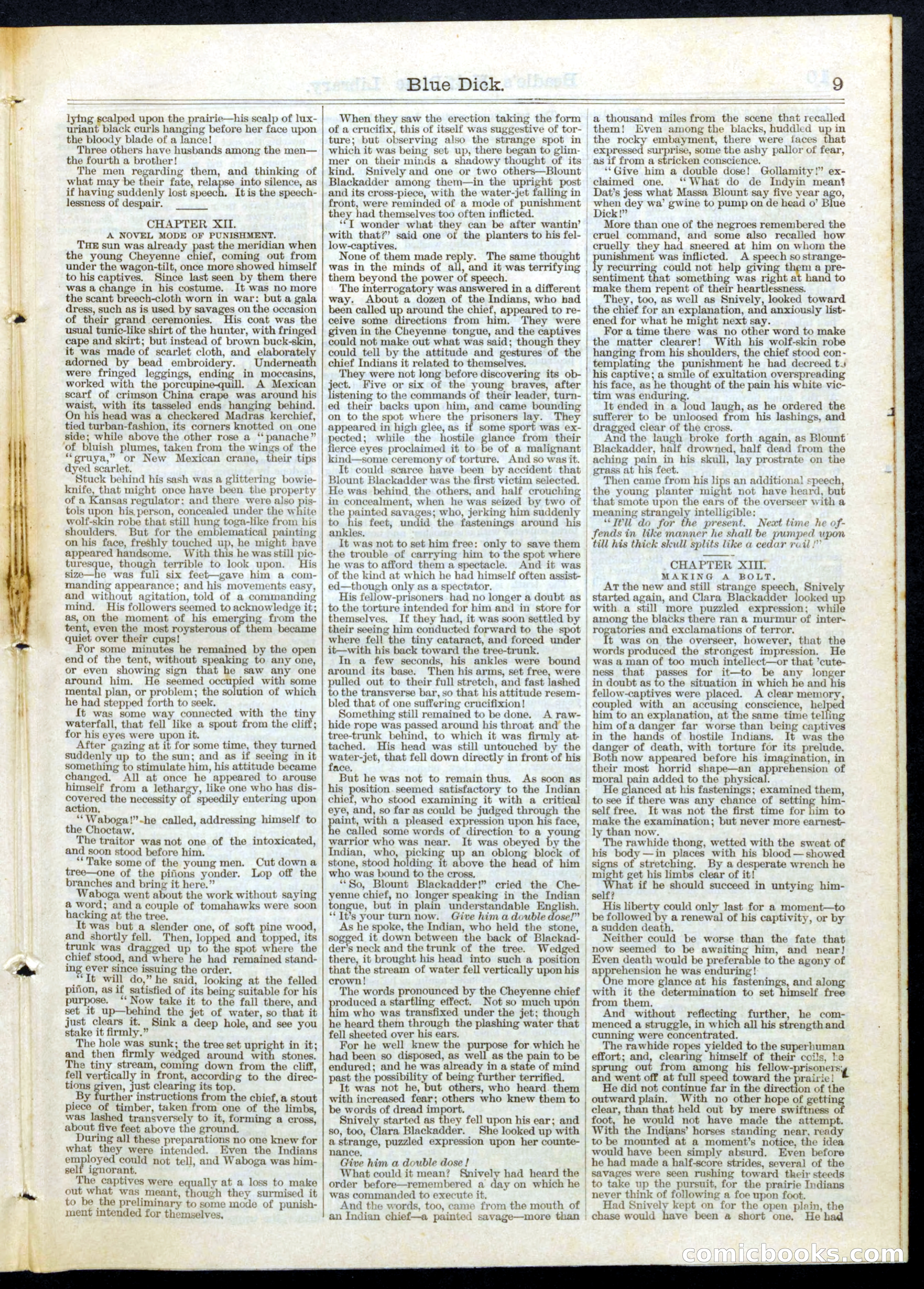
A restored page from Pulp Fiction, 1879. Page through the whole issue in the reader above.
📄 Transcribed text from this page (OCR, searchable)
Machine-transcribed from the original scan — historical spelling and the odd misread are preserved.
lying scalped upon the prairie—his scalp of lux- uriant black curls hanging before her face upon the bloody blade of a lance! Three others have husbands among the men— the fourth a brother! The men regarding them, and thinking of what may be their fate, relapse into silence, as if having suddenly lost speech. It is the speech- lessness of despair. CHAPTER XII. A NOVEL MODE OF PUNISHMENT. THE sun was already past the meridian when the young Cheyenne chief, coming out from under the wagon-tilt, once more showed himself to his captives. Since last seen by them there was a change in his costume. It was no more the scant breech-cloth worn in war: but a gala dress, such as is used by savages on the occasion of their grand ceremonies. His coat was the usual tunic-like shirt of the hunter, with fringed cape and skirt; but instead of brown buck-skin, it was made of scarlet cloth, and elaboratel adorned by bead embroidery. Underneat were fringed leggings, ending in moccasins, worked with the porcupine-quill. A Mexican scarf of crimson China crape was around his waist, with its tasseled ends hanging behind. On his head was a checkered Madras kerchief, tied turban-fashion, its corners knotted on one side; while above the other rose a ‘‘ panache” of bluish plumes, taken from the wings of the ““gruya,” or New Mexican crane, their tips dyed scarlet. Stuck behind his sash was a glittering bowie- knife, that might once have been the property of a Kansas regulator: and there were also pis- tols upon his, person, concealed under the white wolf-skin robe that still hung toga-like from his shoulders. But for the emblematical painting on his face, freshly touched up, he might have appeared handsome. With this he was still pic- a ot though terrible to look upon. His size—he was fuli six feet—gave him a com- manding appearance; and his movements easy, and without agitation, told of a commanding mind. His followers seemed to acknowledge it; as, on the moment of his emerging from the tent, even the most roysterous of them became quiet over their cups! For some minutes he remained by the open end of the tent, without speaking to any one, or even showing sign that he saw any one around him. He seemed occupied with some mental plan, or problem; the solution of which he had stepped forth to seek. {t was some way connected with the tiny waterfall, that fell like a spout from the cliff; for his eyes were upon it. After gazing at it for some time, they turned suddenly up to the sun; and as if seeing in it something to stimulate him, his attitude became changed. All at once he appeared to arouse himself from a lethargy, like one who has dis- covered the necessity of speedily entering upon action. ‘“Waboga!”-he called, addressing himself to the Choctaw. The traitor was not one of the intoxicated, and soon stood before him. ‘Take some of the young men. Cut downa tree—one of the pifions yonder. Lop off the branches and bring it here.” Waboga went about the work without saying a word; and a couple of tomahawks were soon hacking at the tree. It was but a slender one, of soft pine wood, and shortly fell. Then, lopped and topped, its trunk was dragged up to the spot where the chief stood, and where he had remained stand- ing ever since issuing the order. It will do,” he said, looking at the felled pifion, as if satisfied of its being suitable for his purpose. “‘ Now take it to the fall there, and set it up—behind the jet of water, so that it just clears it. Sink a deep hole, and see you stake it firmly.” The hole was sunk; the tree set upright in it; and then firmly wedged around with stones. The tiny stream, coming down from the cliff, fell vertically in front, according to the direc- tions given, just clearing its top. _By further instructions from the chief, a stout plece of timber, taken from one of the limbs, was lashed transversely to it, forming a cross, about five feet above the ground. During all these preparations no one knew for what they were intended. Even the Indians employed could not tell, and Waboga was him- self ignorant. The captives were equally at a loss to make out what was meant, though they surmised it to be the preliminary to some mode of punish- ment intended for themselves, Blue Dick. rr When they saw the erection taking the form of a crucifix, this of itself was suggestive of tor- ture; but observing also the strange spot in which it was being set up, there began to glim- mer on their minds a shadowy thought of its kind. Snively and one or two others—Blount Blackadder among them—in the upright post and its cross-piece, with the water-jet falling in front, were reminded of a mode of punishment they had themselves too often inflicted. ‘*T wonder what they can be after wantin’ with that?’ said one of the planters to his fel- low-captives. None of them made reply. The same thought — was in the minds of all, and it was terrifying , sentiment that something was right at hand to them beyond the power of speech. The interrogatory was answered in a different way. About a dozen of the Indians, who had been called up around the chief, appeared to re- ceive some Rivehtiunt from him. They were given in the Cheyenne tongue, and the captives could not make out what was said; though they could tell by the attitude and gestures of the chief Indians it related to themselves. They were not long before discovering its ob- eee Five or six of the young braves, after istening to the commands of their leader, turn- ed their backs upon him, and came bounding on to the spot where the prisoners lay. They appeared in high glee, as if some sport was ex- pected; while the hostile glance from their fierce eyes proclaimed it to be of a malignant kind—some ceremony of torture. And so was it. It could scarce have been by accident that Blount Blackadder was the first victim selected. He was behind. the others, and half crouching in concealment, when he was seized by two of the painted savages; who, jerking him suddenly to his feet, undid the fastenings around his ankles. It was not to set him free: only to save them the trouble of carrying him to the spot where he was to afford them a spectacle. And it was of the kind at which he had himself often assist- ed—though only as a spectator. His fellow-prisoners had no longer a doubt as to the torture intended for him and in store for themselves. If they had, it was soon settled by their seeing him conducted forward to the spot 9 —SESS_ a thousand miles from the scene that recalled them! Even among the blacks, huddled up in the rocky embayment, there were faces that expressed surprise, some the ashy pallor of fear, as if from a stricken conscience. ‘Give him a double dose! Gollamity!”’ ex- claimed one. ‘“‘ What do de Indyin meant Dat’s jess what Massa Blount say five vear ago, when dey wa’ gwine to pump on de head o’ Blue Dick!” More than one of the negroes remembered the cruel command, and some also recalled how cruelly they had sneered at him on whom the unishment was inflicted. <A speech so strange- y recurring could not help giving them a pre- make them repent of their heartlessness. They, too, as well as Snively, looked toward the chief for an explanation, and anxiously list- ened for what he might next say. For a time there was no other word to make the matter clearer! With his wolf-skin robe hanging from his shoulders, the chief stood con- templating the punishment he had decreed tw his captive; a smile of exultation overspreading his face, as he thought of the pain his white vic- tim was enduring. It ended in a loud laugh, as he ordered the sufferer to be unloosed from his lashings, and dragged clear of the cross. And the laugh broke forth again, as Blount Blackadder, half drowned, half dead from the aching pain in his skull, lay prostrate on the grass at his feet. Then came from his lips an additional! speech, the young planter might not have heard, but that smote upon the ears of the overseer with a meaning strangely intelligible: “Ttll do for the present. Next time he of- Sends in like manner he shall be pumped upon till his thick skull splits like a cedar rail!” CHAPTER XIII. MAKING A BOLT, AT the new and still strange speech, Snively started again, and Clara Slackaddee looked up with a still more puzzled expression; while among the blacks there ran a murmur of inter- where fell the tiny cataract, and forced under | it—with his back toward the tree-trunk. In a few seconds, his ankles were bound around its base. Then his arms, set free, were pulled out to their full stretch, and fast lashed to the transverse bar, so that his attitude resem- bled that of one suffering crucifixion! Something still remained to be done. A raw- hide rope was passed around his throat and the tree-trunk behind, to which it was firmly at- tached. His head was still untouched by the enerieh, that fell down directly in front of his ace, But he was not to remain thus. As soon as his position seemed satisfactory to the Indian chief, who stood examining it with a critical eye, and, so far as could be judged through the saint, with a pleased expression upon his face, e called some words of direction to a young warrior who was near. It was obeyed ce the Indian, who, 7 up an oblong block of stone, stood holding it above the head of him who was bound to the cross. ‘*So, Blount Blackadder!” cried the Che- yenne chief, no longer speaking in the Indian ‘* It’s your turn now. As he spoke, the Indian, who held the stone, sogged it down between the back of Blackad- der’s neck and the trunk of the tree. Wed there, it brought his head into such a position that the stream of water fell vertically upon his crown! The words pronounced by the Cheyenne chief produced a startling effect. Not so much upon him who was transfixed under the jet; though he heard them through the plashing water that fell sheeted over his ears. rogatories and exclamations of terror. It was on the overseer, however, that the words produced the strongest impression. He was a man of too much intellect—or that ’cute- ness that passes for it—to be any longer in doubt as to the situation in which he and his fellow-captives were placed. A clear memory, coupled with an accusing conscience, hel him to an explanation, at the same time telling him ofa danger far worse than being captives in the hands of hostile Indians. It was the danger of death, with torture for its prelude. Both now appeared before his imagination, in their most horrid shape—an “dla AGS nt of moral pain added to the physical. He P pooch at his fastenings; examined them, to see if there was any chance of setting him- self free. It was not the first time for him to make the examination; but never more earnest- ly than now. The rawhide thong, wetted with the sweat of his body —in places with his blood — showed signs of stretching. By a desperate wrench he might get his limbs clear of it! at if he should succeed in untying him- self? tongue, but in plain understandable English. | Give him a double dose!” — For he well knew the purpose for which he | had been so disposed, as well as the pain to be endured; and he was already in a state of mind past the possibility of being further terrified. It was not he, but others, who heard them with increased fear; others who knew them to be words of dread import. Snively started as they fell upon his ear; and so, too, Clara Blackadder. She looked up with His liberty could only last for a moment—to be followed by a renewal of his captivity, or by a sudden death. Neither could be worse than the fate that now seemed to be awaiting him, and near! Even death would be preferable to the agony of Be eran: he was enduring! ne more glance at his fastenings, and along with it the determination to set himself free from them. And without reflecting further, he com- _menced a struggle, in which all his strength and cunning were concentrated. The rawhide ropes yielded to the superhuman effort; and, clearing himself of their coils, he a strange, puzzled expression upon her counte- | nance, Give him a double dose ! What could it mean? Snively had heard the order before—remembered a day on which he was commanded to execute it. And the words, too, came from the mouth of an Indian chief—a painted savage—more than ' / sprung out from among his fellow-prisoners; and went off at full speed toward the prairie! He did not continue far in the direction of the outward plain. With no other hope of gettin clear, than that held out by mere swiftness o foot, he would not have made the attempt. With the Indians’ horses standing near, ready to be mounted at a moment’s notice, the idea would have been simply absurd. Even before he had made a half-score strides, several of the savages were seen rushing toward their steeds to take up the pursuit, for the prairie Indians never think of following a foe upon foot. Had Snively kept on for the open plain, the chase would have been a short one. He had COMIMEIOO Ss com