
Pulp Fiction, 1879 · page 8 of 16
Beadle's Half Dime Library, Vol. III, No. 78 — page 8: what you’re looking at
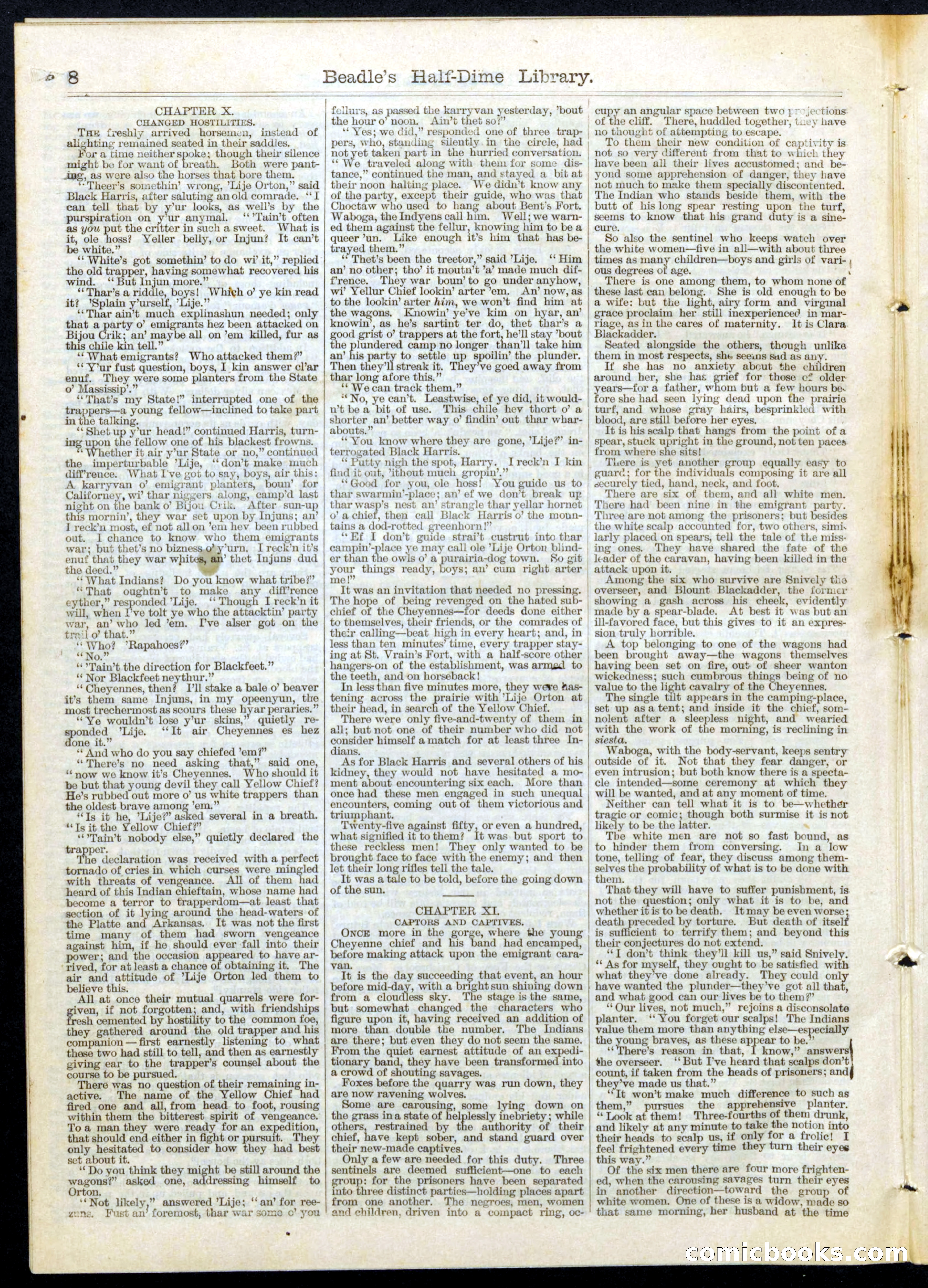
A restored page from Pulp Fiction, 1879. Page through the whole issue in the reader above.
📄 Transcribed text from this page (OCR, searchable)
Machine-transcribed from the original scan — historical spelling and the odd misread are preserved.
Beadle’s Half-Dime Library. Eee - —_ CHAPTER X. CHANGED HOSTILITIES. THE freshly arrived horsemen, instead of alightinge remained seated in their saddles, For a time neither spoke; though their silence might be for want of breath. Both were pant- ipg, as were also the horses that bore them. **Theer’s somethin’ wrong, ’Lije Orton,” said Black Harris, aiter saluting anold comrade, ‘I can tell that by y’ur looks, as well’s by the purspiration on yur anymal, ‘’Tuin’t often as you put the critter in such asweet. What is it, ole hoss? Yeller belly, or Injun? It can’t be white.” ‘ White’s got somethin’ to do wi’ it,” replied the old trapper, having somewhat recovered his wind. ‘‘ But Injun more.” **Thar’s a riddle, boys! Which o’ ye kin read it? "Splain y’urself, ’Lije.”’ ‘‘Thar ain’t much explinashun needed; only that a party o’ emigrants hez been attacked on Bijou Crik; an’ maybe all on ’em killed, fur as this chile kin tell.” ‘‘ What emigrants? Who attacked them?’ ‘Yur fust question, boys, I kin answer cl’ar enuf. They were some planters from the State 0’ Massissip’.” “'That’s my State!” interrupted one of the trappers—a young fellow—inclined to take part in the talking. ‘‘Shet up y’ur head!” continued Harris, turn- ing upon the fellow one of his blackest frowns. ‘Whether it air y’ur State or no,” continued the. imperturbable ’Lije, ‘‘don’t make much diff'rence. What I've got to say, boys, air this: A. karryvan o’ emigrant planters, boun’ for Californey, wi’ thar niggers along, camp’d last night on the bank o’ Bijou Crik, After sun-up this mornin’, they war set upon by Injuns; an’ I reck’n most, ef not allon ’em hev been rubbed out. 1 chance to know who them emigrants war; but thet’s no bizness,o%y’urn, I reck’n it’s enuf that they war whites, an’ thet Injuns dud the deed.” ‘‘ What Indians? Do you know what tribe?” “That oughtn’t to make any diff’rence eyther,” responded ’"Lije. ‘*‘ Though I reck’n it will, when I’ve tolt ye who the attacktin’ party war, an’ who led ’em. [ve alser got on the treil o’ that.” ‘Who? ’Rapahoes?’ se No. ”? “ °Tain’t the direction for Blackfeet.” “Nor Blackfeet neythur.” ‘‘Cheyennes, then? I’ll stake a bale o’ beaver it’s them same Injuns, in my opeenyun, the most trechermost as scours these hyar peraries.” “Ye wouldn’t lose y’ur skins,” quietly re- nded ’Lije. ‘‘It air Cheyennes es hez one it.” ‘* And who do you say chiefed ’em?” “There’s no need asking that,” said one, “now we know it’s Cheyennes. Who should it be but that young devil they call Yellow Chief? He’s rubbed out more o’ us white trappers than the oldest brave among ’em,” “Ts it he, "Lije?”’ asked several in a breath. “Ts it the Yellow Chief?’ ‘“'Tain’t nobody else,” quietly declared the trapper. the declaration was received with a perfect tornado of cries in which curses were mingled with threats of vengeance. All of them had heard of this Indian chieftain, whose name had become a terror to trapperdom—at least that section of it lying around the head-waters of the Platte and Arkansas. It was not the first time many of them had sworn vengeance against him, if he should ever fall into their power; and the occasion appeared to have ar- ‘rived, for at least a chance of obtaining it. The air and attitude of ’Lije Orton led them to believe this. All at once their mutual quarrels were for- iven, if not forgotten; and, with friendships sh cemented by hostility to the common foe, they gathered around the old trapper and his companion — first earnestly listening to what these two had still to tell, and then as earnestly giving ear to the trapper’s counsel about the course to be pursued. bad? «7 There was no question of their remaining in- active. The name of the Yellow Chief had fired one and all, from head to foot, rousing within them the bitterest spirit of vengeance. Toa man they were ready for an expedition, that should end either in fight or pursuit. They only hesitated to consider how they had best set about it. ‘** Do you think they might be still around the to egal asked one, addressing himself to rton, ‘* Not likely,” answered ’Lije; ‘‘ an’ for ree- guns. Fust an’ foremost, thar war somo o’ you 8 ae ———— ES TT Ss -_ - fellurs, as passed the karryvan yesterday, ’bout the hour o’ noon. Ain’t thet so?’ ‘Yes; we did,” responded one of three trap- pers, who, standing silently.in the circle, had not yet taken part in the hurried conversation. ‘We traveled along with them for some dis- tance,” continued the man, and stayed a bit at their noon halting place. We didn’t know any of the party, es their guide, who was that Choctaw who used to hang about Bent’s Fort. Waboga, the Indyens call him. Well; we warn- ed them against the fellur, knowing him to be a queer ’un. Like enough it’s him that has be- trayed them.” ‘** Thet’s been the treetor,” said ’Lije. ‘‘ Him an’ no other; tho’ it moutn’t ’a’ made much dif- frence. They war boun’ to go under anyhow, wi’ Yellur Chief lookin’ arter’em. An’ now, as to the lookin’ arter him, we won’t find him at the wagons. Knowin’ ye’ve kim on hyar, an’ knowin’, as he’s sartint ter do, thet thar’s a good grist o’ trappers at the fort, he’ll stay "bout the Pings ag camp no longer than’ll take him an’ his party to settle up spoilin’ the plunder. Then they’ll streak it. They’ve goed away from thar long afore this.” ‘* Wecan track them.” **No, ye can’t. Leastwise, ef ye did, it would- n’t bea bit of use. This chile hev thort o’ a shorter an’ better way o’ findin’ out thar whar- abouts.” ‘* You know where they are gone, ’Lije?’ in- terrogated Black Harris. ‘“ Putty nigh the spot, Harry. Ireck’n I kin find it out, ’ithout much gropin’.” ‘‘Good for you, ole hoss! You guide us to thar swarmin’-place; an’ ef we don’t break up thar wasp’s nest an’ strangle thar yellar hornet o’ a chief, then call Black Harris o’ the moun- tains a dod-rotted greenhorn!” ‘“‘Ef I don’t guide strai’t custrut into thar campin’-place ye may call ole ’Lije Orton blind- er than the owls o’ a purairia-dog town. So git cupy an angular space between two y,r>jections of the cliff. There, huddled together, taey have no thought of attempting to escape. To them their new condition of captivity is not so very different from that to which they have been all their lives accustomed; and be- yond some apprehension of danger, they have not much to make them specially discontented. The Indian who stands beside them, with the butt of his long spear resting upon the turf, seems to know that his grand duty is a sine- cure. So also the sentinel who keeps watch over the white women—five in all—with about three times as many children—boys and girls of vari-, ous degrees of age. ‘ There is one among them, to whom none of these last can belong. She is old enough to be a wife: but the light, airy form and virginal grace proclaim her still inexperienced in mar- riage, as in the cares of maternity. It is Clara Blackadder. Seated alongside the others, though unlike them in most respects, she seews sud as any. If she has no anxiety about the children around her, she has grief for those cf older years—for a father, whom but a few hours be. fore she had seen lying dead upon the prairie turf, and whose gray hairs, besprinkled with blood, are still before her eyes. It is his sealp that hangs from the point ofa spear, stuck upright in the ground, not ten paces from where she sits! There is yet another group equally easy to _guarc; for the individuals composing it are all your things ready, boys; an’ cum right arter | me!” It was an invitation that needed no pressing. The hope of being revenged on the hated sub- | chief of the Cheyennes—for deeds done either to themselves, their friends, or the comrades of their calling—beat high in every heart; and, in less than ten minutes’ time, every trapper stay- ing at St. Vrain’s Fort, with a half-score other hangers-on of the establishment, was armed to the teeth, and on horseback! In less than five minutes more, they we¥e fas- tening across the prairie with ’Lije Orton at their head, in search of the Yellow Chief. There were only five-and-twenty of them in all: but not one of their number who did not consider himself a match for at least three In- dians. As for Black Harris and several others of his kidney, they would not have hesitated a mo- ment about encountering six each. More than once had these men engaged in such unequal encounters, coming out of them victorious and triumphant. Twenty-five against fifty, oreven a hundred, what signified it to them? It was but sport to these reckless men! They only Wanted to be brought face to face with the enemy; and then let their long rifles tell the tale. It was a tale to be told, before the going down of the sun. CHAPTER XI. CAPTORS AND CAPTIVES. ONCE more in the gorge, where the young Cheyenne chief and his band had encamped, before making attack upon the emigrant cara- van. It is the day succeeding that event, an hour before mid-day, with a bright sun shining down from a cloudless sky. The stage is the same, but somewhat changed the characters who figure upon it, having received an addition of more than double the number. The Indians are there; but even they do not seem the same. From the quiet earnest attitude of an expedi- tionary band, they have been transformed into a crowd of shouting savages. Foxes before the quarry was run down, they are now ravening wolves. Some are carousing, some lying down on the grass ina state of helplessly inebriety ; while others, restrained by the authority of their chief, have kept sober, and stand guard over their new-made captives. Only a few are needed for this duty. Three sentinels are deemed sufficient—one to each lee for the prisoners have been separated into three distinct parties—holding places apart from one another. The negroes, men, women and children, driven into a compact ring, oc- EE — securely tied, hand, neck, and foot. There are six of them, and all white men. There had been nine in the emigrant party. Three are not among the prisoners; but besides the white scalp accounted for, two others, simi. larly placed on spears, tell the tale of the miss- ing ones. They have shared the fate of the leader of the caravan, having been killed in the attack upon it. Among the six who survive are Snively tho overseer, and Blount Blackadder, the former showing a gash across his cheek, evidently made by a spear-blade. At best it was but an ill-favored face, but this gives to it an expres- sion truly horrible. A top belonging to one of the wagons had been brought away—the wagons themselves having been set on fire, out of sheer wanton wickedness; such cumbrous things being of no value to the light cavalry of the Cheyenner: The single tilt appears in the camping-place, set up asa tent; and inside it the chief, som- nolent after a ee night, and wearied past the work of the morning, is reclining in Siesta, Waboga, with the body-servant, keeps sentry outside of it. Not that they fear danger, or even intrusion; but both know there is a specta- cle intended—some ceremony at which they will be wanted, and at any moment of time. Neither can tell what it is to be—whether tragic or comic; though both surmise it is not likely to be the latter. . Tbe white men are not so fast bound, as to hinder them from conversing. In a low tone, telling of fear, they discuss among them- roe the probability of what is to be done with them. That they will have to suffer punishment, is not the question; only what it is to be, and whether itis to be death. Itmay be even worse; death preceded by torture. But death of itself is sufficient to terrify them; and beyond this their conjectures do not extend. ““[ don’t think they’ll kill us,” said Snively. ** As for myself, they ought to be satisfied with what they’ve done already. They could onl have wanted the plunder—they’ve got all that, and what good can our lives be to them?” ‘‘Our lives, not much,” rejoins a disconsolate planter. ‘‘ You forget our scalps! The Indians value them more than anytbing else—especially the young braves, as these appear to be.” ‘“There’s reason in that, 1 know,” answers the overseer. ‘‘ But I’ve heard that scalps don’t count, if taken from the heads of prisoners; and they’ve made us that.” “Tt won’t make much difference to such as them,” pursues the apprehensive planter. “Took at them! Three-fourths of them drunk, and likely at any minute to take the notion into their heads to scalp us, if only for a frolic! I feel frightened every time they turn their eyes this way.” Of the six men there are four more frighten- ed, when the carousing savages turn their eyes in another direction—toward the group of white women. One of these is a widow, made so that same morning, her husband at the time S) Eomicboo