
Pulp Fiction, 1879 · page 10 of 16
Beadle's Half Dime Library, Vol. III, No. 78 — page 10: what you’re looking at
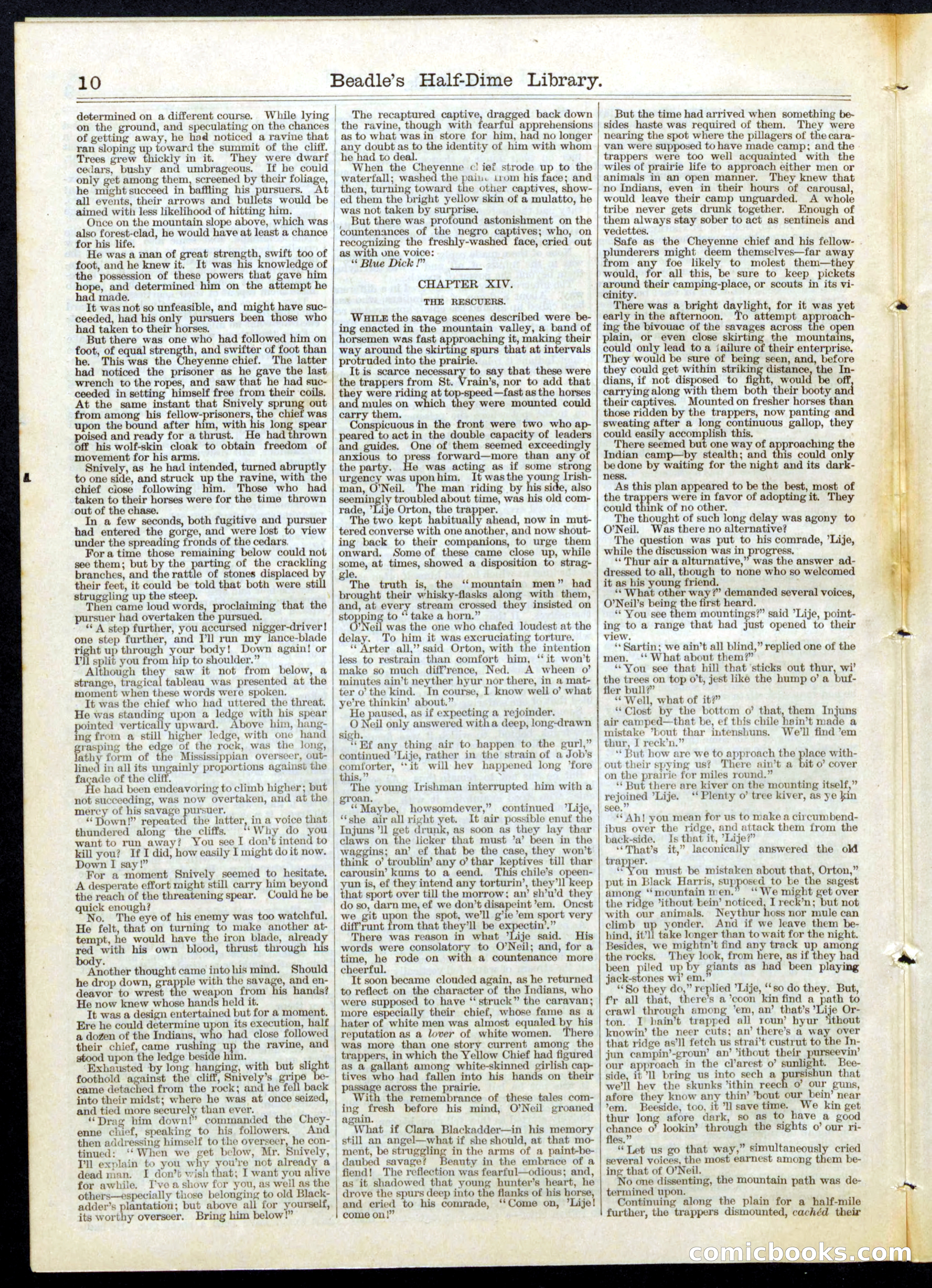
A restored page from Pulp Fiction, 1879. Page through the whole issue in the reader above.
📄 Transcribed text from this page (OCR, searchable)
Machine-transcribed from the original scan — historical spelling and the odd misread are preserved.
_——— eee determined on a different course. on the ground, and speculating on the chances of getting away, he had noticed a ravine that ran sloping up toward the summit of the cliff. Trees grew thickly in it. They were dwarf cedars, bushy and umbrageous. If he could only get among them, screened by their foliage, he might succeed in baffling his pursuers. At all events, their arrows and bullets would be aimed with less likelihood of hitting him. Once on the mountain slope above, which was also forest-clad, he would have at least a chance for his life. He was a man of great strength, swift too of foot, and he knew it. It was his knowledge of the possession of these powers that gave him hope, and determined him on the attempt he had made. It was not so unfeasible, and might have suc- ceeded, had his only pursuers been those who had taken to their horses. But there was one who had followed him on foot, of equal strength, and swifter of foot than he. This was the Cheyenne chief. The latter had noticed the prisoner as he gave the last wrench to the ropes, and saw that he had suc- ceeded in setting himself free from their coils. At the same instant that Snively sprung out from among his fellow-prisoners, the chief was upon the bound after him, with his long spear poised and ready for a thrust. He had thrown off his wolf-skin cloak to obtain freedom of movement for his arms. Snively, as he had intended, turned abruptly to one side, and struck up the ravine, with the chief close following him. Those who had taken to their horses were for the time thrown out of the chase. In a few seconds, both fugitive and pursuer had entered the gorge, and were lost to view under the spreading fronds of the cedars. Fora time those remaining below could not see them; but by the parting of the crackling branches, and the rattle of stones displaced b their feet, it could be told that both were sti struggling up the steep. Then came loud words, proclaiming that the pursuer had overtaken the pursued. ‘‘ A step further, you accursed nigger-driver! one step further, and Tl run my lance-blade right up through your body! Down again! or I'll split you from hip to shoulder.” Although they saw it not from below, a strange, tragical tableau was presented at the moment when these words were spoken, It was the chief who had uttered the threat. He was standing upon a ledge with his spear yointed vertically upward. ing from a still higher ledge, with one hand rrasping the edge of the rock, was the long, athy form of the Mississippian overseer, out- lined in all its ungainly proportions against the facade of the cliff. fe had been endeavoring to climb higher; but not succeeding, was now overtaken, and at the mercy of his savage pursuer. “Down!” repbated the latter, in a voice that thundered along the cliffs. ‘“‘Why do you want to run away? You see I don’t intend to kill you? If I did, how easily I might do it now. Down I say!” For a moment Snively seemed to hesitate. A desperate effort might still carry him beyond the reach of the threatening spear. Could he be quick enough? No. The eye of his enemy was too watchful. He felt, that on turning to make another at- tempt, he would have the iron blade, alread red with his own blood, thrust through his body. Another thought came intohis mind. Should he drop down, grapple with the savage, and en- deavor to wrest the weapon from his hands? He now knew whose hands held it. It was a design entertained but for a moment. Ere he could determine upon its execution, half a dozen of the Indians, who had close followed their chief, came rushing up the ravine, and stood upon the ledge beside him. Exhausted by long hanging, with but ry foothold against the cliff, Snively’s gri - came detached from the rock; and he fell back into their midst; where he was at once seized, and tied more securely than ever. “Drag him down!” commanded the Chey- enne chief, speaking to his followers. And then addressing himself to the overseer, he con- tinued: ‘‘When we get below, Mr. Snively, Tl explain to you why you're not already a dead man. I don’t wish that; I want you alive for awhile. I’ve a show for you, as well as the others—especially those belonging to old Black- adder’s plantation; but above all for yourself, its worthy overseer. Bring him below!” While lying | Beadle’s Half-Dime Library. The recaptured captive, dragged back down the ravine, though with fearful apprehensions as to what was in store for him, had no longer _any doubt as to the identity of him with whom Above him, hang- | ————— he had to deal. When the Cheyenne c! ief strode up to the waterfall; washed the pai. irom his face; and then, turning toward the other captives, show- ed them the bright yellow skin of a mulatto, he was not taken by surprise. But there was profound astonishment on the countenances of the negro captives; who, on recognizing the freshly-washed face, cried out as with one voice: ** Blue Dick !” CHAPTER XIV. THE RESCUERS. WHILE the savage scenes described were be- ing enacted in the mountain valley, a band of horsemen was fast approaching it, making their way around the skirting spurs that at intervals protruded into the prairie. It is scarce necessary to say that these were the trappers from St. Vrain’s, nor to add that they were riding at top-speed —fast as the horses and mules on which they were mounted could carry them. Conspicuous in the front were two who ap- peared to act in the double capacity of leaders and guides. One of them seemed exceedingly anxious to press forward—more than any of the party. e was acting as if some strong urgency was uponhim. It wasthe young Irish- man, O’Neil. The man riding by his side, also seemingly troubled about time, was his old com- rade, ’Lije Orton, the trapper. The two kept habitual y ahead, now in mut- tered converse with one another, and now shout- ing back to their companions, to urge them onward. Some of these came close up, while hig at times, showed a disposition to strag- e. The truth is, the ‘‘mountain men” had brought their whisky-flasks along with them, and, at every stream crossed they insisted on stopping to * take a horn.” "Neil was the one who chafed loudest at the delay. To him it was excruciating torture. ‘Arter all,’ said Orton, with the intention less to restrain than comfort him, “it won’t make so much diff’rence, Ned. A wheen o’ minutes ain’t neyther hyur nor there, in a mat- ter o’ the kind. In course, | know well o’ what ye’re thinkin’ about.” He paused, as if expecting a rejoinder. O Neil only answered witha deep, long-drawn sigh. “Bf any thing air to happen to the gurl,” continued ’Lije, rather in the strain of a Job’s comforter, ‘‘it will hev happened long ‘fore this,” The young Irishman interrupted him with a groan. ‘Maybe, howsomdever,” continued ’*Lije, ‘she air all right yet. It air possible enuf the Injuns ’}l get drunk, as soon as they lay thar claws on the licker that must ’a’ been in the waggins; an’ ef that be the case, they won’t think o’ troublin’ any o’ thar keptives till thar carousin’ kums to a eend. This chile’s opeen- yun is, ef they intend any torturin’, they’ll keep that sport over till the morrow: an’ sh’u’d they do so, darn me, ef we don’t disapeint ’em. Oncst we git ee the spot, we'll g’ie em sport very diff'runt from that they'll be expectin’.” There was reason in what ’Lije said. His words were consolatory to O’Neil; and, for a time, he rode on with a countenance more cheerful. It soon became clouded again, as he returned to reflect on the character of the Indians, who were supposed to have “struck” the caravan; more especially their chief, whose fame as a hater of white men was almost equaled by his reputation as a lover of white women. There was more than one story current among the trappers, in which the Yellow Chief had figured as a gallant among white-skinned girlish cap- tives who had fallen into his hands on their passage across the prairie. With the remembrance of these tales com- ing fresh before his mind, O’Neil groaned again. What if Clara Blackadder—in his memory still an angel—what if she should, at that mo- ment, be struggling in the arms of a paint-be- daubed savage? eauty in the embrace of a fiend! The reflection was fearful—odious; and, as it shadowed that young hunter’s heart, he drove the spurs deep into the flanks of his horse, and eried to his comrade, ‘‘Come on, ’Lije! come on!” = — << =o oe ee ee But the time had arrived when something be~- sides haste was required of them. They were nearing the spot where the pillagers of the cara- van were supposed to have made camp; and the trappers were too well acquainted with the wiles of prairie life to approach either men or animals in an open manner. They knew that no Indians, even in their hours of carousal, would leave their camp unguarded. A whole tribe never gets drunk together. Enough of them always stay sober to act as sentinels and vedettes. Safe as the Cheyenne chief and his fellow- lunderers might deem themselves—far away rom any foe likely to molest them—they would, for all this, be sure to keep pickets teem their camping-place, or scouts in its vi- cinity. There was a bright daylight, for it was yet early in the afternoon. To attempt approach- ing the bivouac of the savages across the open plain, or even close skirting the mountains, could only lead to a iailure of their enterprise. They would be sure of being seen, and, before they could get within striking distance, the In- dians, if not disposed to fight, would be off carrying along with them both their booty and their captives. Mounted on fresher horses than those ridden by the trappers, now panting and sweating after a long continuous gallop, they could easily accomplish this, There seemed but one way of approaching the Indian camp—by stealth; and this could only be done by waiting for the night and its dark- ness. As this plan appeared to be the best, most of the trappers were in favor of adopting it. They could think of no other. The thought of such long delay was agony to O’Neil. Was there no alternative? The question was put to his comrade, ’Lije, while the discussion was in progress. ‘‘ Thur air a alturnative,” was the answer ad- dressed to all, though to none who so welcomed it as his young friend. . ‘* What other way?’ demanded several voices, O’Neil’s being the first heard. ‘You see them mountings?” said ’Lije, point- ing to a range that had just opened to their view. ‘‘Sartin; we ain’t all blind,” replied one of the men. ‘‘ What about them?’ ‘You see that hill that ‘sticks out thur, wi’ the trees on top o’t, jest like the hump o’ a buf- fler bull?” “Well, what of it?” “Clost by the bottom o’ that, them Injuns air camped—that be, ef this chile hain’t made a mistake “bout thar intenshuns. We'll find ’em thur, I reck’n.” ‘* But how are we to approach the place with- out their spying us? There ain’t a bit o’ cover on the prairie for miles round.” ‘‘ But there are kiver on the mounting itself,” rejoined ’Lije. ‘‘ Plenty o’ tree kiver, as ye kin see.” ‘‘ Ah! you mean for us to make a circumbend- ibus over the ridge, and attack them from the back-side. Is that it, “Lije?”’ ‘‘That’s it,” laconically answered the olf trapper. Ss Ye must be mistaken about that, Orton,” put in Black Harris, supposed to be the sagest among “mountain men.” ‘We might get over the ridge ’ithout bein’ noticed, I reck’n; but not with our animals. Neythur hoss nor mule can climb up yonder. And if we leave them be- hind, it'll take longer than to wait for the night. Besides, we mightn’t find any track up among the rocks. They look, from here, as if they had been piled up by giants as had been playing jack-stones wi’ em.” ““So they do,” replied ’Lije, ‘‘so do they. But, fr all that, there’s a’coon kin find a path to crawl through among ’em, an’ that’s ’Lije Or- ton. I hain’t trapped all roun’ hyur ‘ithout knowin’ the neer cuts; an’ there’s a way over that ridge as’ll fetch us strai’t custrut to the In- jun campin’-groun’ an’ ‘ithout their purseevin’ our approach in the cl’arest o’ sunlight. Bee- side, it ‘ll bring us into sech a ursishun that we'll hev the skunks ’ithin reech 0’ our guns, afore they know any thin’ bout our bein’ near ‘om. Beeside, too, it ll save time. We kin get thur long afore dark, so as to have a good chance o’ lookin’ through the sights o’ our ri- fles.” “Tet us go that way,” simultaneously cried several voices, the most earnest among them be- ing that of O’Neil. No one dissenting, the mountain path was de- termined upon. Continuing along the plain for a half-mile further, the trappers dismounted, cachéd their eom ; $ ’ t : :