
Pulp Fiction, 1879 · page 7 of 16
Beadle's Half Dime Library, Vol. III, No. 78 — page 7: what you’re looking at
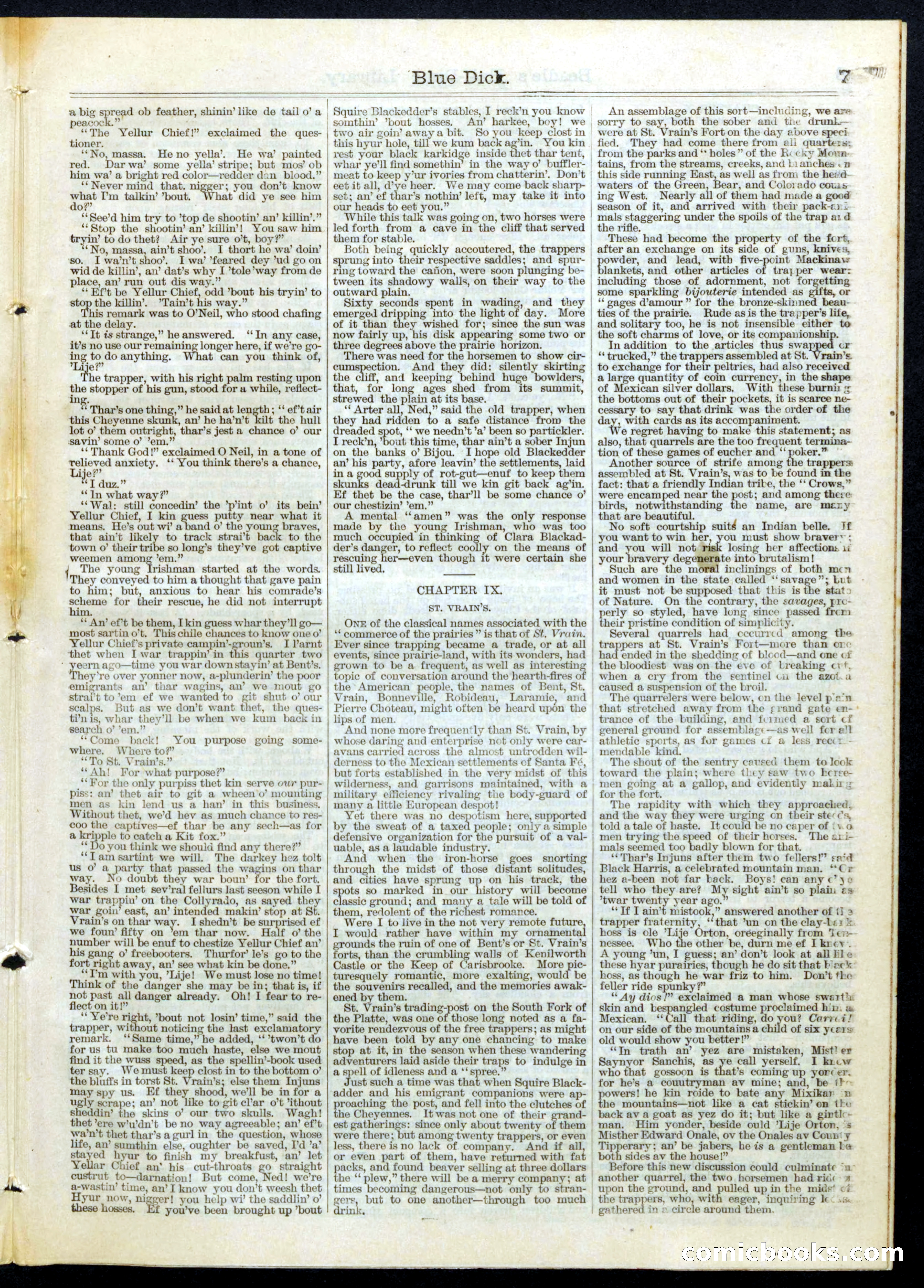
A restored page from Pulp Fiction, 1879. Page through the whole issue in the reader above.
📄 Transcribed text from this page (OCR, searchable)
Machine-transcribed from the original scan — historical spelling and the odd misread are preserved.
~~ —- — ee ee on + eS read ob feather, shinin’ like de tail o’a 99 a big —P peacock. “The Yellur Chief!” exclaimed the ques- | two air goin’ away a bit. tioner. ‘*No, massa. Heno yella’. He wa’ painted red. Darwa’ some yella’ stripe; but mos’ ob him wa’ a bright red color—vredder dan _ blood,” ‘* Never mind that. nigger; you don’t know a [’'m talkin’ bout. What did ye see him o? ‘*See’d him try to ’top de shootin’ an’ killin’.” **Stop the shootin’ an’ killin’! You saw him tryin’ to do thet? Air ye sure o’t, boy?’ ‘No, massa, ain’t shoo’. I thort he wa’ doin’ so. I wa’n’t shoo’. I wa’ ’feared dey ’ud go on wid de killin’, an’ dat’s why I ’tole’way from de place, an’ run out dis way.” ‘*Ef’t be Yellur Chief, odd ’bout his tryin’ to stop the killin’. ’Tain’t his way.” his remark was to O’Neil, who stood chafing at the delay. ‘Tt is strange,” he answered. ‘In any case, it’s no use our =e ae here, if we’re go- me. bo do anything. What can you think of, e? The trapper, with his right palm resting upon — stopper of his gun, stood for a while, reflect- a Thar’s one thing,” he said at length; ‘‘ ef’t air this Cheyenne skunk, an’ he ha’n’t kilt the hull lot o’ them outright, thar’s jest a chance o’ our savin’ some 0’ ’em,” ‘* Thank God!” exclaimed O Neil, in a tone of relieved anxiety. ‘* You think there’s a chance, i Pe ‘“‘In what way?” ‘*Wal: still concedin’ the ’p’int o’ its bein’ Yellur Chief, I kin guess putty near what it means. He’s out wi’ a band o’ the young braves, that ain't likely to track strai’t back to the town 0’ their tribe so long’s they’ve got captive weemen among ’em.” { The young Irishman started at the words. They conveyed to him a thought that gave pain to him; but, anxious to hear his comrade’s scheme for their rescue, he did not interrupt m, ‘** An’ ef’t be them, I kin guess whar they’ll go— most sartin o’t. This chile chances to know one 0’ Yellur Chief's private campin’-groun’s. I arnt thet when I war trappin’ in this quarter two ‘ yeern ago—time you war downstayin’ at Bent’s. 1ey’re over yonner now, a-plunderin’ the poor emigrants an’ thar wagins, an’ we mout go strai’t to’em ef we wanted to git shut o’ our scalps. But as we don’t want thet, the ques- ti’nis, whar they’ll be when we kum back in search o’ ’em.” ‘*Come back! You purpose going some- where. Where to?” “To St. Vrain’s.” ‘“‘Ah! For what purpose?” ‘** For the only purpiss thet kin serve owr pur- piss: an’ thet air to git a wheen’o’ mounting men as kin lend us a han’ in this business. Without thet, we’d hev as much chance to res- coo the captives—ef thar be any sech—as for a nto to catch a Kit fox.” ‘* Do you think we should find any there?” ‘‘Tam sartint we will. The darkey hez tolt us 0’ a party that passed the wagins on thar way. No doubt they war boun’ for the fort. Besides I met sev’ral fellurs last seeson while I war trappiu’ on the Collyrado, as sayed they war goin’ east, an’ intended makin’ stop at St. Vrain’s on thar way. I shedn’t be surprised ef we foun’ fifty on ’em thar now. Half o’ the number will be enuf to chestize Yellur Chief an’ his gang o’ freebooters. Thurfor’ le’s go to the fort right away, an’ see what kin be done.” “I’m with you, ’Lije! We must lose no time! Think of the danger she may be in; that is, if not past all danger already. Oh! I fear to re- flect on it!” ‘ Ye’re right, bout not losin’ time,” said the trapper, without noticing the last exclamatory remark. ‘‘Same time,” he added, ‘‘ ’twon’t do for us tu make too much haste, else we mout find it the wuss speed, as the spellin’-book used ter say. Wemust keep clost in to the bottom o’ the bluffs in torst St. Vrain’s; else them Injuns may spy us. Ef they shood, we'll be in for a ugly scrape; an’ not like to git cl’ar o’t ’ithout sheddin’ the skins o’ our two skulls. Wagh! thet ere w’u’dn’t be no way agreeable; an’ ef’t wa’n’t thet thar’s a gurl in the question, whose life, an’ sumthin else, oughter be saved, I’d ’a’ 3 he hyur to finish my breakfust, an’ let Yellar Chief an’ his cut-throats go straight custrut to—darnation! But come, Ned! we're a-wastin’ time, an’ I know you don’t weesh thet Hyur now, ni rer! you help wi’ the saddlin’ o’ these hosses. Ef you’ve been brought up ’bout ! i i Blue Dick. ——w eee eee CS Squire Blackedder’s stables, I reck’n you know somthin’ "bout hosses, An’ harkee, boy! we So you keep clost in this hyur hole, till we kum back ag’in. You kin rest your black karkidge inside thet thar tent, whar ye’ll find somethin’ in the way o’ buffler- meat to keep y’ur ivories from chatterin’. Don’t eet it all, d’ye heer. We may come back sharp- set; an’ ef thar’s nothin’ left, may take it into our heads to eet you.” While this talk was going on, two horses were | led forth from a cave in the cliff that served them for stable. Both being quickly accoutered, the trappers sprung into their respective saddles; and spur- ring toward the cafion, were soon plunging be- tween its shadowy walls, on their way to the outward plain. Sixty seconds spent in wading, and they emerged dripping into the light of day. More of it than they wished for; since the sun was now fairly up, his disk appearing some two or three degrees above the prairie horizon. There was need for the horsemen to show cir- ¢c ction. And they did: silently skirting the cliff, and keeping behind huge bowlders, that, for long ages shed from its summit, strewed the plain at its base. ‘* Arter all, Ned,” said the old trapper, when they had ridden to a safe distance from the — a Ci — — Ot ———— —_ ~ oe An assemblage of this sort—including, we are sorry to say, both the sober and the drunk— were at St. Vrain’s Fort on the day ebove speci fied. They had come there from ali quarters: from the parks and ‘* holes” of the Ki cky Mown- tains, from the streams, creeks, and bi anches « » this side running East, as well as from the hewd- waters of the Green, Bear, and Colorado cows ing West. Nearly all of them had made a good season of it, and arrived with their pack-cr mals staggering under the spoils of the trap a: d the rifle. These had become the property of the fort, after an exchange on its side of guns, knives, yowder, and lead, witb five-point Mackinaw lankets, and other articles of tra}; per wear: including those of adornment, not forgetting some sparkling bijouterie intended as gifts, or ‘‘oaces d’amour” for the bronze-skinned beaun- ties of the prairie. Rude as is the trapper’s life, and solitary too, he is not insensible either to the soft charms of love, or its companionship. In addition to the articles thus swapped cr “trucked,” the trappers assembled at St. Vrain’s. to exchange for their peltries, had also received a large quantity of coin currency, in the shape dreaded se ‘* we needn’t ’a’ been so partickler. | I reck’n, *bout this time, thar ain’t a sober Injun on the banks o’ Bijou. I hope old Blackedder an’ his party, afore leavin’ the settlements, laid in a good supply of rot-gut—enuf to keep them skunks dead-drunk till we kin git back ag’in. Ef thet be the case, thar’ll be some chance oO’ our chestizin’ ’em.” A mental ‘‘amen” was the only response made by the young Irishman, who was too much occupied in thinking of Clara Blackad- der’s danger, to reflect coolly on the means of rescuing her—even though it were certain she still lived. CHAPTER IX, ST. VRAIN’S. ONE of the classical names associated with the ‘* commerce of the prairies ” is that of St. Vrain. Ever since trapping became a trade, or at all events, since prairie-land, with its wonders, had | | of Mexican silver dollars, With these burni: the bottoms out of their pockets, it is scarce ne- cessary to say that drink was the order of the day. with cards as its accompaniment. ’e regret having to make this statement; as also, that quarrels are the too frequent termina- tion of these games of eucher and ‘‘ poker.” Another source of strife among the trappers assembled at St. Vrain’s, was to be found im the fact: that a friendly Indian tribe, the ‘‘ Crows,” were encam near the post; and among there birds, notwithstanding the name, are meny that are beautiful. No soft courtship suit¢ an Indian belle. Tf you want to win her, you must show braver’ : and you will not risk losing her affections i your bravery degenerate into brutalism! Such are the m inclinings of both mcn and women in the state called ‘‘ savage”; Lut it must not be supposed that this is the stat» of Nature. On the contrary, the savages, pre- perly so styled, have long since passed frem their pristine condition of simplicity. Several quarrels had cccurrcd among the trappers at St. Vrain’s Fort—more than one had ended in the shedding of blood—and one of grown to be a frequent, as well as interesting | topic of conversation around the hearth-fires of the American people, the names of Bent, St. Vrain, Bonneville, Robideau, Laramie, and | Pierre Choteau, might often be heard upon the ‘ lips of men. And none more frequently than St. Vrain, by whose daring and enterprise not only were car- avans carried across the almost untrodden wil- derness to the Mexican settlements of Santa Fé, but forts established in the very midst of this wilderness, and garrisons maintained, with a military efficiency rivaling the body-guard of many a little Kuropean despot! Yet there was no despotism here, supported the bloodiest was on the eve of breaking crf, when a cry from the sentinel cu the azot.a caused a suspension of the broil. The quarrelers were below, on the level p’e'n that stretched away from the srand gate en- ' trance of the building, and fvimed a sort cf general ground for assemblagc—as well for all athletic sports, as fur games ci a less rect - mendable kind. The shout of the sentry cavsed them to look toward the plain; where they saw two hcrre- men going at a gallop, and evidently makirs for the fort. The rapidity with which they approached, _and the way they were urging on their ster cs, by the sweat of a taxed people; only a simple | defensive organization for the pursuit of a val- | uable, as a laudable industry. And when the iron-horse goes snorting through the midst of those distant solitudes, and cities have sprung up on his track, the — so marked in our classic ground; and many a tale will be told of them, redolent of the richest romance. Were I to live in the not very remote future I would rather have within my ornamental grounds the ruin of one of Bent’s or St. Vrain’s forts, than the crumbling walls of Kenilworth Castle or the Keep of Carisbrooke. More pic- turesquely romantic, more exalting, would be the souvenirs recalled, and the memories awak- ened by them. St. Vrain’s trading-post on the South Fork of the Platte, was one of those long noted as a fa- vorite rendezvous of the free trappers; as might ; | told atale of haste. Itcould be no caper of ‘v.o men trying the speed of their horses. The ani- mals seemed too lady blown for that. ‘‘Thar’s Injuns after them two fellers!” satd _ Black Harris, a celebrated mountain man. “*Cr iistory will become | hez a-been not far back. Boys! can any c’ye tell who they are? My sight ain’t so pla es *twar twenty year ago.” ‘If I ain’t mistook,” answered another of {J > trapper fraternity, ‘“‘that ‘un on the clay-be: = hoss is ole *Lije Orton, oréeginally from Ten- nessee. Who the other be, durn me ef I krey. A young ’un, I guess; an’ don’t look at all Ele these hyar purairies, though he do sit that b’ack hoss, as though he war friz to him. Don’t fhe feller ride spunky?’ “ Ay dios!” exclaimed a man whose swartl skin and bespangled costume proclaimed hin. Mexican. ‘‘Call that riding, do you? Carri! on our side of the mountains a child of six ycars have been told by any one chancing to make | old would show you better!” stop at it, in the season when these wandering adventurers laid aside their traps to indulgein | Saynyor Sanchis, as a pel of idleness and a *‘ spree.” ust such a time was that when Squire Black- adder and his emigrant companions were ap- the Cheyennes. Itwas not one of their grand- est gatherings: since only about twenty of them were there; but among twenty trappers, or even less, there is no lack of company. And if all or even part of them, have returned with fat packs, and found beaver selling at three dollars the ‘‘ plew,” there will be a merry company; at times becoming dangerous—not only to stran- gore but to one another—through too much "ink, yez are mistaken, Mist! er e call yerself. I krcw at’s coming up yore er. man av mine; and, be ih “Tn trath an’ who that gossoon is for he’s a couutry ; | powers! he kin roide to bate any Mixikar » proaching the post, and fell into the clutches of | the mountains—not like a cat stickin’ on the | | gathered in = circ back av a goat as yez do it; but like a gintlc- man. Him yonder, beside ould ’Lije Orton, s Misther Edward Onale, ov the Onales av Coun‘ ¥ Tipperary; an’ be jabers, he is a gentleman be both sides av the house!” Before this new discussion could culminate ‘a- another quarrel, the two horsemen had ric 4 upon the ground, and | up in the mids’ cf the trappers, who, with eager, inquiring Ic« us le around them. (E com —, = ——— Oo (EO