
Pulp Fiction, 1879 · page 6 of 16
Beadle's Half Dime Library, Vol. III, No. 78 — page 6: what you’re looking at
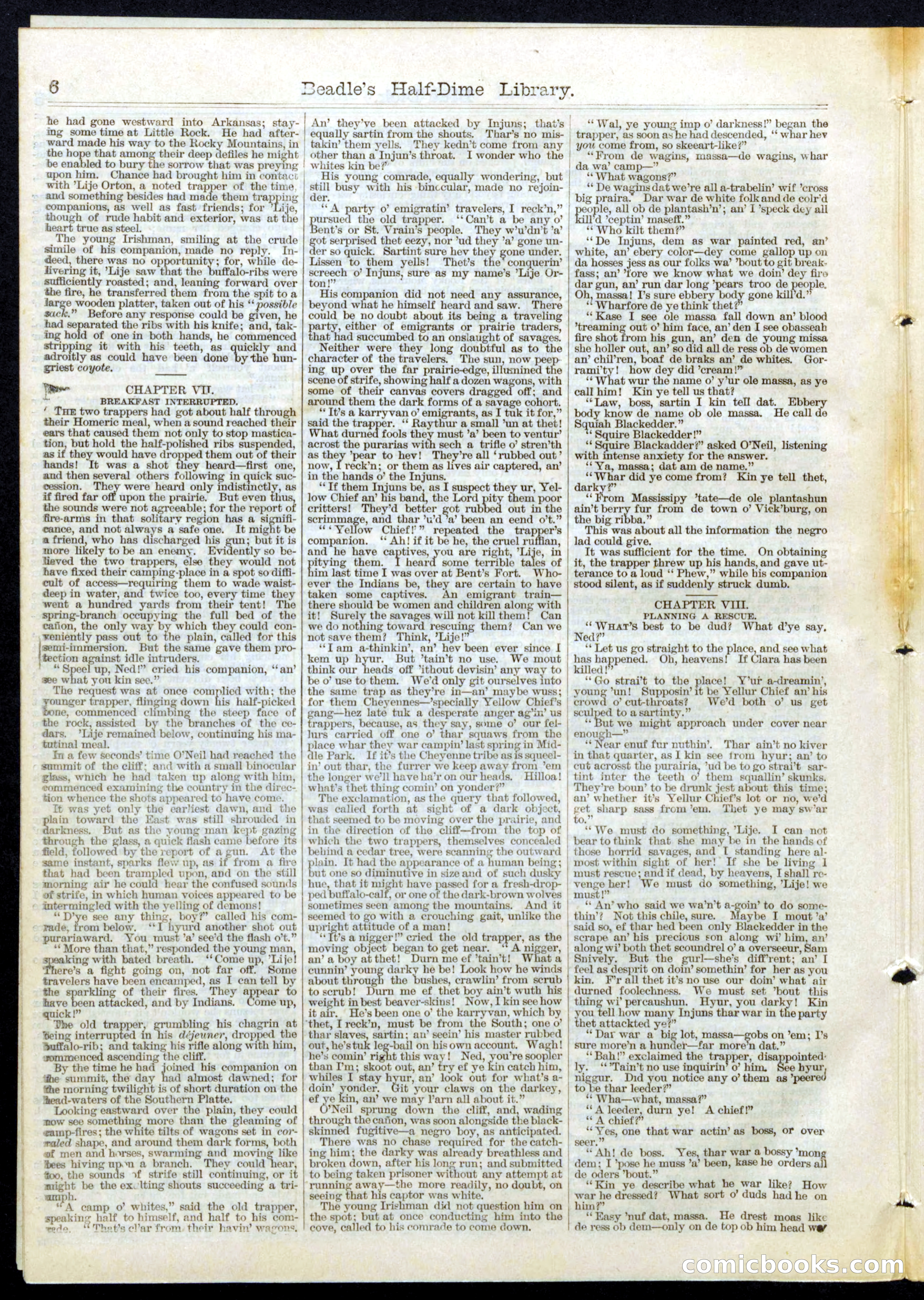
A restored page from Pulp Fiction, 1879. Page through the whole issue in the reader above.
📄 Transcribed text from this page (OCR, searchable)
Machine-transcribed from the original scan — historical spelling and the odd misread are preserved.
= _ nr See a Sa. —_———_ — em ee ee ee 6 he had gone westward into Arkansas; stay- ing some time at Little Rock. He had after- ward made his way to the Rocky Mountains, in the ae that among their deep defiles he might Beadle’s HalfDime Library. be enabled to bury the sorrow that was preying | upon him. Chance had brought him in contaci with ’Lije Orton, a noted trapper of the time. and something besides had made them trapping companions, as well as fast friends; for tiie though of rude habit and exterior, was at the heart true as steel. The young Irishman, smiling at the crude simile of his companion, made no reply. In- deed, there was no opportunity; for, while de- fivering it, ’Lije saw that the buffalo-ribs were sufficiently roasted; and, leaning forward over the fire, he transferred them from the spit to a jarge wooden platter, taken out of his “ possible sack.” Before any response could be given, he had separated the ribs with his knife; and, tak- ing hold of one in both hands, he commenced stripping it with his teeth, as quickly and adroitly as could have been done by the hun- griest coyote. Vw CHAPTER VII. 4 BREAKFAST INTERRUPTED. ‘ THE two trappers had got about half through their Homeric meal, when a sound reached their ears that caused them not only to stop mastica- tion, but hold the half-polished ribs suspended, as if they would have dropped them out of their hands! It was a shot they heard—first one, and then several others following in quick suc- cession. They were heard only indistinctly, as if fired far off upon the prairie. But even thus, the sounds were not agreeable; for the report of fire-arms in that solitary region has a signifi- cance, and not always a safe one. It might be a friend, who has discharged his gun; but it is more likely to be an enemy. Evidently so be- lieved the two trappers, else they would not have fixed their camping-place in a spot so diffi- cult of access—requiring them to wade waist- deep in water, and twice too, every time they went a hundred yards from their tent! The spring-branch occupying the full bed of the cafion, the only way by which they could con- veniently pass out to the plain, called for this semi-immersion. But the same gave them pro- tection against idle intruders. ‘ac ” of ‘ . : se ? Speel up, Ned!” cried his companion, “an see what you kin see.” The request was at once complied with; the younger trapper, flinging down his half-picked fone, commenced climbing the steep face of the rock, assisted by the branches of the ce- dars. ’Lije remained below, continuing his ma- tutinal meal. In a few seconds’ time O’Neil had reached the summit of the cliff: and with a small binocular giass, which he had taken up along with him, commenced examining the country in the direc- tion whence the shots appeared to have come. [ft was yet only the earliest dawn, and the plain toward the East was still shrouded in darkness. But as the young man kept gazing through the glass, a quick flash came before its field, followed by the report of agun. At the same instant, sparks flew up, as if from a fire that had been trampled upon, and on the still morning air he could hear the confused sounds of strife, in which human voices appeared to be intermingled with the yelling of demons! “D’ye see any thing, boy?” called his com- rade, from below. ‘‘I hyurd another shot out purariaward. You must ’a’ see’d the flash o’t.” ‘More than that,” responded the young man, waking with bated breath. ‘‘Come up, ’Lije! There's a fight going on, not far off. Some travelers have been encamped, as I can tell by the sparkling of their fires. They appear to have Eden attacked, and by Indians. Come up, quick!” Dhe old trapper, imbling his chagrin at Being interrupted in his déjeuner, dropped the Suffalo-rib; and taking his rifle along with him, gommenced ascending the cliff. By the time he had joined his companion on the summit, the day had almost dawned; for the morning twilight is of short duration on the thead-waters of the Southern Platte. Looking eastward over the plain, they could mow see something more than the gleaming of eainp-fires; the white tilts of wagons set in cor- raled shape, and around them dark forms, both ef men and horses, swarming and moving like bees hiving up a branch. They could hear, foo, the = Is, ¢ vf strife still continuing, or it might be the ex lting shouts succeeding a tri- amiph. “A camp o’ whites,” said the old trapper, speaking half to himself, and half to his com- vede, “Thet’s car from. their havin’ warons, b -eS-—e oe ee ee ee -- An’ they’ve been attacked by Injuns; that’s equally sartin from the shouts. Thar’s no mis- takin’ them yells. They kedn’t come from any other than a Injun’s throat. I wonder who the whites kin be? His young comrade, equally wondering, but still busy with his binccular, made no rejoin- | der. ‘‘A party o’ emigratin’ travelers, I reck’n,” yursued the old trapper. ‘‘Can’t a be any o’ ent’s or St. Vrain’s people. They w’u’dn’t ’a’ got serprised thet eezy, nor ’ud they ’a’ gone un- der so quick. Sartint sure hev they gone under. Lissen to them yells! Thet’s the‘ conquerin’ screech o’ Injuns, sure as my name’s ’Lije Or- ton!” His companion did not need any assurance, beyond what he himself heard and saw. There could be no doubt about its being a traveling party, either of emigrants or prairie traders, that had succumbed to an onslaught of savages. Neither were they long doubtful as to the character of the travelers. The sun, now pee ing up over the far prairie-edge, illumined the scene of strife, showing half a dozen wagons, with some of their canvas covers dragged off; and around them the dark forms of a savage cohort. ** It’s a karryvan o’ emigrants, as I tuk it for,” said the trapper. ‘‘ Raythur a small ’un at thet! What durned fools they must ’a’ been to ventur’ acrost the purarias with sech a trifle o’ stren’th as they ‘pear to hev! They’re all ‘rubbed out’ now, I reck’n; or them as lives air captered, an’ in the hands o’ the Injuns. ‘Tf them Injuns be, as I suspect they ur, Yel- low Chief an’ his band, the Lord pity them poor critters! They’d better got rubbed out in the scrimmage, and thar ’u’d ’a’ been an eend o’t.” “** Yellow Chief!” repeated the trapper’s companion. ‘* Ah! if it be he, the cruel holy and he have captives, you are right, we in vitying them. heard some terrible tales of 1im last time I was over at Bent’s Fort. Who- ever the Indians be, they are certain to have taken some captives. An emigrant train— there should be women and children along with it! Surely the savages will not kill them! Can we do dothing toward rescuing them? Can we not save them? Think, ’Lije!” ‘*‘Tam a-thinkin’, an’ hev been ever since I kem up hyur. But ’tain’t no use. We mout think our heads off ‘ithout devisin’ any way to be o’ use to them. the same trap as they’re in—an’ maybe wuss; for them Cheyennes—’specially Yellow Chief’s gang—hez late tuk a desperate anger ag’in’ us trappers, because, as they say, some o’ our fel- lurs carried off one o’ thar squaws from the place whar they war campin’ last spring in Mid- dle Park, If it’s the Cheyenne tribe as is squeel- in’ out thar, the furrer we keep away from ’em the longer we'll have ha’r on our heads. Hilloa! what's thet thing comin’ on yonder?” The exclamation, as the query that followed, was calied forth at sight of a dark object, that seemed to be moving over the prairie, and in the direction of the cliff—from the top of which the two trappers, themselves concealed behind a cedar tree, were scanning the outward plain. It had the appearance of a human being; but one so diminutive in size and of such dusky hue, that if might have passed for a fresh-drop- ped buffalo-calf, or one of the dark-brown wolves sometimes seen among the mountains. And it seemed to go with a crouching gait, unlike the upright attitude of a man! “Tt’s a nigger!” cried the old trapper, as the moving object began to get near. ‘ A nigger, an’ a boy atthet! Durn me ef ’tain’t! Whata cunnin’ young darky he be! Look how he winds about through the bushes, crawlin’ from scrub to scrub! Durn me ef thet boy ain’t wuth his weight in best beaver-skins! Now, I kin see how it air. He’s been one o’ the karryvan, which by ‘thet, Ireck’n, must be from the South; one o’ thar slaves, sartin; an’ seein’ his master rubbed out, he’s tuk leg-bail on hisown account. Wagh! he’s comin’ right this way! Ned, you’re soopler than I’m; skoot out, an’ try ef ye kin catch him, whiles I stay hyur, an’ look out for what’s a- doin’ yonder. Git your claws on the darkey, ef ye kin, an’ we may l’arn all about it.” O’Neil sprung down the cliff, and, wading through the cafion, was soon alongside the black- skinned fugitive—a negro boy, as anticipated. There was no chase required for the catch- ing him; the darky was already breathless and | broken down, after his long run: and submitted ——_—_— oo OS Sr -Cr C —— ‘Wal, ye young imp o’ darkness!” began the trapper, as soon as he had descended, ‘* whar hev you come from, so skeeart-like?” “From de wagins, massa—de wagins, whar 'da wa’ camp—” big praira. ‘What wagons?” ** De wagins dat we’re all a-trabelin’ wif ’cross Dar war de white folk and de colr’d | people, all ob de plantash’n’; an’ I ’speck dey all Se —-——=sssssssSsssssssslsssssSslssssSsssssesesessssssessslltslssslstt We'd only git ourselves into | get sharp sass from ’em. _venge ber! to being taken prisoner without any attempt at — running away—the more readily, no doubt, on seeing that his captor was white. The young Irishman did not question him on the spot; but at once conducting him into the cove, called to his comrade to come down. ld ’ceptin’ maseff.” ‘* Who kilt them?” ‘*De Injuns, dem as war painted red, an’ white, an’ ebery color—dey come gallop up on da hosses jess as our folks wa’ ’bout to git break- fass; an’ fore we know what we doin’ dey fire dar gun, an’ run dar long ’pears troo de ple. Oh, massa! I’s sure ebbery body gone kill’d.’ ‘*'Wharfore de ye think thet?” ‘** Kase I see ole massa fall down an’ blood *treaming out o’ him face, an’ den I see obasseah fire shot from his gun, an’ dem de young missa she holler out, an’ so did all de ress ob de women an’ chil’ren, boaf de braks an’ de whites. Gor- rami’ty! how dey did ’cream!” Ys What wur the name o’ y’ur ole massa, as ye call him! Kin ye tell us that? ‘*Law, boss, sartin I kin tell dat. Ebbery body know de name ob ole massa. He call de Squiah Blackedder.” ‘Squire Blackedder!” ‘* Squire Blackadder?” asked O’Neil, listening with intense anxiety for the answer. ‘Ya, massa; dat am de name.” ‘Whar did ye come from? Kin ye tell thet, darky?” ‘From Massissipy *tate—de ole plantashun ain’t berry fur from de town o’ Vick’burg, on the big ribba.” This was about all the information the negro lad could give. It was sufficient for the time. On obtaining it, the trapper threw up his hands, and gave ut- terance to a loud ‘‘ Phew,” while his companion stood silent, as if suddenly struck dumb. CHAPTER VIII. PLANNING A RESCUE. ‘“WHAT’S best to be dud? What d’ye say, Ned?” ‘* Let us go straight to the place, and see what eri happened. Oh, heavens! If Clara has been illed! ‘‘Go strai’t to the place! Yur a-dreamin’, young ’un! Supposin’it be Yellur Chief an’ his crowd o’ cut-throats? We'd both o’ us get sculped to a sartinty.” ‘*But we might approach under cover near enough—” ‘* Near enuf fur nuthin’. Thar ain’t no kiver in that quarter, as 1 kin see from hyur; an’ to cut acrosst the purairia, ’ud be to go strai’t sar- tint inter the teeth o’ them squallin’ skunks. They’re boun’ to be drunk jest about this time; an’ whether it’s Yellur Chief’s lot or no, we’d Thet ye may sw’ar to.” ‘*We must do something, ’Lije. I can not bear to think that she may be in the hands of those horrid savages, and I standing here al- most within sight of her! If she be living 1 must rescue; and if dead, by heavens, I shall re- We must do something, ’Lije! we must!” ‘‘ An’ who said we wa’n’t a-goin’ to do some- thin’? Not this chile, sure. Maybe I mout’a’ said so, ef thar hed been only Blackedder in the scrape an’ his precious son along wi’ him, an’ along wi’ both thet scoundrel o’ a overseeur, Sam Snively. But the gurl—she’s diffrent; an’ I feel as desprit on doin’ somethin’ for her as you kin. F’r all thet it’s no use our doin’ what air durned foolechness. We must set "bout this thing wi’ percaushun. Hyur, you darky! Kin you tell how many Injuns thar war in the party thet attackted ye?” ‘Dar war a big lot, massa—gobs on ’em; I’s sure more’n a hunder—far more’n dat.” ‘* Bah!” exclaimed the trapper, disappointed: ly. ‘**Tain’t no use inquirin’ o’ him, hyur niggur. Did you notice any o’ them as ‘peered to be thar leeder?”’ ** Wha—what, massa?” ‘*A leeder, durn ye! A chief!” ‘* A chief?’ “ Yes, one that war actin’ as boss, or over “Ah! de boss. Yes, thar war a bossy ’mon dem; I pose he muss ’a’ been, kase he orders all de oders "bout.” ‘Kin ye describe what he war like? How sh he dressed? What sort 0’ duds had he on Lim? ‘Rasy ’nuf dat, massa. He drest moas like de ress ob dem—only on de top ob him head wer 0\(0)(6) eoim (E cS «> ts