
Pulp Fiction, 1879 · page 14 of 16
Beadle's Half Dime Library, Vol. III, No. 78 — page 14: what you’re looking at
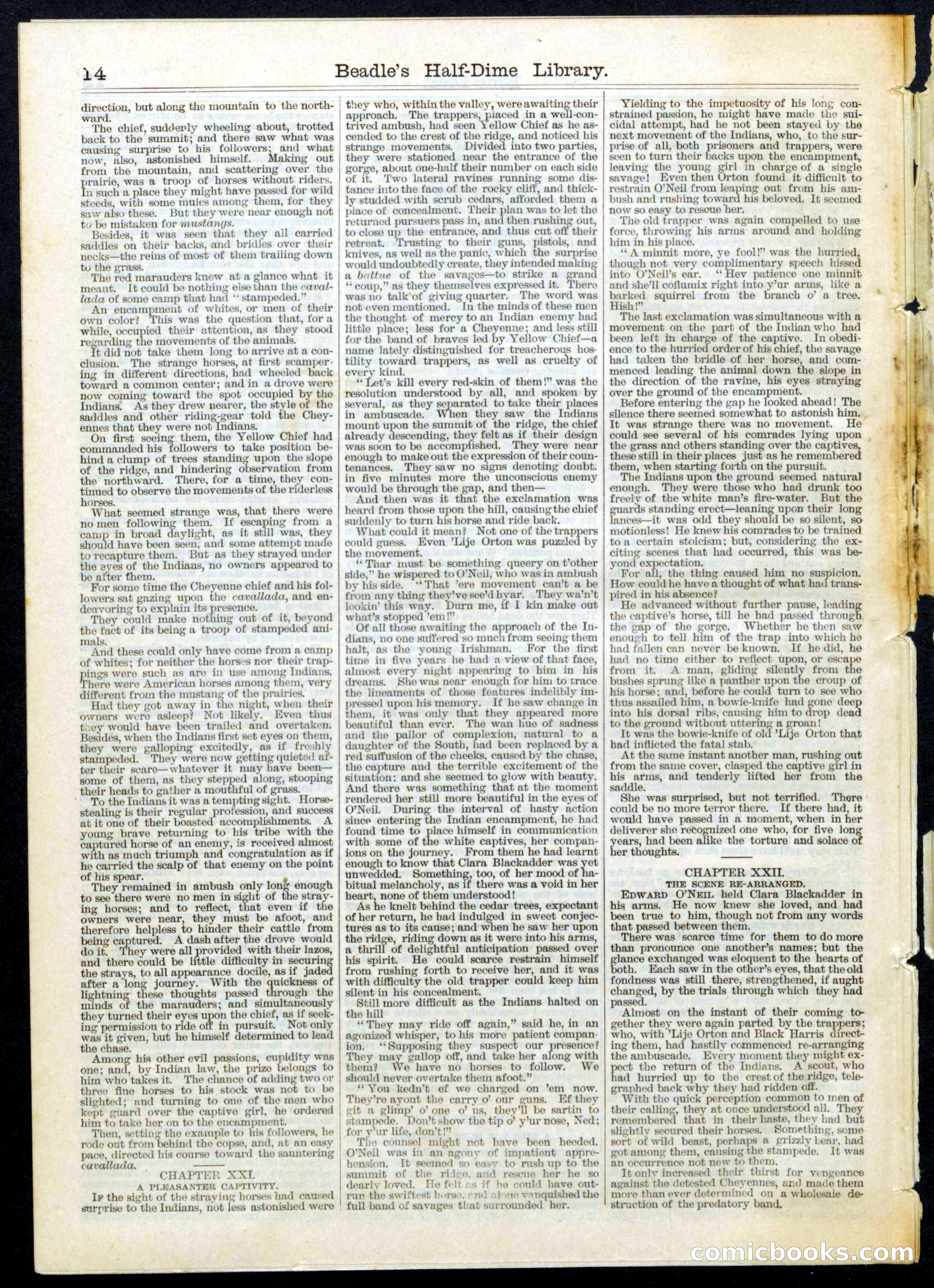
A restored page from Pulp Fiction, 1879. Page through the whole issue in the reader above.
📄 Transcribed text from this page (OCR, searchable)
Machine-transcribed from the original scan — historical spelling and the odd misread are preserved.
14 —E a ———$ direction, but along the mountain to the north- ward. The chief, sudderly wheeling about, trotted back to the summit; and there saw what was causing surprise to his followers; and what now, also, astonished himself. Making out from the mountain, and scattering over the | | of it. decree was a troop of horses without riders. n such a place they might have passed for wild | steeds, with some mules among them, for they saw also these. But they were near enough not to be mistaken for mustangs. Besides, it was seen that they all carried | saddles on their backs, and bridles over their necks—the reins of most of them trailing down to the grass. The red marauders knew at a glance what it meant. It could be nothing else than the caval- lada of some camp that had ‘* stampeded.” An encampment of whites, or men of their own color? This was the question that, for a while, occupied their attention, as they stood regarding the movements of the animals. It did not take them long to arrive at a con- clusion. The strange horses, at first scamper- ing in different directions, had wheeled back toward a common center; and in a drove were now coming toward the spot occupied by the Indians. As they drew nearer, the style of the saddles and other riding-gear told the Chey- ennes that they were not Indians. On first seeing them, the Yellow Chief had commanded his followers to take position be- hind a clump of trees standing upon the slope of the ridge, and hindering observation from the northward. There, for a time, they con- tinued to observe the movements of the riderless horses. What seemed strange was, that there were nomen following them. If escaping from a camp in broad daylight, as it still was, they should have been seen, and some attempt made to recapture them. But as they strayed under the eyes of the Indians, no owners appeared to be after fhem. For some time the Cheyenne chief and his fol- lowers sat gazing upon the cavallada, and en- deavoring to explain its presence. They could make nothtrie out of it, beyond the fact of its being a troop of stampeded ani- mals. And these could only have come from a camp of whites; for neither the horses nor their trap- xings were such as are in use among Indians, There were American horses among them, very different from the mustang of the prairies. Had they got away in the night, when their owners were asleep? Not likely. Even thus they would have been trailed and overtaken. Besides, when the Indians first set eyes on them, they were galloping excitedly, as if freshly stampeded. They were now getting quieted atf- ter their scare— whatever it may have been— some of them, as they stepped along, stooping their heads to gather a mouthful of grass. ’ To the Indians it was a tempting sight. Horse- stealing is their regular profession, and success at it one of their boasted accomplishments. A young brave returning to his tribe with the captured horse of an enemy, is received almost with as much triumph and congratulation as if he carried the scalp of that enemy on the point of his spear. , They remained in ambush only long enough to see there were no men in sight of the stray- ing horses; and to reflect, that even if the owners were near, they must be afoot, and therefore helpless to hinder their cattle from being captured. A dash after the drove would do it. ey were all provided with their lazos, and there could be little difficulty in securin the strays, to all appearance docile, as if jad after a long journey. With the quickness of lightning these thoughts passed through the minds of the marauders; and simultaneously they turned their eyes upon the chief, as if seek- ing permission to ride off in pursuit. Not only was it given, but he himself determined to lead the chase. Among his other evil passions, cupidity was one; and, by Indian law, the prize belongs to him who takes it. The chance of adding two or three fine horses to his stock was not to be slighted; and turning to one of the men who kept guard over the captive girl, he ordered | him to take her on to the encampment. Then, setting the example to his followers, he rode out from behind the copse, and, at an easy pace, directed his course toward the sauntering cavallada. —eemcine CHAPTER XXII. A PLEASANTER CAPTIVITY. IF the sight of the straying horses had caused surprise to the Indians, not less astonished were © | not even mentioned. 'yrur the swiftest horse. : they who, within the valley, were awaiting their approach. The trappers, placed in a well-con- trived ambush, had seen Yellow Chief as he as- cended to the crest of the ridge, and noticed his strange movements. Divided into two parties, they were stationed near the entrance of the gorge, about one-half their number on each side Two lateral ravines running some dis- tance into the face of the rocky cliff, and thick- ly studded with scrub cedars, afforded them a place of concealment. Their plan was to let the returned pursuers pass in, and then rushing out, to close up the entrance, and thus cut off their retreat. Trusting to their guns, pistols, and | knives, as well as the panic, which the surprise | would undoubtedly create, they intended making 'a battue of the savages—to strike a grand | ‘‘eoup,” as they themselves expressed it. There was no talk*of giving quarter. The word was In the minds of these men the thought of mercy to an Indian enemy had little place; less for a Cheyenne; and less still for the band of braves led by Yellow Chief—a name Jately distinguished for treacherous hos. tility toward trappers, as well as cruelty of every kind. “ Let’s kill every red-skin of them!” was the resolution understood by all, and spoken by several, as they separated to take their places in ambuscade. When they saw the Indians mount upon the summit of the ridge, the chief already descending, they felt as if their design was soon to be accomplished. They were near enough to make out the expression of their coun- tenances. They saw no signs denoting doubt. in five minutes more the unconscious enemy would be through the gap, and then— And then was it that the exclamation was heard from those upon the hill, causing the chief suddenly to turn his horse and ride back. What could it mean? Not one of the trappers could guess. Even ’Lije Orton was batanlod by the movement. “Thar must be something queery on t’other side,” he wispered to O'Neil, who was in ambush by his side. ‘‘That ‘ere movement can’t a be from any thing they’ve see’d hyar. .They wa’n’t lookin’ this way. Durn me, if I kin make out what’s stopped ’em!”’ Beadle’s Half-Dime Library. —— En - — = - ee NS SEED Yielding to the impetuosity of his long con- strained passion, he might have made the sui- cidal attempt, had he not been stayed by the next movement of the Indians, who, to the sur- prise of all, both prisoners and trappers, were seen to turn their backs upon the encampment, leaving the young girl in charge of a single savage! Even then Orton found it difficult to restrain O’Neil from leaping out from his am- bush and rushing toward his beloved. It seemed now so easy to rescue her. The old trapper was again compelled to use force, throwing his arms around and holding him in his place. ‘‘A minnit more, ye fool!” was the hurried though not very ae speech hissed into O’Neil’s ear. ‘‘ Hev patience one minnit | and she’ll coflumix right into y’ur arms, like a Of all those awaiting the approach of the In- | | enough to tell him of the trap into which he dians, no one suffered so much from seeing them halt, as the young Irishman. [For the time in five years he had a view of that face, - first | almost every night appearing to him in his | dreams. Shewas near enough for him to trace the lineaments of those features indelibly im- pressed upon his memory. If he saw change in them, it was only that they appeared more beautiful than ever. The wan hue of sadness and the pallor of complexion, natural to a daughter of the South, had been replaced by a red suffusion of the cheeks, caused by the chase, the capture and the terrible excitement of the situation: and she seemed to glow with beauty. And there was something that at the moment rendered her still more beautiful in the eyes of O’Neil. During the interval of hasty action since entering the Indian encampment, he had found time to place himself in communication with some of the white captives, her compan- ions on the journey. From them he had learnt enough to know that Clara Blackadder was yet unwedded, Something, too, of her mood of ha- bitual melancholy, as if there was a void in her heart, none of them understood! As he knelt behind the cedar trees, expectant of her return, he had indulged in sweet conjec- tures as to its cause; and when he saw her upon the ridge, riding down as it were into his arms, a thrill of delightful anticipation passed over his spirit. He could scarce restrain himself from rushing forth to receive her, and it was with difficulty the old trapper could keep him silent in his concealment. Still more difficult as the Indians halted on the hill “They may ride off again,” said he, in an agonized whisper, to his more patient compan- ion. ‘‘Supposing they suspect our presence? They may gallop off, and take her alone with them? We have no horses to follow. We should never overtake them afoot.” ‘** You kedn’t ef we charged on ’em now. They’re ayont the carry o’ our guns. Ef they cit a glimp’ o’ one o’ us, they'll be sartin to stampede. Don’t show the tip o’ y’ur nose, Ned; for y’ur life, don’t!” The counsel might not have been heeded. O’Neil was in an agony of impatient appre- hension. It seemed so easy to rush up to the summit of the ridee, and rescue her he so dearly loved. He felt as if he could have out- nd alone vanquished the full band of savages that surrounded her. could be no more terror there. barked squirrel from the branch o’ a tree, Hish !” The last exclamation was simultaneous with a movement on the part of the Indian who had been left in charge of the captive. In obedi- ence to the hurried order of his chief, the savage had taken the bridle of her horse, and com- menced leading the animal down the slope in the direction of the ravine, his eyes straying over the ground of the encampment. Before entering the gap he looked ahead! The silence there seemed somewhat to astonish him, _ It was strange there was no movement. He could see several of his comrades lying upon the grass and others standing over the captives these still in their places just as he remembered them, when starting forth on the pursuit. The Indians upon the ground seemed natural enough. They were those who had drunk too freely of the white man’s fire-water. But the guards standing erect—leaning upon their long lances—it was odd they shout be so silent, so motionless! He knew his comrades to be trained toa certain stoicism; but, considering the ex- citing scenes that had occurred, this was be- yond se tar eames For all, the thing caused him no suspicion. How could he have a thought of what had trans- pired in his absence? He advanced without further pause, leadin the captive’s horse, till he had passed throws the gap of the gorge. Whether he then saw had fallen can never be known. If he did, he had no time either to reflect upon, or escape from it. A man, gliding silently from the bushes sprung like a panther upon the croup of his horse; and, before he could turn to see who thus assailed him, a bowie-knife had gone dee into his dorsal ribs, causing him to drop dea to the ground without uttering a groan! It was the bowie-knife of old ’Lije Orton that had inflicted the fatal stab. At the same instant another man, rushing out from the same cover, clasped the captive girl in his arms, and tenderly lifted her from the saddle. She was surprised, but not terrified. There If there had, it would have passed in a moment, when in her deliverer she cat, xe one who, for five lon years, had been alike the torture and solace o her thoughts. CHAPTER XXII. THE SCENE RE-ARRANGED., Epwarp O’Ne rl held Clara Blackadder in his arms. He now knew she loved, and had been true to him, though not from any words that passed between them. There was scarce time for them to do more than pronounce one another’s names; but the lance exchanged was eloquent to the hearts of th. Each saw in the other’s eyes, that the old fondness was still there, strengthened, if aught pee by the trials through which they had passed. Almost on the instant of their coming to- gether they were again parted by the trappers; who, with ’Lije Orton and Black Harris direct- ing them, had hastily commenced re-arranging the ambuscade. Every moment they might ex- pect the return of the Indians. A scout, who had hurried up to the crest of the ridge, tele- graphed back why they had ridden off. With the quick perception common to men of their calling, they at once understood all. They remembered that in their haste, they had but slightly secured their horses. Something, some sort of wild beast, perhaps a grizzly bear, had got among them, causing the stampede. It was an occurrence not new to them. It only increased their thirst for vengeance against the detested Cheyennes, and made them more than ever determined on a wholesaie de struction of the predatory band. com (E] 9)