
Pulp Fiction, 1879 · page 15 of 16
Beadle's Half Dime Library, Vol. III, No. 78 — page 15: what you’re looking at
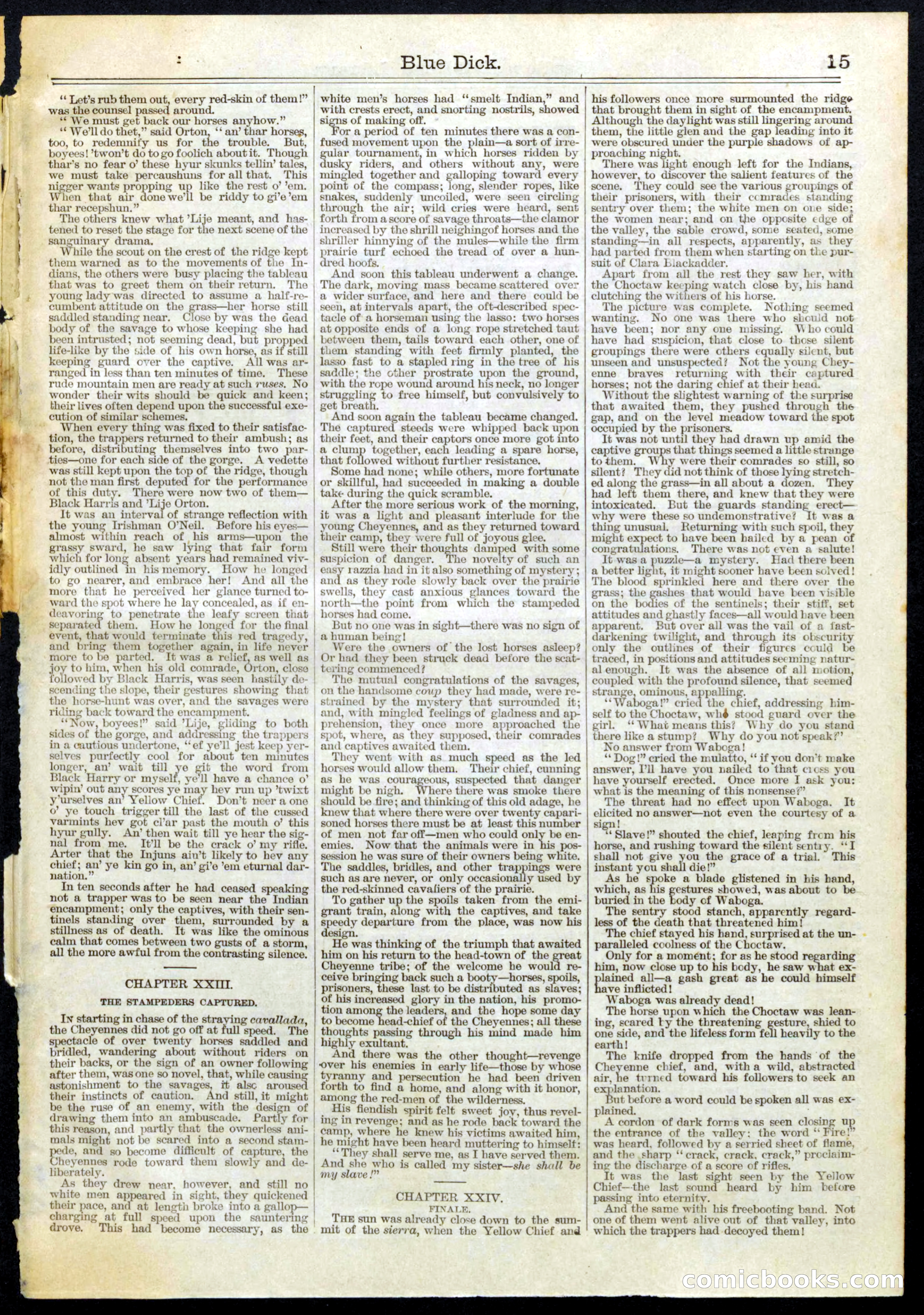
A restored page from Pulp Fiction, 1879. Page through the whole issue in the reader above.
📄 Transcribed text from this page (OCR, searchable)
Machine-transcribed from the original scan — historical spelling and the odd misread are preserved.
eae FB te was the counsel passed around. ** We must get back our horses anyhow.” ‘** We'll do thet,” said Orton, ‘‘ an’ thar horses, too, to redemnify us for the trouble. But, boyees! ’twon’t do to go foolich aboutit. Though thar’s no fear o’ these hyur skunks tellin’ tales, we must take percaushuns forall that. This nigger wants propping up like the rest o’ ’em. When that air done we'll be riddy to gi’e’em thar recepshun.” The others knew what ’Lije meant, and has- sanguinary drama, While the scout on the crest of the ridge kept them warned as to the movements of the In- dians, the others were busy placing the tableau that was to greet them on their return. The young lady was directed to assume a half-re- cumbent attitude on the grass—her horse still saddled standing near. body of the savage to whose keeping she had been intrusted; not seeming dead, but propped life-like by the side of his own horse, as if still keeping guard over the captive. All was ar- ranged in less than ten minutes of time. These rude mountain men are ready at such ruses. No wonder their wits should be quick and keen; their lives often depend upon the successful exe- cution of similar schemes, When every thing was fixed to their satisfac- tion, the trappers returned to their ambush; as before, distributing themselves into two par- ties—one for each side of the gorge. A vedette was still kept upon the top of the ridge, though not the man first deputed for the performance of this duty. There were now two of them— Black Harris and ’Lije Orton. It was an nhaeval of strange reflection with the young Irishman O’Neil. almost within reach of his arms—upon the | ‘“« Let’s rub them out, every red-skin of them!” | Blue Dick. white men’s horses had ‘smelt Indian,” and with crests erect, and snorting nostrils, showed signs of making off. or a period of ten minutes there was a con- fused movement upon the plain—a sort of irre- gular tournament, in which horses ridden by dusky riders, and others without any, were mingled together and galloping toward every point of the compass; long, slender ropes, like snakes, suddenly uncoiled, were seen circling through the air; wild cries were heard, sent | forth from ascore of savage throats—the clamor tened to reset the stage for the next scene of the | increased by the shrill neighingof horses and the | shriller hinnying of the mules—while the firm Close by was the dead | prairie turf echoed the tread of over a hun- dred hoofs. And soon this tableau underwent a change. The dark, moving mass became scattered over a wider surface, and here and there could be seen, at intervals apart, the oft-described spec- tacle of a horseman using the lasso: two horses | at opposite ends of a long rope stretched taut Before his eyes— | grassy sward, he saw lying that fair form | which for long absent years had remained viv- | idly outlined in hismemory. How he longed to go nearer, and embrace her! And all the more that he perceived her glance turned to- ward the spot where he lay concealed, as if en- deavoring to penetrate the leafy screen that separated them. How he longed for the final event, that would terminate this red tragedy, and bring them together again, in life never more to be parted. It was a relief, as well as joy to him, when his old comrade, Orton, close followed by Black Harris, was seen hastily de- scending the slope, their gestures showing that the horse-hunt was over, and the savages were riding back toward the encampment. ‘**Now, boyees!” said ’Lije, gliding to both sides of the gorge, and addressing the trappers Black Harry or myself, ye'll have a chance o’ between them, tails toward each other, one of them standing with feet firmly planted, the lasso fast to a stapled ring in the tree of his saddle; the other prostrate upon the ground, with the rope wound around his neck, no longer struggling to free himself, but convulsively to get breath. And soon again the tableau became changed. The captured steeds were whipped back upon their feet, and their captors once more got into a clump together, each leading a spare horse, that followed without further resistance. Some had none; while others, more fortunate or skillful, had succeeded in making a double take during the quick scramble. After the more serious work of the morning, it was a light and pleasant interlude for the young Cheyennes, and as they returned toward their camp, they were full of joyous glee. Still were their thoughts damped with some suspicion of danger. The sovelty of such an won| razzia had in it also something of mystery ; and as they rode slowly back over the prairie swells, they cast anxious glances toward the north—the point from which the stampeded horses had come. jut no one was in sight—there was no sign of a human being! Were the owners of the lost horses asleep? Or had they been struck dead before the scat- tering commenced? The mutual congratulations of the savages, on the handsome coup they had made, were re- strained by the mystery that surrounded it; and, with mingled feelings of gladness and ap- | prehension, they once more approached the | spot, where, as they supposed, their comrades in a cautious undertone, “ef ye’ll jest keep yer- | selves purfectly cool for about ten minutes | longer, an’ wait till ye git the word from | wipin’ out any scores ye may hev run up ’twixt | y’urselves an’ Yellow Chief. Don’t neer a one 0’ ye touch trigger till the last of the cussed varmints hev got cl’ar past the mouth o’ this hyur gully. An’ then wait till ye hear the sig- nal from me. It'll be the crack o’ my rifle. Arter that the Injuns ain’t likely to hev any chief; an’ ye kin go in, an’ gi’e ’em eturnal dar- nation.” In ten seconds after he had ceased speaking not a trapper was to be seen near the Indian encampment; only the captives, with their sen- tinels standing over them, surrounded by a stillness as of death. It was like the ominous calm that comes between two gusts of a storm, all the more awful from the contrasting silence. CHAPTER XXTII. THE STAMPEDERS CAPTURED. In starting in chase of the straying cavallada, the Cheyennes did not go off at full speed. The tacle of over twenty horses saddled and bridled, wandering about without riders on their backs, or the sign of an owner following after them, was one so novel, that, while causin astonishment to the savages, it alsc aroused their instincts of caution. And still, it might be the ruse of an enemy, with the design of drawing them into an ambuscade. Partly for this reason, and partly that the ownerless ani- mals might not be scared into a second stam- “le, and so become difficult of capture, the sheyennes rode toward them slowly and de- liberately. As they drew near, however, and still no white men appeared in sight, they quickened their pace, and at length broke into a gallop— charging at full speed upon the sauntering drove. This had become necessary, as the and captives awaited them. They went with as. much speed as the led horses would allow them. Their chief, cunning as he was courageous, suspected that danger might be nigh. ‘here there was smoke there should be fire; and thinking of this old adage, he knew that where there were over twenty capari- soned horses there must be at least this number of men not far off—men who could only be en- emies. Now that the animals were in his pos- session he was sure of their owners being white. The saddles, bridles, and other trappings were such as are never, or only oncadionnih y used by the red-skinned cavaliers of the prairie. To gather up the spoils taken from the emi- grant train, along with the captives, and take cpeoly departure from the place, was now his esign. He was thinking of the triumph that awaited him on his return to the head-town of the t Cheyenne tribe; of the welcome he would re- ceive bringing back such a booty—horses, spoils, prisoners, these last to be distributed as slaves; of his increased glory in the nation, his promo- tion among the leaders, and the hope some day to become head-chief of the Cheyennes; all these thoughts passing through his mind made him highly exultant. And there was the other thought—revenge ‘over his enemies in early life—those by whose tyranny and persecution he had been driven forth to find a home, and along with it honor, among the red-men of the wilderness. _ His fiendish spirit felt sweet joy, thus revel- ing in revenge; and as he rode back toward the camp, where he knew his victims awaited him, he might have been heard muttering to himself: ‘* They shall serve me, as I have served them. And she who is called my sister—she shall be my slave !” CHAPTER XXIV. FINALE, THE sun was already close down to the sum- mit of the sierra, when the Yellow Chief and i5 his followers once more surmounted the ridge that brought them in sight of the encampment. Although the daylight was still lingering around them, the little glen and the gap leading into it were obscured under the purple shadows of ap- proaching night. There was light enough left for the Indians, however, to discover the salient features of the scene. They could see the various groupings of their prisoners, with their ccmraces standing sentry over them; the white men on one side; the women near; and on the opposite cdge of the valley, the sable crowd, some seated, some standing—in all respects, apparently, as they had parted from them when starting on the pur- suit of Clara blackadder. Apart from all the rest they saw her, with the Choctaw keeping watch close by, his hand clutching the withers of his horse. The picture was complete. Nothing seemed wanting. No one was there who should not have been; nor any one missing. Who could have had suspicion, that close to those silent groupings there were others equally silent, but unseen and unsuspected? Not the young Chey- enne braves returning with their captured horses; not the daring chief at their head. Without the slightest warning of the surprise that awaited them, they pushed through the gap, and on the level meadow toward the spot occupied by the prisoners. lt was not until they had drawn up amid the captive groups that things seemed a little strange tothem. Why were their comrades so still, so silent? They did not think of those lying stretch- ed along the grass—in all about a dozen. They had left them there, and knew that they were intoxicated. But the guards standing erect— why were these so undemonstrative? It was a thing unusual. Returning with such spoil, they might expect to have been hailed by a pean of congratulations. There was not even a salute! It was a puzzle—a mystery. Had there been a better light, it might sooner have been solved! The blood sprinkled here and there over the grass; the gashes that would have been visible on the bodies of the sentinels; their stiff, set attitudes and ghastly faces—all would have been apparent. But over all was the vail of a fast- darkening twilight, and through its obscurity only the outlines of their figures could be traced, in positions and attitudes seeming natur- alenough. It was the absence of all motion, coupled with the profound silence, that seemed strange, ominous, appalling. **Waboga!” cried the chief, addressing him- self to the Choctaw, whé stood guard over the girl. ‘* What means this? Why do you stand there like a stump? Why do you not speak?’ No answer from Waboga! ‘* Dog!” cried the mulatto, ‘‘ if you don’t make answer, Till have you nailed to that cioss you have yourself erected. Once more I ask you: what is the meaning of this nonsense?” The threat had no effect upon Waboga. It elicited no answer—not even the courtesy of a sign ! ss Slave!” shouted the chief, leaping from his horse, and rushing toward the silent sentry. ‘I shall not give Me: the grace of a trial. This instant you shall die!” As he spoke a blade glistened in his hand, which, as his gestures showed, was about to be buried in the body of Waboga. The sentry stood stanch, apparently regard- less of the death that threatened him! The chief stayed his hand, surprised at the un- paralleled coolness of the Choctaw. Only for a momént; for as he stood nears him, now close up to his body, he saw what ex- ee all—a gash great as he could himself ve inflicted! Waboga was already dead! The horse upon which the Choctaw was lean- ing, scared ty the threatening gesture, shied to one side, and the lifeless form fell heavily to the earth! The knife dropped from the hands of the Cheyenne chief, and, witha wild, abstracted air, he tvrned toward his followers to seek an explanation. ut before a word could be plained. A cordon of dark forms was seen closing up the entrance of the valley: the word ‘ Fire!” was heard, followed by a serried sheet of flame, and the .sharp ‘‘ crack, crack, crack,” proclaim- ing the discharge of a score of rifles. It was the last sight seen by the Yellow Chief—-the last sound heard by him before passing into eternity. And the same with his freebooting band. Not one of them went alive out of that valley, into which the trappers had decoyed them! spoken all was ex- EORNIE DOO KS Cc (E€@)