
Pulp Fiction, 1879 · page 13 of 16
Beadle's Half Dime Library, Vol. III, No. 78 — page 13: what you’re looking at
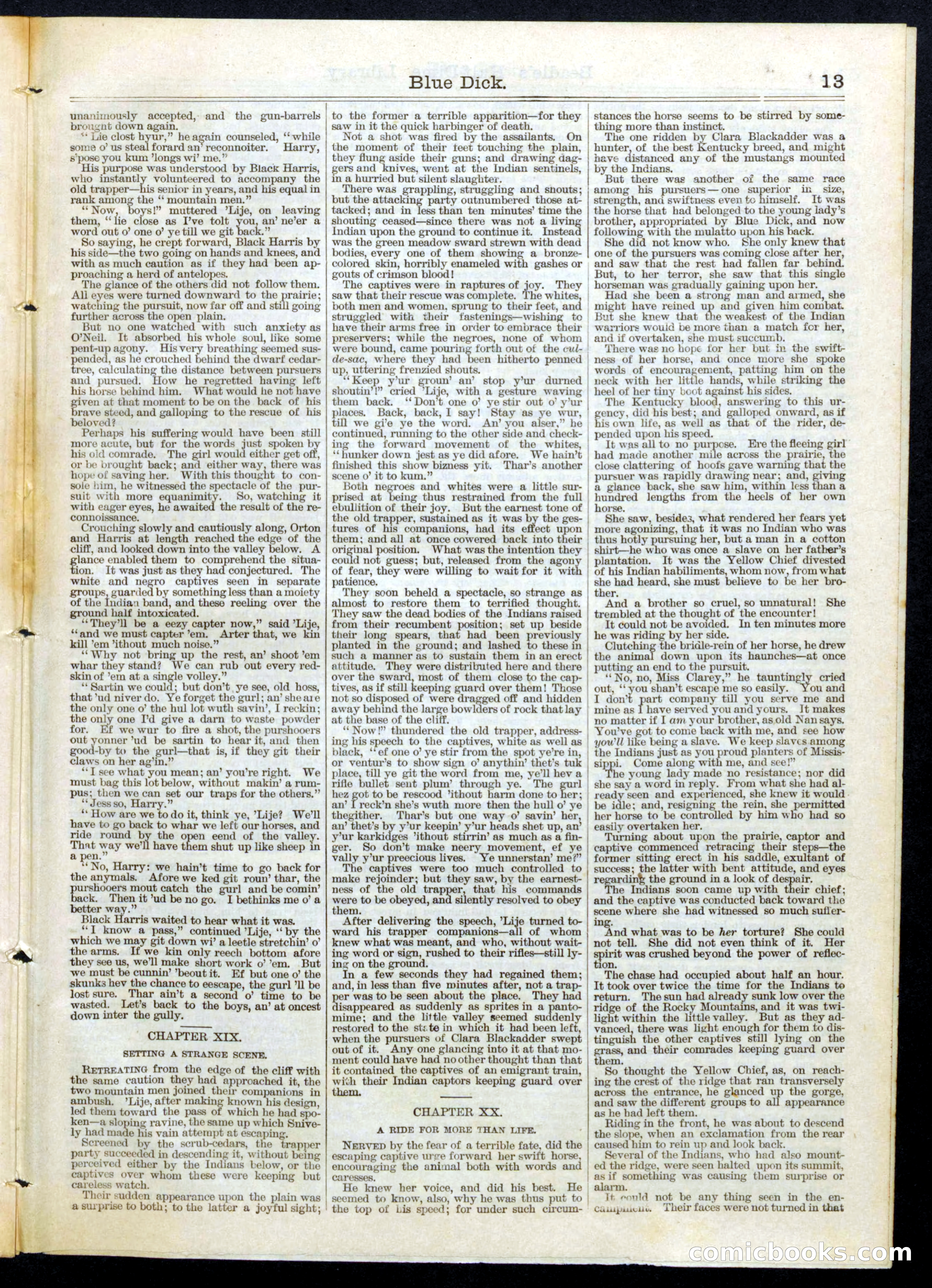
A restored page from Pulp Fiction, 1879. Page through the whole issue in the reader above.
📄 Transcribed text from this page (OCR, searchable)
Machine-transcribed from the original scan — historical spelling and the odd misread are preserved.
—” o-<) am -_—— oo — Blue Dick. unanimously accepted, and the gun-barrels to the former a terrible apparition—for they brought down again. ** Lie clost hyur,” he again counseled, ‘* while some o’ us steal forard an’ reconnoiter. Harry, s’pose you kum ’longs wi’ me.” His purpose was understood by Black Harris, who Soumer volunteered to accompany the old trapper—his senior in years, and his equal in rank among the ‘‘ mountain men.” ** Now, ys!” muttered ’Lije, on leaving them, ‘“‘lie close as I’ve tolt you, an’ ne’er a word out 0’ one o’ ye till we git ack.” So saying, he crept forward, Black Harris by his side—the two going on hands and knees, and with as much caution as if they had been ap- proaching a herd of antelopes. The glance of the others did not follow them. All eyes were turned downward to the hare watching the pursuit, now far off and still going further across the open plain. But no one watched with such anxiety as O’Neil. It absorbed his whole soul, like some pent-up agony. Hisvery breathing seemed sus- pended, as he crouched behind the dwarf cedar- tree, calculating the distance between pursuers and pursued. How he regretted having left his horse behind him. What would he not have given at that moment to be on the back of his brave steed, and galloping to the rescue of his beloved? Perhaps his suffering would have been stil] more acute, but for the words just spoken by his old comrade. The girl would either get off, or be brought back; and either way, there was hope of saving her. With this thought to con- sole him, he witnessed the spectacle of the pur- suit with more equanimity. So, watching it with eager eyes, he awaited the result of the re- connoissance. Crouching slowly and cautiously along, Orton and Harris at length reached the edge of the cliff, and looked down into the valley below. A lance enabled them to comprehend the situa- ion. It was just as they had conjectured. The white and negro captives seen in separate groups, guarded by something less than a moiety of the Indian band, and these reeling over the ground half intoxicated. ‘*They’ll be a eezy capter now,” said ’Lije, ‘‘and we must capter’em. Arter that, we kin kill ’em ’ithout much noise.” ‘Why not bring up the rest, an’ shoot ’em whar they stand? We can rub out every red- skin of ’em at a single volley.” ‘**Sartin we could; but don’t ye see, old hoss, that ’ud niver do. Ye forget the gurl; an’ sheare the only one o’ the hul lot wuth savin’, I reckin; the only one I'd give a darn to waste powder for. Ef we wur to fire a shot, the purshooers out yonner ’ud be sartin to hear it, and then good-by to the gurl—that is, if they git their claws on her ag’in.” ‘**T see what you mean; an’ you’re right. We must bag this lot below, without makin’ a rum- pus; then we can set our traps for the others.” ‘‘ Jess so, Harry.” ** How are we to do it, think ye, "Lije? We'll have to go back to whar we left our horses, and ride round by the open eend of the valley. That way we'll have them shut up like sheep in a pen. ‘No, Harry: we hain’t time to go back for the anymals. Afore we ked git roun’ thar, the urshooers mout catch the gurl and be comin’ ck. Then it ’ud be no go. I bethinks me o’ a better way.” Black Harris waited to hear what it was. ‘I know a pass,” continued ’Lije, ‘‘ by the which we may git down wi’ a leetle stretchin’ o’ the arms. If we kin only reech bottom afore they see us, we'll make short work o’’em. But we must be cunnin’ ’beoutit. Ef but one o’ the skunks hev the chance to eescape, the gurl ’Il be lost sure. Thar ain’t a second o’ time to be wasted, Let’s back to the boys, an’ at oncest down inter the gully. oan CHAPTER XIX, SETTING A STRANGE SCENE. RETREATING from the edge of the cliff with the same caution they had approached it, the two mountain men joined thelr companions in ambush, ’Lije, after oe known his design, led them toward the pass of which he had spo- ken—a sloping ravine, the same up which Snive- ly had made his vain attempt at escaping. Screened by the scrub-cedars, the trapper party succeeded in descending it, without being perceived either by the Indians below, or the captives over whom these were keeping but careless watch. Their sudden appearance upon the plain was a surprise to both; to the latter a joyful sight; | saw in it the quick harbinger of death. Not a shot was fired by the assailants. On the moment of their teet touching the plain, they flung aside their guns; and drawing dag- gers and knives, went at the Indian sentinels, in a hurried but silent slaughter. There was grappling, struggling and shouts; but the attacking party outnumbered those at- tacked; and in less than ten minutes’ time the shouting ceased—since there was not a living Indian upon the ground to continue it. Instea was the green meadow sward strewn with dead bodies, every one of them showing a bronze- colored skin, horribly enameled with gashes or gouts of crimson blood! The captives were in raptures of joy. They saw that their rescue was complete. The whites both men and women, sprung to their feet, and struggled with their fastenings—wishing to have their arms free in order to embrace their preservers; while the negroes, none of whom were bound, came pouring forth out of the cul- de-sac, where they had been hitherto penned up, uttering frenzied shouts. ‘‘Keep y’ur groun’ an’ stop y’ur durned shoutin’!” cried *Lije, with a gesture waving them back. ‘‘ Don’t one o’ ye stir out o’ y’ur places. Back, back, 1 say! Stay as ye wur, till we gi’e ye the word. An’ you alser,” he continued, running to the other side and check- ing the forward movement of the whites, ‘‘hunker down jest as ye did afore. We hain’t finished this show bizness yit. Thar’s another scene o’ it to kum.” ~13 | stances the horse seems to be stirred by some- ' | | | thing more than instinct. The one ridden by Clara Blackadder was a hunter, of the best Kentucky breed, and might have distanced any of the mustangs mounted by the Indians. But there was another of among his pursuers—one superior size, strength, ana swiftness even to himself. It was the horse that had belonged to the young lady’s brother, appropriated by Blue Dick, and now following with the mulatto upon his back. She did not know who. She only knew that one of the pursuers was coming close after her, and saw that the rest had fallen far behind. But, to her terror, she saw that this single horseman was gradually gaining upon her. Had she been a strong man and armed, she might have reined up and given him combat. But she knew that the weakest of the Indian warriors would be more than a match for her, and if overtaken, she must succumb. There was no hope for her but in the swift- ness of her horse, and once more she spoke words of encouragement, patting him on the neck with her little hands, while striking the heel of her tiny boot against his sides. The Kentucky blood, answering to this ur- the same race in ' gency, did his best; and galloped onward, as if his own life, as well as that of the rider, de- pended upon his speed. It was all to no purpose. Ere the fleeing girl had made another ae across the prairie, the close clattering of hoofs gave warning that the | pursuer was rapidly drawing near; and, giving Both negroes and whites were a little sur- | prised at being thus restrained from the full ebullition of their joy. But the earnest tone of the old trapper, sustained as it was by the ges- tures of his companions, had its effect Spon them: and all at once cowered back into their | original position. could not guess; but, released from the agony What was the intention they | of fear, they were willing to wait for it with | patience. They soon beheld a spectacle, so strange as almost to restore them to terrified thought. They saw the dead bodies of the Indians raised from their recumbent position; set up beside their long spears, that had been previously planted in the ground; and lashed to these in such a manner as to sustain them in an erect attitude. They were distributed here and there over the sward, most of them close to the cap- tives, as if still keeping guard over them! Those not so disposed of were dragged off and hidden away behind the large bowlders of rock that lay at the base of the cliff. ‘* Now!” thundered the old trapper, address- ing his speech to the captives, white as well as black, ‘‘ef one o’ ye stir from the spot ye’re in, or ventur’s to show sign o’ anythin’ thet’s tuk place, till ye git the word from me, ye’ll hev a rifle bullet sent plum’ through ye. The gurl hez got to be rescood ’ithout harm done to her; an’ I reck’n she’s wuth more then the hull o’ ye thegither. Thar’s but one way 0’ savin’ her, an’ thet’s by y’ur keepin’ y’ur heads shet up, an’ y’ur karkidges ’ithout stirrin’ as much as a fin- ger. So don’t make neery movement, ef ye vally y’ur preecious lives. Ye unnerstan’ me?’ The captives were too much controlled to make rejoinder; but they saw, by the earnest- ness of the old trapper, that his commands et to be obeyed, and silently resolved to obey them. After delivering the speech, ’Lije turned to- ward his trapper companions—all of whom knew what was meant, and who, without wait- ing word or sign, rushed to their rifles—still ly- ing on the ground. In a few seconds they had regained them; and, in less than five minutes after, not a trap- r was to be seen about the place. They had disappeared as suddenly as sprites in a panto- mime; and the little valley seemed sudden! restored to the st«te in which it had been left, when the pursuers of Clara Blackadder swept out of it. Any one glancing into it at that mo- ment could have had no other thought than that it contained the captives of an emigrant train, ie their Indian captors keeping guard over ™m. CHAPTER XX. A RIDE FOR MORE THAN LIFE. NERVED by the fear of a terrible fate, did the escaping captive urce forward her swift horse, encouraging the animal both with words and Caresses. He knew her voice, and did his best. He a glance back, she saw him, within less than a hundred lengths from the heels of her own horse. She saw, besides, what rendered her fears yet more agonizing, that it was no Indian who was thus hotly pursuing her, but a man in a cotton shirt—he who was once a slave on her father’s plantation. It was the Yellow Chief divested of his Indian habiliments, whom now, from what she had heard, she must believe to be her bro- ther. She And a brother so cruel, so unnatural! trembled at the thought of the encounter! It could not be avoided. In ten minutes more _ he was riding by her side. Clutching the bridle-rein of her horse, he drew the animal down upon its haunches—at once putting an end to the pursuit. ‘*No, no, Miss Clarey,” he tauntingly cried out, ‘‘ you shan’t escape me so easily. ou and I don’t part company till you serve me and mine as | have served youand yours. It makes no matter if I am your brother, as old Nan says. You’ve got to come back with me, and see how yow ll like being a slave. We keep slaves among the Indians just as you proud planters of Missis- i. Come along with me, and see!” — ( | he young lady made no resistance; nor did | | | ‘ y | | | | | | | seemed to know, also, why he was thus put to | ‘the top of Lis speed; for under such circum- she say a word in reply. From what she had al- ready seen and experienced, she knew it would be idle; and, resigning the rein, she permitted her horse to be controlled by him who had so easily overtaken her. Turning about upon the prairie, captor and captive commenced retracing their steps—the former sitting erect in his saddle, exultant of success; the latter with bent attitude, and eyes regardint the ground in a look of despatr, The Indians soon came up with their chief; and the captive was conducted back toward the scene where she had witnessed so much sufler- ing. aad what was to be her torture? She could not tell. She did not even think of it. Her irit was crushed beyond the power of reflec- tion. The chase had occupied about half an hour. It took over twice the time for the Indians to return. The sun had already sunk low over the ridge of the Rocky Mountains, and it was twi- light within the little valley. But as they ad- vanced, there was light enough for them to dis- tinguish the other captives still lying on the grass, and their comrades keeping guard over them. So thought the Yellow Chief, as, on reach- ing the crest of the ridge that ran transversely across the entrance, he glanced up the gorge, and saw the different groups to all appearance as he bad left them. Riding in the front, he was about to descend the slope, when an exclamation from the rear caused him to rein up and look back. Several of the Indians, who had also mount- ed the ridge, were seen halted upon its summit, as if something was causing them surprise or alarm. it eonld not be any thing seen in the en- Caiupaswcus, Their faces were not turned in that ECORVICLOOOKS (G ———e ae eee « eek . Ao re a €om