
Pulp Fiction, 1879 · page 11 of 16
Beadle's Half Dime Library, Vol. III, No. 78 — page 11: what you’re looking at
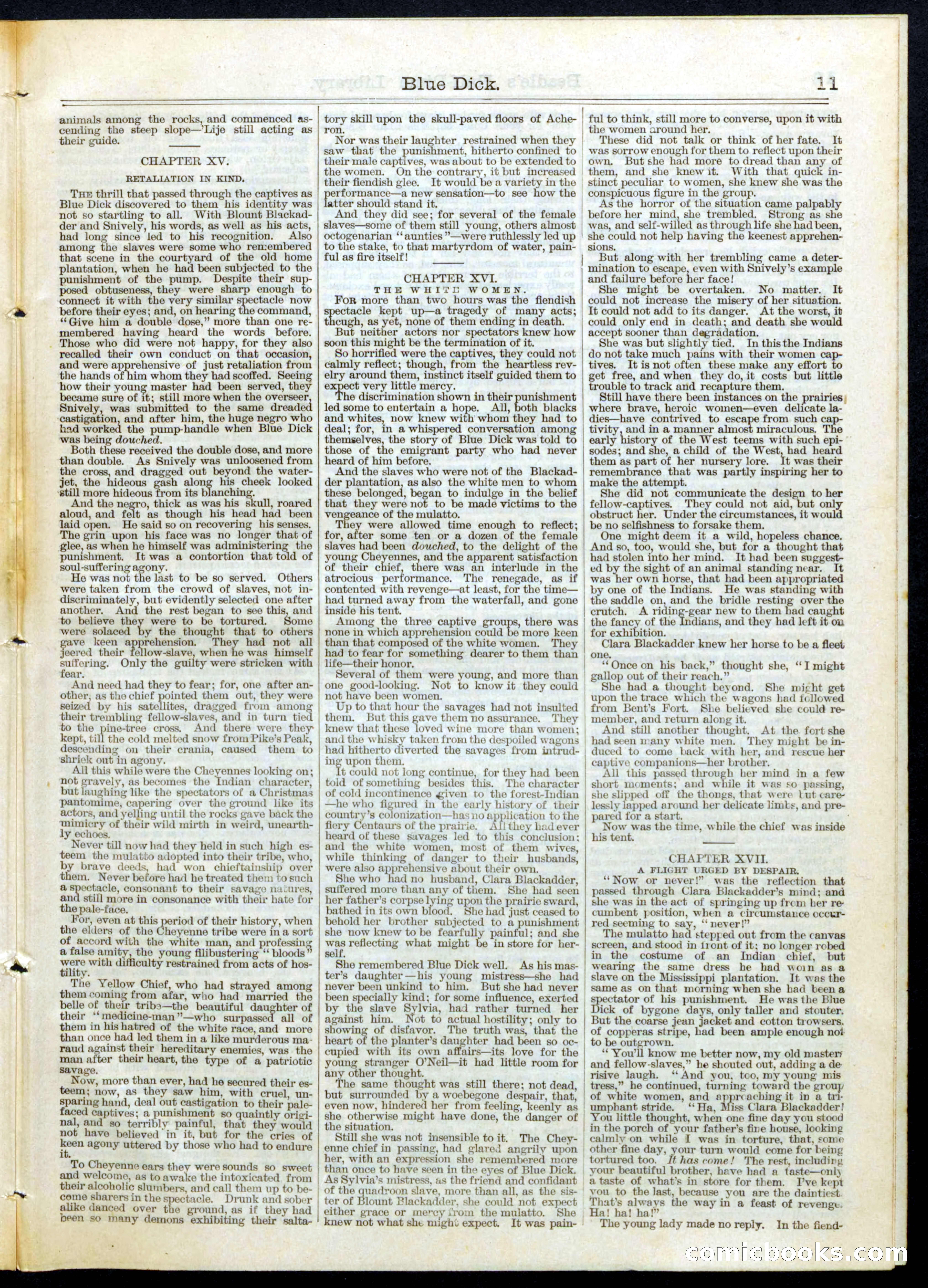
A restored page from Pulp Fiction, 1879. Page through the whole issue in the reader above.
📄 Transcribed text from this page (OCR, searchable)
Machine-transcribed from the original scan — historical spelling and the odd misread are preserved.
their guide. Blue Dick. animals among the rocks, and commenced as- cending the steep slope—’Lije still acting as CHAPTER XV. RETALIATION IN KIND, Tue thrill that passed through the captives as Blue Dick discovered to them his identity was not so startling to all. With Blount Blackad- der and Snively, his words, as well as his acts, had long since led to his recognition. Also among the slaves were some who remembered that scene in the courtyard of the old home plantation, when he had been subjected to the punishment of the pump. Despite their sup- posed obtuseness, they were sharp enough to connect it with the very similar spectacle now before their eyes; and, on hearing the command, “Give him a double dose,” more than one re- membered having heard the words before. _ Those who did were not happy, for they also recalled their own conduct on that occasion, and were apprehensive of just retaliation from the hands of him whom they had scoffed. Seeing how their young master had been served, they e sure of it; still more when the overseer Snively, was submitted to the same dread Fee mou! and after him, the huge negro who had worked the pump-handle when Blue Dick was being douched. Both these received the double dose, and more than double. As Snively was unloosened from the cross, and dragged out beyond the water- jet, the hideous gash along his cheek looked ‘still more hideous from its blanching. And the negro, thick as was his skull, roared aloud, and felt as though his head had been laid open. He said so on recovering his senses. The grin upon his face was no longer that of glee, as when he himself was administering the punishment. It was a contortion that told of soul-suffering agony. He was not the last to be so served. Others were taken from the crowd of slaves, not in- discriminately, but evidently selected one after another. And the rest began to see this, and to believe they were to be tortured. ome were solaced by the thought that to others gave keen Seen on had not all jeered their fellow-slave, when he was himself a Only the guilty were stricken with ear. And need had they to fear; for, one after an- other, as the chief pointed them out, they were seized by his satellites, dragged from among their trembling fellow-slaves, and in turn tied to the pine-tree cross, And there were they kept, till the cold melted snow from Pike’s Peak, descending on their crania, caused them to shriek out in agony. All this while were the Cheyennes looking on; not gravely, as becomes the Indian character, but laughing like the spectators of a Christmas pantomime, capering over the ground like its actors, and yelling until the rocks gave back the mimicry of their wild mirth in weird, unearth- ly echoes, Never till now had they held in such high es- teem the mulatto adopted into their tribe, who, by brave deeds, had won chieftainship over them. Never before had he treated them to such a spectacle, consonant to their savage natures, and still more in consonance with their hate for the pale-face. For, even at this period of their history, when the elders of the Cheyenne tribe were ina sort of accord with the white man, and professing a false amity, the young filibustering ‘ bloods’ were with difficulty restrained from acts of hos- y. The Yellow Chief, who had strayed among them coming from afar, who had married the belle of their tribs—the beautiful daughter of their *‘medicine-man”—who surpassed all of them in his hatred of the white race,and more than once had led them in a like murderous ma- raud against their hereditary enemies, was the man after their heart, the type of a patriotic savage. Now, more than ever, had he secured their es- m; now, as they saw him, with cruel, un- sparing hand, deal out castigation to their pale- faced captives; a punishment so quaintly origi- nal, and so terribly painful, that they would not have believed in it, but for the cries of oe agony uttered by those who had to endure To Cheyenne ears they were sounds so sweet and welcome, as to awake the intoxicated from | their alcoholic slumbers, and call them up to be- | come sharers in the spectacle. Drunk and sober alike danced over the ground, as if they had been so many demons ron. il tory skill upon the skull-paved floors of Ache- | ful to think, still more to converse, upon it with the women around her. Nor was their laughter restrained when they | saw that the punishment, hitherto confined to their male captives, was about to be extended to the women. On the contrary, it but increased their fiendish glee. It would be a variety in the rformance—a new sensation—to see how the atter should stand it. And they did see; for several of the female slaves—some of them still young, others almost octogenarian ‘‘aunties ”—were ruthlessly led up to the stake, to that martyrdom of water, pain- ful as fire itself! CHAPTER XVI. THE WHITL WOMEN. For more than two hours was the fiendish spectacle kept up—a tragedy of many acts; theugh, as yet, none of them ending in death. But neither actors nor spectators knew how soon this might be the termination of it. So horrified were the captives, they could not calmly reflect; though, from the heartless rev- elry around them, instinct itself guided them to e t very little mercy. he discrimination shown in their punishment led some to entertain a hope. All, both blacks and whites, now knew with whom they had to deal; for, in a whispered conversation among themselves, the story of Blue Dick was told to those of the emigrant party who had never heard of him before. And the slaves who were not of the Blackad- der plantation, as also the white men to whom these belonged, began to indulge in the belief that they were not to be made victims to the vengeance of the mulatto. They were allowed time enough to reflect; for, after some ten or a dozen of the female slaves had been douched, to the delight of the young Cheyennes, and the apparent satisfaction of their chief, there was an interlude in the atrocious performance. The renegade, as if contented with revenge—at least, for the time— had turned away from the waterfall, and gone inside his tent. These did not talk or think of her fate. It was sorrow enough for them to reflect upon their own. Butshe had more to dread than any of them, and she knew it. With that quick in- stinct peculiar to women, she knew she was the conspicuous figure in the group. As the horror of the situation came palpably before her mind, she trembled. Strong as she was, and self-willed as through life she had been, ' she could not help having the keenest apprehen- sions. But along with her trembling came a deter- | mination to escape, even with Snively’s example _and failure before | | | tivity early | er face! She might be overtaken. No matter. It could not increase the misery of her situation. It could not add to its danger. At the worst, it could only end in death; and death she would accept sooner than degradation. She was but slightly tied. In this the Indians do not take much pains with their women cap- tives. It is not often these make any effort to get free, and when they do, it costs but little trouble to track and recapture them. Still have there been instances on the prairies) where brave, heroic women—even delicate la- dies—have contrived to escape from such cap- and in a manner almost miraculous. The history of the West teems with such epi- sodes; and she, a child of the West, had heard them as part of her nursery lore. It was their remembrance that was partly inspiring her to | _ fellow-captives. make the attempt. She did not communicate the desi They could not aid, to her ut only obstruct her. Under the circumstances, it would | _by one of the Indians. Among the three captive groups, there was | none in which apprehension could be more keen than that composed of the white women. They had to fear for something dearer to them than life—their honor. Several of them were young, and more than one good-looking. Not to know it they could not have been women. Up to that hour the savages had not insulted them. But this gave them no assurance. They knew that these loved wine more than women: and the whisky taken from the despoiled wagons had hitherto diverted the savages from intrud- ing upon them. It could not long continue, for they had been told of something besides this. The character of cold incontinence given to the forest-Indian —he who figured in the early history of their country’s colonization—has no application to the fiery Centaurs of the prairie. Al! they had ever heard of these suvages led to this conclusion: and the white women, most of them wives, while thinking of danger to their husbands, were also apprehensive about their own. She who had no husband, Clara Blackadder, suffered more than any of them. She had seen her father’s corpse lying upon the prairie sward, bathed in its own blood. She had just ceased to behold her brother subjected to a punishment she now knew to be fearfully painful; and she was reflecting what might be in store for her- self, She remembered Blue Dick well. As his mas- | be no selfishness to forsake them. One might deem it a wild, hopeless chance. And so, too, would she, but for a thought that had stolen into her mind. It had been suggest- ed by the sight of an animal standing near. It was her own horse, that had been appropriated He was standing with the saddle on, and the bridle resting over the crutch. A riding-gear new to them had caught the fancy of the Indians, and they had left it oa for exhibition. Clara Blackadder knew her horse to be a fleet one, ‘*Once on his back,” thought she, ‘I might gallop out of their reach.” She had a thought beyond. She might get upon the trace which the wagons had followed from Bent’s Fort. She believed she could re- member, and return along it. And still another thought. had seen many white men. At the. fort she They might be in- duced to come back with her, and rescue her NS ——— ter’s daughter—his young mistress—she had | never been unkind to him. But she had never been specially kind; for some influence, exerted by the slave Sylvia, had rather turned her against him. Not to actual hostility; only to showing of disfavor. The truth was, that the heart of the planter’s daughter had been so oc- captive companions—her brother. All this passed through her mind in a few short moments; and while it was so passing, she slipped off the thongs, that were Lut care- lessly lapped around her delicate limbs, and pre- pared for a start. Now was the time, while the chief was inside his tent. CHAPTER XVII. A FLIGHT URGED BY DESPAIR. ‘“‘Now or never!” was the reflection that passed through Clara Blackadder’s mind; and she was in the act of springing up from her re cumbent position, when a circumstance occer- red seeming to say, “‘ never!” The mulatto had stepped out from the canvas screen, and stood in tront of it: no longer robed in the costume of an Indian chief, but wearing the same dress he had woin as a slave on the Mississippi plantation. It was the same as on that morning when she had beena pry of his punishment. He was the Blue ick of bygone days, only taller and stouter, But the coarse jean jacket and cotton trowsers. of copperas stripe, had been ample enough noi cupied with its own affairs—its love for the | young stranger O’Neil—it had little room for any other thought. The same thought was still there; not dead, but surrounded by a woebegone despair, that, even now, hindered her from feeling, keenly as she otherwise might have done, the danger of the situation. Still she was not insensible toit. The Chey- enne chief in passing, had glared angrily upon her, with an expression she remembered more than once to have seen in the eyes of Blue Dick. As Sylvia’s mistress, as the friend and confidant of the quadroon slave, more than all, as the sis- ter of Blount Blackadder, she could not expect either grace or mercy ‘rom the mulatto. She | 'risive laugh. to be outgrown. ‘** You'll know me better now, my old masters and fellow-slaves,” he shouted out, adding a de “And you, too, my young mis tress,” he continued, turning toward the grou exhibiting their salta-' knew not what she might expect. It was pain- | of white women, and apprceaching it in a tn- umphant stride. ‘Ha, M iss Clara Blackadder! You little thought, when one fine day you stood in the porch of your father’s fine house, looking calmly on while I was in torture, that, some other fine day, your turn would come for being tortured too. Jt has come! The rest, including your beautiful brother, have had a taste—only a taste of what’s in store for them. I’ve kept vou to the last, because you are the daintiest That’s always the way in a feast of revenge. Ha! ha! ha!” The young lady made no reply. In the fiend- COUMICE CS JOO (ECO ere eee ——— oe —s oe tl ee ee — —o 9 ee eee es os ee — —— eee -