
Pulp Fiction, 1878 · page 5 of 16
Beadle's Half Dime Library, No. 58 — page 5: what you’re looking at
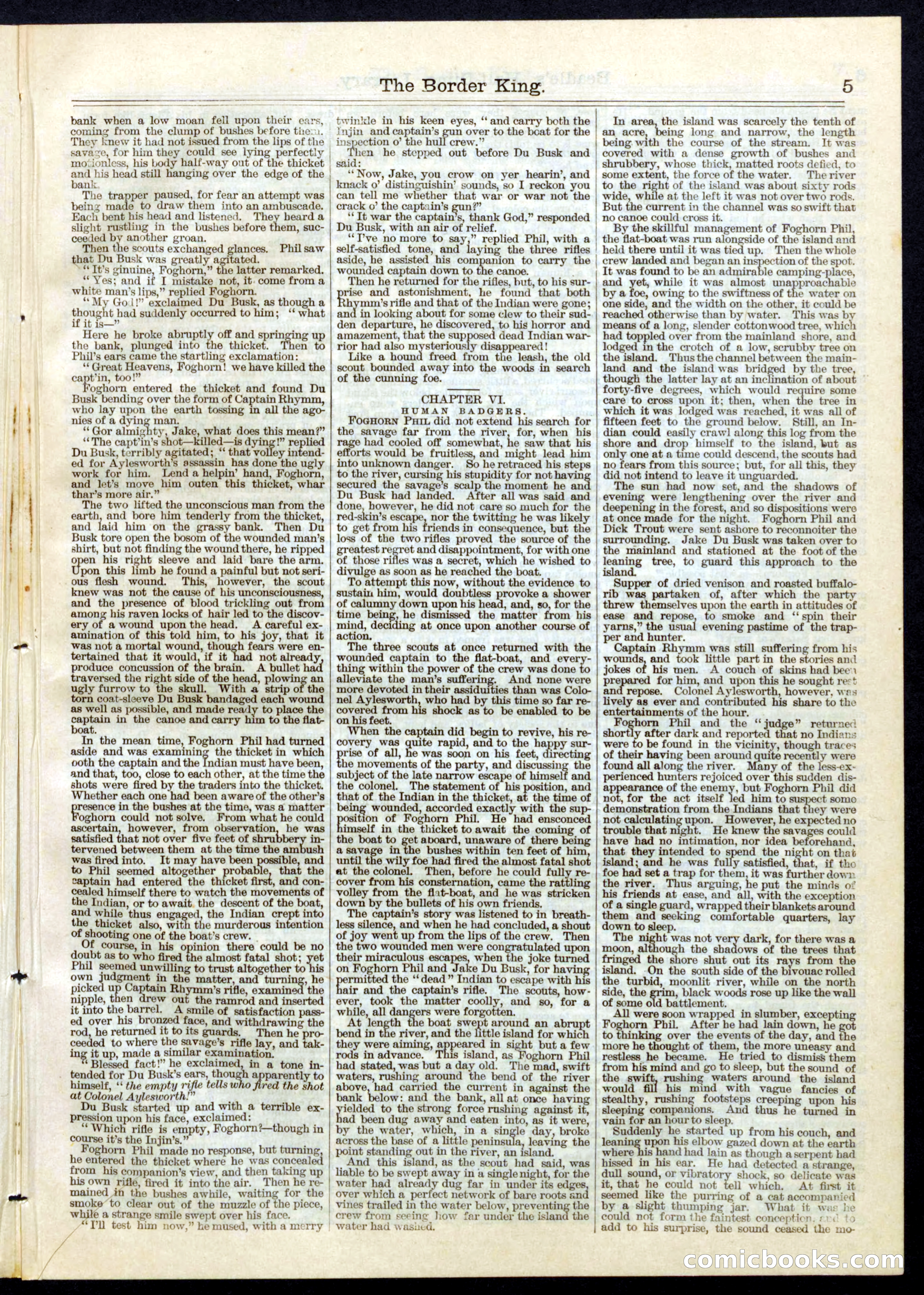
A restored page from Pulp Fiction, 1878. Page through the whole issue in the reader above.
📄 Transcribed text from this page (OCR, searchable)
Machine-transcribed from the original scan — historical spelling and the odd misread are preserved.
—_——_ -—_—_— —- ee ee —-+- — ——— ee bank when a low moan fell upon their ears, coming from the clump of bushes before tines... They knew it had not issued from the lips of the savaze, for him they could see lying perfectly motionless, his body half-way out of the thicket and his head still hanging over the edge of the bank The trapper paused, for fear an attempt was being made to draw them into an ambuscade. Each bent his head and listened. They heard a slight rustling in the bushes before them, suc- ceeded by another groan. Then the scouts exchanged glances. Phil saw | that Du Busk was greatly agitated. *“ Tt’s ginuine, Foghorn,” the latter remarked. “Yes; and if I mistake not, it. come from a white man’s lips,” replied Foghorn. ‘My Gol!” exclaimed Du Busk, as though a rete ta had suddenly occurred to him; ‘ what if it is—” Here he broke abruptly off and springing up the bank, plunged into the thicket. en to Phil’s ears came the startling exclamation: ‘* Great Heavens, Foghorn! we have killed the capt’in, too!” ‘oghorn entered the thicket and found Du Busk bending over the form of Captain Rhymm, who lay upon the earth tossing in all the ago- nies of a dying man. ‘Gor almighty, Jake, what does this mean?” “The capt’in’s shot—killed—is dying!” replied Du Busk, terribly agitated; ‘‘ that volley intend- ed for Aylesworth’s assassin has done the ugly work for him. Lend a helpin’ hand, Foghorn, and let’s move him outen this thicket, whar thar’s more air.” The two lifted the unconscious man from the earth, and bore him tenderly from the thicket, and laid him on the grassy bank. Then Du Busk tore open the bosom of the wounded man’s shirt, but not finding the wound there, he ripped open his right sleeve and laid bare the arm. pon this limb he found a painful but not seri- ous flesh wound. This, however, the scout knew was not the cause of his unconsciousness, and the presence of blood trickling out from among his raven locks of hair led to the discov- ery of a wound upon the head. A careful ex- amination of this told him, to his joy, that it was not a mortal wound, though fears were en- tertained that it would, if it not already produce concussion of the brain. A bullet had traversed the right side of the head, plowing an ugly furrow to the skull. With a strip of the torn coat-sleeve Du Busk bandaged each wound as well as possible, and made cag sag place the — in the canoe and carry to the flat- In the mean time, Foghorn Phil had turned aside and was examining the thicket in which ooth the captain and the Indian must have been, and that, too, close to each other, at the time the shots were fired by the traders into the thicket. Whether each one had been aware of the other’s presence in the bushes at the time, was a matter oghorn could not solve. From what he could ascertain, however, from observation, he was satisfied that not over five feet of shrubbery in- tervened between them at the time the ambush was firedinto. It may have been agg nee and to Phil seemed altogether probable, that the captain had entered the thicket first, and con- cealed himself there to watch the movements of the Indian, or to await. the descent of the boat, and while thus engaged the Indian crept into the thicket also, with the murderous intention of shooting one of the boat’s crew. Of course, in his opinion there could be no doubt as to who fired the almost fatal shot: yet Phil seemed unwilling to trust altogether to his own judgment in the matter, and turning, he picked up Captain Rhymm’s rifle, examined the nipple, then drew out the ramrod and inserted it into the barrel. A smile of satisfaction pass- ed over his bronzed face, and withdrawing the rod, he returned it to its guards, Then he pro- ceeded to where the savage’s rifle lay, and tak- ing it up, made a similar examination. ‘Blessed fact!” he exclaimed, in a tone in- tended for Du Busk’s ears, though apparently to himself, ‘‘ the empty rifle tells w red the shot at Colonel Aylesworth!” Du Busk started up and with a terrible ex- pression upon his face, exclaimed: “Which rifle is empty, Foghorn?-though in course it’s the Injin’s.” Foghorn Phil made no response, but turning he entered the thicket where he was concealed from his companion’s view, and then taking up his own riflé, fired it into the air. Then he re- mained in the bushes awhile, waiting for the smoke’ to clear out of the muzzle of the piece, while a strange smile swept over his face. “Tl test him now,” he mused, with a merry ee The Border King. twinkle in his keen eyes, ‘‘ and carry both the injin and captain’s | yes over to the boat for the inspection o’ the hull crew.” / ‘rea he stepped out before Du Busk and said: can tell me whether that war or war not the crack o’ the captain’s gun?” ‘* It war the captain’s, thank God,” responded Du Busk, with an air of relief. 5 In area, the island was scarcely the tenth of an acre, being long and narrow, the length being. with the course of the stream. It was covered with a dense growth of bushes and | shrubbery, whose thick, matted roots defied, to ‘* Now, Jake, you crow on yer hearin’, and | knack 0’ distinguishin’ sounds, so I reckon you | some extent, the force of the water. Theriver to the right of the island was about sixty rods wide, while at the left it was not over two rods, But the current in the channel was so swift that no canoe could cross it. ‘“T’ve no more to say,” replied Phil, with a | J p self-satisfied tone, and laying the three rifles aside, he assisted his companion to carry the | wounded captain down to the canoe. Then he returned for the rifles, but, to his sur- rise and astonishment, he found that both hymm’s rifle and that of the Indian were gone; and in looking about for some clew to their sud- den departure, he discovered, to his horror and amazement, that the sup ed dead Indian war- rior had also mysteriously disappeared! Like a hound freed from the leash, the old scout bounded away into the woods in search of the cunning foe. CHAPTER VI. HUMAN BADGERS. FOGHORN Pui did not extend his search for the savage far from the river, for, when his rage had cooled off somewhat, he saw that his efforts would be fruitless, and might lead him into unknown danger. So he retraced his steps to the river, cursing his stupidity for not havin secured the savage’s scalp the moment he an Du Busk had landed. After all was said and done, however, he did not care so much for the red-skin’s escape, nor the twitting he was likely to get from his friends in consequence, but the loss of the two rifles proved the source of the greatest regret and disappointment, for with one of those rifles was a secret, which he wished to divulge as soon as he reached the boat. To attempt this now, without the evidence to sustain him, would doubtless provoke a shower of calumny down upon his head, and, so, for the time being, he dismissed the matter from his mind, de ding at once upon another course of action. The three scouts at once returned with the wounded captain to the flat-boat, and every- thing within the power of the crew was done alleviate the man’s suffering. And none were more devoted in their assiduities than was Colo- nel Aylesworth, who had by this time so far re- covered from his shock as to be enabled to be on his feet. When the captain did begin to revive, his re- covery was quite rapid, and to the happy sur- alge of all, he was soon on his feet, directing he movements of the party, and discussing the subject of the late narrow escape of himself and the colonel. The statement of his position, and that of the Indian in the thicket, at the time of being wounded, accorded exactly with the sup- renin of Foghorn Phil. He had ensconced imself in the thicket to await the coming of the boat to get aboard, unaware of there being a savage inthe bushes within ten feet of him until the wily foe had fired the almost fatal shot at the colonel. Then, before he could fully re- cover from his consternation, came the rattling volley from the flat-boat, and he was stricken down by the bullets of his own friends. The captain’s story was listened to in breath- less silence, and when he had concluded, a shout of joy went up from the lips of the crew. Then the two wounded men were congratulated upon their miraculous escapes, when the joke turned on Foghorn Phil and Jake Du Busk, for havi berg oe the ‘“‘dead” Indian to escape with his air and the captain’s rifle. The scouts, how- ever, took the matter coolly, and so, for a while, all dangers were forgotten. At length the boat abe around an abrupt bend in the river, and the little island for which they were aiming, od gp in sight but a few rods in advance. This island, as Foghorn Phil had stated, was but a day old. The mad, swift waters, rushing around the bend of the river above, had carried the current in against the bank below: and the bank, all at once having fe ge to the strong force rushing against it, ad been dug away and eaten into, as it were, by the water, which, in a single day, broke across the base of a little peninsula, leaving the point standing out in the river, an island. _And this island, as the scout had said, was liable to be swept away in a single night, for the water had already dug far in under its edges over which a perfect network of bare roots and vines trailed in the water below, preventing the crew from seeing how far under the island the water had washed. ee — ————_ A By the skillful management of Foghorn Phil, the flat-boat was run alongside of the island and heid there until it was tied up. Then the whole crew landed and began an inspection of the spot. It was found to be an adwhirabie camping-place, and yet, while it was almost apy hed aco by a foe, owing to the swiftness of the water on one side, and the width on the other, it could be reached otherwise than by water. This was by means of a long, slender cottonwood tree, which had toppled over from the mainland shore, and lodged in the crotch of a low, scrubby tree on the island. Thus the channel between the main- land and the island was bridged by the tree, though the latter lay at an inclination of about forty-five degrees, which would require some care to cross upon it; then, when the tree in which it was lodged was reached, it was all of fifteen feet to the ground below. Still, an In- dian could easily craw] along this log from the shore and drop himself to the island, but as only one at a time could descend, the scouts had no fears from this source; but, for all this, they did not intend to leave it unguarded. The sun had now set, and the shadows of evening were lengthening over the river and deepening in the forest, and so dispositions were at once made for the night. Foghorn Phil and Dick Trout were sent ashore to reconnoiter the surrounding. Jake Du Busk was taken over to the mainland and stationed at the foot of the leaning tree, to guard this approach to the island. Supper of dried venison and roasted buffalo- rib was partaken of, after which the party threw themselves upon the earth in attitudes of ease and repose, to smoke and ‘spin their yarns,” the u: evening pastime of the trap- per and hunter. Captain Rhymm was still suffering from his wounds, and took little part in the stories and jokes of his men. A couch of skins had bee" pre for him, and upon this he sought rest and repose. Colonel Aylesworth, however, wes lively as ever and contributed his share to the entertainments of the hour. Foghorn Phil and the ‘ judge” returned shortly after dark and reported that no Indians were to be found in the vicinity, though traces of their having been soa see recently were found all along the river. any of the less-ex- perienced hunters rejoiced over this sudden dis- ap ce of the enemy, but Foghorn Phil did not, for the act itself led him to t somo demonstration from the Indians that they were not calculating upon. However, he expected no trouble that night. He knew the ayer could have had no intimation, nor idea beforehand, that they intended to spend the night on that island; and he was fully satisfied, that, if tho foe had set a trap for them, it was further down the river. Thus arguing, he put the minds of his friends at ease, and all, with the exception of a single guard, wrapped their blankets around them and seeking comfortable quarters, lay down to sleep. The night was not ia dark, for there was a moon, although the shadows of the trees that the shore shut out its rays from the island. On the south side of the bivouac rolled the turbid, moonlit river, while on the north side, the grim, black woods rose up like the wall of some old battlement. All were soon wrapped in slumber, excepting A wal Phil. After he had lain down, he got to thinking over the events of the day, and the more he thought of them, the more uneasy and restless he became. He tried to dismiss them from his mind and go to sleep, but the sound of the swift, rushing waters around the island would his mind with vague fancies of stealthy, rushing footsteps creeping upon his sleeping companions. And thus he turned in vain for an hour to sleep. Suddenly he started up from his couch, and leanin § pan his elbow gazed down at the earth where his hand had lain as though aserpent had hissed in his ear. He had detected a strange, dull sound, or vibratory shock, so delicate was it, that he could not tell which. At first it seemed like the purring of a cat accompanied by a slight thumping jar. What it was he could not form the faintest conception. crc to add to his surprise, the sound ceased the mo- GONG CS ICO (El)