
Pulp Fiction, 1878 · page 4 of 16
Beadle's Half Dime Library, No. 58 — page 4: what you’re looking at
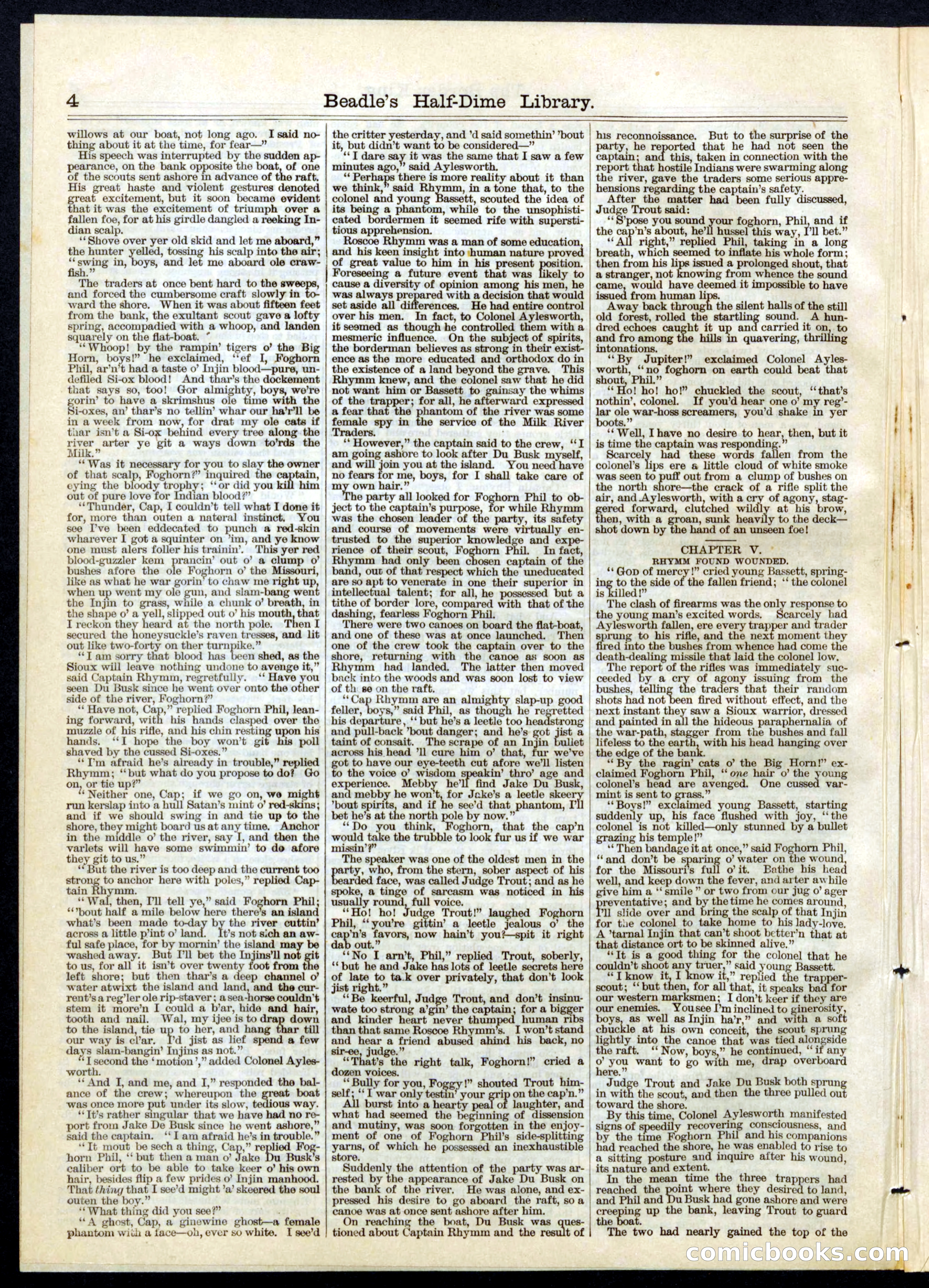
A restored page from Pulp Fiction, 1878. Page through the whole issue in the reader above.
📄 Transcribed text from this page (OCR, searchable)
Machine-transcribed from the original scan — historical spelling and the odd misread are preserved.
ze - —_— -——— _—_———- CT ———- —$— -~-— — willows at our boat, not long ago. I said no- thing about it at the time, for fear—” His speech was interrupted by the sudden ap- pearance, on the bank opposite the boat, of one of the scouts sent ashore in advance of the raft. His great haste and violent gestures denoted great excitement, but it soon became evident that it was the excitement of triumph over a fallen foe, for at his girdle dangled a reeking In- dian scalp. ‘*Shove over yer old skid and let me aboard,” the hunter yelled, tossing his scalp into the air; Pe one in, boys, and let me aboard ole craw- 1 The traders at once bent hard to the swee and forced the cumbersome craft slowly in ward the shore. When it was about fifteen feet from the bank, the exultant scout gave a lofty spring, ac compadied with a whoop, and landen squarely on the flat-boat. ‘“Whoop! by the rampin’ tigers o’ the Big Horn, boys!” he exclaimed, of I, Foghorn Phil, ar’n’t had a taste o’ Injin blood—pure, un- defiled Si-ox blood! And that? ’s the dockement that Says so, too! Gor almighty, boys, we’re gorin’ to have a skrimshus ole time with the Si-oxes, an’ thar’s no tellin’ whar our ha’r’ll be in a week from now, for drat my ole cats if thar isn’t a Si-ox behind every tree along the river arter ye git a ways down to’rds the Milk.” “Was it necessary for you to slay the owner of that scalp, Foghorn?’ inquired the ve see eying the blc« oody trophy; ‘‘or did you him out of pure love for Indian blood?” ‘Thunder, Cap, I couldn’t tell what I done it for, more than outen a nateral instinct, You see I’ve been eddecated to punch a red-skin wharever I got a squinter on ’im, and ye know one must alers foller his trainin’. This yer red blood-guzzler kem pr ancin’ out 0” a clump o’ bushes afore the ole Foghorn o’ the Missouri, like as what he war gorin’ to chaw me right up when up went my ole gun, and slam-bang went the Injin to grass, while a chunk 0’ breath, in the shape o’ a yell, slipped out o’ his mouth that I reckon they heard at the north pole. Then I secured the eysuckle’s raven tresses, and lit out like two-forty on ther turnpike.” “Tam sorry that blood has te en shed, as the Sioux will leave nothing undone to avenge it,” said Captain Rhymm, regretfully. ‘‘ Have you seen Du Busk since he went over onto the other side of the river, Foghorn?” ‘* Have not, ) Cap,’ ’ replied Foghorn Phil, lean- ing forward, with his hands clasped over the muzzle of his rifle, and his chin resting upon his hands. ‘‘I hope the boy won ‘t git his poll shaved by the cussed Si-oxes.’ ‘‘T’m afraid he’s already in trouble,” replied Rhymm; “ but what do you propose to do? Go on, or tie up?” “ Neither one, Cap; if we go on, We might run kerslap into a hull Satan’s mint 0’ red-skins; and if we should swing in and tie up to the shore, they might board us at any time. Anchor in the middle o’ the river, say I, and then the varlets will have some swimmin’ to do afore they git to us.” ‘* But the river is too deep and the current too stron he anchor here with poles,” replied Cap- tain Wal the then, [ll tell ye,” said Foghorn Phil; ‘bout half a mile below here there's an island what’s been made to-da ki the river cuttin’ across a little p’int o’ land. It’s not sich an aw- ful safe place, for by mornin’ the island may be washed away. But [ll bet the Injins’ll not git to us, for all it isn’t over twenty foot from the left shore; but then thar’s a deep channel o’ water atwixt the island and land, and the cur- rent’sa reg’ler ole rip-staver ; asea- -horse couldn't stem it more’n I could a bar, hide and § rad tooth and nail. Wal, my ijee ‘is to dra down to the island, tie u to her, and hang till our way is evar. I'd jist as lief spend a few day: s slam-bangin’ Injins as not.” ‘I second the ‘motion’,” added Colonel Ayles- worth. ‘* And I, and me, and I,” carina the bal- ance of the crew ; whereupon the t boat ‘Was once more put under its slow, tedious way. ‘‘Tt’s rather singular that we have hod no re- port from Jake De Busk since he went ashore,” said the captain. ‘‘ Iam afraid he’s in trouble.” ‘Tt mout be sech a thing, C ‘ap ” replied Fog- horn Phil, ‘‘ but then a man o’ Jake Busk’s ealiber ort to be able to take keer o’ his own hair, besides flip a few prides o’ Injin manhood. That thi ing that I see’d might ’a ‘skeawed the soul outen the boy.” ‘What thing did you see?” “A ghost, Cap, a ginew ine ghost—a female phantom with a face—oh, ever so white. I see’d of great value to him in his present the critter yesterday, and ‘d said somethin’ ’bout it, but didn’t want to be considered—” «T dare say it was the same that I saw a few minutes ago,” said Aylesworth. . Perhaps there is more reality about it than we think,” said Rhymm, in a tone that, to the colonel and young assett, scouted the idea of its being a phantom, while to the unsophisti- cated bordermen it seemed rife with supersti- tious apprehension. Rhymm was a man of some education and his keen insight into ‘human nature cee ition. Foreseeing a future event that was likely to cause a diversity of opinion among his 3 men, he was ee prepared with a decision that would set aside all rences. He had entire control over his men. In fact, to Colonel Aylesworth, if seamed as though he controlled them with a mesmeric influence. On the subject of spirits, the borderman believes as strong in their exist- ence as the more educated and orthodox do in the existence of a land beyond the grave. This Rhymm knew, and the colonel saw that he did not want him or Bassett to gainsay the whims of the trapper; for all, he afterward expressed a fear that the phantom of the river was some — oa in the service of the Milk River a However, ” the captain said to the crew, “I am going ashore to look after Du Busk myself, and will join you at the island. You need have no fears for me, boys, for I shall take care of my own hair.” he party all looked for Foghorn Phil to ob- ject to the captain’ for while Rhymm was the chosen leader of tl of the party, its safety and course of movements were virtually en- trusted to the superior knowledge and an rience of their scout, Foghorn Phil. In fact, Rhymm had only been chosen captain of the band, out of that respect which the uneducated are so apt to venerate in one their super ior in intellectual talent; for all, he but a tithe of border lore, compared with that of the dashing, fearless Foghorn Phil. There were two canoes on board the flat-boat, and one of these was at once launched. Then one of the crew took the captain over to the shore, returning with the canoe as soon as Rhymm had landed. The latter then moved back into the woods and was soon lost to view of th se on the raft. ‘Cap Rhymm are an almighty slap-up good | feller, boys,” said Phil, as though he regretted his departure, ‘“but he’s a leetle too h trong | and pull- back "bout danger; and he’s got jist a_ taint of consait. The scrape of an Injin across his head ’ll cure him o’ that, got to have our eye-teeth cut afore ‘we'll listen to the voice o’ wisdom in’ thro’ age and experience. Mebby he'll find Jake Du Busk, and mebby he won't, for Jake’s a leetle skee 62) *bout spirits and if he see’d that phantom, YP bet he’s at the north pole by now.’ “Do you think, Foghorn, that the cap’n would take the trubble to look fur us if we war missin’?” The speaker was one of the oldest men in the Pearviod who, from the stern, sober aspect of his | ded face, was called J udge Trout; and as ge spoke, a tinge of sarcasm was noticed in usually round, full voice. “Ho! ho! Judge Trout!” laughed Foghorn Phil, “you're gittin’ a leetle jealous o’ the aes iP pale now hain’t you?—spit it right ou ‘*No I arn’t, Phil,” replied Trout, soberly, “but he and Jake has lots of leetle secrets here of eat! ta.k over privately, that don't look jist ‘Be keerful, Judge Trout, and don’t insinu- wate too strong a’gin’ the captain; for a bigger and kinder heart mit thum umped human ribs than that same Roscoe Rhymm’s. I won’t stand and coeatataanl friend ab ahind his back, no rs Se That's the right talk, Foghorn!” cried a dozen voices. ‘‘ Bully for you, Fog gey!” shouted Trout him- self; ‘‘ l war only testin your on the cap’n.” burst into. a hearty Bp laughter, and what had seemed the oe, nee Me of dissension and mutiny, was soon forgotten in the enjoy- ment of one of Foghorn Phil’s side-splitting here of which he possessed an inexhaustible "Suddenly the attention of the party was ar- ted by the appearance of Jake Du Busk on the of the river. He was alone, and ex- pressed his desire to go aboard the raft, soa canoe was at once sent ashore after gore On reaching the boat, Du Busk w tioned about Captain Rhymm and thie Fe ues- t of Beadle’s Half-Dime ee i nN eeeOOEOEOEOEOEOEOEOEOEeEEeEEEeEEE his reconnoissance. But to is? taish' his Wlclicaete, Bat 6 bo ae surprise of the party, he reported that he had not seen the captain; and this, taken in connection with the report t that hostile Indians were swarming along the river, gave the traders some serious appre- hensions regarding the captain’s safety. After the matter had been fully discussed, Judge Trout said: ‘‘S’pose you sound Pf send foghorn, Phil, and if the ca Dn" ’s "abouk, he’ll hussel this way, I'll bet.” right,” replied Phil, taking in a long breath, which seemed to inflate his whole form: : then from his mye issued a prolonged shout, that a stranger, not knowing from whence the sound came, would have deemed it impossible to have issued from human li oe Away back through the silent halls cee the still old forest, rolled the startling sound. A hun- dred echoes caught it Pe an carried it on, to and fro ‘among the. hills in quavering, thrilling intonations. ‘*By Jupiter!” exclaimed Colonel Ayles- hia at) no foghorn on earth could beat that shou “ Ho! hol ho!” chuckled the scout, ‘that’s nothin’, colonel. If you'd hear one o’ my reg’- lar ole war-hoss screamers, you’d shake in yer boots.” ‘* Well, Ihave no desire to hear, then, but it is time the wee was ph ae 7, pcg Atypon these words fallen from the colonel’ ae ere & little cloud of white smoke was seen to puff out from a clump of bushes on the north shore—the crack of a rifle split the air, and. Aylesworth, with a cry of agony, stag- og forward, clutched wil at his brow, ep, with a , sunk heavily to the deck— shot down by e hand of an unseen foe! CHAPTER V. RHYMM FOUND WOUNDED. ‘*Gop of mercy!” cried young Bassett, spring- - ” ber: side of the fallen friend; ‘* the colonel lled !” » The clash of firearms was the only response to the young man’s excited words, Scarcely had Aylesworth fallen, ere every trapper and trader - a to his rifle, and the next moment they ed into the bushes from whence had come the death-dealing missile that laid the colonel low, The report of the Sag was immediately suc- ceeded by a go ay agony issuing from the _ bushes, tellin e traders that their random shots had not been fired without effect, and the next instant they saw a Sioux warrior, dressed and painted in all the hideous paraphernalia of the war-path, ger from the bushes and fall pa ullet | lifeless to the earth, with his head hanging over we've | the edge of the ‘By the ragin’ cats o’ the Big Horn!” ex- claimed Foghorn Phil, ‘‘ one hair o’ the young colonel’s head are avenged. One c var- mint is sent to hee “Boys!” exclaimed young Bassett, starting suddenly up, “his face flushed with joy, “the colonel is not killed—only stunned by a bullet grazing his temple!” ‘*Then bandage a at once, ” said Foghorn Phil, ‘and don’t be s o’ water on the wound. for the Missouri’s ‘ful oit. Bathe his head well, and keep down the fever, and arter aw hile _ give him a ‘“‘ smile” or two from our jug 0’ ager reventative; and by the time he comes around, I] slide over and bring the scalp of that Injin for the colonel to take home to his lady -love. A ’tarnal Injin that can’t shoot better’ n that at that distance ort to be skinned alive.” “Tt is a good ening for the colonel that he couldn’t shoot any truer,” said youn Bassett. ‘“T know it, I know it,” replied the trap scout; *‘ but then, for all that, it speaks for our western marksmen; I don’t keer if they are our enemies. Yousee I’m inclined to ginerosity, boys, as ho logge Sp ha’r,” and with a soft chuckle at hi own conceit, the scout sprung lightly into the canoe that was tied moe side ap raft. ‘ Now, boys, ” he continued, “‘if any . 0’ you want to go with me, drap overboard ere.’ Judge Trout and Jake Du Busk both sprung in wit “he scout, and then the three pulled out toward the shore. By this time, Colonel Aylesworth manifested signs of ily recovering consciousness, and by the time Foghorn Phil and his companions had reached the shore, he was enabled to rise to a sitting posture and inquire after his wound, its nature and extent. In the mean time the three trappers had reached the point where they desired to land, and Phil and b Pek had gone ashore and were Fry oe 4 up the bank, leaving Trout to guard The two had nearly gained the top of the Gomicvooks co be +f i