
Pulp Fiction, 1878 · page 6 of 16
Beadle's Half Dime Library, No. 58 — page 6: what you’re looking at
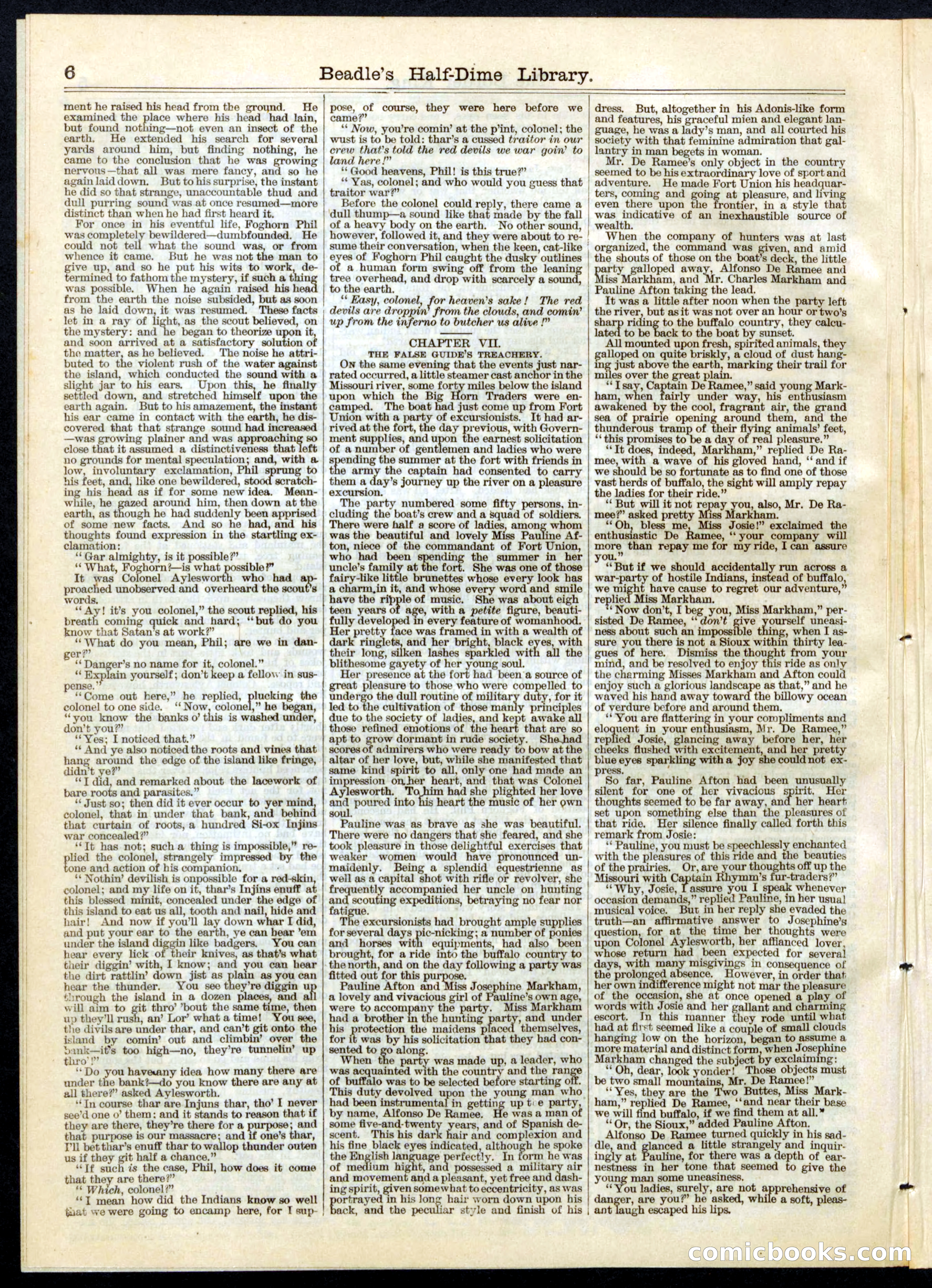
A restored page from Pulp Fiction, 1878. Page through the whole issue in the reader above.
📄 Transcribed text from this page (OCR, searchable)
Machine-transcribed from the original scan — historical spelling and the odd misread are preserved.
| | } 1 1 7 i 6 ment he raised his head from the ground. He examined the place where his head had lain, but found celitaeotok even an insect of the earth, He extended his search for several yards around him, but finding nothing, he came to the conclusion that he was growing nervous —that all was mere fancy, and so he again laiddown. But to his surprise, the instant he did so that strange, unaccountable thud and dull purring sound was at once resumed—more distinct than when he had first heard it. For once in his eventful life, Foghorn Phil was per bewildered—dumbfounded. He could not tell what the sound was, or from whence it came. But he was not the man to give up, and so he put his wits to work, de- termined to fathom the mystery, if such a thin was possible. When he again raised his h from the earth the noise subsided, but as soon | as he laid down, it was resumed. These facts , pose, of course, they were here before we came?” ‘* Now, you're comin’ at the p’int, colonel; the wust is to be told: thar’s a cussed traitor in our crew that’s told the red devils we war goin’ to land here !” ‘** Good heavens, Phil! is this true?” ** Yas, colonel; and who would you guess that traitor war?” Before the colonel could reply, there came a dull thump—a sound like that made by the fall _of a heavy body on the earth. No other sound, however, followed it, and they were about to re- sume their conversation, when the keen, cat-like | eyes of Foghorn Phil caught the dusky outlines of a human form swing off from the leanin tree overhead, and drop with scarcely a soun to the earth. The red ** Kasy, colonel, for heaven's sake ! devils are droppin’ from the clouds, and comin’ let in a ray of light, as the scout believed, on | up from the inferno to butcher us alive !” the mystery: and he began to theorize upon it, and soon arrived at a satisfactory heise of the matter, as he believed. The noise he attri- buted to the violent rush of the water against the island, which conducted the sound with a slight jar to his ears. Upon this, he finally settled down, and stretched himself upon the earth again. But to his amazement, the instant his ear came in contact with the earth, he dis- covered that that strange sound had increased —was growing plainer and was approaching so close that it assumed a distinctiveness that left no grounds for mental speculation; and, with a low, involuntary exclamation, Phil sprung to his feet, and, like one bewildered, s scratch- ing his head as if for some new idea. Mean- while, he gazed around him, then down at the earth, as though he had suddenly been apprised of some new facts. And so he had, and his thoughts found expression in the startling ex- sg ot rie ar almighty, is it possible? ** What, Pe t~is what possible?” It was Colonel Aylesworth who had a proached unobserved and overheard the scout’s words. ‘‘ Ay! it’s you colonel,” the scout replied, his breath coming quick and hard; “but do you know that Satan’s at work?” ‘‘ What do you mean, Phil; are we in dan- er?” ‘*Danger’s no name for it, colonel.” = Explain yourself; don’t keep a fellow in sus- pense. ’ ‘Come out here,” he replied, cy eme the colonel to one side. ‘‘ Now, colonel,” he began, “vou know the banks o’ this is washed under, don’t you?’ ‘* Yes; I noticed that.” ‘* And ye also noticed the roots and vines that hang around the edge of the island like fringe, didn’t ye?” ‘“T did, and remarked about the lacework of bare roots and parasites.” ‘“‘ Just so; then did it ever occur to yer mind colonel, that in under that bank, and behind that curtain of roots, a hundred Si-ox Injins war concealed?” ‘*Tt has not; such a thing is impossible,” re- lied the colonel, strangely impressed by the one and action of his companion. ‘* Nothin’ devilish is onpossible for a red-skin, colonel; and my life on it, thar’s Injins enuff at this blessed minit, concealed under the edge of this island to eat us all, tooth and nail, hide and hair! And now if you'll lay down whar I did, and put your ear to the earth, ye can bear ’em under the island diggin like badgers. You can hear every lick of their knives, as that’s what their diggin’ with, I know; and you can hear the dirt rattlin’ down jist as pl as you can hear the thunder. You see they’re diggin - ‘hrough the island in a dozen places, and will aim to git thro’ bout the same time, then up they’ll rush, an’ Lor’ what a time! ‘You see, the divils are under thar, and can’t git onto the island by comin’ out and climbin’ over the bank—its too high—no, they’re tunnelin’ up thro’ !”’ ‘Do you haveany idea how many there are under the bank?—do you know there are any at all there?’ asked Aylesworth. ‘‘In course thar are Injuns thar, tho’ I never see’d one o’ them: and it stands to reason that if they are there, they’re there for a purpose) and that purpose is our massacre; and if one’s thar, Vl betthar’s enuff thar to wallop thunder outen us if they git half a chance,” “Tf such is the case, Phil, how does it come that they are there Q” ‘’ Which, colonel?” ‘“T mean how did the Indians know so well juat we were going to encamp here, for I sup- | CHAPTER VIL. THE FALSE GUIDE’S TREACHERY. On the same evening that the events just nar- rated occurred, a little steamer cast anchor in the Missouri river, some forty miles below the island upon which the Big Horn Traders were en- camped. The boat had just come up from Fort Union with a y of excursionists. It had ar- rived at the fort, the day previous, with Govern- ment supplies, and upon the earnest solicitation of a number of gentlemen and ladies who were ee the summer at the fort with friends in the army the captain had consented to them a day’s journey up the river on a pleasure excursion. The party numbered some fifty persons, in- cluding the boat’s crew and a squad of soldiers. There were half a score of ladies, among whom was the beautiful and lovely Miss Pauline Af- ton, niece of the commandant of Fort Union, who had been nding the summer in her uncle’s family at the fort. She was one of those fairy-like little brunettes whose every look has a charm,in it, and whose every word and smile have the ripple of music. She was about eigh teen years of age, with a petite figure, beauti- fully petra sie every feature of womanhood. Her pretty face was framed in with a wealth of dark ringlets, and her bright, black eyes, with their long, silken lashes sparkled with all the blithesome gayety of her young soul. Her presence at the fort had been ’a source of great pleasure to those who were compelled to undergo the dull routine of military duty, for it led to the cultivation of those manly principles due to the society of ladies, and kept awake all those refined emotions of the h that are so apt to grow dormant in rude society. She had scores of admirers who were ready to bow atthe altar of her love, but, while she manifested that same kind spirit to all, only one had made an impression on her heart, and that was Colonel Aylesworth. To him had she plighted her love in poured into his heart the music of her own soul. Pauline was as brave as she was beautiful. There were no dangers that she feared, and she took pleasure in those delightful exercises that weaker women would have pronounced un- maidenly. Being a splendid equestrienne as well as a capital shot with rifle or revolver, she poe gre accompanied her uncle on hunting ape scouting expeditions, betraying no fear nor igue. The excursionists had brought ample supplies for several days pic-nicking; a number of ponies and horses with equipments, had also been brought, for a ride into the buffalo country to the north, and on the day following a party was fitted out for this pu é Pauline Afton and Miss Josephine Markham, a lovely and vivacious girl of Pauline’s own age, were to accompany the party. Miss Markham had a brother in the hunting arty, and under his protection the maidens pla themselves, for it was by his solicitation that they had con- sented to go along. When the party was made up, a leader, who was acquainted with the rong tl and the range of buffalo was to be selected before starting off. This duty devolved upon the young man who had been instrumental in getting up t:e party, by name, Alfonso De Ramee. He was a man of some A eerie eee ears, and of Spanish de- scent. This his dar fairy and complexion and his fine black eyes indicated, although he spoke the English pneueee rfectly. In form he was of medium hight, and possessed a military air and movement and a pleasant, yet free and dash- ing spirit, given somewhat to eccentricity, as was rtrayed in his long hair worn down upon his k, and the peculi Beadle’s Half-Dime Library. NC dress. But, altogether in his Adonis-like form and features, his graceful mien and elegant lan- guage, he was a lady’s man, and all courted his society with that feminine admiration that gal- lantry in man begets in woman. Mr. De Ramee’s only object in the country seemed to be his extraordinary love of sport and adventure. He made Fort Union his headquar- ters, coming and going at pleasure, and living even there upon the Rather in a style that was indicative of an inexhaustible source of o° eee | —— | ; } A — ————— ar style and finish of his | ant me wealth. When the company of hunters was at last organized, the command was given, and amid the shouts of those on the boat’s deck, the little y galloped away, Alfonso De Ramee and iss Markham, and Mr. Charles Markham and Pauline Afton taking the lead. It was a little after noon when the party left the river, but asit was not over an hour or two’s sharp riding to the buffalo country, they calcu- lated to be back to the boat by sunset. All mounted upon fresh, spirited animals, they galloped on quite briskly, a cloud of dust hang- ing just above the earth, marking their trail for es over the great plain. ie say, Captain De Ramee,” said young Mark- ham, when fairly under way, his enthusiasm awakened by the cool, fragrant air, the grand sea of prairie opening around them, and the thunderous tramp of their flying animals’ feet, ‘*this promises to be a day of real pleasure.” ‘Tt does, indeed, Markham,” replied De Ra- mee, with a wave of his gloved hand, “ and if we should be so fortunate as to find one of those vast herds of buffalo, the sight will amply repay the ladies for their ride.” ** But will it not repay you, also, Mr. De Ra- mee?” asked pretty Miss Markham. ‘Oh, bless me, Miss Josie!” exclaimed the enthusiastic De Ramee, *“your company will more than repay me for my ride, I can assure ou. “But if we should accidentally run across a war- we might have cause to regret our adventure,” replied Miss Markhaim. ‘Now don’t, I beg you, Miss Markham,” per- sisted De Ramee, ‘‘ don’t give ourself uneasi- ness about such an impossible ung, when I as- sure you there is not a Sioux wi thirty lea- gues of here. Dismiss the thought from your mind, and be resolved to enjoy this ride as only the charming Misses Markham and Afton could enjoy such a glorious landscape as that,” and he waved his hand away toward the billowy ocean of verdure before and around them. * You are flattering in your compliments and eloquent in your enthusiasm, Mr. De Ramee,” replied Josie, glancing away before her, her cheeks flushed with excitement, and her pretty blue eyes sparkling with a joy she could not ex- press. So far, Pauline Afton had been unusually silent for one of her vivacious spirit. Her thoughts seemed to be far away, and her heart set upon something else than the pleasures of that ride. Her silence finally called forth this remark from Josie: ‘‘ Pauline, you must be speechlessly enchanted with the pleasures of this ride and the beauties of the prairies. Or, are your thoughts off up the Missouri with yee Rhymm’s fur-traders?” “Why, Josie, [assure you I speak whenever occasion demands,” replied Pauline, in her usua! musical voice. But in her reply she evaded the truth—an affirmative answer to Josephine’s question, for at the time her thoughts were upon Colonel Aylesworth, her affianced lover, whose return had been expected for several days, with many misgivings in consequence of the prokngey. absence. However, in order that her own indifference might not mar the pleasure of the occasion, she at once opened a play of words with Josie and her gallant and charming escort. Jn this manner they rode until what had at first seemed like a couple of small clouds hanging low on the horizon, bewsx to assume a more material and distinct form, when Josephine Markham changed the subject by exclaiming: ‘Oh, dear, look yonder! Those objects must be two small mountains, Mr. De Ramee!” ‘Yes, they are the Two Buttes, Miss Mark- ham,” replied De Ramee, ‘‘and near their base we will find buffalo, if we find them at all.” “Or, the Sioux,” added Pauline Afton, Alfonso De Ramee turned quickly in his sad- dle, and glanced a little strangely and inquir- ingly at Pauline, for there was a depth of ear- nestness in her tone that seemed to give the young man some uneasiness, " You ladies, surely, are not {Spprehons ys of danger, are you?” he asked, while a soft, pleas- ugh escaped his lips, GOMIGDOOCKS of hostile Indians, instead of buffalo,