
Pulp Fiction, 1878 · page 3 of 16
Beadle's Half Dime Library, No. 58 — page 3: what you’re looking at
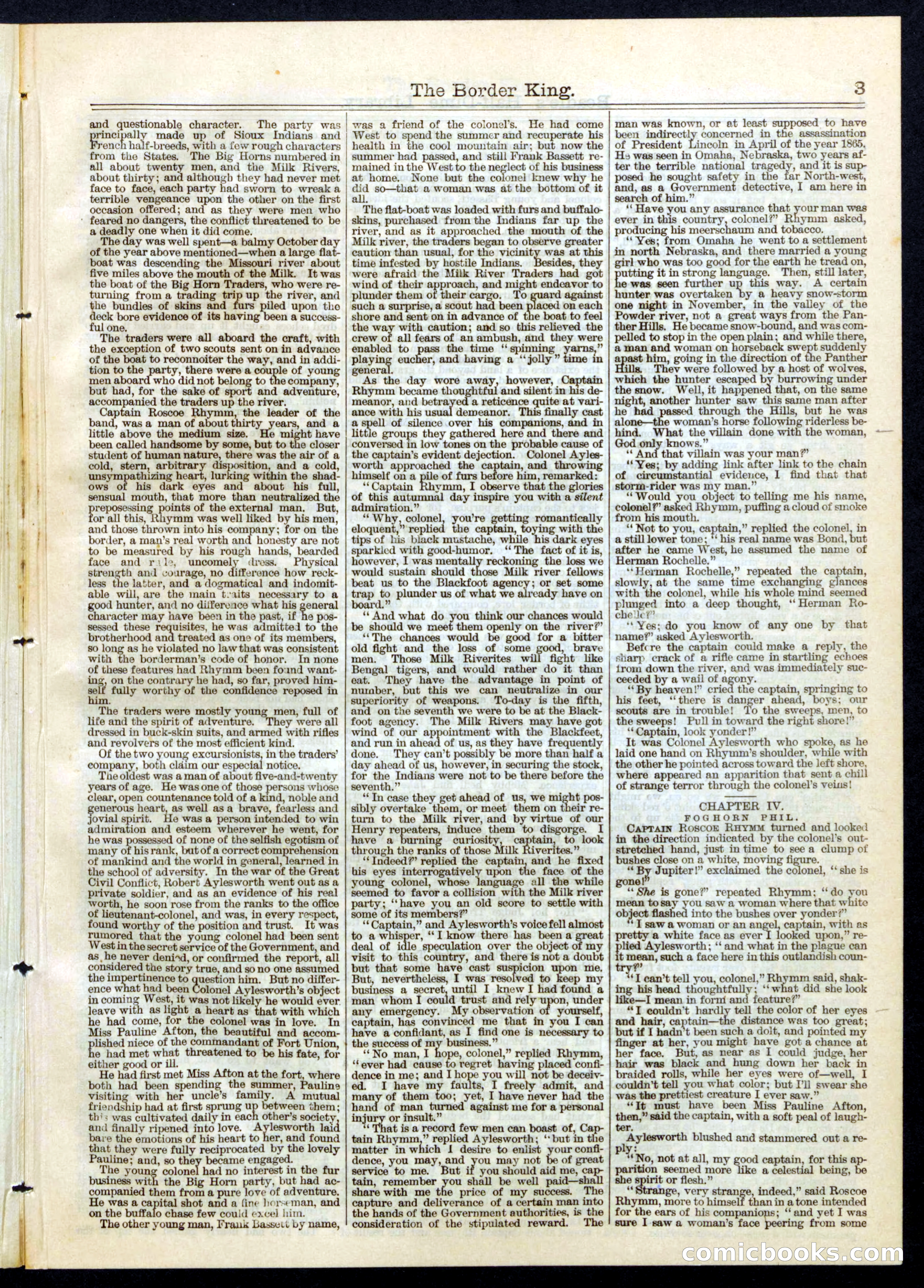
A restored page from Pulp Fiction, 1878. Page through the whole issue in the reader above.
📄 Transcribed text from this page (OCR, searchable)
Machine-transcribed from the original scan — historical spelling and the odd misread are preserved.
The Border King. 3 and questionable character. The party was | was a friend of the colonel’s. He had come one anape made up of Sioux Indians and | West to spend the summer and recuperate his ench half-breeds, with a few rough characters from the States. The Big Horns numbered in all about twenty men, and the Milk Rivers, about thirty; and although they had never met face to face, each party had sworn to wreak a terrible vengeance upon the other on the first occasion offered; and as they were men who ' feared no dangers, the conflict threatened to be a deadly one when it did come. The day was well spent—a balmy October day of the year above mentioned—when a large flat- boat was descending the Missouri river about five miles above the mouth of the Milk. It was the boat of the Big Horn Traders, who were re- turning from a trip up the river, and the bundles of skins and piled upon tho ae bore evidence of its having been a success- ul one. , The traders were all aboard the craft, with the exception of two scouts sent on in advance of the boat to reconnoiter the way, and in addi- tion to the y, there were a couple of young men aboard who did not belong to the company, but had, for the sake of sport and adventure, accompanied the traders up the river. Captain ymm, the leader of the band, was a man of about thirty ere, and a little above the medium size. He ht have been called handsome by some, but to the closer student of human nature, there was the air of a cold, stern, arbitrar rarLine wit and a cold, ee g heart lurking within the shad- ows of his dark eyes and about his full, sensual mouth, that more than neutralized the Sek gt em oints of the externa] man. But, or all this, Rhymm was well liked by his men, and those thrown into his company; for on the border, a man’s real worth and honesty are not to be measured by his rough hands, bearded face and rile, uncomely less. Physical strength and courage, no difference how reck- less the latter, and a dogmatical and indomit- able will, are the main t-aits necessary to a good hunter, and no diiference what his general character may have been in the past, if he pos- sessed these requisites, he was admitted to the brotherhood and treated as one of its members, so long as he violated no law that was consistent with the borderman’s code of honor. In none of these features had Rhymm been found want- ing, on the contrary he had, so far, proved him- ea fully worthy of the confidence reposed in The traders were mostly yo men, full of life and the spirit of aaventoré tee ware all dressed in buck-skin suits, and armed with rifles and revolvers of the most efficient kind. Of the two young excursionists, in the traders’ company, both claim our especial notice. The oldest was aman of about five-and-twenty years of age. He wasone of those persons whose clear, open countenance told of a kind, noble and enerous heart, as well asa brave, fearless and rial spirit. He was a person intended to win admiration and esteem wherever he went, for he was possessed of none of the selfish egotism of many of his rank, but of a correct comprehension of mankind and the world in general, learned in the school of adversity. In the war of the Great Civil Conflict, Robert Aylesworth went out as a private soldier, and as an evidence of his real worth, he soon rose from the ranks to the office of lieutenant-colonel, and was, in every respect, found worthy of the position and trust. It was rumored that the young colonel had been sent West in the secret service of the Government, and as he never denid, or confirmed the report, all considered the story true, and so no one assumed the ope ae to ying him. But no differ- ence what had been Colonel Aylesworth’s object in coming West, it was not likely he would ever leave with as light a heart as t with which he had come, for the colonel was in love. In Miss Pauline Afton, the beautiful and accom- pe niece of the commandant of Fort Union, e had met what threatened to be his fate, for either good orill. _ He had first met Miss Afton at the fort, where both had been spending the summer, Pauline visiting with her uncle’s family. A mutual friendship had at first sprung . between them; this was cultivated daily in each other’s society and finally ripened into love. Aylesworth laid bare the emotions of his heart to her, and found that they were fully reciprocated by the lovely Pauline; and, so they became engaged. The yo colonel had no interest in the fur business with the Big Horn party, but had ac- companied them from a pure love of adventure. He was a capital shot and a fine horseman, and on the buffalo chase few could excel him. The other young man, Frank Lasse.i by name, health in the cool mountain air; but now the summer had passed, and still Frank Bassett re- mained inthe West to the neglect of his business at home. None but the colonel knew why he did so—that a woman was at the bottom of it all. The flat-boat was loaded with furs and buffalo- skins, purchased from the Indians far up the river, and as it approached the mouth of the Milk river, the traders began to observe greater caution than usual, for the Agee, ip at this time infested by hostile Indians. ides, they were afraid the Milk River Traders had got wind of their eg gee and might endeavor to plunder them of their cargo. To eae against such a surprise, a scout had been on each shore and sent on in advance of the boat to feel the way with caution; and so this relieved the crew of all fears of an ambush, and they were enabled to pass the time ‘spinning yarns,” playing eucher, and having a ‘‘jolly” in general. As the day wore away, however, Captain Rhymm became thoughtful and silent im his de- meanor, and betra a reticence quite at vari- ance with his usual demeanor. This finally cast a spell of silence over his companions, and in little groups they gathered here and there and conversed in low tones on the probable cause of the captain’s evident dejection. Colonel Ayles- worth approached the captain, and throwing himself on a pile of furs before him, remarked: ‘*Captain Rhymm, I observe that the glories of this autumnal day inspire you with a silent admiration.” “Why, colonel, you’re getting romantically eloquent,” replied the captain, toying with the tips of his black mustache, while his dark eyes sparkled with good-humor. “ The fact of it is, however, I was mentally reckoning the loss we would sustain should those Milk river fellows beat us to the Blackfoot agency; or set some trap to plunder us of what we already have on board.” ** And what do you think our chances would be should we meet them openly on the river?’ ‘‘The chances would be good for a bitter old fight and the loss of some , brave men. Those Milk Riverites Bengal tigers, and would rather do it than eat. They have the advantage in point of nuraber, but this we can neutralize in our superiority of weapons. To-day is the fifth, and on the seventh we were to be at the Black- foot agency. The Milk Rivers may have got wind of our Ke ese with the Blackfeet, and run in ahead of us, as they have frequently done. They can’t possibly be more than half a day ahead of us, however, in securing the stock, for the Indians were not to be there before the seventh.” ‘“* In case they get ahead of us, we apie pos- sibly overtake them, or meet them on their re- turn to the Milk river, and by virtue of our Henry repeaters, induce them to disgorge. I have a burnin weeny captain, to look through the ranks of those Milk Riverites.” ‘* Indeed?” replied the captain, and he fixed his eyes ge a ay! upon the face of the young colonel, whose all the while seemed to favor a collision with the Milk river party; ‘‘have you an old seore to settle with some of its members?” “Captain,” and Aylesworth’s voice fell almost to a whisper, ‘‘ I know there has been a t deal of idle speculation over the object of my visit to this country, and there is not a doubt but that some have cast suspicion wu me, But, nevertheless, I was resolved to keep my business a secret, until I knew I had found a man whom I could trust and rely upon, under any emergency. My observation ourself, captain, has convinced me that in you I can have a confidant, as I find one is necessary to the or of “‘ seep nee b edible tit ‘No man, ope, colonel,” rep ymm, ‘“‘ever had cause to regret having placed confi- dence in me; and I hope you will not be deceiv- ed. I have my faults, I freely admit, and many of them ; yet, I have never had the hand of man against me for a personal injury or insult.” ‘That is a record few men can boast of, Ca tain Rhymm,” replied Aylesworth; ‘but in the matter in which I desire to enlist your confi- dence, you may, and Pn may not be of great service to me. But if you should aid me, ca tain, remember you shall be well pai share with me the price of my success. The capture and deliverance of a certain man into the hands of the Government authorities, is the consideration of the stipulated reward. The il fight like | — man was known, or at least supposed to have been indirectly concerned in the assassination of President Lincoln in April of the year 1865, Hs was seen in Omaha, Nebraska, two years af- ter the terrible national tragedy, and it is sup- posed he sought safety in the far North-west, and, as a Government detective, I am here in search of him.” ‘‘ Have you any assurance that your man was ever in this country, colonel?’ Rhymm asked, producing his meerschaum and tobacco. ‘‘ Yes; from Omaha he went to a settlement in north Nebraska, and there married a young girl who was too good for the earth he tread on, utting it in strong language. Then, still later, o was seen further up this way. A certain hunter was overtaken by a heavy snow-storm one night in November, in the valley of the Powder river, not a great ways from the Pan- ther Hills. He became snow-bound, and was com- pelled to stop in the open plain; and while there, a man and woman on horseback swept suddenly — him, going in the direction of the Panther i Thev were followed by a host of wolves, which the hunter escaped by burrowing under the snow. Well, it happened that, on the same night, another hunter saw this same man after he had i through the Hills, but he was sietios-tihe wepiadis horse following riderless be- hind. What the villain done with the woman, God only knows.” “ And that villain was your man?” ‘‘Yes; by adding link after link to the chain of circumstantial evidence, I find that that storm-rider was my man.” “Would you object to telling me his name, colonel?” asked Rhymm, puffing a cloud of smoke from his mouth. ‘“‘ Not to you, captain,” replied the colonel, in a still lower tone; ‘‘ his real name was Bond, but after he came West, he assumed the name of Herman Rochelle.” ‘‘Herman Rochelle,” repeated the capes, slowly, at the same time exchanging glances with the colonel, while his whole mind seemed pinged into a deep thought, ‘‘Herman Ro- che le?” ‘‘ Yes; do you know of any one by that ' name?” asked Aylesworth. Befcre the captain could make a reply, the sharp crack of a rifle came in startling echoes from down the river, and was immediately suc- ceeded by a wail of agony. ‘By heaven!” cried the captain, springing to his feet, ‘“‘there is danger ahead, boys; our scouts are in trouble! To the sweeps, men, to the sweeps! Pull in toward the right shore!” ‘“‘Captain, look yonder!” It was Colonel Aylesworth who spoke, as he laid one hand on Rhymm’s shoulder, while with the other he pointed across toward the left shore, where appeared an apparition that sent a chill of strange terror through the colonel’s veius! CHAPTER IV. FOGHORN PHIL. CaPprTraIn Roscok Ruym™ turned and looked in the direction indicated by the colonel’s out- stretched hand, just in time to see a clump of bushes close on a white, moving figure. 7 By Jupiter!” exclaimed the colonel, ‘‘ she is gone! ““ She is gone?” repeated Rhymm; “do you mean tosay you saw a woman where that white object flashed into the bushes over yonder?” ‘I saw a woman or an angel, captain, with as pretty a white face as aver" looked upon,” re- lied Aylesworth; ‘‘ and what in the plague can t my such a face here in this outlandish coun- ‘tT can’t tell you, colonel,” Rhymm said, shak- ing his head thoughtfully; ‘‘what did she look like—I mean in form and feature?” “T couldn't hardly tell the color of her eyes — and hair, captain— e distance was too great; but if I hadn’t been such a doit, and pointed my finger at her, you might have got a chance at her face. But, as near as I could judge, her hair was black and hung down her back in braided rolls, while her eyes were of—well, I couldn’t tell you what color; but I'l] swear she was the prettiest creature I ever saw.” “It must have been Miss Pauline Afton, then,” said the captain, with a soft peal of laugh- ter. Aylesworth blushed and stammered out a re- ply: : ‘* No, not at all, my i captain, for this a tion seemed more like a celestial being, she spirit or flesh.” = ge, very strange, indeed,” said Roscoe Rhymm, more to himself than in a tone intended for the ears of his companions; “and yet I was sure I saw a woman’s face g from some CGOMIGEROOKS EO