
Pulp Fiction, 1878 · page 2 of 16
Beadle's Half Dime Library, No. 58 — page 2: what you’re looking at
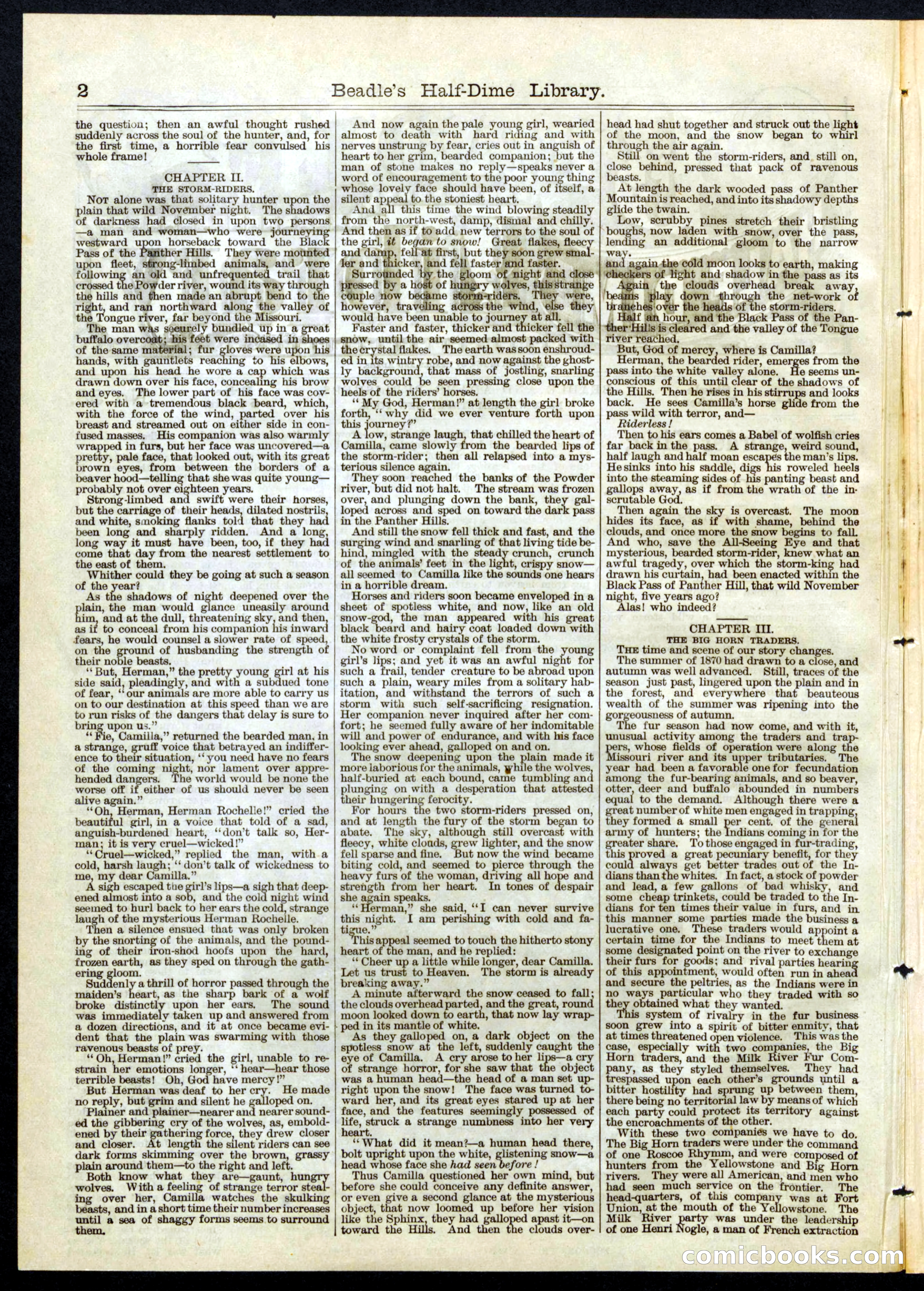
A restored page from Pulp Fiction, 1878. Page through the whole issue in the reader above.
📄 Transcribed text from this page (OCR, searchable)
Machine-transcribed from the original scan — historical spelling and the odd misread are preserved.
2 the question; then an awful thought rushed suddenly across the soul of the hunter, and, for the first time, a horrible fear convulsed his whole frame! CHAPTER II. THE STORM-RIDERS. Nor alone was that solitary hunter upon the plain that wild November night. The shadows of darkness had closed in upon two persons. —a man and woman—who were ‘journeyin westward pale horseback toward the Blac Pass of the Paiither Hills. They were motnted upon fleet, sfrong-limbed animals, and were following an old and unfrequented trail that crossed the Powder river, wound its way through the hills and then made an abrupt bend to the right, and ran northward along the valley of the Tongue river, far beyond the Missouri. The man was seeurely bundied up in a great buffalo overcoat; his feet were incased in shoes of the same material ; fur gloves were upon his hands, with gauntlets reaching to his elbows, and upon his head he wore a cap which was drawn down over his face, concealing his brow and eyes. The lower part of his face was cov- ered with a tremendous black beard, which, with the force of the wind, parted over his breast and streamed out on either side in con- fused masses. His companion was also warmly wrapped in furs, but her face was uncovered—a retty, pale face, that looked out, with its great ows eyes, from between the borders of a beaver hood—telling that she was quite young— probably not over eighteen years. Strong-limbed and swift were their horses, but the carriage of their heads, dilated nostrils and white, smoking flanks told that they had been long and sharply ridden. And a long, long way it must have been, too, if they had come that day from the nearest settlement to the east of them. Whither could they be going at such a season of the year? As the shadows of night deepened over the lain, the man would glance uneasily around him and at the dull, threatening sky, and then as if to conceal from his companion his inward fears, he would counsel a slower rate of speed, on the — of husbanding the strength of their noble beasts. ‘‘ But, Herman,” the pretty young girl at his side said, pleadingly, and with a subdued tone of fear, ‘‘our animals are more able to carry us on to our destination at this speed than we are to run risks of the dangers that delay is sure to bring upon us.” ‘Rie, Camilla,” returned the bearded man, in a strange, gruff voice that betrayed an indiffer- ence to their situation, ‘‘ you need have no fears of the coming night, nor lament over appre- hended dangers. The world would be none the worse off if either of us should never be seen alive again.” ‘‘Oh, Herman, Herman Rochelle!” cried the beauti girl, in a voice that told of a sad, anguish-burdened heart, ‘‘don’t talk so, Her- man; it is very cruel—wicked!” “ Cruel—wicked,” replied the man, with a cold, harsh laugh; ‘‘ don’t talk of wickedness to me, my dear Camilla.” A sigh escaped the girl’s lips—a sigh that deep- ened almost into a sob, and the cold night wind seemed to hurl back to her ears the cold, strange laugh of the mysterious Herman Rochelle. en a silence ensued that was only broken by the snorting of the animals, and the pound- ing of their iron-shod hoofs upon the hard, frozen earth, as they sped on through the gath- ering a ; Suddenly a thrill of horror passed through the maiden’s haart, as the sharp bark of a wolf broke we A upon her ears. The sound was immediately taken up and answered from a dozen directions, and it at once became evi- dent that the plain was swarming with those ravenous beasts of prey. ‘*Oh, Herman!” cried the girl, unable to re- strain her emotions longer, ‘‘ hear—hear those terrible beasts! Oh, God have mercy!” But Herman was deaf to her pt 6 He made no reply, but grim and silent he galloped on. Plainer and plainer—nearer and nearer sound- ed the gibbering cry of the wolves, as, embold- ened by their gathering force, they drew closer and closer. At length the silent riders can see dark forms skimming over the brown, grassy plain around them—to the right and left. Both know what they are—gaunt, hun wolves. With a feeling of strange terror steal- ing over her, Camilla watches the skulking beasts, and in a short time their number increases — a sea of shaggy forms seems to surround em, Beadle’s Half-Dime Library. — = = o- EE oe SS TL SEE ee eee ee eee aaa — And now again the pale young girl, wearied almost to death with hard riding and with nerves unstrung by fear, cries out in anguish of heart to her grim, bearded companion; but the man of stone makes no reply—speaks never a word of encouragement to the poor young thing whose lovely face should have been, of itself, a silent ap to. the stoniest heart. And all this time the wind blowing steadily from the north-west, damp, dismal and chilly. And then as if to add new terrors to the soul of the girl, i began to snow! Great flakes, fleec and damp, fell at first, but they aon grew smal- Jer and thicker, and fell faster and fa: oad og ‘the £ pressed By a host of would have been unable to tg Ae all. Faster and faster, thicker and thicker fell the snow, until the air seemed almost packed with the crystal flakes. The earth wassoon enshroud- ed in its wintry robe, and now against the ghost- ly background, that mass of jostling, snarling wolves could seen pressing close upon the heels of the riders’ horses. ‘My God, Herman!” at length the girl broke forth, ‘‘ why did we ever venture forth upon this bp ”? A low, strange laugh, that chilled the heart of Camilla, came slowly from the bearded lips of the storm-rider; then all relapsed into a mys- terious silence in. They soon reached the banks of the Powder river, but did not halt. The stream was frozen over, and plunging down the bank, they gal- loped across and sped on toward the dark pass in the Panther Hills. And still the snow fell thick and fast, and the surging wind and snarling of that living tide be- hind, mingled with the steady crunch, crunch of the animals’ feet in the light, crispy snow— all seemed to Camilla like the sounds one hears in a horrible dream. Horses and riders soon became enveloped in a sheet of spotless white, and now, like an old snow-god, the man appeared with his great black beded and hairy coat loaded down with the white frosty crystals of the storm. No word or complaint fell from the young girl’s lips; and yet it was an awful night for such a frail, tender creature to be abroad upon such a plain, weary miles from a solitary hab- itation, and withstand the terrors of such a storm with such self-sacrificing resignation. Her companion never inquired after her com- fort; he seemed fully aware of her indomitable will and power of endurance, and with his face looking ever ahead, galloped on and on. The snow deepening upon the plain made it more laborious for the animals, while the wolves half-buried at each bound, came tumbling anc plunging on with a desperation that attested their hungering ferocity. For hours the two storm-riders pressed on, and at length the fury of the storm began to abate. The sky, although still overcast with fleecy, white clouds, grew lighter, and the snow fell sparse and fine. But now the wind became biting cold, and seemed to pierce through the heavy furs of the woman, driving all hope and strength from her heart. In tones of despair she again speaks. ‘‘Herman,” she said, ‘‘I can never survive this night. I am perishing with cold and fa- tigue.” Thisa peal seemed to touch the hitherto stony heart of the man, and he replied: “ Cheer up a little while longer, dear Camilla. Let us tras to Heaven. The storm is already breaking away.” A minute afterward the snow ceased to fall; the clouds overhead gees and the great, round moon looked down earth, that now lay wrap- ped in its mantle of white. As they galloped on, a dark object on the spotless snow at the left, suddenly caught the eye of Camilla. A cry arose to her a cry of strange horror, for she saw that the object was a human head—the head of a man set up- right upon the snow! The face was turned to- ward her, and its great eyes stared up at her face, and the features seemingly d of life, struck a strange numbness into her very ‘“What did it mean?—a human head there, bolt upright upon the white, glistening snow—a head whose face she had seen before ! Thus Camilla questioned her own mind, but before she could conceive any definite answer, or even give a second glance at the mysterious ge is t Paahe era Pu before head ee like the Sphinx, the oped a it—on toward the Hills. Sid then a clouds over- e couple now e storm-riders. They were die vedi fra Cilia Oss the wind, else they head had shut together and struck out the light of the moon, and the snow began whirl through the air again. Still on went the storm-riders, and. still on, close behind, pressed that pack of ravenous beasts. At length the dark wooded pass of Panther Mountain is reached, and into its shadowy depths glide the twain. Low, scrubby pines stretch their bristling boughs, now laden with snow, over the pass, lending an additional gloom to the narrow sain the cold moon looks to earth, making eckers of light and shadow in the as its 4gnin the clouds overhead b away cdmis 7 Ro through the net-work o dnehes heads of the storm-riders. ulf jan hour, and Black Pass of the Pan- her ‘Hil s is cleared and the valley of the Tongue river réathed, But, God of mercy, where is Camilla? Herman, the bearded rider, emerges from the pass into the white valley alone. He seems un- conscious of this until clear of the shadows of the Hills. Then he rises in his stirrups and looks back. He sees Camilla’s horse glide from the pass wild with terror, and— Riderless ! Then to his ears comes a Babel of wolfish cries far back in the pass. A strange, weird sound, half laugh and half moan escapes the man’s lips. Hesinks into his saddle, digs his roweled heels into the steaming sides of his panting beast and gallops away, as if from the wrath of the in- scrutable God. Then again the sky is overcast. The moon hides its face, as if with shame, behind the clouds, and once more the snow be to fall And who, save the All-Seeing Eye and that mysterious, bearded storm-rider, knew what an awful tragedy, over which the storm-king had drawn his curtain, had been enacted within the Black Pass of Panther Hill, that wild November night, five years ago? Alas! who indeed? CHAPTER III. THE BIG HORN TRADERS. THE time and scene of our story changes. The summer of 1870 had drawn to a close, and autumn was well advanced. Still, traces of the season just past, lingered upon the plain and in the forest, and everywhere that beauteous wealth of the summer was ripening into the gorgeousness of autumn. e fur season had now come, and with it, unusual activity among the traders and tra rs, whose fields of operation were along the issouri river and its upper tributaries. The year had been a favorable one for fecundation among the fur-bearing animals, and so beaver, otter, deer and buffalo abounded in numbers equal to the demand. Although there were a great number of white men engaged in trapping they formed a small per cent. of the general army of hunters; the Indians coming in for the greater share. To those engaged in fur-trading, this proved a great pe benefit, for they could always get better trades out of the In- dians thanthe whites. In fact, a stock of powder and lead, a few gallons of bad whisky, and some cheap trinkets, could be traded to the In- dians for ten times their value in furs, and in this manner some parties made the business a lucrative one. These traders would appoint a certain time for the Indians to meet them at some designated point on the river to exchange their furs for goods; and rival parties hearin of this appointment, would often run in ah and secure the peltries, as the Indians were in no ways particular who they traded with so a what they wanted. system of rivalry in the fur business soon grew into a spirit of bitter enmity, that at times threatened open violence. This was the case, especially with two com es, the Big Horn traders, and the Milk River Fur Com- pany, as they styled themselves. They had tres upon each other’s grounds until a bitter hostility had sprung up between them, there being no territorial law by means of which each party could protect its territory against the encroachments of the other. With these two companiés we have to do. The Big Horn traders were under the command of one Roscoe Rhymm, and were composed of hunters from the Yellowstone and Big Horn rivers. They were all American, and men who had seen much service on the frontier. The head-quarters, of this company was at Fort Union, at the mouth of the Yellowstone. The Milk River was under the leadership of one Henri Nogle, a man of French extraction COME IOOKS coir t ae