
Pulp Fiction, 1887 · page 5 of 16
Beadle's Half Dime Library No. 522 — page 5: what you’re looking at
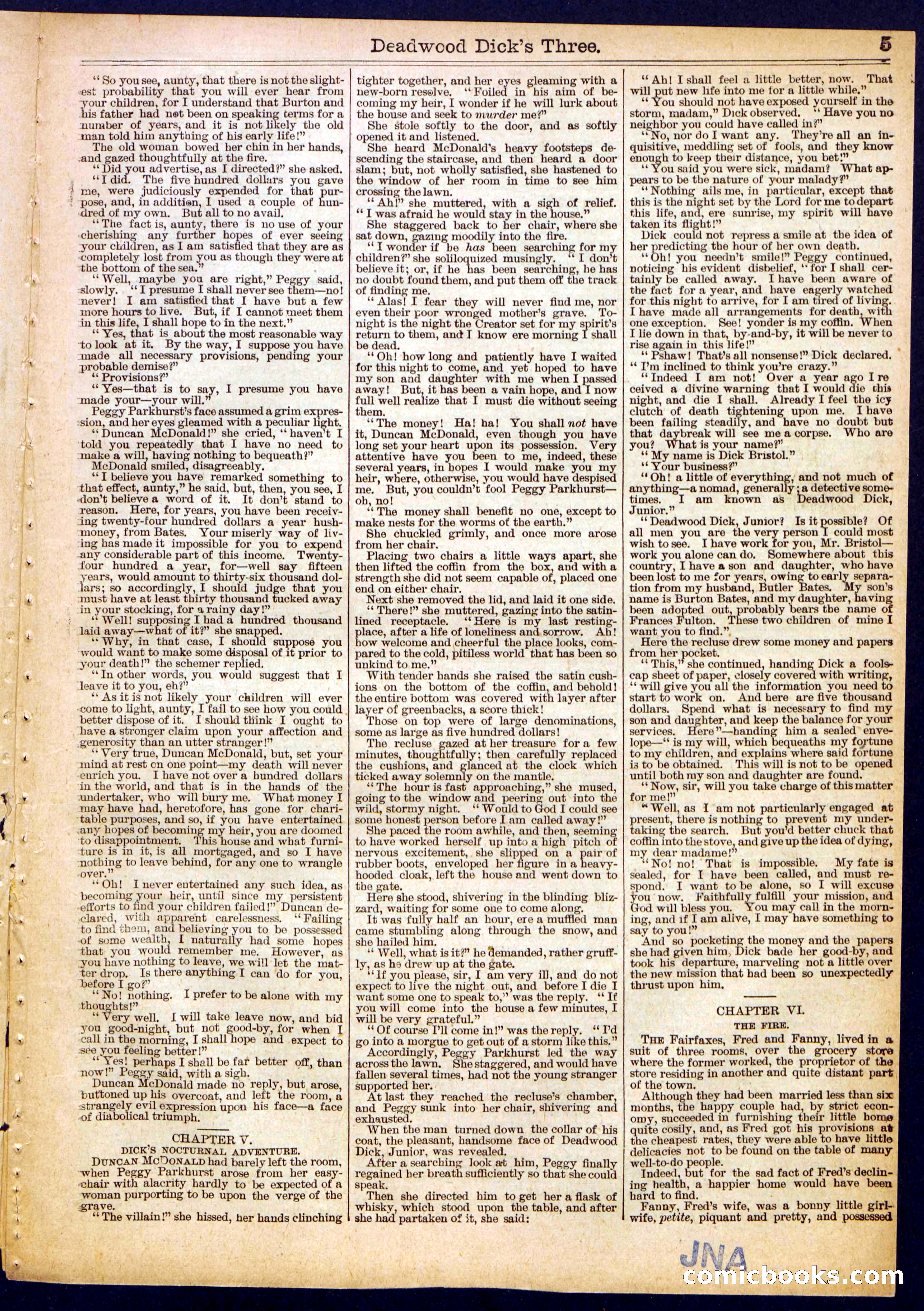
A restored page from Pulp Fiction, 1887. Page through the whole issue in the reader above.
📄 Transcribed text from this page (OCR, searchable)
Machine-transcribed from the original scan — historical spelling and the odd misread are preserved.
=. — . ~. Aaa ai - ye mot Fes. * ee ‘* So you see, aunty, that there is not the slight- est probability that you will ever hear from ‘your children, for I understand that Burton and his father had net been on speaking terms for a number of years, and it is not likely the old man told him anything of his early life!” The old woman bowed her chin in her hands, and gazed thoughtfully at the fire. ‘* Did you advertise, as I directed?” she asked. ‘*T did. The five hundred dollars you gave me, were judiciously expended for that pur- + pose, and, in additien, 1 used a couple of hun- dred of my own. But all to no avail, ‘The fact is, aunty, there is no use of your cherishing any further hopes of ever seeing your children, as 1 am satisfied that they are as completely lost from you as though they were at the bottom of the sea.” ‘* Well, maybe you are right,” Peggy said, slowly. ‘‘I presume I shall never see them—no! never! I am satisfied that [I have but a few more hours to live. But, if I cannot meet them in this life, I shall hope to in the next.” ‘* Yes, that is about the most reasonable way ‘to look at it. By the way, I suppose you have made all necessary provisions, pending your probable demise?” ** Provisions?” ‘*'Yes—that is to Say, I presume you have made your—your will.’ Peggy Parkhurst’s face assumed a grim expres- ‘sion, and her eyes gleamed with a peculiar light. ‘*Duncan McDonald!” she cried, ‘‘ haven’t I ‘told you repeatedly that I have no need tu make a will, having nothing to bequeath?” McDonald smiled, disagreeably. ‘**I believe you have remarked something to that effect, aunty,” he said, but, then, you see, I <lon’t believe a word of it. It don’t stand to reason. Here, for years, you have been receiv- ing twenty-four hundred dollars a year hush- money, from Bates. Your miserly way of liy- ing has made it impossible for you to expend any considerable part of this income. Twenty- four hundred a year, for—well say fifteen years, would amount to thirty-six thousand dol- jars; so accordingly, I should judge that you toust have at least thirty thousand tucked away in your stocking, for a rainy day!” ‘* Well! supposing I hada hundred thousand laid away—what of it?” she sna poe ‘* Why, in that case, I Soul suppose you ‘would want to make some oar Oe of it prior to ‘your death!” the schemer replied. ‘In other words, you would suggest that I leave it to you, eh?” ** As itis not likely your children will ever -come to light, aunty, I fail to see how you could. better dispose of it. I should think I ought to have a stronger claim upon your affection and generosity than an utter stranger!” * Very true, Duncan McDonald, but, set your mind at rest on one point—my death will never enrich you. I have not over a hundred dollars ‘in the world, and that is in the hands of the undertaker, who will bury me. What money I may have had, heretofore, has gone for chari- ‘table purposes, and so, if you have entertained _ sany hopes of becoming G5 heir, you are doomed ‘to disappointment, ‘1 ouse and what furni- ture is In it, is all mortgaged, and so I have nothing to leave behind, for any one to wrangle “Oh! I never entertained any such idea, as becoming your heir, until since my persistent -efforts to find your children failed!” Duncan de- clarved, with apparent carelessness. ‘ Failing to find them, and believing you to be possessed of some wealth, [ naturally had some hopes that you would remember me, However, as you have nothing to leave, we will let the mat- ter drop. Is there anything I can do for you, before I go?” ‘No! nothing. I prefer to be alone with my thoughts!” ‘Very well, I will take leave now, and bid you good-night, but not good-by, for when [ call in the morning, I shall hope and expect to see you feeling better!” ‘Yes! perhaps I shall be far better off, than now!” Peggy said, with a sigh. Duncan McDonald made no reply, but arose, buttoned up his overcoat, and left the room, a strangely evil expression upon his face—a face of diabolical triumph, CHAPTER V. DICK’S NOCTURNAL ADVENTURE. | Duncan MCDONALD had barely left the room, when Peggy Parkhurst arose from her easy- chair with alacrity hardly to be expected of a ‘woman purporting to be upon the verge of the ‘The villain!” she hissed, her hands clinching Deadwood Dick’s Three. tighter together, and her eyes gleaming with a new-born resolve, ‘‘ Foiled in his aim of be- coming my heir, I wonder if he will lurk about the bouse and seek to murder me?” She stole softly to the door, and as softly opened it and listened. She heard McDonald's heavy footsteps de- scending the staircase, and then heard a door slam; but, not wholly satisfied, she hastened to the window of her room in time to see him crossing the lawn. ‘‘Ah!” she muttered, with a sigh of relief. ‘I was afraid he would stay in the house.” She staggered back to her chair, where she sat down, gazing moodily into the fire. ‘*T wonder if be has been searching for my children?” she soliloquized musingly. ‘ I don’t believe it; or, if he as been searching, he has no doubt found them, and put them off the track of finding me. ‘Alas! I fear they will never find me, nor even their poor wronged mother’s grave. To- night is the night the Creator set for my spirit’s return to them, and J know ere morning I shall be dead. **Oh! how long and patiently have I waited for this night to come, and yet hoped to have my son and daughter with me when I passed away! But, it has been a vain hope, and I now ipa well realize that I must die without seeing em. ‘*‘The money! Ha! ha! You shall not have it, Duncan McDonald, even though you have long set your heart upon its possession. Very attentive have you been to me, indeed, these several years, in hopes I would make you my heir, where, otherwise, you would have despised me. But, you couldn’t fool Peggy Parkhurst— oh, no! ‘‘The money shall benefit no one, except to make nests for the worms of the earth.” She chuckled grimly, and once more arose from her chair. Placing two chairs a little ways apart, she then lifted the coffin from the box, and witha strength she did not seem capable of, placed one end on either chair. Next she removed the lid, and laid it one side, ‘* There!” she muttered, gazing into the satin- lined receptacle. ‘‘ Here is my last resting- lace, after a life of loneliness and. sorrow. Ah! ow welcome and cheerful the place looks, com- pared to the cold, pitiless world that has been so unkind to me.” With tender hands she raised the satin cush- ions on the bottom of the coffin, and behold! the entire bottom was covered with layer after layer of greenbacks, a score thick! Those on top were of large denominations, some as large as five hundred dollars! The recluse gazed at her treasure fora few minutes, thoughtfully; then carefully replaced the cushions, and glanced at the clock which ticked away solemnly on the mantle. ‘*The hour is fast approaching,” she mused, going to the window and peering out into the wild, stormy night. ‘* Would to God I could see some honest person before [am called away!” She paced the room awhile, and then, seeming to have worked herself up into a high pitch of nervous excitement, she slipped on a pair of rubber boots, enveloped her figure in a heavy- hooded cloak, left the house and went down to the gate. Here she stood, shivering in the blinding bliz- zard, waiting for some one to come along. It was fully half an hour, ere a muffled man came stumbling along through the snow, and she hailed him. ‘‘ Well, what is it?” he demanded, rather gruff- ly, as he drew up at the gate. “If you please, sir, I am very ill, and do not expect to live the night out, and before I die I want some one to speak to,” was the reply. ‘‘If you will come into the house a few minutes, I will be very grateful.” ‘Of course Pll come in!” was thereply. ‘Pd go into a morgue to get out of a storm like this.” Accordingly, Peggy Parkhurst led the way across the lawn, Shestaggered, and would have fallen several times, had not the young stranger supported her. At last they reached the recluse’s chamber and Peggy sunk into her chair, shivering and exhausted. | When the man turned down the collar of his coat, the pleasant, handsome face of Deadwood Dick, Junior, was revealed. After a searching look at him, Peggy finally prcesnes her breath sufficiently so that she could speak, Then she directed him to get her a flask of whisky, which stood upon the table, and after she had partaken of it, she said: bias ih ang Es RBA Cen Se ‘“‘ Ah! I shall feel a little better, now. That — will put new life into me for a little while.” ‘‘- You should not have exposed yourself in the storm, madam,” Dick observed, ‘' Have you no neighbor you could have called in?” ‘*No, nor dol want any. They’re all an in- quisitive, meddling set of fools, and they know enough to keep their distance, you bet!” ‘You said you were sick, madam? What ap- pears to be the nature of your malady?” ‘‘Nothing ails me, in particular, except that this is the night set by the Lord for me todepart this life, and, ere sunrise, my spirit will have taken its flight!” | Dick conta not repress a smile at the idea of her predicting the hour of her own death. ‘*Oh! you needn’t smile!” Peggy continued, noticing his evident disbelief, ‘‘for I shall cer- tainly be called away. Ihave been aware of the fact for a year, and have eagerly watched for this night to arrive, for I am tired of living. Ihave made all arrangements for death, wit one exception. See! yonder is my coffin, When I lie down in that, by-and-by, it will be never to rise again in this life!” J ‘‘ Pshaw! That’s all nonsense!” Dick declared. ‘* T’m inclined to think you’re crazy.” ‘‘TIndeed I am not! Over a year ago Ire ceived a divine warning that I would die chis night, and die I shall. Already I feel the icy clutch of death tightening upon me. I have been failing steadily, and bave no doubt but that daybreak will see me acorpse. Who are you? hat is your name?” ‘* My name is Dick Bristol.” ‘** ‘Your business?” ‘“*Oh! a little of iow tice and not much of anything—a nomad, generally ; a detective some- times. am known as Deadwood Dick, Junior.” ‘* Deadwood Dick, Junior? Is it possible? Of all men you are the very person [ could most wish tosee. I have work for you, Mr. Bristol— work you alone can do, Somewhere about this country, Ihave ason and daughter, who have © been lost to me for years, owing to early separa- — tion from my husband, Butler Bates. son’s name is Burton Bates, and my daughter, havin been adopted out, probably bears the name o Frances Fulton. These two children of mine I want you to find.”, Here the recluse drew some money and papers © from her pocket, ‘* This,” she continued, handing Dick a fools cap sheet of paper, closely covered with writing, — ‘* will give you all the information you need to — start to work on. And here are five thousand — dollars. Spend what is necessary to find my — son and daughter, and keep the balance for your — services. Here ae him a sealed’ enve-— lope—‘‘ is my will, which bequeaths my fortune _ to my children, and explains where said fortune is to be obtained. This will is not to be opened — until both my son and daughter are found. ‘ ‘** Now, sir, will you take charge of this matter for me!” pte “Well, as I am not particularly engaged at present, there is nothing to prevent my under- taking the search. But you'd better chuck that | coffin into the stove, and give up the idea of dying, — my dear madame!” ey ‘“No! no! That is impossible. My fate is | sealed, for I have been called, and must re-— spond. I want to be alone, so I will excuse | ou now. Faithfully fulfill your mission, and — od will bless you. You may call in the morn-— ing, and if I am alive, I may have something to — say to you!” | And so pocketing the money and the papers: she had given him, Dick bade her good-by, and — took his departure, marveling not a little over the new mission that had been so unexpectedly thrust upon him, RS a te 4 CHAPTER VI. . eh THE FIRE. ‘J THE Fairfaxes, Fred and Fanny, lived in suit of three rooms, over the grocery stor where the former worked, the proprietor of the store residing in another and quite distant par 7 of the town. ‘ks ‘te Although they had been married less than six - : 1 . > ! “Ks months, the happy couple had, by strict econ- omy, succeeded in furnishing their little home ite cosily, and, as Fred got his provisions at) y ui the cheapest rates, they were able to have li tle delicacies not to be found on the table of many well-to-do people. Seer | Indeed, but for the sad fact of Fred’s declin- | ing health, a happier home would have been | hard to find. ek Fanny, Fred’s wife, was a bonny little girl wife, petite, piquant and pretty, and possesset wt Wg G r; >