
Pulp Fiction, 1887 · page 4 of 16
Beadle's Half Dime Library No. 522 — page 4: what you’re looking at
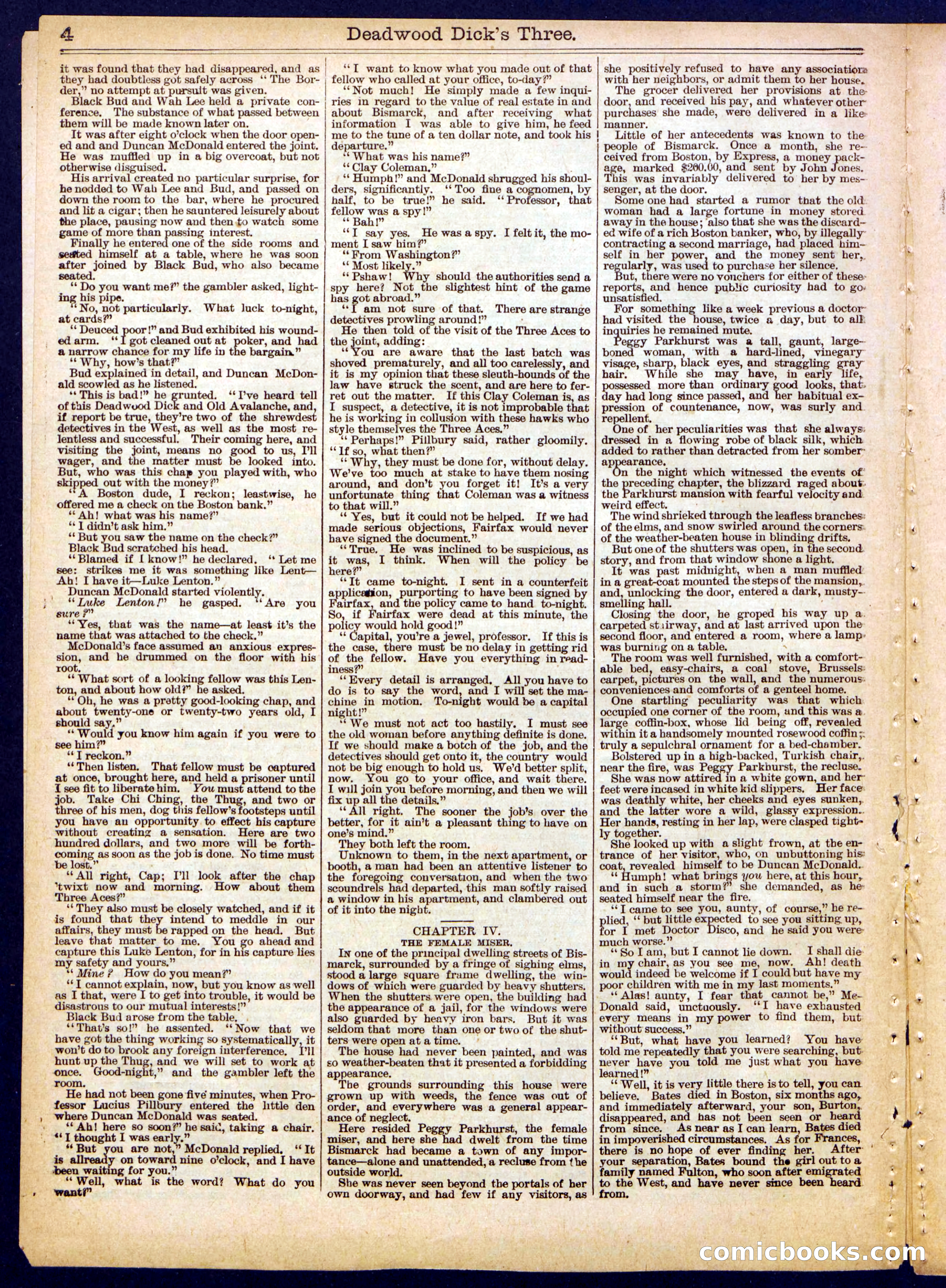
A restored page from Pulp Fiction, 1887. Page through the whole issue in the reader above.
📄 Transcribed text from this page (OCR, searchable)
Machine-transcribed from the original scan — historical spelling and the odd misread are preserved.
o , , ** ; ? _ » = oe. w ’ i , ; -—F : 4 a “ ‘. , . 5 ' - }° “Iuke Lenton!” once. - ie , et hese oe. it was found that they had disappeared, and as they had doubtless got safely across ‘‘ The Bor- der,” no attempt at pursuit was given. Black Bud and Wah Lee held a private con- ference. The substance of what passed between them will be made known later on. It was after eight o’clock when the door open- ed and and Duncan McDonald entered the joint. He was muffled up in a big overcoat, but not otherwise disguised. His arrival created no particular surprise, for he nodded to Wab Lee and Bud, and passed on down the room to the bar, where he procured and lit a cigar; then he sauntered leisurely about the place, pausing now and then to watch some game of more than passing interest. Finally he entered one of the side rooms and himself at a table, where he was soon ae joined by Black Bud, who also became sea, ** Do you want me?” the gambler asked, light- ing his pipe. ‘No, not particularly. What luck to-night, at cards?” ** Deuced r!” and Bud exhibited his wound- edarm. ‘| got cleaned out at poker, and had a narrow chance for my life iv the bargain” ** Why, how’s that?” Bud explained in detail, and Duncan McDon- ald scowled as he listened. ‘* This is bad!” he grunted. ‘‘ I’ve heard tell of this Deadwvod Dick and Old Avalanche, and, if report be true, they’re two of the shrewdest detectives in the West, as well as the most re- lentless and successful. Their coming here, and visiting the joint, means no good to us, I'll wager, and the matter must be looked into. But, who was this chap you played with, who skipped out with the money?” ‘‘A Boston dude, 1 reckon; leastwise, he offered me a check on the Boston bank.” ‘*Ah! what was his name?” ** 1 didn’t ask him.” ‘** But you saw the name on the check?” Black Bud scratched his head. ‘*Blamed if | know!” he declared, ‘* Let me see: strikes me it was something like Lent— Ah! I have it—Luke Lenton.” Duncan McDonald started violently. he gasped. sure ?” ‘Yes, that was the name—at least it’s the name that was attached to the check,” McDonald’s face assumed an anxious expres- sion, and he drummed on the floor with his root, ** What sort of a looking fellow was this Len- ton, and about how old?” he asked. ** Oh, he was a pretty good-looking chap, and about twenty-one or twenty-two years old, I should say,” “Would you know him again if you were to ‘“*T reckon.” “‘Then listen, That fellow must be captured at once, brought here, and held a prisoner until { see fit to liberatehim. You must attend to the job. Take Chi Ching, the Thug, and two or three of his men, dog this fellow’s footsteps until you have au opportunity to effect his capture without creating a sensation. Here are two hundred dollars, and two more will be forth- coming as soon as the job is done. No time must be lost.” “All right, Cap; [Pll look after the chap ‘twixt now and morning. How about them Three Aces?” ‘* They also must be closely watched, and if it is found that they intend to meddle in our affairs, they must be rapped on the head. But leave that matter to me, You go ahead and capture this Luke Lenton, for in his capture lies my safety and yours,” ** Mine ? How do you mean?” ‘“‘T cannot explain, now, but you know as well as I that, were I to get into trouble, it would be disastrous to our mutual interests!” Black Bud arose from the table, . ‘*That’s so!” he assented. ‘‘Now that we have got the thing working so systematically, it -won’t do to brook any foreign interference, Tl hunt up the Thug, and we will set to work at Good-night,” and the gambler left the room. He had not been gone five minutes, when Pro- fessor Lucius Pillbury entered the little den where Duncan McDonald was seated. Are you ‘‘ Ah! here so soon?” he saic, taking a chair. . **T thought I was early.” hy ** But hay are not,” McDonald replied, ‘“‘ It ply > ae on toward nine o’clock, and I have been w for you.” “Well, what is the word? What do you want?” a ' Deadwood Dick's — Three. ‘*T want to know what you made out of that fellow who called at your office, to-day?” ‘*Not much! He simply made a few inqui- ries in regard to the value of real estate in and about Bismarck, and after receiving what information I was able to give him, he feed me to the tune of a ten dollar note, and took his departure.” ‘What was his name?” **Clay Coleman,” : ‘* Humph!” and McDonald shrugged his shoul- ders, significantly. ‘‘ Too fine a cognomen, by half, to be true!” he said. ‘‘ Professor, that fellow was a spy!” sé Bah 1”? ““T say yes. He wasaspy. I felt it, the mo- ment I saw him?’ “From Washington?’ ** Most likely.” ‘* Pshaw! hy should the authorities send a spy here? Not the slightest hint of the game has got abroad.” ‘*T am not sure of that. detectives prowling around!” He then told of the visit of the Three Aces to the joint, adding: ‘You are aware that the last batch was shoved prematurely, and all too carelessly, and it is my opinion that these sleuth-hounds of the law have struck the scent, and are here to fer- ret out the matter. If this Clay Coleman is, as I suspect, a detective, it is not improbable that he is working in collusion with these hawks who style themselves the Three Aces,” ‘* Perhaps!” Pillbury said, rather gloomily. “If so, what then?” ‘* Why, they must be done for, without delay. We've too much at stake to have them nosing around, and don’t you forget it! It’s a very unfortunate thing that Coleman was a witness to that will.” ‘* Yes, but it could not be helped. If we had made serious objections, Fairfax would never have signed the document.” There are strange ‘‘True. He was inclined to be suspicious, as 9 was, I think. When will the policy be ere? “Tt came to-night. I sent in a counterfeit application, purporting to have been signed by airfax, and the policy came to hand to-night. So, if Fairfax were dead at this minute, the policy would hold good!” ‘* Capital, you’re a jewel, professor. If this is the case, there must be no delay in getting rid of the fellow. Have you everything in read- iness?” | ‘‘Every detail is arranged, All you have to do is to say the word, and I will set the ma- ohite jin motion. To-night would be a capital ght! ‘*We must not act too hastily. I must see the old woman before anything definite is done. If we should make a botch of the job, and the detectives should get onto it, the country would not be big enough to hold us. We'd better split, now. You go to your office, and wait there. I will join you before morning, and then we will fix up all the details.” ‘All right. The sooner the job’s over the better, for it ain’t a pleasant thing to have on one’s mind.” They both left the room, Unknown to them, in the next apartment, or booth, a man had been an attentive listener to the foregoing conversation, and when the two scoundrels had departed, this man softly raised a window in his apartment, and clambered out of it into the night. CHAPTER IV. THE FEMALE MISER, In one of the gp dwelling streets of Bis- marck, surrounded by a fringe of sighing elms, stood a large square frame dwelling, the win- dows of which were guarded by heavy shutters. When the shutters were open, the building had the appearance of a jail, for the windows were also guarded by heavy iron bars. But it was seldom that more than one or two of the shut- ters were open at a time. The house had never been painted, and was so weather-beaten that it presented a forbidding appearance, The grounds surrounding this house were grown up with weeds, the fence was out of order, and everywhere was a general appear- ance of neglect. Here resided Feaey Parkhurst, the female miser, and here she dwelt from the time Bismarck had became a town of any impor- tance—alone and unattended, a recluse from the outside world. She was never seen beyond the portals of her own doorway, and had few if any visitors, as LLL LLL LLL CL LS LC ta, a a LE she positively refused to have any associatior with her neighbors, or admit them to her house, The grocer delivered her provisions at the door, and received his pay, and whatever other purchases she made, were delivered in a like: manner. Little of her antecedents was known to the people of Bismarck. Once a month, she re-- ceived from Boston, by Express, a money pack- age, marked $200.00, and sent by John Jones. his was invariably delivered to her by mes- senger, at the door. Some one had started a rumor that the old woman had a large fortune in money stored away in the house; ‘also that she was the discard- ed wife of a rich Boston banker, who, by illegally” contracting a second marriage, had placed him- self in her power, and the money sent her, regularly, was to purchase her silence, ut, there were no vonchers for either of these: reports, and hence public curiosity had to gov unsatisfied. For something like a week previous a doctor had visited the house, twice a day, but to alP inquiries he remained mute. eggy Parkhurst was a tall, gaunt, large- boned woman, with a hard-lined, vinegary visage, sharp, black eyes, and straggling gray hair. While she may have, in early life, possessed more than ordinary good looks, that. day had long since passed, and her habitual ex- pression of countenance, now, was surly and repellent. One of her peculiarities was that she always: dressed in a flowing robe of black silk, which added to rather than detracted from her somber’ si cit n the night which witnessed the events of the preceding chapter, the blizzard raged about: the Parkhurst mansion with fearful velocity and weird effect. . | The wind shrieked through the leafless branches: of the elms, and snow swirled around the corners: of the weather-beaten house in blinding drifts, But one of the shutters was open, in the second story, and from that window shone a light. It was past midnight, when a man muffled in a great-coat mounted the steps of the mansion,, and, unlocking the door, entered a dark, musty-- smelling hall. Closing the door, he groped his way up a. carpeted stiirway, and at last arrived upon the second floor, and entered a room, where a lamp, was burning on a table. . The room was well furnished, with a comfort- able bed, easy-chairs, a coal stove, Brussels: carpet, pictures on the wall, and the numerous: conveniences and comforts of a genteel home. One startling peculiarity was that which occupied one corner of the room, und this was a. large coffin-box, whose lid being off, revealed within it a handsomely mounted rosewood coffin ;: truly a sepulchral ornament for a bed-chamber. Bolstered up in a high-backed, Turkish chair,. near the fire, was Peggy Parkburst, the recluse. She was now attired in a white gown, and her feet were incased in white kid slippers, Her face. was deathly white, her cheeks and eyes sunken, and the latter wore a wild, glassy expression.. Her hands, resting in her lap, were clasped tight- ly together. She looked up with a slight frown, at the en- trance of her visitor, who, on unbuttoning his: coat, revealed himself to be Duncan McDonald. ¥ Humph! what brings you here, at this hour, and in such a storm?’ she demanded, as he seated himself near the fire. , ‘“‘T came to see you, aunty, of course,” he re- lied, ‘‘ but little expected to see you sitting up, or I met Doctor Disco, and he said you were much worse.” | ‘So Iam, but I cannot lie down. I shall die in my chair, as you see me, now. Ah! death would indeed be welcome if I could but have my poor children with me in my last moments.” ‘‘ Alas! aunty, I fear that cannot be,” Me- Donald said, unctuously. ‘‘I have exhausted every means in my power to find them, but without success,” | ‘‘But, what have you learned? You have told me repeatedly that you were searching, but. never have you told me just what you have learned!” | , ‘‘ Well, it is very little there is to tell, you can believe. Bates died in Boston, six months ago, and immediately afterward, your son, Burton. disappeared, and has not been seen or hear from since. As near as I can learn, Bates died in impoverished circumstances. As for Frances, there is no hope of ever finding her. your separation, Bates bound the girl out toa family named Fulton, who soon after emi ed to the West, and have never since been eed from, ; | After ‘ y * * a ey, | f- Fi ay - | RE CE, A — Se ae ~ 4 iy al R, : ; X