
Pulp Fiction, 1887 · page 6 of 16
Beadle's Half Dime Library No. 522 — page 6: what you’re looking at
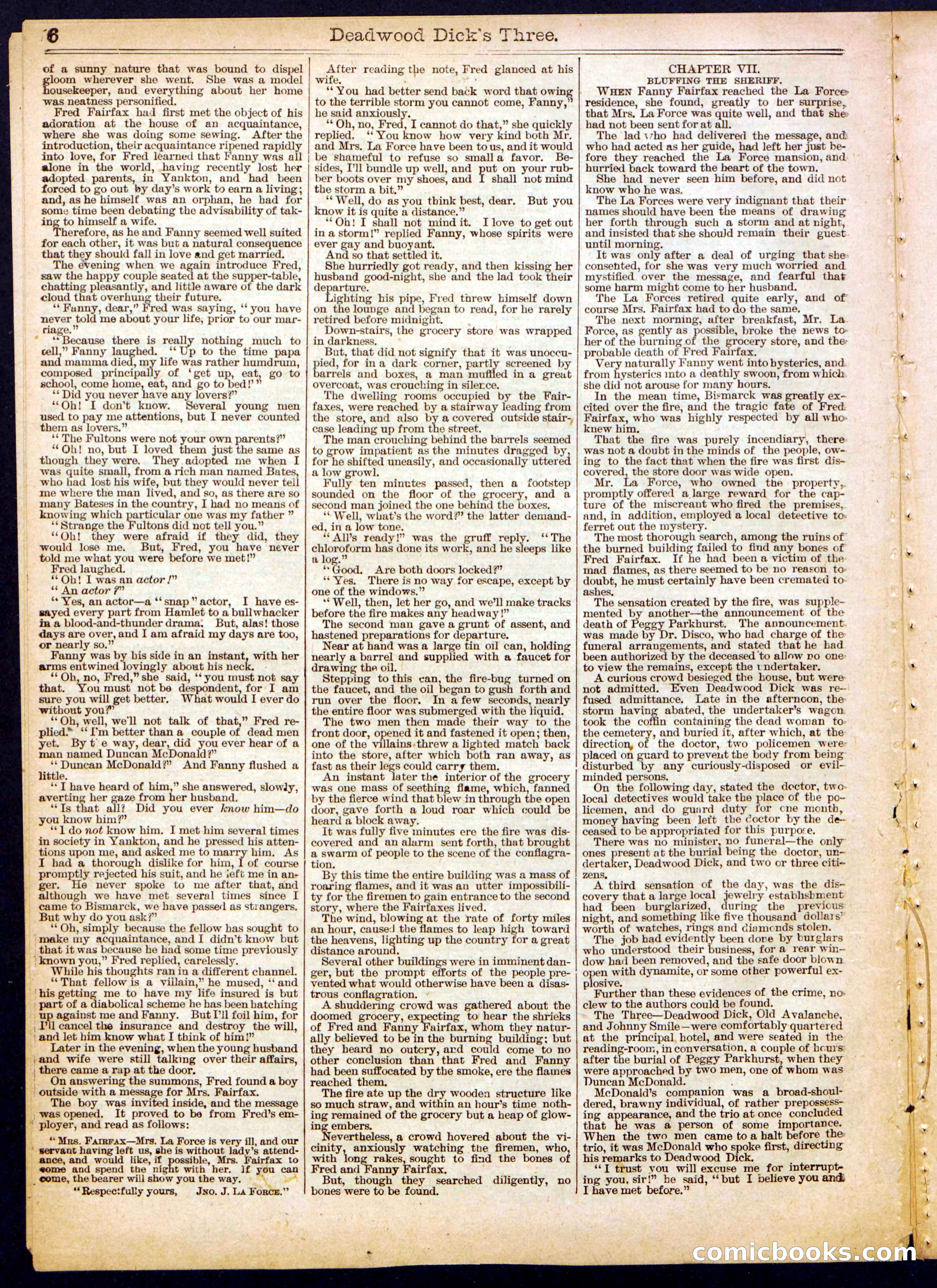
A restored page from Pulp Fiction, 1887. Page through the whole issue in the reader above.
📄 Transcribed text from this page (OCR, searchable)
Machine-transcribed from the original scan — historical spelling and the odd misread are preserved.
\ie es * , - Ps * * ‘a / is > - due =o loom wherever she went. She was a model ousekeeper, and everything about her home was neatness personified. Fred Fairfax had first met the object of his adoration at the house of an acquaintance, where she was doing some sewing. After the introduction, their acquaintance ripened rapidly into love, for Fred learned that Fanny was all alone in the world, .having recently lost her adopted parents, in Yankton, and had been forced to go out by day’s work to earn a living; and, as he himself was an orphan, he had for some time been debating the advisability of tak- ang to himself a wife. herefore, as he and Fanny seemed well suited for each other, it was but a natural consequence that they should fall in love and get married. The évening when we again introduce Fred, saw the happy couple seated at the supper-table, chatting pleasantly, and little aware of the dark cloud that overhung their future. ‘* Funny, dear,” Fred was saying, ‘*‘ you have never told me about your life, prior to our mar- riage.” ‘‘ Because there is really nothing much to cell,” Fanny laughed. ‘‘ Up to the time papa and mamma died, my life was rather humdrum, composed principally of ‘get up, eat, go to school, come home, eat, and go to bed!’” ‘*Did you never have any lovers?” ““Oh! I don’t know. Several young men used to pay me attentions, but I never counted them as lovers.” ‘** The Fultons were not your own parents?” ““QOh! no, but I loved them just the same as though they were. They adopted me when I was quite small, from a rich man named Bates, who had lost his wife, but they would never tell me where the man lived, and so, as there are so many Bateses in the country, I had no means of knowing which particular one was my father ” ‘* Strange the Fultons did not tell you.” ‘“‘Oh! they were afraid if they did, they would lose me. But, Fred, you have never told me what you were before we met!” Fred laughed. **Oh! I was an actor !” | ** An actor ?” *“* Yes, an actor—a ‘“‘snap” actor, I have es- sayed every part from Hamlet to a bullwhacker im a blood-and-thunder drama. But, alas! those days are over, and | am afraid my days are too, or nearly so.” Fanny was by bis side in an instant, with her arms entwined lovingly about his neck, - **Oh, no, Fred,” she said, ‘‘ you must not say that. You must not be despondent, for I am sure you will get better. What would I ever do without you?” **Oh, well, we'll not talk of that,” Fred re- plied” ‘‘ I’m better than a couple of dead men yet. By t e way, dear, did you ever hear of a - man named Duncan McDonald?” < A Duncan McDonald?” And Fanny flushed a jittle. | ‘*T have heard of him,” she answered, slowdy, - averting her gaze from her husband. _ “Ts that all? Did you ever know him—do you know him?” ~ **7 do not know him. I met him several times - in society in Yankton, and he pressed his atten- h: tions upon me, and asked me to marry him, As I had a thorough dislike for him, I of course _ promptly rejected his suit, and he ieft me in an- ger. He never spoke to me after that, and although we have met several times since I | came to Bismarck, we have passed as strangers. _ But why do you ask?” _ ‘Oh, simply because the fellow has sought to _/meke my acquaintance, and I didn’t know but that it was because he had some time previously _| known you,” Fred replied, carelessly. | While his thoughts ran in a different channel. “That fellow is a villain,” he mused, ‘‘ and | his getting me to have my life insured is but _) part of a diabolical scheme he has been hatching - up against meandFanny. ButTll foil him, for _, Pl cancel the insurance and destroy the will, and Jet him know what I think of him!” Later in the evening, when the young husband ,and wife were still talking over their affairs, 4 there came a rap at the door, |, On answering the summons, Fred found a boy 4 outside with a message for Mrs. Fairfax. | The boy was invited inside, and the message _, was opened, It proved to be from Fred’s em- ’ ployer, and read as follows: _ “Mrs. Farrrax—Mrs. La Force is very ill, and our -’ servant having left us, she is without lady’s attend- - ance, and would like, if possible, Mrs. Fairfax to _@ome and spend the night with her. ]f you can come, the bearer will show you the way. — 3 ‘ “Respectfully yours, Jno. J. La Force.” . 7 : - es — - - * SS ——~ -_—.o --- — — — - — - ~~ 4 a ¢ = * 1? * * . « . . a i a oe of a sunny nature that was bound to dispel | — <i a a aR RR Rm a a A a ee oe ee é pe“ y ri. ira ' 7. ee wer . a * FE Re eee Te ——— Deadwood Dick's Three. ——--- — — 20 owe — oo s- - “ ae After reading the note, Fred glanced at his wife. Sy ‘* You had better send back word that owing } to the terrible storm you cannot come, Fanny,” he said anxiously. ‘** Oh, no, Fred, I cannot do that,” she quickly replied. ‘‘ You know how very kind both Mr. and Mrs. La Force have been to us, and it would be shameful to refuse so smalla favor. Be- sides, P'll bundle up well, and put on your rub- ber boots over my shoes, and i shall not mind the storm a bit.” ‘* Well, do as you think best, dear. know it is quite a distance.” ‘**Ohb! I shall not mind it. I love to get out in a storm!” replied Fanny, whose spirits were ever gay and buoyant. And so that settled it. She hurriedly got ready, and then kissing her husband good-night, she and the lad took their departure. ighting his pipe, Fred threw himself down on the lounge and began to read, for he rarely retired before midnight. Down-stairs, the grocery store was wrapped in darkness. But, that did not signify that it was unoccu- pied, for ina dark corner, partly screened by barrels and boxes, a man muffled in a greut overcoat, was crouching in silerce. The dwelling rooms occupied by the Fair- faxes, were reached by a stairway leading from the store, and also by a covered outside stair- case leading up from the street. The man crouching behind the barrels seemed to grow impatient as the minutes dragged by for he shifted uneasily, and occasionally uttered a low growl. Fully ten minutes passed, then a footstep sounded on the floor of the grocery, and a second man joined the one behind the boxes. ‘* Well, what’s the word?’ the latter demand- ed, in a low tone. ‘Alls ready!” was the gruff reply. ‘‘ The chloroform has done its work, and he sleeps like a log.” «Good. Are both doors locked?” ‘* Yes. There is no way for escape, except by one of the windows.” ‘Well, then, let her go, and we'll make tracks before the fire makes any headway !” The second man gave a grunt of assent, and hastened preparations for departure. Near at hand was a large tin oil can, holding nearly a barrel and supplied with a faucet for drawing the oil. Stepping to this can, the fire-bug turned on the faucet, and the oil began to gush forth and run over the floor. In a few seconds, nearly the entire floor was submerged with the liquid. The two men then made their way to the front door, opened it and fastened it open; then, one of the villains: threw a lighted match back into the store, after which both ran away, as fast as their legs could carry them. An instant later the interior of the grocery was one mass Of seething flame, which, fanned by the fierce wind that blew in through the open door, gave forth a loud roar which could be heard a block away. It was fully five minutes ere the fire was dis- covered and an alarm sent forth, that brought a swarm of people to the scene of the conflagra- tion. By this time the entire building was a mass of roaring flames, and it was an utter impossibili- ty for the firemen to gain entrance to the second story, where the Fairfaxes lived. The wind, blowing at the rate of forty miles an hour, cause:! the flames to leap high toward the heavens, lighting up the country for a great distance around, Several other buildings were in imminent dan- ger, but the prompt efforts of the people pre- vented what would otherwise have been a disas- trous conflagration. A shuddering crowd was gathered about the doomed grocery, expecting to hear the shrieks of Fred and Fanny Fairfax, whom they natur- ally believed to be in the burning building; but they heard no outcry, ard could come to no other conclusion than that Fred and Fanny had been suffocated by the smoke, ere the flames reached them, The fire ate up the dry wooden structure like so much straw, and within an hour’s time noth- ing remained of the grocery but a heap of glow- ing embers. evertheless, a crowd hovered about the vi- cinity, anxiously watching the firemen, who with long rakes, sought to find the bones o Fred and Fanny Fairfax. But, though they searched diligently, no bones were to be found, But you > >| - CHAPTER VII. BLUFFING THE SHERIFF, WHEN Fanny Fairfax reached the La Force residence, she found, greatly to her surprise, that Mrs, La Force was quite well, and that she had not been sent for at all. The lad \7ho had delivered the message, and who had acted as her guide, had left her just be- fore they reached the La Force mansion, and: hurried back toward the heart of the town. She had never seen him before, and did not know who he was, The La Forces were very indignant that their names should have been the means of drawing her forth through such a storm and at night, and insisted that she showd remain their guest until morning. It was only after a deal of urging that she: consehted, for she was very much worried and mystified over the message, and fearful that some harm might come to her husband. The La Forces retired quite early, and of course Mrs. Fairfax had to do the same, The next morning, after breakfast, Mr. La Force, as gently as possible, broke the news to her of the burning of the grocery store, and the: probable death of Fred Fairfax, Very naturally Fanny went into hysterics, and. from hysterics into a deathly swoon, from which she did not arouse for many hours. In the mean time, Bismarck was greatly ex- cited over the fire, and the tragic fate of Fred. Fairfax, who was highly respected by all who- knew him, | That the fire was purely incendiary, there was not a doubt in the minds of the people, ow-. ing to the fact that when the fire was first dis- covered, the store door was wide open. Mr. La Force, who owned the property,. promptly offered a large reward for the cap- ture of the miscreant who fired the premises, and, in addition, employed a local detective to ferret out the mystery. The most thorough search, among the ruins of the burned building failed to find any bones of Fred Fairfax. If he had been a victim of the mad flames, as there seemed to be no reason to doubt, he must certainly have been cremated to ashes, The sensation created by the fire, was supple- mented by another—the announcement of the death of Peggy Parkhurst. The announcement. was made by Dr. Disco, who had charge of the funeral arrangements, and stated that he had been authorized by the deceased to allow pro one: to view the remains, except the undertaker. A curious crowd besieged the house, but were not admitted. Even Deadwood Dick was re-- fused admittance, Late in tbe afternoon, the storm having abated, the undertaker’s wagon took the coftin containing the dead woman to the cemetery, and buried it, after which, at the direction, of the doctor, two policemen were placed on guard to preveut the body from being: disturbed by any curiously-disposed or evil- minded persons, On the following day, stated the doctor, two. local detectives would take the place of the po- licemen, and do guard duty for cne month, money having been left the Coctor by the de- ceased to be appropriated for this purpose. There was no minister, no funeral—the only ones present at the burial being the doctor, un- sateaker. Deadwood Dick, and two or three citi- zens, A third sensation of the day, was the dis- covery that a large local jewelry establishment had n burglarized, during the previous night, and something like five thousand dollars” worth of watches, rings and ciamends stolen. The job bad evidently been dove by burglars who understood their business, for a rear win- dow had been removed, and the safe door blown open with dynamite, or some other powerful ex- plosive. : Further than these evidences of the crime, no clew to the authors could be found. The Three—Deadwood Dick, Old Avalanche, and Johnny Smile—were comfortably quartered at the principal, hotel, and were seated in the irae ag a in conversation, a couple of bours: after t were approached by two men, one o Duncan McDonald. McDonald’s companion was a broad-shoul- dered, brawny individual, of rather prepossess- ing appearance, and the trio at once conclu that he was a person of some importance. When the two men came toa halt before the: trio, it was McDonald who spoke first, direcung his remarks to Deadwood Dick. . . I trust you will excuse me for interrupt- ing you, sir!” he said, “but I believe you and I have met before.” e burial of Peggy Parkhurst, when they f whom was ’ ‘ . | hI \ ~ | es “