
Pulp Fiction, 1882 · page 7 of 16
Beadle's Half Dime Library No. 282 — page 7: what you’re looking at
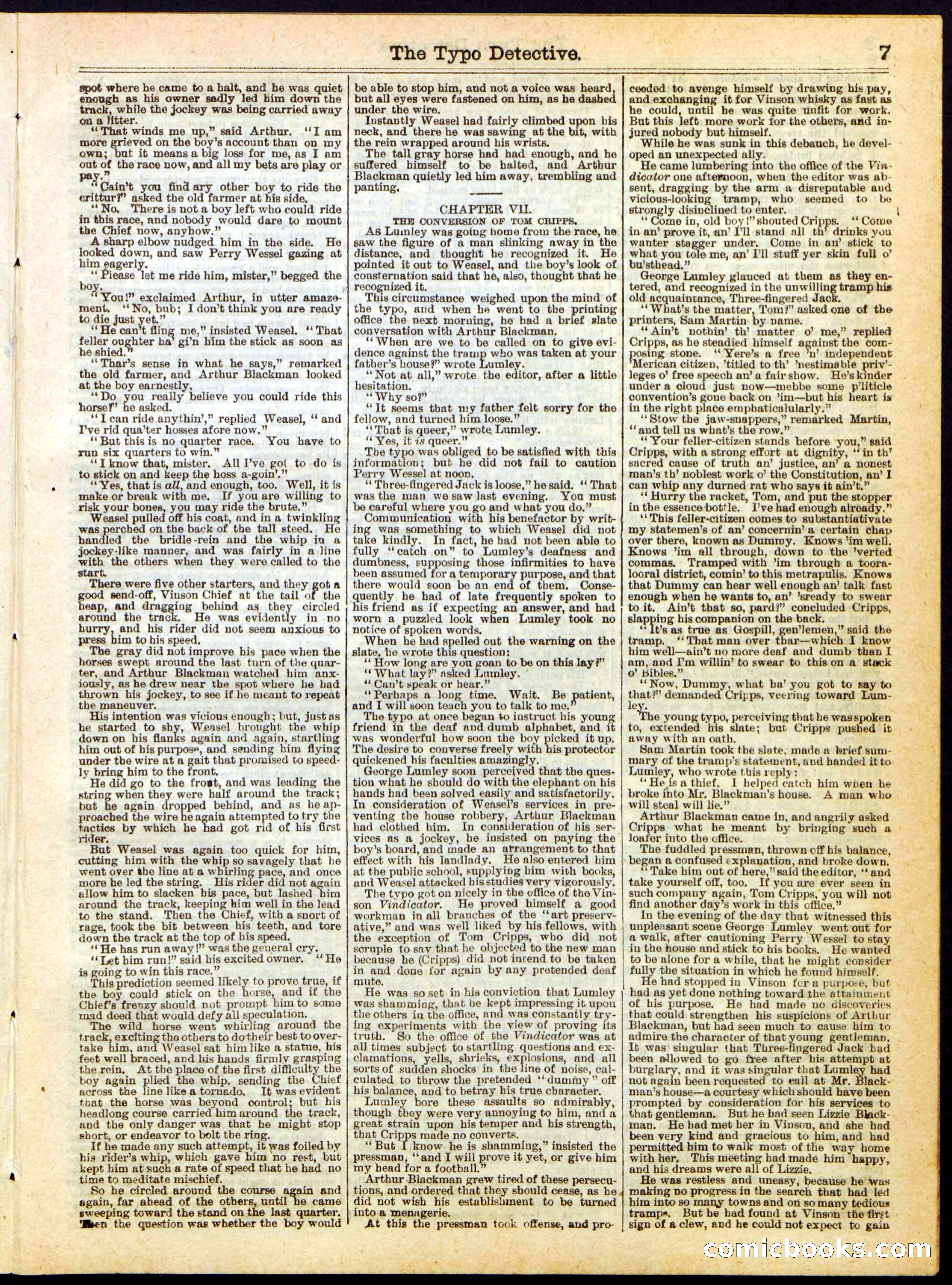
A restored page from Pulp Fiction, 1882. Page through the whole issue in the reader above.
📄 Transcribed text from this page (OCR, searchable)
Machine-transcribed from the original scan — historical spelling and the odd misread are preserved.
_—~ a a et ne eet re ne enough as his owner sadly led him down the track, while the jockey was being carried away on a litter. “That winds me up,” said Arthur. more grieved on the boy’s account than on my own; but it means a big loss for me, as I am out of the race now, and all my bets are play or pay.” *Oain't you find ary other boy to ride the erittur?”’ asked the old farmer at his side, ““No, There is not a boy left who could ride in this race, and nobody would dare to mount the Chief now, anyhow.” A sharp elbow nudged him in the side. He looked down, and saw Perry Wessel gazing at him eagerly. *‘ Please let me ride him, mister,” begged the “T am boy. Cron !” exclaimed Arthur, in utter amaze- ment, ‘No, bub; I don’t think you are ready to die just yet.” “He can’t fling me,” insisted Weasel. ‘‘ That feller oughter ha’ gi’n him the stick as soon as he shied.” ‘‘Thar’s sense in what he says,” remarked the old farmer, and Arthur Blackman looked at the boy earnestly, ‘““Do you really believe you could ride this horse?” he asked. ‘*I can ride anythin’,” replied Weasel, ‘‘ and I’ve rid qua’ter hosses afore now.” ‘But this is no quarter race. You have to rup six quarters to win.” ‘‘T know that, mister. All I’ve got to do is to stick on and keep the hoss a-goin’.” ‘Yes, that is all, and enough, too. Well, it is make or break with me. If youare willing to risk your bones, you may ride the brute.” Weasel pulled off his coat, and in a twinkling was perched on the back of the tall steed. He handled the bridle-rein and the whip iu a jockey-like manner, and was fairly in a line with the others when they were called to the start. There were five other starters, and they got a ood send-off, Vinson Chief at the tail of the eap, and dragging behind as they circled around the track. He was evidently in no hurry, and his rider did not seem anxious to press him to his speed, The gray did not improve bis pace when the horses swept around the last turn of the quar- ter, and Arthur Blackman watched him anx- iously, as he drew near the spot where he had thrown his jockey, to see if he meant to repeat the maneuver. His intention was vicious enough; but, just as he started to shy, Weasel brought the whip down on his flanks again and again, startling him out of his purpose, and sending him flying under the wire at a gait that promised to speed- ly bring him to the front. : He did go to the froat, and was leading the string when they were half around the track; but he again dropped behind, and as he ap- proached the wire toa ain attempted to try the tacties by which he rider, But Weasel was again too quick for him, cutting him with the whip so savagely that he went over the line at a whirling pace, and once more he led the string. His rider did not again allow him to slacken his pace, but lashed him around the track, keeping him well in the lead to the stand. Then the Chief, with a snort of rage, took the bit between his teeth, and tore down the track at the top of bis speed. ‘He has run away!” was the general cry. ‘(Let him run!” said his excited owner. ‘He is going to win this race.” This prediction seemed likely to prove trug, if the boy could stick on the horse, and if the Chief’s frenzy should not prompt bim to some mad deed that would defy all ap: op The wild horse went whirling around the track, exciting the otbers to dotheir best to over- take him, and Weasel sat him like a statue, his feet well braced, and his hands firmly grasping the rein, At the place of the first difficulty the boy again plied the whip, sending the Chief across the line likeatornado. It was evident that the horse was beyond control; but his headlong course carried him around the track, and the only danger was that be might stop short, or endeavor to bolt the ring. If he made any such attempt, it was foiled by his rider’s whip, which gave him no rest, but kept him at such a rate of speed that he had no time to meditate mischief. ad got rid of his first So he circled around the course in and again, far ahead of the others, until he came sweeping toward the stand on the last quarter. Men the question was whether the boy would er Oe Sere spot where he came to a halt, and he was quiet | be able to stop him, The Typo Detective, and not a voice was heard but all eyes were fastened on him, as he dashed under the wire. Instantly Weasel had fairly climbed upon his neck, and there he was sawing at the bit, with the rein wrapped around his wrists. The tall gray horse had had enough, and he suffered himself to be halted, and Arthur Blackman quietly led him away, trembling and panting, CHAPTER VII. THE CONVERSION OF TOM CRIPPS, As Lumley was going home from the race, he saw the figure of a man slinking away in the distance, and thought he recognized it. He pointed it out to Weasel, and the boy’s look of consternation said that he, also, thought that he recognized it. This circumstance weighed upon the mind of the typo, and when he went to the printing office the next morning, he had a brief slate conversation with Arthur Blackman. ** When are we to be called on to give evi- dence against the tramp who was taken at your father’s house?” wrote Lumley. ‘Not at all,” wrote the editor, after a little hesitation. ‘Why so?” “It seems that my father fellow, and turned him loose.’ ‘‘That is queer,” wrote Lumley. “ Yes, it is queer.” Tbe typo was obliged to be satisfied with this information; but he did not fail to caution Perry Wessel at noon, ** Three-fingered Jack is loose,” he said. ‘‘ That was the man we saw last evening. You must be careful where you go and what you do,” Comwmunication with his benefactor by writ- ing was something to which Weasel did not take kindly. In fact, he had not been able to fully “‘catch on” to Lumley’s deafness and dumbness, supposing those infirmities to have been assumed for a temporary purpose, and that there would soon be an end of them, Conse- quently he had of late frequently spoken to his friend as if expecting an answer, and had worn a puzzled look when Lumley took no notice of spoken words. When he had spelen out the warning on the slate, he wrote this question: ‘* How long are you goan to be on this lay?” ‘* What lay?” asked Lumley. | *‘ Can’t speak or hear.” ‘Perhaps a long time. Wait. Be patient, and I will soon teach you to talk to me. The typo at once began to instruct his young friend in the deaf and dumb alphabet, and it was wonderful how soon the boy picked it up. The desire to converse freely with his protector quickened his faculties amazingly. George Lumley soon perceived that the ques- tion what he should do with the elephant on his hands had been solved easily and satisfactorily. In consideration of Weasel’s services in pre- venting the house robbery, Arthur Blackman had clothed him, In consideration of his ser- vices as a jockey, he insisted on paying the boy’s board, and made an afrangement to that effect with his landlady. He also entered him at the public school, supplying bim with books, and Weasel attacked his studies very vigorously, The typo got on nicely in the office of the Vin- son Vindicator. He proved himself a good workman in all branches of the “art preserv- ative,” and was well liked by his fellows, with the exception of Tom Cripps, who did not scruple to say that he objected to the new man because he (Cripps) did not inrend to be taken in and done for again by any pretended deaf mute, He was soset in his conviction that Lumley was shamming, that he kept impressing it upon the others in the office, and was constantly try- ing experiments with the view of proving its truth, So the office of the Vindicator was at all times subject to startling questions and ex- clamations, yells, shrieks, erp lonions, and all sorts of sudden shocks in the line of noise, cal- culated to throw the pretended *‘ dummy ” off his balance, and to betray bis true character. Lumley bore these assaults so admirably, though they were very annoying to him, and a great strain upon his temper and his strength, that ribs made no converts. ‘But I know he is shamming,” insisted the pressman, ‘‘and I will prove it yet, or give him my head for a football. ur Blackman grew tired of these persecu- tions, and ordered that they should cease, as he did not wish his establishment to be turned At this the pressman took offense, and pro- felt sorry for the LLL LLL LDL BALL ALLA LLL LLL ALLL CC CT CT aE LT y ee ee ee ageemers ++ —— se ceeded to avenge himself by drawing his pay, and exchanging it for Vinson whisky as fast as he could, until he was quite unfit for work. But this left. more work for the others, and in- jured nobody but himself. While he was sunk in this debauch, he devel- oped an unexpected ally. He came lumbering into the office of the Vin- dicator one afternoon, when the editor was ab- sent, dragging by the arm a disreputable and vicious-looking tramp, who seemed to strongly disinclined to enter. ‘*Come in, old boy!” shouted Cri Ops. * Come in an’ prove it, an’ I'll stand all th’ drinks you wanter stagger under. Come in an’ stick to what you tole me, an’ I'll stuff yer skin full o’ bu’sthead,” George Lumley glauced at them as they en- tered, and recognized in the coving eae old acquaintance, Three-fingered Jack, ‘*What’s the matter, Tom?” asked one of the printers, Sam Martin by name. . ‘*Ain’t nothin’ th’ matter o’ me,” replied Cripps, as he steadied himself against the com- posing stone. ‘* Yere’s a free ’n’ independent Merican citizen, ‘titled to th’ ’nestimable priv’- leges o’ free speech an’a fairshow. He’s kinder under a cloud just now—mebbe some pliticle convention’s gone back on *im—but his heart is in the right place empbaticalularly.” ‘‘Stow the jaw-snappers,” remarked Martin, ‘‘and tell us what’s the row.” ‘Your feller-citizen stands before you,” said Cripps, with a strong effort at dignity, ‘* in th’ sacred cause of truth an’ justice, an’ a nonest man’s th’ noblest work o’ the Constitution, an’ I can whip any durned rat who says it ain’t,.” ‘‘ Hurry the racket, Tom, and put the stopper in the essence bottle. I’ve had enough already.” ‘* This feller-citizen comes to substantiativate my statemen’s of an’ concernin’ a certain cha over there, known as Dummy. Knows ‘im w Knows ’im all through, down to the 'verted — ; commas. Tram with ’im through a toora- looral district, comin’ to this metrapulis. Knows that Dummy can hear well enough an’ talk fast enough when he wants to, an’ ’sready to swear to it. Ain’t that so, pard?” concluded Cripps, slapping bis companion on the back. ‘It’s as true as Gospill, peor said the tramp. ‘That man over thar—which I know him well—ain’t no more deaf and dumb than I am, and I’m willin’ to swear to this on a stack 0’ Bibles,” ‘Now, Dummy, what ha’ you got to say to that?’ demanded Cripps, veering toward Lum- ley. x The young typo, perceiving that he wasspoken to, extended his away with an oath. Sam Martin took the slate, made a brief sum- mary of the tramp’s statement, and handed itto Lumley, who wrote this reply: “He isa thief. I helped catch him when he broke into Mr. Blackman’s house. A wan who. will steal will lie.” Artaur Blackman came in, and angrily asked Cripps what he meant by bringing such a loafer into the office. The fuddled pressman, thrown off his balance, — began a confused <«xplanation, and broke down, **Take him out of here,” said the editor, ‘and take yourself off, too. If you are ever seen in such company again, Tom Cripps, you will not find another day’s work in this office.” In the evening of the da unpleasant scene George Lumley went out for a walk, after cautioning Perry Wessel to sta in the house and stick to his books. He wante to be alone for a while, that he might consider fully the situation in which he found himself, e had stopped in Vinson fer a purpose, but had as yet done nothing toward the attainment — of his purpose. He had made no discoveries that could strengthen his suspicions of Arthur Blackman, but had seen much to cause him to admire the character of that young gentleman, It was singular that Three-fingered Jack bad pit gee to go free after his attempt at urgla 4 not again been requested to eall at Mr. Black-- man’s house—a courtesy which should have been prompted by consideration for his i that gentleman. But he bad seen Lizzie man. He had met her in Vinson, and she had been very kind and gracious to permitted bim to walk most of the way home with her, This meeting had made him happy, and his dreams were all of Lizzie, Da He was restless and uneasy, because he was making no progress in the search that had led him into so many towns and on somany tramps. But he had found at Vinson’: sign of a clew, and he could not expect to gain slate; but Cripps pushed it | that witnessed this — , and it was singular that Lu had > im, and had | fn, FF Se KAD 2 «* * cee oe 7. + ‘4 4 o oey (E m o. JOOKS a $