
Pulp Fiction, 1882 · page 8 of 16
Beadle's Half Dime Library No. 282 — page 8: what you’re looking at
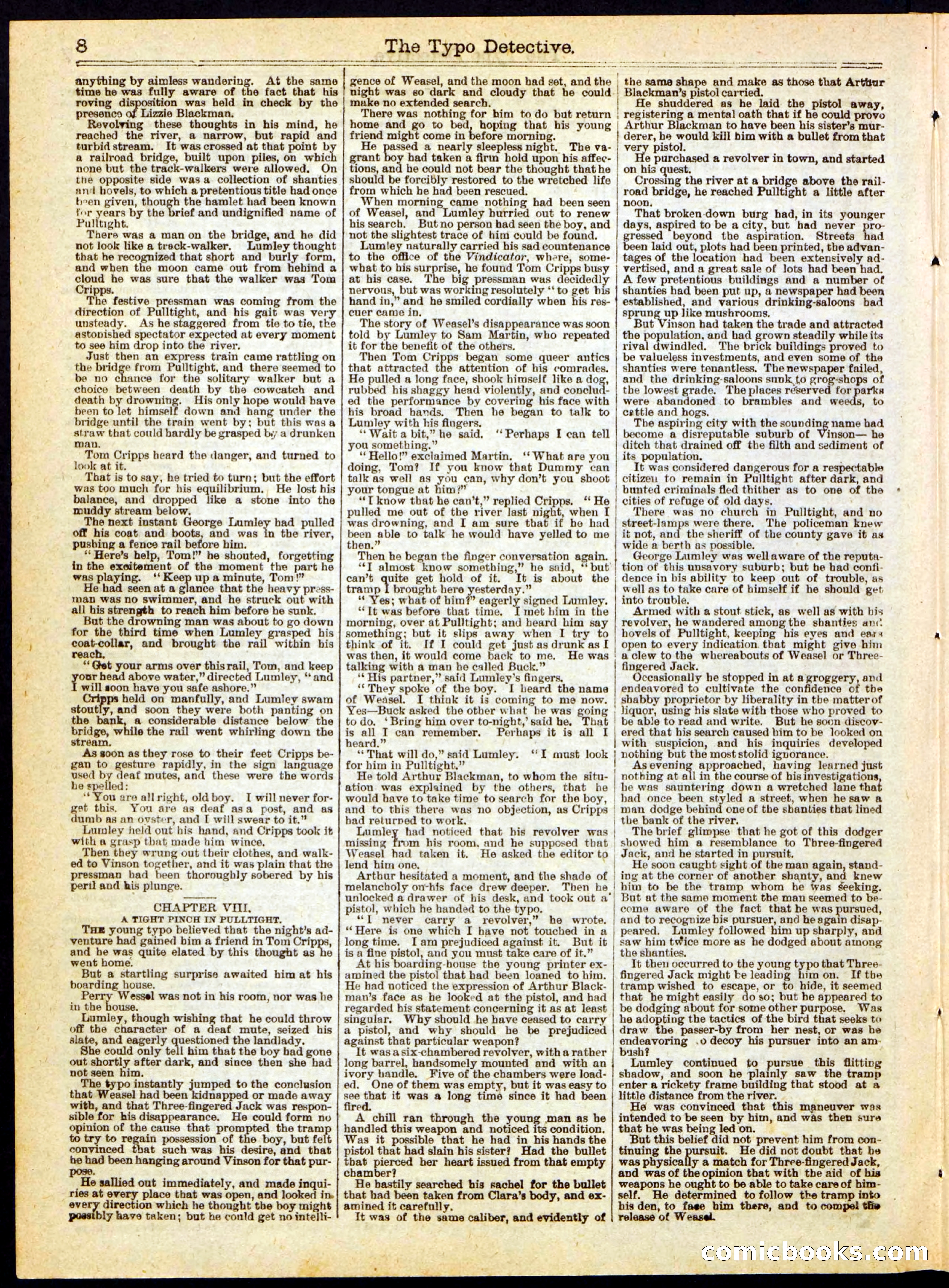
A restored page from Pulp Fiction, 1882. Page through the whole issue in the reader above.
📄 Transcribed text from this page (OCR, searchable)
Machine-transcribed from the original scan — historical spelling and the odd misread are preserved.
time he was fully every d 8 ae sehen anything by aimless wandering. At the same aware of the fact that his roving disposition was held in check by the presencs of Lizzie Blackman. Revolving these thoughts in his mind, he reached the river, a narrow, but rapid and turbid stream. It was crossed at that point b a railroad bridge, built upon piles, on whic none but the track-walkers were allowed. On the opposite side wasa collection of shanties andl hovels, to which a pretentious title had once been given, though the hamlet had been known for years by the brief and undignified name of Pulltight. There was a man on the bridge, and he did not look like a treck-walker. Lumley thought that he recognized that short and burly form, and when the moon came out from hehind a cloud he was sure that the walker was Tom oe The festive pressman was coming from the direction of Pulltight, and his gait was very unsteady. As he staggered from tie to tie, the astonished spectator expected at every moment to see him drop into the river. Just then an express train came rattling on the bridge from Pulltight, and there seemed to be no chance for the solitary walker but a choice between death by the cowcatch and death by drowning. His only hope would have been to let himself down and hang under the bridge until the train went by; but this was a straw that could bardly be grasped by a dranken man. Tom Cripps heard the danger, and turned to look at it. That is to say, he tried to turn; but the effort was too much for his equilibrium. He lost his balance, and dropped like a stone into the muddy stream below. The next instant George rowan & bad pulled off his coat and boots, and was in the river, pushing a fence rail before him. ** Here’s help, Tom!” he shouted, forgetting in the excitement of the moment the part he was playing. ‘‘ Keep up a minute, Tom!” He had seen at a glance that the heavy press- man was no swimmer, and he struck out with all his strength to reach him before he sunk. But the drowning man was about to go down for the third time when Lumley grasped his om aged and brought the rail within his “Get your arms over thisrail, Tom, and keep our head above water,” directed Lumley, “ and will soon have you safe ashore.” Cripps held on manfully, and Lumley swam stoutly, and soon they were both panting on the ges considerable distance below the bridge, while the rail went whirling down the stream. As goon as they rose to their feet Cripps be- gan to gesture rapidly, in the sign language used by deaf mutes, and these were the words he epelled: ‘You are allright, oldboy. I will never for- ef this, You are as deaf asa post, and as umb as an ovster, and [ will swear to it.” Lumley held out bis hand, and Cripps took it with a grasp that made him wince, Then they wrung out tbeir clothes, and walk- to Vinson together, and it was plain that the pressman had been thoroughly sobered by his peril and his plunge. CHAPTER VII, A TIGHT PINCH IN PULLTIGHT. THE young typo believed that the night’s ad- venture had gained bim a friend in Tom ee and he was quite elated by this thought as he went home. But a startling surprise awaited him at his boarding house. Perry Wessel was not in his room, nor was he in the house. Lumley, though wishing that he could throw off the character of a deaf mute, seized his slate, and eagerly questioned the landlady. She could only tell him that the boy bad gone out shortly after dark, and since then she had not seen him. The typo instantly somapee to the conclusion that Weasel had been kidnapped or made away with, and that Three-fingered Jack was respon- sible for his disappearance. He could form nu opinion of the cause that prompted the tram to to regain possession of the boy, but felt convinced that such was his desire, and that he had been hanging around Vinson for that pur- pose. He sallied out immediately, and made inqui- ries at ars A place that was open, and looked im ion which he thought the boy might y have taken; but he conld get no intelli- The Typo, Detective. 02+. mee ad ++ nemo ; soe wee =e ee — ens ee ae ee ee eee gence of Weasel, and the moon had set, and the ' the same shape and make as those that Arthur night was eo dark and cloudy that he could! Blackman’s pistol carried muke no extended search. He shuddered as he laid the pistol away, There was nothing for him to do but return | registering a mental oath that if he could provo home and go to bed, hoping that his young | Arthur Blackman to have been his sister’s mur- friend might come in before morning. He passed a nearly sleepless night. grant y bad taken a firm hold upon his affee- tions, an should be forcibly restored to the wretched life from which he had been rescued. When morning came nothing had been seen of Weasel, and Lumley burried out to renew his search. But no person had seen the boy, and not the slightest trace of him could be found. Lumley naturally carried bis sad countenance to the office of the Vindicator, where, some- what to bis surprise, he found Tom Cripps busy at his case. The big pressman was decided! nervous, but was working resolutely ‘‘ to get bis hand in,” and he smiled cordially when his res- cuer came in. The story of Weasel’s disappearance was soon told by Lumley to Sam Martin, who repeated it for the benefit of the others. Then Tom ‘gies began some queer antics that attracted the attention of his comrades. He pulled a long face, shook himself like a dog, rubbed his shaggy head violently, and conelud- ed the performance by covering his face with his broad hands. Then he began to talk to Lumley with his fingers. ** Wait a bit,” he said, you something.” ‘“‘ Hello!” exclaimed Martin. ‘‘ What are you doing, Tom? If you know that Dummy can talk as well as you can, why don’t you shoot your tongue at him?” “‘T know that he can’t,” replied Cripps. “‘ He pulled me out of the river last night, when I was drowning, and [ am sure that if he had been able to talk he would have yelled to me then.” Then he began the finger conversation again. “IT almost know something,” he said, ** but can’t quite get hold of it. It is about the tramp I brought here yesterday.” ** Yes; what of him?” eagerly signed Lumley. “It was before that time. I met him in the morning, over at Pulltight; and beard him say ‘Perhaps I can tell something; but it slips away when I try to | think of it. was then, if would come back to me. talking with a man he called Buck.” ‘* His partner,” said Lumley’s fingers, ‘They spoke of the boy. I heard the name of Weasel. I think it is coming to me now. Yes—Buck asked the other what he was going to do. ‘ Bring him over to-night,’ said he. That is all IT can remember. Perhaps it is all I heard.” “That will do,” said Lumley. for him in Pulltight.” He told Arthur Blackman, to whom the situ- ation was explained by the others, that he would have to take time to search for the boy, and to this thera was no objection, as Cripps had returned to work, If I could get just as drunk as [ He was “T must look eae had noticed that his revolver was | r m his room, and he supposed that He asked the editor to missing Weasel had taken it. lend him one, Arthur hesitated a moment, and the shade of melancholy on-his face drew deeper. Then he unlocked a drawer of his desk, and took out a’ pistol, which he handed to the typo. ‘““] never carry a revolver,” he wrote. “Here is one which I have not touched in a long time. [I am prejudiced against it. But it is a fine pistol, and you must take care of it.” At his boarding-bouse the young printer ex- amined the pistol that had been loaned to him. He had noticed the expression of Arthur Black- man’s face as he looked at the pistol, and had regarded his statement concerning it as at least singular, Why should he have ceased to carry a pistol, and why should he be prejudiced against that particular weapon? The va- | be could not bear the thought thathe | SS SS Ss ssi iih-eemenr-es-stesssstseeseeneentepeee t a — + eee derer, he would kill bim with a bullet from that vey pistol. e purchased a revolver in town, and started on his quest, Crossing the river at a bridge above the rail- road bridge, he reached Pulltight a little after noon. That broken-down burg had, in its younger days, aspired to be a city, but had never pro- gressed beyond the aspiration. Streets had been laid out, plots had been printed, the advan- tages of the location had been extensively ad- vertised, and a great sale of lots had been had. A few pretentious buildings and a number of shanties had been put up, a newspaper had been established, and various drinking-saloons bad sprung up like mushrooms. But Vinson had taken the trade and attracted the population, and had grown steadily while its rival dwindled. The brick buildings proved to be valueless investments, and even some of the shanties were tenantless. The newspaper failed, and the drinking-saloons sunk to grog-shops of the lowest grade. The places reserved for parka were abandoned to brambles and weeds, to cattle and hogs. The aspiring city with the agen name bad become a disreputable suburb of Vinson— he ditch that drained off the filth and sediment of its population. , It was considered dangerous for a respectable citizen: to remain in Pulltight after dark, and bunted criminals fled thither as to one of the cities of refuge of old days. There was no church in Pulltight, and no dig bran were there. The policeman knew it not, and the sheriff of the county gave it as wide a berth as possible. George Lumley was well aware of the reputa- tion of this unsavory suburb; but he bad confi- dence in bis ability to keep out of trouble, as well as to take care of himself if he should get into trouble. Armed with a stout stick, as well as with bis revolver, he wandered among the shanties anc: hovels of Pulltight, keeping his eyes and ears open to every indication that might give him a clew to the whereabouts of Weasel or Three- fingered Jack. Occasionally be stopped in at agroggery, and endeavored to cultivate the confidence of the shabby proprietor by liberality in the matter of liquor, using his slate with those who proved to be able to read and write. But he soon discov- ered that bis search caused him to be looked on with suspicion, and his inquiries developed nothing but the most stolid ignorance. Asevening approached, having learned just nothing at all in the course of bis investigations he was sauntering down a wretched lane that had once been styled a street, when he saw a ' man dodge behin i _ lt was asix-chambered revolver, witharather | long barrel, handsomely mounted and with an ivory handle. Five of the chambers were load- ed. One of them was empty, but it was easy to = ae it was a long time since it had been A chill ran through the young man as he handled this weapon and noticed its condition. Was it possible that he had in his hands the pistol that had slain his sister? Had the bullet that pierced her heart issued from that empty chamber? He bastily searched his sachel for the bullet that had been taken from Clara’s body, and ex- amined it carefully. It was of the same caliber, and evidently of f one of the shanties that lined the bank of the river. The brief glimpse that he got of this dodger showed him a resemblance to Tbree-fingered Jack, and he started in pursuit, He soon caught sight of the man again, stand- | ing at the corner of another shanty, and knew him to be the tramp whom he Was seeking. But at the same moment the man seemed to be- come aware of the fact that he was pursued, and to recognize bis pursuer, and he again disap- peared. Lumley followed him up sharply, and saw him twice more as he dodged about among the shanties. It then occurred to the young typo that Three- fingered Jack might be leading himon. If the tramp wished to escape, or to hide, it seemed that he might easily do so; but be appeared to be dodging about for some other purpose. Was he adopting the tactics of the bird that seeks to draw the passer-by from her nest, or was be Sree hi .o decoy his pursuer into an am- 48 Lumley continued to pursue this flitting shadow, and soon he plainly saw the tramp enter a rickety frame building that stood at a little distance from the river. He was convinced that this maneuver was intended to be seen by him, and was then sura that he was being led on. But this belief did not prevent him from con- tinuing the pursuit. He did not doubt that be was physically a match for Three-fingered Jack, and was of the opinion that with the aid of his weapons he ought to be able to take care of bim- self. He determined to follow the tramp into his den, to fage him there, and to compel tie release of Weasel. ay Eomilebooks ; r the as . i) ve =