
Pulp Fiction, 1882 · page 6 of 16
Beadle's Half Dime Library No. 282 — page 6: what you’re looking at
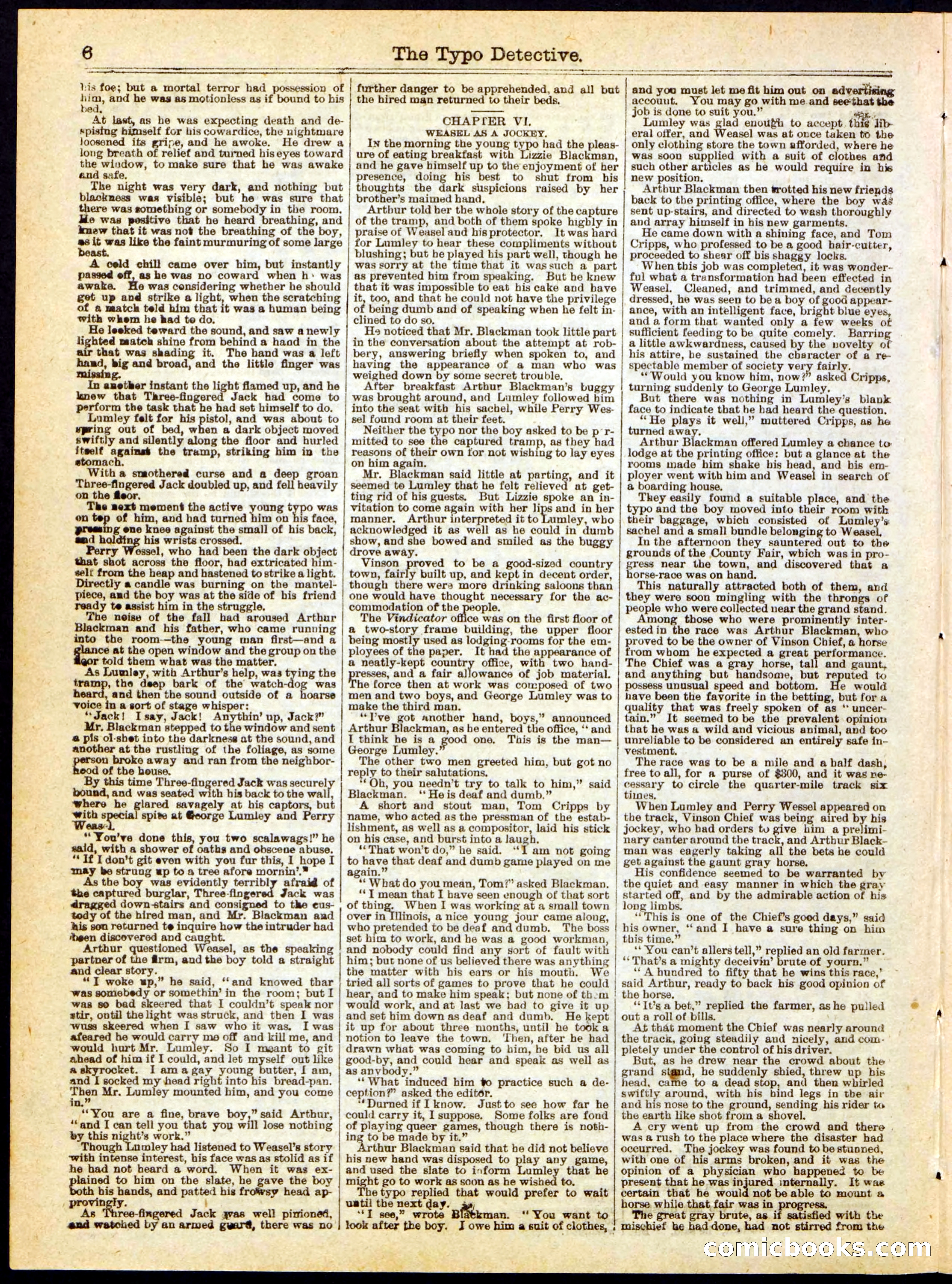
A restored page from Pulp Fiction, 1882. Page through the whole issue in the reader above.
📄 Transcribed text from this page (OCR, searchable)
Machine-transcribed from the original scan — historical spelling and the odd misread are preserved.
6 - — his foe; but a mortal terror had possession of ne and he was as motionless as if bound to his rr) At last, as be was expecting death and de- spistng bimself for his cowardice, the nightmare loosened its gripe, and he awoke. He drew a long breath of relief and turned his eyes toward the window, to make sure that he was awake and safe. The night was very dark, and nothing but blackness was visible; but he was sure that there was something or somebody in the room. Moe was positive that he heard breathing, and knew that it was not the breathing of the boy, as it was like the faint murmuring of some large A celd chill came over him, but instantly passed eff, as he was no coward when h* was awake. He was censidering whether he should get up and strike a light, when the scratching of « match teld him that it was a human being with whem he had to do. He leeked teward the sound, and saw a newly lighted matek shine from behind a hand in the that was skading it. The hand was a left hand, big and broad, and the little finger was | g- In another instant the light flamed up, and he | ksnew that Three-fingered Jack had come to perform the task that he had set himself to do. Lumley felt for his pistol, and was about to ya out of bed, when a dark object moved swiftly and silently along the floor and hurled | iteelf against the tramp, striking him in the | stomach, With a smothered curse and a deep groan Three-fingered Jack doubled up, and fell heavily on the fleor. The aext mement the active young typo was on of him, and bad turned him on his face, ene knee against the small of his back, | ‘ The Typo Detective, ee _ further danger to be apprehended, and all but the hired man returned to their beds. CHAPTER VI. WEASEL AS A JOCKEY. | In the morning the young typo had the pleas- ure of eating breakfast with Lizzie Blackman, and he gave himself up to the enjoyment of ber presence, doing his best to shut from his | thoughts the dark suspicions raised by her brother’s maimed hand, Artbur told ber the whole story of the capture of the tramp, and both of them spoke higbly in praise of Weasel and his protector. It was hard for Lumley to hear these compliments without blushing; but he played his part well, though he was sorry at the time that it wassuch a part as prevented him from speaking. But he knew that it was impossible to eat his cake and have it, too, and that he could not have the privilege of being dumb and of speaking when he felt in- clined to do so. He noticed that Mr. Blackman took little part in the conversation about the attempt at rob- bery, answering briefly when spoken to, and having the appearance of a man who was weighed down by some secret trouble. After breakfast Arthur Blackman’s buggy was brought around, and Lumley followed bim into the seat with his sachel, while Perry Wes- sel found room at their feet. Neither the typo nor the boy asked to be p r- mitted to see the captured tramp, as they had reasons of their own for not wishing to lay eyes on him again. Mr. Blackman said little at parting, and it seemed to Lumley that he felt relieved at get- ting rid of his guests. But Lizzie spoke an in- vitation to come again with her ie and in her manner. Arthur interpreted it to Lumley, who acknowledged it as well as he could in dumb AO a ern a me one we ee - - and you must let me fit him out on advertising account. You may go with me and seethat the job is done to suit you.” 2K. Lumley was glad enoufh to accept. thi¢ Jib- eral offer, and Weasel was at once taken to the only clothing store the town afforded, where he was soon supplied with a suit of clothes and such other articles as be would require in his new position. Artbur Blackman then trotted his new friends back to the printing office, where the boy was sent up-stairs, and directed to wash thoroughly and array himself in his new garments. He came down with a shining face, and Tom Cripps, who professed to be a good hair-cutter, proceeded to shear off bis shaggy locks. When this job was completed, it was wonder- ful what a transformation had been effected in Weasel. Cleaned, and trimmed, and decently dressed, he was seen to be a boy of good appear- ance, with an intelligent face, bright blue eyes, and a form that wanted only a few weeks of sufficient feeding to be quite comely. Barring a little awkwardness, caused by the novelty of his attire, be sustained the character of a re- spectable member of society very fairly. “Would you know him, now?” asked Cripps, turning suddenly to George Lumley. But there was nothing in Lumley’s blank face to indicate that he bad heard the question. “He plays it well,” muttered Cripps, as he turned wai Artbur Blackman offered Lumley a chance to lodge at the printing office: but a glance at the rooms made him shake bis head, and bis em- ployer went with him and Weasel in search of a boarding house, They easily found a suitable place, and the typo and the boy moved into their room with their baggage, which consisted of Lumley’s sachel and a small bundle belonging to Wease aad bh his wrists crossed. | show, and she bowed and smiled as the buggy In the afternoon they sauntered out to the essel, who had been the dark object | drove away. grounds of the County Fair, which was in pro- that shot across the floor, had extricated him- Vinson proved to be a good-sized country | gress near the town, and discovered that a self from the heap and hastened to strike a light. Directly a candle was burning on the mantel- piece, amd the boy was at the side of bis friend ready te assist him in the struggle. The noise of the fall had aroused Arthur Blackman and his father, who came running into the room--the young man first—and a at the open window and the group on the told them what was the matter. As Lumley, with Arthur’s help, was eo the deep bark of the watch-dog was ing the and then the sound outside of a hoarse voice in a sort of stage whisper: “Jack! Isay, Jack! Anythin’ up, Jack?” Mr. Blackman stepped to the window and sent a pis ol-shet into the darkness at the sound, and another at the rustling of the foliage, as some “ear ge broke away and ran from the neighbor- of the house. By this time Three-fingered Jack was securel bound, and was seated with his back to the wall, where he pees savagely at his captors, but with _ spite at George Lumley and Perry Weas “You've done this, you two scalawags!” he sald, with a shower of oaths and obscene abuse. “If I don’t git even with you fur this, I hope I may bo strung up to a tree afore mornin’.* As the boy was evidently terribly afraid of the captured burglar, Three-finge Jack was down-stairs and consigned to the cus- 7 tody of the hired man, and Mr. Blackman and his son returned te inquire how the intruder had heen discovered and caught. ‘was somiebedy or somethin’ in the room; but I town, fairly built up, and keptin decent order, though there wera more drinking saloons than one would have thought necessary for the ac- commodation of the people. The Vindicator office was on the first floor of a two-story frame building, the upper floor being mostly used as lodging-rooms for the em- ployees of the paper. It had the appearance of a neatly-kept rit ee office, with two hand- resses, and a fair allowance of job material. he force then at work was composed of two men and two boys, and George Lumley was to make the third man. “lve got another hand, boys,” announced Arthur Blackman, as he entered the office, ‘* and I think he is a good one, This is the man— George Lumley. The other two men greeted him, but got no reply to their salutations, **Oh, you needn’t try to talk to him,” said Blackman. ‘ Heis deaf and dumb,” A short and stout man, Tom Cripps by name, who acted as the pressman of the estab- lishment, as well as a compositor, laid his stick on his case, and burst into a laugh. “That won't do,” he said. “I am not going to have that deaf and dumb game played on me ain. ‘What do you mean, Tom?” asked Blackman. of thing. When I was working at a small town over in Illinois, a nice young jour came along, set him to work, and he was a good workman, ‘I mean that I bave seen enough of that sort | long limbs. hear, and to make him speak; but none of th-m ! i } | horse-race was on hand. This naturally attracted both of them, and they were soon mingling with the throngs of people who were collected near the grand stand. Among those who were prominently inter- ested in the race was Arthur Blackman, who proved to be the owner of Vinson Chief, a horse from whom he expected a great performance. The Chief was a gray horse, tall and gaunt, and anything but handsome, but reputed to possess unusual speed and bottom. He would have been the favorite in the betting, but for a quality that was freely spoken of as * uncer- tain.” It seemed to be the prevalent opinion that he was a wild and vicious animal, and too unreliable to be considered an entirely safe in- vestment. The race was to be a mile and a half dash, free toall, for a purse of $300, and it was ne- cessary to circle the quarter-mile track six times, When Lumley and Perry Wessel appeared on the track, Vinson Chief was being aired by his jockey, who had orders tu give him a prelimi- nary canter around the track, and Arthur Black- man was eagerly taking all the bets he could get against the gaunt gray horse. His confidence seemed to be warranted by the quiet and easy manner in which the gray started off, and by the admirable action of his ‘This is one of the Chief’s good days,” said who pretended to be deaf anddumb. The boss | his owner, ‘“‘and I have a sure thing on him this time.” the horse. rt Arthur questioned Weasel, as the speaking | and nobody could find any sort of fault with | ‘* You can’t allers tell,” replied an old farmer. " him; but none of us believed there was anything | **That’s a mighty deceivin’ brute of yourn.” and clear story. the matter with his ears or his mouth. We ‘‘A hundred to fifty that he wins this race,’ “I woke up,” he said, ‘‘and knowed thar | tried all sorts of games to prove that he could | said Arthur, ready to back his good opinion of was so bad skeered that I couldn’t speak nor stir, ontil the light was struck, and then I was wuss skeered when I saw who it was. I was afeared he would carry me off and kill me, and would hurt Mr. Lumley. So I meant to git ahead ood I could, and let myself om like a skyrocket. amagay young butter, I am, and I socked my head right into his bread-pan. tai Mr. Lumley mounted him, and you come n. ‘You are a fine, brave boy,” said Arthur, ““and I can tell you that you will lose nothing by this night’s work.” Though Lumley had listened to Weasel’s story ‘with intense interest, his face was as stolid as if he had not heard a word. When it was ex- lained to him on the slate, he gave the boy th his hands, and patted his frolwsy head ap- As fir: Jack yas well pirioned, and watoied by an armed gyard, there was no | a partner of the firm, and the boy told a straight | would work, and at last we bad to give it up and set him down as deaf and dumb. He kept it up for about three months, until he tooka notion to leave the town. ‘Then, after he had drawn what was coming to him, be bid us all good-by, and could hear and speak as well as as anvbody.” ‘* What induced him #0 practice such a de- ception?” asked the editor. “*Darned if Iknow. Just to see how far he could carry it, I suppose. Some folks are fond of playing queer games, though there is noth- ing to be made by it.” thur Blackman said that be did not believe his new hand was disposed to play any game, and used the slate to inform Lumley that he might go to work as soon as he wish e typo replied that would prefer to wait uatil the next day. ‘“*T see,” wrote Bfitkman. “You want to look after the boy. “It’s a bet,” replied the farmer, as he pulled out a roll of bills. At that moment the Chief was nearly around the track, going steadily and nicely, and com- pletely under the control of his driver. But, as be drew near the crowd about the grand stgmd, he suddenly shied, threw up his head, came to a dead stop, and then whirled swiftly around, with his bind legs in the air and his nose to the ground, sending his rider to the earth like shot from a shovel. A cry went up from the crowd and there . was a rush to the place where the disaster had occurred. The jockey was found to be stunned, with one of his arms broken, and it was the opinion of a physician who happened to be present that he was in internally. It wae certain that he would not be able to mount a horse while tha was in progres The rest coo aby as if satisfied with the J owe him a suit of clothes, ; mischief be had done, had not stirred from the eR ¢oim ~ chooks: co ~ => + ’ » é rs _ -* - + & se >