
Pulp Fiction, 1882 · page 3 of 16
Beadle's Half Dime Library No. 282 — page 3: what you’re looking at
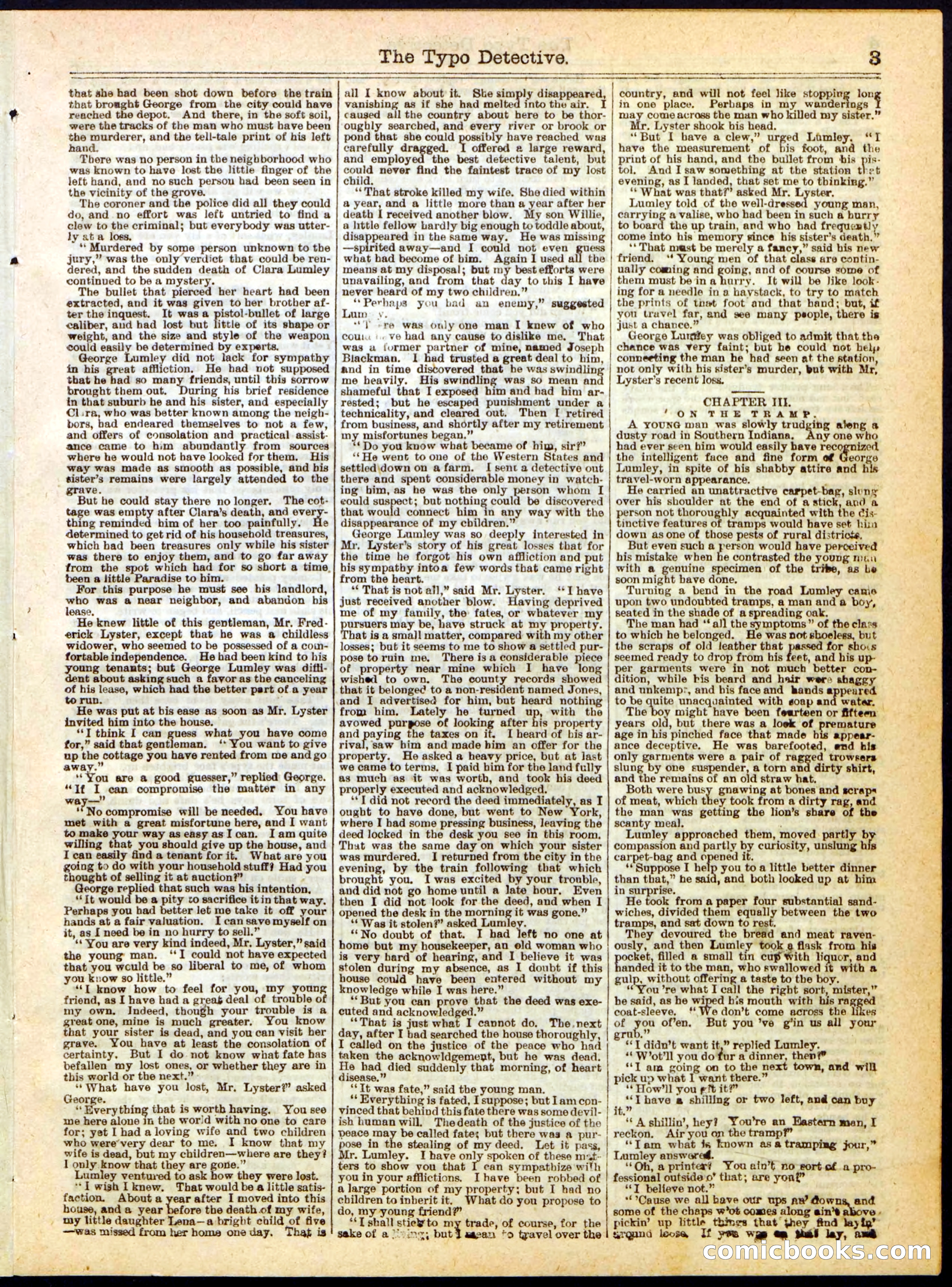
A restored page from Pulp Fiction, 1882. Page through the whole issue in the reader above.
📄 Transcribed text from this page (OCR, searchable)
Machine-transcribed from the original scan — historical spelling and the odd misread are preserved.
that she had been shot down before the train that brought George from the city could have reached the depot. And there, in the soft soil, were the tracks of the man who must have been the murderer, and the tell-tale print of his left hand. There was no person in the neighborhood who was known to have lost the little finger of the left hand, and no such person had been seen in the vicinity of the grove. The coroner and the police did all they could do, and no effort was left untried to find a clew to the criminal; but everybody was utter- ly ata loss. ‘* Murdered by some person unknown to the jury,” was the only verdict that could be ren- dered, and the sudden death of Clara Lumley continued to be a mystery. The bullet that pierced her heart had been extracted, and it was given to her brother af- ter the inquest. It wasa nen of large caliber, and had lost but little of its shape or weight, and the size and style of the weapon could easily be determined by experts. George Lumley did not lack for sympathy in his great affliction. He had not supposed that he had so many friends, until this sorrow brought them out. During his brief residence in that suburb he and his sister, and especially Cl.ra, who was better known among the neigh- bors, bad endeared themselves to not a few, and offers of consolation and practical assist- ance came to him abundantly from sources where he would not have looked forthem. His way was made as smooth as possible, and bis sister’s remains were largely attended to the grave. But he could stay there no longer. The cot- tage was ree after Clara’s death, and every- thing reminded him of her too painfully. @ determined to get rid of his household treasures, which bad been treasures only while his sister was there to enjoy them, and to go far away from the spot which had for so short a time, been a little Paradise to him. For this purpose he must see bis landlord, who was a near neighbor, and abandon bis lease. He knew little of this gentleman, Mr. Fred- erick Lyster, except that he was a childless widower, who seemed to be possessed of a coin- fortable independence. He had been kind to his young tenants; but George Lumley was ditti- dent about asking such a favor as the canceling of his lease, which had the better part of a year to run. He was put at bis ease as soon as Mr. Lyster invited him into the house. ‘*] think I can guess what you have come for,” said that gentleman. ‘* You want to give up the cottage you have rented from me and go away. “You are a good guesser,” replied George. “It I can compromise the matter in any wa ee | P No compromise will be needed. You have met with a great misfortune here, and I want to make your way as easy asIcan. I am quite willing that you should give up the house, and I can easily find a tenant for it. What are you going to do with your household stuff? Had you thought of selling it at auction?” George replied that such was his intention, ‘It would be a pity co sacrifice itin that way. Perhaps you had better let me take it off your hands at a fair valuation. I can save myself on it, as I need be in no hurry to sell.” ‘* You are very kind indeed, Mr, Lyster,” said the young man. “I could not have expected that you would be so liberal to me, of whom you know so little.” “IT know how to feel for you, my young friend, as I have had a grea$ deal of trouble of my own. Indeed, though your trouble is a great one, mine is much greater. You know that your sister is dead, and you can visit ber grave. You have at least the consolation of certainty. But I do not know what fate has befallen my lost ones, or whether they are in this world or the next.” * What have you lost, Mr. Lyster?’ asked Gescge. ; 2 ‘Everything that is worth having. You see me here alone in the world with no one to care for; yet | had a loving wife and two children who were’very dear to me. I know that my wife is dead, but my children—where are they? 1 only know that they are gone.” Lumley ventured to ask how they were lost. “I wish Lknew. That would be a little satis- faction. About a year after I moved into this house, anda year a es the death of my wife, _ wy little daughter Lena—a bright child of five —was missed from her home oneday. Thaé is tn a ee ee ee rene ee ee ee oe eee = eee The T'ypo Detective. Cm a a a we 3 —— + - all I know about it. Ste simply disappeared, vanishing as if she had melted into the air. I caused ail the country about here to be thor- oughly searched, and every river or brook or pond that she could possibly have reached was carefully cine go Y offered e large reward, and employed the best detective talent, but — never find the faintest trace of my lost child. ‘That stroke killed my wife. She died within a year, and a little more than a year after ber death I received another blow. My son Willie, a little fellow Lardly big enough to toddle about, disappeared in the same way. He was missing —spirited away—and I could not even guess what bad become of bim. Again I used all the means at my disposal; but my best efforts were | unavailing, and from that day to this I have | never heard of my two children,” ‘Perhaps you bad an enemy,” suggested Lum v *) -re was only one man I knew of who cour. |. ve had any cause to dislike me. That was a (urmer partner of mine, named Joseph Blackman. I had trusted a great deal to him, and in time distovered that he was swindlin me heavily. His swindling was so mean an shameful that I exposed him and had him ar- rested; but he escaped punishment under a technicality, and cleared out. Then [I retired from business, and shortly after my retirement iny misfortunes began,” ‘Do you know what became of hig, sir?” ‘‘He went to one of the Western States and settled\down on afarm. I sent a detective out there and spent considerable money in watch- ing bim, as he was the only person whom I eould ag but nothing could be discovered that would connect him in any way with the disappearance of my cbildren.” : George Lumley was so deeply interested in Mr, Lyster’s story of his great losses that for the time he forgot his own affliction and put his sympathy intoa few words that came right from the heart. ** That is not all,” said Mr. Lyster. ‘I have just received another blow. Having deprived me of my family, the fates, or whatever my ursuers may be, have struck at my property. hat is a smal]! matter, compared with my other losses; but it seems to me to show a settled pur- pose toruin me. There is a considerable piece of property near mine which I have long wished to own. The county records showed that it belonged to a non-resident named Jones, and I advertised for him, but heard nothing from him. Lately he turned up, with the avowed purpose of looking after his property and paying the taxes on it. I heard of bis ar- rival, saw him and made bim an offer for the property. He asked a heavy price, but at last we came to terms, I paid bim for the land fully as much as it was worth, and took his deed properly executed and acknowledged. ‘*I did not record the deed immediately, as I ought to have done, but went to New York, where I had some pressing business, leaving the deed locked in the desk you see in this room, That was the same day on which your sister was murdered. I returned from the city in the evening, by the train following that which brought you. I was excited by your trouble, and did not go home until a late bour. Even then I did not look for the deed, and when I opened the desk in the morning it was gone.” ‘* Was it stolen?” asked Lumley. ‘““No doubt of that. I bad left no one at home but my housekeeper, an_eld woman who is very bard of hearing, and I believe it was stolen during my absence, as I doubt if this house could have been entered without my knowledge while I was here.” ‘*But you can prove tbat the deed was exe- cuted and acknowledged.” “That is just what I cannot do. The.next day, after I bad searched the house thoroughly, I called on the justice of the peace who had taken the acknowldgemert, but he was dead. He had died suddenly that morning, of heart disease.” ‘It was fate,” said the young man. ** Everything is fated, I suppose; but Iam con- vinced that behind this fate there was some devil- ish human will. Thedeath of the justice of the peace gre be called fate; but there was a pur- »0se_in the stealing of my deed, Let it pass, . Lumley. I have only spoken of these mst- ters to show vou that I can sympathize with you in your afflictions. Ihave been robbed of a large portion of my property; but I had no children to inherit it. What do you propose to do, my young friend?” **T shall stieyto m sake of a) inc; boty — =a — less ~~atheeneenereene trade, of course, for the aacan *o travel over the >» tux pa ae country, and will not feel like stoppirg lon in one place. Perbaps in my wandertngs may come across the man who killed my sister.” . Lyster shook his head. “But I bave a clew,” urged Limley. “T have the measurement of bis foot, and the print of his hand, and the bullet from his pis- tol. And I saw something at the station thet evening, as I landed, that set me to thinking.” ‘* What was that?’ asked Mr. Lyster. Lumley told of the well-dressed young man, carrying a valise, who had been in such a burry to board the up train, and who had frequeatly come into his memory since his sister’s death,” ‘*That mast be merely a fancy,” said bis new friend. ‘* Young men of that class are contin- ually coming and going, and of course some of them must be ina hurry. It will be Jike look- ing for a needle in a haystack, to try to match the prints of that foot and that hand; but, if you travel far, and see many people, there is just a chance.” George Lurtiey was obliged to admit that the chance was very faint; but he could not hely conneeting the man he had seen at the station, not only with bis sister’s murder, but with Mr, Lyster’s recent loss. CHAPTER IT. “ON TEE TEAM. A YOUNG man was sloWly trudging aleng a ; dusty road in Southern Indiana, Any one who had ever seen him would easily have pees lamas the intelligent face and fine form of George Lumley, in spite of his shabby attire and his travel-worn appearance. : He carried an unattractive carpet-bag, slung over his shoulder at the end of a stick, and a person not thoroughly acquainted with the cis- tinctive features of tramps would have set him down as one of those pests of rural districte, But even such a ag would have perceived his mistake when he contrasted the young miu with a pone specimen of the soon might bave done. Turning a bend in the road Lumley canie upon two undoubted tramps, a man and a boy, seated in the shade of a spreading oak, The man had “ a!) the symptoms” of the class to which he belonged. He was not shoeless, but the scraps of old leather that for shois seemed ready to drop from his feet, and his up- per garments were in not much better con- dition, while bis beard and hair wers shaggy and unkemp?, and bis face and hands appe to be quite unacquainted with soap anit aes Vig The boy might have > years old, but there was a loek of premature age in his pinched face that made bis appear- ance deceptive. He was barefooted, end his only garments were a pair of ragged trow slung by one suspender, a torn and dirty shirt, and the remains of an old straw hat. Both were busy gnawing at bones and scraps of meat, which they took from a dirty r id. the man was getting the lion’s share of ‘the scanty meal. rome | Lumley approached them, moved partly by compassion and partly by curiosity, unslung | carpet-bag and opened it. ‘** Suppose I he p you toa little better dinner than that,” he said, and both looked up at him in surprise. , a5 be He took from a paper four substantial sand- a wiches, divided them cay between the two tramps, and sat down to a3 ‘ They devoured the bread and meat raven- ously, and then Lumle ore flask from his ee ce filled a small tin c ith liquor, and anded it to the man, who swallowed it with gulp, without offering a taste to the boy. : “You ’re what I call the right sort, mister,” be said, as he wiped bis mouth with his ragged | coat-sleeve, ‘ Wedon’t come across the likes of you offen. But you've g’in us all your — **T didn’t want it,” replied Lumley. ‘* W’ot’ll you do fur a dinner, then?” “T am going on to the next town, pick up what I want there.” ‘* How’ll you @ft it?” i a, have a@ shilling or two left, and can buy ‘* A shillin’, hey? You’re an Hastern man, I reckon. Air you on the tramp?” ‘‘Tam what is known asa tramping jour,” Lumley answered. ‘Oh, a printer? You eain’t no eort of a pro- fess outside o’ that; are yon?” **T believe not.” “Cause we all have our ups an’ Gowns, and some of the chaps w’ot comes along ain - pickin’ up little thimes that jhey find hn srqand loose If yee wee tn and will >» been feurteen or fiftem — * eine ~~ -eom Ae,” ee Oe z anil €b@oksico