
Pulp Fiction, 1882 · page 2 of 16
Beadle's Half Dime Library No. 282 — page 2: what you’re looking at
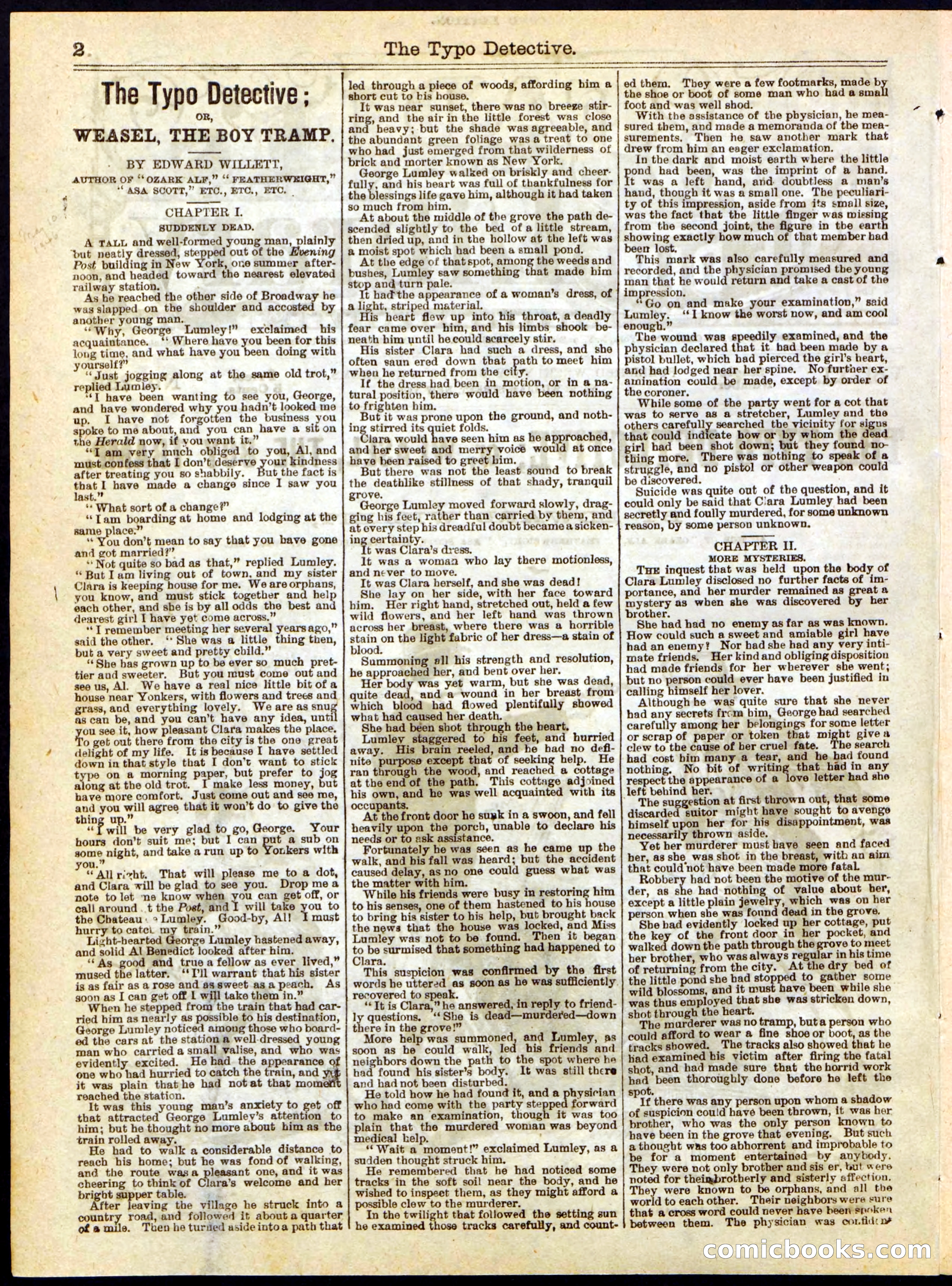
A restored page from Pulp Fiction, 1882. Page through the whole issue in the reader above.
📄 Transcribed text from this page (OCR, searchable)
Machine-transcribed from the original scan — historical spelling and the odd misread are preserved.
The Typo Detective. The Typo Detective ; WEASEL, THE BOY TRAMP. BY EDWARD WILLETT, AUTHOR OF ‘* OZARK ALF,” “‘ FEATHERWEIGHT,” ‘“ ASA SCOTT,” ETC., ETC,, ETC. — CHAPTER I. SUDDENLY DEAD. A TALL and well-formed young man, plainly ‘but neatly dressed, stepped out of the Hvening Post building in New York, one summer after- noon, and headed toward the nearest elevated railway station. As he reached the other side of Broadway he was slapped on the shoulder and accosted by another young man. “Why, George Lumley!” exclaimed his acquaintance. ‘t Where have you been for this long time, and what have you been doing with yourself?” ‘Just jogging along at the same old trot,” replied Lumley. ‘‘T have been wanting to see you, George, and have wondered why you hadn’t looked me up. I have not forgotten the business you me to me about, and you can have a sit on the Herald now, if you want it.” “I am very much obliged to you, Al, and mtist confess that I don’t deserve your kindness after treating you so shabbily. But the fact is that | have made a change since I saw you last.”’ ‘* What sort of a change?” “Tam boarding at home and lodging at the same place.” ** You don’t mean to say that you bave gone and got married?” *‘ Not quite so bad as that,” replied Lumley. “ But Iam living out of town, and my sister Clara is keeping house for me. We are orphans, you know, and must stick together an help each other, and she is by all odds the best and dearest girl I have yet come across,” **T remember meeting her several yearsago,” said the other. ‘* She was a little thing then, but a very sweet and pretty cbild.” ‘She has grown up to be ever so much pret- tier and sweeter. But you must come out and seo us, Al. We have a real nice little bitofa house near Yonkers, with flowers and trees and grass, and everything lovely. We areas snug as can be, and you can’t have any idea, unt ou see it, how pleasant Clara makes the place. o get out there from the city is the one great delight of my life. It is because I have settled down in that style that I don’t want to stick type on a morning paper, but prefer to jog oud at the old trot. I make less money, but have more comfort. Just come out and see me, and you will agree that it won’t do to give the thin oe: “Twill be very glad to go, George. Your hours don’t suit me; but I can put a sub on some night, and take a run up to Youkers with ou,’ | “Allrivht. That will please me to a dot, and Clara will be glad to see you. Drop mea note to let ne know when A can get off, or call around . t the Post, and I will take you to the Chateau: > Lumley. Good-by, Al! 1 must hurry to catci my train.” Light-bearted rge Lumley hastened away, and solid Al Benedict looked after him. ‘As good and true a fellow as ever lived,” mused the latter. ‘'Tll warrant that his sister is as fair as a rose and assweet asapeach. As goon as I can get off L will take them in.” When he stepped from the train that had car- ried him as nearly as possible to his destination, George Lumley noticed among those who board- ed the cars at the stationa well-dressed young man who carried a small Valise, and who was evidently excited. He had the appearance o one who had hurried to catch the train, and yr it was plain thathe had notat that mome reached the station. It was this young man’s anxiety to get off that attracted George Lumley’s attention to him; but he thought no more about him as the train rolled away. He had to walk a considerable distance to reach his home; but he was fond of walking, and the route wasa pleasant one, and it was cheering to think of Clara’s welcome and her brigbt supper table. fter Jeaving the village he struck into a country road, and followed it about a quarter ofamils. Then he tured asideintoa path that = led through a piece of woods, affording him a short cut to bis house, It was pear sunset, there was no breege stir- ring, and the air in the little forest was close and beavy; but the shade was agreeable, and the abundant green foliage was a treat to one who had just emerged from that wilderness of brick and morter known as New York. George Lumley walked on briskly and cheer- at f and his beart was full of thankfulness for the blessings life gave him, although it had taken so much from him. At about the middle of the grove the path de- scended slightly to the bed ofa little stream, then dried up, and in the hollow at the left was a moist spot which had been a small pond. At the edge of that spot, among the weeds and bushes, Lumley saw something that made him cogs and turn pale. t had'the appearance of a woman’s dress, of a light, striped material. : His heart flew up into his throat, a deadly fear came over him, and his limbs shook be- neath him until he could scarcely stir. His sister Clara had such a dress, and she often saun ered down that path to meet him when he returned from the city. If the dress had been in motion, or in a na- tural position, there would have been nothing to frighten him. _ But it was prone upon the ground, and noth- ing stirred its quiet folds. Mara would have seen him as he approached, and her sweet and merry voice would at once have been raised to greet him. But there was not the least sound to break the deathlike stillness of that shady, tranquil grove. George Lumley moved forward slowly, drag- ging his feet, rather than carried by them, and at every step his dreadful doubt became a sicken- ing certainty. t was Clara’s dress. lt was a woman who lay there motionless, and never to move. It was Clara herself, and she was dead! She lay on her side, with her face toward bim. Her right hand, stretched out, held a few wild flowers, and her left hand was thrown across her breast, where there was a horrible stain on the light fabric of her dress—a stain of blood. Summoning all his strength and resolution, he approached her, and bent over her. Her body was yet warm, but she was dead, quite dead, and a wound in her breast from which blood had flowed plentifully showed what had caused her death. She had been shot beet gra S the heart. Lumley staggered to feet, and hurried away. aeaenuace spat ee, Bae a ee nite purpose at of seeking help. e ran dhrva h the wood, and reached a cottage at the end of the path. This cottage adjoined his own, and he was well acquainted with its occupants, ; At the front door he suyk in a swoon, and fell heavily wu} the porch, unable to declare his needs or to ask a: nce, Fortunately he was seen as he came up the walk, and bis fall was heard; but the accident caused delay, as no one could guess what was the matter with him. While his friends were busy in restoring him to his senses, one of them hastened to his house to bring his sister to his help, but brought back the news that the house was locked, and Miss Lumley was not to be found. Then it began o be surmised that something had happened to ara. This suspicion was confirmed by the first words he uttered as soon as he was sufficiently recovered tospeak. — ‘Tt is Clara,” he answered, in reply to friend- ly questions, ‘‘She is dead—murdered—down there in the grove!” More help was summoned, and Lumley, as soon as he could walk, led his friends and neighbors down the path to the spot where he had found his sister’s body. It was still there and had not been disturbed. He told how he had found if, and a physician who had come with the party tee forward to make an examination, though it was too plain that the murdered woman was beyond medical kelp. ‘Wait a moment!” exclaimed Lumley, as a sudden thought struck him. He remembered that he had noticed some tracks in the soft soil near the body, and he wished to inspeet them, as they might afford a ble clew to the murderer. In the twilight that followed the setting sun he examined those tracks carefully, and count- * ed them. They were a few footmarks, made b the shoe or boot of some man who had a sma foot and was well shod. With the assistance of the pbysician, he mea- sured them, and made a memoranda of the mea- surements, Then he saw another mark that drew from him an eager exclamation. In the dark and moist earth where the little ond had been, was the imprint of a hand. t was a left hand, arid doubtless a man’s hand, though it was a small one. The peculiari- ty of this impression, aside from its small size, was the fact that the little finger was wiesin from the second joint, the figure in tbe eart showing exactly how much of that member had beer lost. This mark was also carefully measured and recorded, and the physician promised the young man that he would return and take a cast of the impression. “Go on and make your examination,” said Lumley. ‘1 know the worst now, and am cool enough.” The wound was speedily examined, and the physician declared that it had been made by a pistol bullet, which bad pierced the girl’s heart, and had lodged near her spine. No furtner ex- amination could be made, except by order of the coroner. While some of the party went for a cot that was to serve as a stretcber, Lumley and the others carefully searched the vicinity for sigus that could indicate how or by whom the dead girl had been shot down; but they found no- thing more. There was nothing to speak of a struggle, and no pistol or other weapon could be discovered. Suicide was quite out of the question, and it could only be said that Clara Lumley had been secretly and foully murdered, for some unknown reason, by some person unknown, CHAPTER II. MORE MYSTERIES. THE inquest that was held —_ the body of Clara Lumley disclosed no further facts of im- portance, and her murder remained as great a mystery as when she was discovered by her brother. She had had no enemy as far as was known. How could such a sweet and amiable girl have had an enemy! Nor had she had any very inti- mate friends. Her kind and obliging disposition had made friends for her wherever she went; but no person could ever have been justified in calling himself her lover. Although he was quite sure that she never had cb secrets from bim, George had searched carefully among her belongings for some letter or scrap of paper or token that might give a clew to the cause of ber cruel fate. The search had cost bim many a tear, and he bad found nothing. No bit of writing that had in any respect the appearance of a love letter had she left behind her. — The suggestion at first thrown out, that some discarded suitor might have sought to avenge himself upon her for his disappointment, was necessarily thrown aside. Yet her murderer must have seen and faced ber, as she was shot in the breast, with an aim that could ‘not have been made more fatal Robbery had not been the motive of the mur- der, as she had nothing of value about her, except a little plain jewelry, which was on her person when she was found dead in the grove. She bad evidently locked up her cottage, put the key of the front door in her pocket, and walked down the path through now bag to meet ber brother, who was always regular in his time of returning from the city. At the dry bed of the little pond she bad coor to gather some wild blossoms, and it must have been while she was thus employed that she was stricken down, shot through the heart. The murderer was no tramp, buta person who could afford to wear a fine shoe or boot, as the tracks showed. The tracks also showed that he had examined his victim after firing the fatal shot, and had made sure that the horrid work had been thoroughly done before he left the t. “Pie there was any person upon whom a shadow of suspicion cou!d have been thrown, it was her brother, who was the only person known to have been in the grove that evening. But such a thought was too abhorrent and improbable to be for a moment entertained by anybody. They were not only brother and sis er, but were noted for theimbrotberly and sisterly sffection. They were known to be orphans, and all the world to each other. Their neighbors were sure that a cross word could never have been spoken between them. The physician was corfidc» =) Eomicbooks,. co -_