
Pulp Fiction, 1882 · page 4 of 16
Beadle's Half Dime Library No. 282 — page 4: what you’re looking at
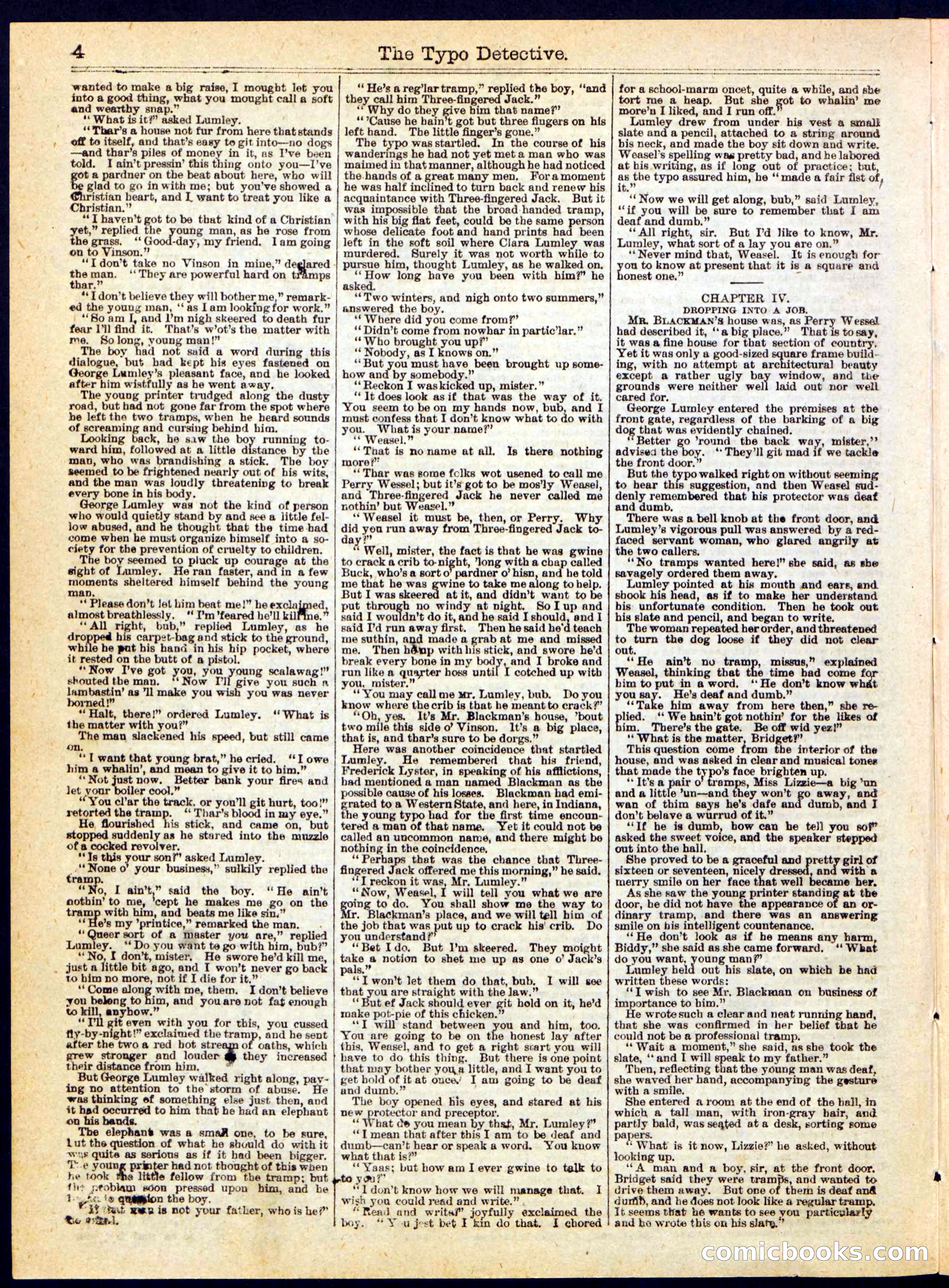
A restored page from Pulp Fiction, 1882. Page through the whole issue in the reader above.
📄 Transcribed text from this page (OCR, searchable)
Machine-transcribed from the original scan — historical spelling and the odd misread are preserved.
| he took OE oe emo ee ee aoe meee —-— + wanted to make a big raise, I mought let you into a good thing, what you mought call a soft and wearthy snap.” ‘* What is it?’ asked Lumley. ‘Thar’s a house not fur from here that stands off to itself, and that’s easy to git into-—-no dogs —and thar’s piles of money in it, as I’ve been told. I ain’t pressin’ this thing onto you—I’ve ta pardner on the beat about here, who will glad to go in with me; but you've showed a Christian heart, and I want to treat you like a Christian.” “Tl haven't got to be that kind of a Christian et,” replied the young man, as he rose from he grass. ‘‘ Sodd-day, my friend. lam going on to Vinson.” “IT don’t take no Vinson in mine,” deglared - the man. thar.” **T don’t believe they will bother me,” remark- ed the young man, ‘as Lam looking for work.” “Bo am I, and I’m nigh skeered to death fur fear I'll find it. That’s w’ot’s the matter with me. Solong, voung man!” The boy had not said a word during this dialogue, but bad kept his eyes fastened on George Lumiley’s pleasant face, and he looked after him wistfully as he went away, The young printer trudged along the dusty road, but had not gone far from the spot where he left the two tramps, when he heard sounds of screaming and cursing behind him, Looking back, he saw the boy running to- ward him, followed at a little distance by the man, who was brandishing a stick. The boy seemed to be frightened nearly out of his wits, and the man was loudly threatening to break every bone in his body. rge Lumley was not the kind of person who would quietly stand by and see a little fel- low abused, and he thought that the time had come when he must organize bimself into a so- ciety for the prevention of cruelty to children. The boy seemed to pluck up courage at the sight of Lumley. He ran faster, and in a few moments sheltered himself behind the young man, ** Please don’t Jot him beat me!” he exclaimed almost breathlessly. ‘ I’m ’feared he’ll kil @.” “All right, bub,” replied Lumley, as he grogpes his carpet-bag and stick to the ground, while he pat his hand in his hip pocket, where it rested on the butt of a pistol. **Now I've got you, you young scalawag!” shouted the man. ‘‘ Now I'l give you such a lambastin’ as "ll make you wish you was never horned!” “What is “ Halt, there!” ordered Lumley. the matter with you?” The man slackened his speed, but still came on, “TI want that young brat,” he cried. ‘I owe him a whalin’, and mean to give it to him.” ‘Not just now. Better bank your fires and ‘They are powerful hard on trAmps _ Jet your boiler cool.” “You cl’ar the track. or you'll git hurt, too!” retorted the tramp. ‘“ Thar’s blood in my eye.” He flourished his stick, and came on, but stopped suddenly as he stared into the muzzle of a cocked revolver. "Is this your son?” asked Lumley. ‘None 0’ your business,” sulkily replied the “ep “No, I ain’t,” said the boy. “He ain’t nothin’ to me, ’cept he makes me go on the EP with him, and beats me like sin,” ‘*He’s my ’printice,” remarked the man. A” engl sort of a master you are,” replied Lumley. “Do you want te go with him, bub?” ‘No, I don’t, mister, He swore he’d kill me, _ justa little bit ago, and I won’t never go back to bim no more, not if I die for it,” ‘* Come mira, vegan me, them. I don’t believe you beleng to him, and youare not fat enough to kill, anyhow.” . rl it even with you for this, you cussed fly-by-night!” exclaimed the tramp, and he sent after the twoa red hot stream of oaths, which w stronger and louder @ they increased their distance from him, But rge Lumley walked right along, pay- ing no attention to the storm of abuse. He was thinking ef something else just then, and it had ae ig to him that he had an elephant on The elephant was a smaA one, to be sure, Lut the question of what he should do with it ws quite as serious as if it had been bigger. The poane easier had not thought of this when little fellow from the tramp; but the problam soon pressed upon him, and he ana ‘oq n the boy. . ‘ES het wwe is not your father, who is he?” Se OE Se eT ae ee momeneenariysameruiRierageiesiscenatesatiihs) gp per respon panerrentraneeannenue The Typo Detective. “* He’s a reg’lar tramp,” replied the boy, ‘“‘and they call him Piven Eacared Jack.” ‘“ Why do they give bim that name?’ “**Cause he hain’t got but three fingers on his left hand. The little finger’s gone.” The typo was startled. In the course of his wanderings he had not yet met a man who was maimed in that manner, although he had noticed the hands of a great many men. Foramoment he was half inclined to turn back and renew his acquaintance with Three-fingered Jack. But it was impossible that the broad handed tramp, with his big flat feet, could be the same person whose delicate foot and hand prints had been left in the soft soil where Clara Lumley was murdered. Surely it was not worth while to pursue him, thought Lumley, as he walked on, ‘How long have you been with him?” he asked. “Two winters, and nigh onto two summers,” answered the boy. ‘Where did you come from?’ ‘* Didn’t come from nowhar in partic’lar.” “Who brought you up?” ‘** Nobody, as I knows on.” ‘**But you must have been brought up some- how and by pomenone. **Reckon I waskicked up, mister.” ‘It does look asif that was the way of it. You seem to be on my hands now, bub, and I must confess that I don’t know what to do with you. What is your name?’ ** Weasel.” “That is no name at all, more?” ‘*Thar was some folks wot usened to call me Perry Wessel; but it’s got to be mos’ly Weasel, and Three-fingered Jack he never called me nothin’ but Weasel.” ‘* Weasel it must be, then, or Perry. Why _ you run away from Three-fingered Jack to- ay?’ if Well, mister, the fact is that he was gwine to crack a crib to-night, ‘long with a chap called Buck, who’s a sort o’ pardner o’ hisn, and he told me that he ee aioe to take me along to belp. But I was skee at it, and didn’t want to be put through no windy at night. Solup and said I wouldn't do it, and he said I should, and I said I’d run away first. Then he said he'd teach me suthin, and made a grab at me and missed me. Then hémp with his stick, and swore he'd break every bone in my boy and I broke and run like a quarter boss until I cotched up witb you, mister.” ‘You may call me mr, Lumley, bub. Do you know where the crib is that he meant to crack?’ “Oh, yes. It’s Mr. Blackman’s house, ’bout two mile this side o’ Vinson. It’s a big place, that is, and thar’s sure to be dorgs.” Here was another coincidence that startled Lumley. He remembered that his friend, Frederick Lyster, in speaking of his afflictions, had mentioned a man named Blackman as the possible cause of his losses. Blackman had emi- rated to a Western State, and here, in Indiana, the young typo had for the first time encoun- tered a man of that name. Yet it could not be called an uncommon name, and there might be nothing in the coincidence, ‘Perhaps that was the chance that Three- fingered Jack offered me this morning,” he said, “'T reckon it was, Mr, Lumley.” “Now, Weasel, I will tell you what we are going to do. You shall show me the way to r. Blackman’s place, and we will tell him of the job that was put up to crack his' crib. Do you understand?’ “Bet Ido. But I’m skeered. They moight take notion to shet me up as one 0’ Jack’s **I won't let them do that, bub. I will see that you are straight with the law.” “But ef Jack should ever git hold on it, he’d make pot-pie of this chicken.” ‘*T will stand between you and him, too. You are going to be on the honest lay after this, Wensel, and to get a right scart you will have to do this thing. But there is one point that may bother youa little, and I want you to get bold of if at ouce’ I am going to be deaf and dumb.” : The boy opened his eyes, and stared at his new protector and preceptor. “What ce you mean by thst, Mr, Lumley?” ‘“‘T mean that after this I am to be deaf and dumb—can’t hear or speak a word. You know what that is?” ‘*Yaas; but how am I ever gwine to talk to 7 Is there nothing LLL MLDLMLBLLLDBLLA LDA AA LLL LLL AL LLL LDA LLL LLL LLL LLL ALLEL LLL LC A LL CC LT LC tem tt ie S you? **] don’t know how we will manage that. I wish you could read and write.” . “Read and writs?’ joyfully exclaimed the boy. “ Y¥ a jest bet Ekin do that. I chored ‘ ‘ SOF OR Os a ah 8 meqeny — 8 to ee eee ie . 0 wee. —e 88 Carre es ee oe me ee Oe ge os — — oa Os i et eee oe for a school-marm oncet, quite a while, and she tort me a heap. But she got to whalin’ me more’n I liked, and I run off. Lumley drew from under his vest a smalk slate and a pencil, attached to a string around bis neck, and made the boy sit down and write. Woeasel’s spelling was pretty bad, and he labored at his writing, as if long out of practice; but, aa pe typo assured him, he “‘ made a fair fist of, t ‘Now we will get along, bub,” said Lumley, ‘if you will be sure to remember that I am deaf and dumb.” “All right, sir. But I’d Jike to know, Mr. Lumley, what sort of a lay you are on.” ‘* Never mind that, Weasel. It is enovgh for a to know at present that it is a square and onest one.” CHAPTER IV. DROPPING INTO A JOR. Mr. BLACKMAN’S house was, as Perry Wessel had described it, ‘‘a big place.” That is tosay, it was a fine house for that section of country, Yet it was only a good-sized square frame build- ing, with no attempt at architectural beauty except a rather ugly bay window, and the grounds were neither well laid out nor well cared for. George Lumley entered the premises at the front gate, regardless of the barking of a big dog that was evidently chained. “Better go ’round tbe back way, mister,”’ advised the boy. ‘They’ll git mad if we tackle the front door.” But the typo walked right on without seeming to hear this suggestion, and then Weasel] sud- denly remembered that his protector was deat and dumb. There was a bell knob at the front door, and Lumley’s vigorous pull was answered by a red- faced servant woman, who glared angrily at the two callers. ‘‘No tramps wanted here!” she said, as she savagely ordered them away. Lumley pointed at his mouth and ears, and shook his head, as if to make her understand his unfortunate condition. Then he took out his slate and pencil, and began to write, The woman repeated her order, and threatened to ang the dog loose if they did not clear out. “He ain’t no tramp, missus,” explained Weasel, thinking that the time bad come f him to put in a word. ‘He don’t know what you my He's deaf and dumb.” ‘“‘Take him away from here then,” she re- lied. ‘* We hain’t got nothin’ for the likes of im. There’s the gate. Be off wid yez!” ‘* What is the matter, Bridget?’ This question come from the interior of the house, and was asked in clear and musical tones that made the typo’s face brighten up. “It's a pair o' tramps, Miss Lizzie—a big ‘un and a little ’un—and they won’t go away, and wan of thim says he’s dafe and dumb, and J don’t belave a wurrud of it.” “Tf he is dumb, bow can he tell you sof” asked the sweet voice, and the speaker stepped out into the hall, She proved to be a graceful and pretty girl of sixteen or seventeen, — dre and with a merry smile on her face that well became her, As she saw the young printer standing at the door, he did not have the appearance of an or- dinary tramp, and there was an answering smile on his intelligent countenance. ‘He don’t look as if he means any harm, Biddy,” she said as she came forward. ‘‘ What do you want, young man?” Lumley held out his slate,on which be had written these words: ' ‘‘T wish to see Mr. Blackman on business of importance to him.” He wrotesuch a clear and neat running hand, that she was confirmed in her belief that he could not be a professional tramp. ‘* Wait a moment,” she said, as she took the slate, ‘‘and I will k to my father.” Then, reflecting that the young man was deaf, she waved her hand, accompanying the gesture with a smile. She entered a room at the end of the ball, in which a tall man, with iron-gray bair, and partly bald, was seated ata desk, sorting some papers. ‘What is it now, Lizzie?’ he asked, without looking up. ‘“A man and a boy, sir, at the front door, Bridget said they were tramjis, and wanted to drive them away. But one of them is deaf an& duis, and he does not look like a regular tramp, Tt seems that he wants to see you particularly and ho wrote this on his slaty.” \ | ms EGomrebooks.co