
Pulp Fiction, 1882 · page 12 of 16
Beadle's Half Dime Library No. 282 — page 12: what you’re looking at
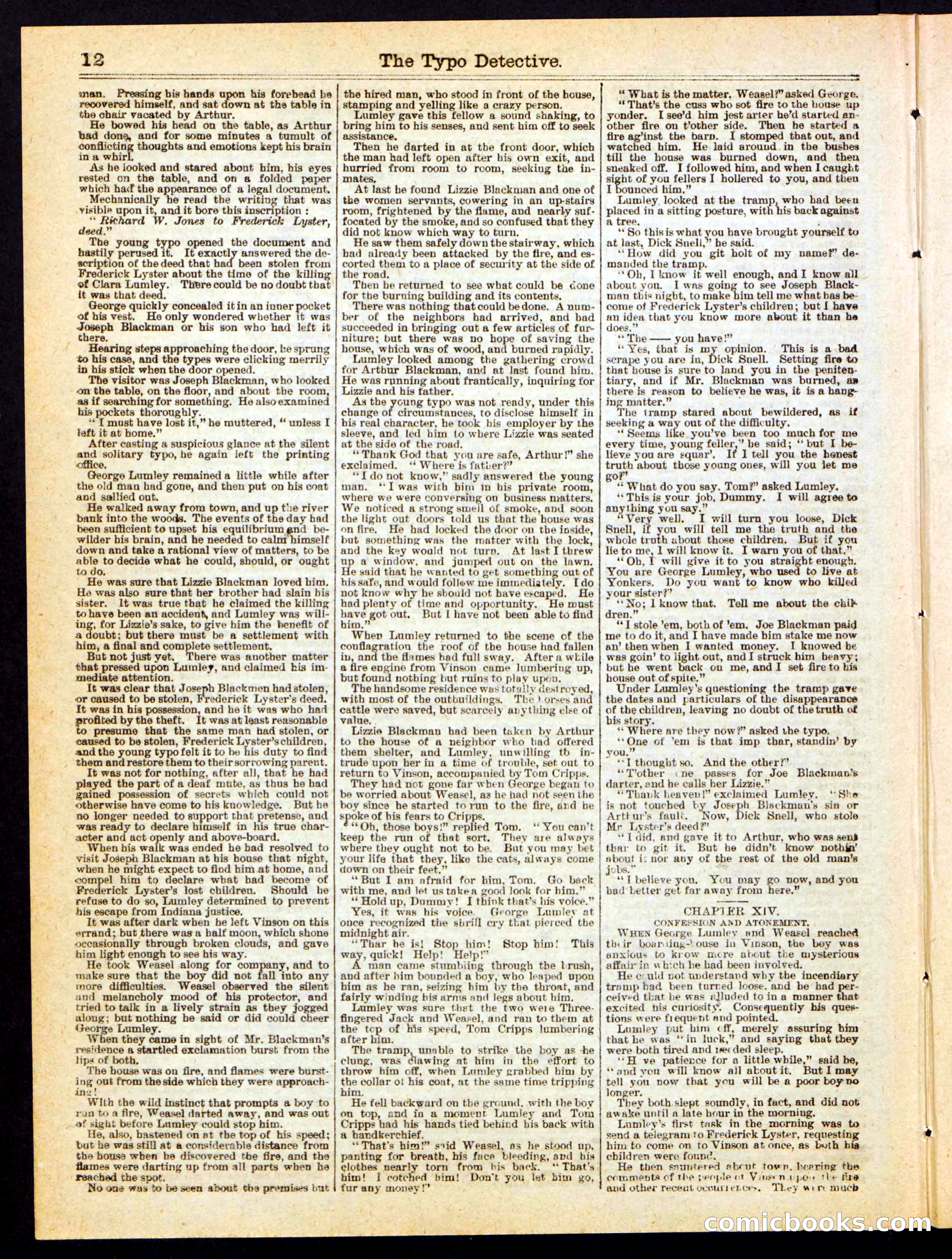
A restored page from Pulp Fiction, 1882. Page through the whole issue in the reader above.
📄 Transcribed text from this page (OCR, searchable)
Machine-transcribed from the original scan — historical spelling and the odd misread are preserved.
ee ee + tere eee er ee ere we ee - man. Pressing bis hands upon his forehead he recovered himself, and sat down at the table in the chair vacated by Arthur. He bowed his head on the table, as Arthur had dona, and for some minutes a tumult of ee thoughts and emotions kept his brain in a whir As he looked and stared abont him, his eyes rested on the table, and on a folded paper which had the appearance of a legal document. Mechanically he read the writing that was visible upon it, and it bore this inscription : “ Rithard W. Jones to Frederick Lyster, deed,” The young typo opened the document and hastily perused it. It exactly answered the de- scription of the deed that had been stolen from Frederick Lyster about the time of the killing of Clara Lumley. Thre could be no doubt that it was that deed. George quickly concealed it in an inner pocket of his vest. He only wondered whether it was pt, Blackman or his son who had left it there. Hearing steps approaching the door, be sprung to his case, and the types were clicking merrily in his stick when the door opened. The visitor was Joseph Blackman, who looked om the table, on the floor, and about the room, as if searching for something. He alsoexamined his pockets thoroughly. ** T must have lost it,” he muttered, “ unless I left it at home.” After casting a suspicious glance at the silent and sojitary typo, he again left the printing ce, George Lumley remained a little while after the old man had gone, and then puf on his coat and sallied out. He walked away from town, and up the river bank into the woods, The events of the day had been sufficient to upset bis equilibrium @nd be- wilder bis brain, and he needed to calm himself down and take a rational view of matters, to be ryan to decide what he could, should, or ought to oO. He was sure that Lizzie Blackman loved him. He was also sure that her brother had slain bis sister. It was true that he claimed the killing to have been an accident, and Lumley was will- ing, for Lizzie’s sake, to give him the benefit of a doubt; but there must be a settlement with him, a final and complete settlement. But not just yet. There was another matter that pressed upon Luinley, and claimed kis im- mediate attention. It was clear that Joseph Blackmen had stolen, or caused to be stolen, Frederick Lyster's deed, Tt was in his sion, and he it was who had fited by the theft. It was at least reasonable presume that the same man had stolen, or caused to be stolen, Frederick Lyster’s children, and the young typo felt it to be his duty to find _ them and restore them to their sorrowing parent. It was not for nothing, after all, that he had played the part of a deaf mute, as thus he had gained possession of secrets which could not otherwise have come to his knowledge. But he no longer needed to support that pretense, and was ready to declare himself in his true char- acter and act openly and above-board. When his walk was ended he bad resolved to visit Joseph Blackman at his house that night, when he might expect to find him at home, and eompel him to declare what had become of Frederick Lyster’s lost children. Should he refuse to do so, Lumley determined to prevent his escape from Indiana justice. It was after dark when he left Vinson on this errand; but there was a half moon, which shone oceasionally through broken clouds, and gave him light enough to see his way. He took Weasel along for company, and to make sure that the boy did not fall into any more difficulties. Weasel observed the silent and melancholy mood of his protector, and tried to talk in a lively strain as they jogged aloug; but nothing be said or did could cheer . George Lumley. _ When they cameo in sight of Mr. Blackman’s residence a startled exclamation burst from the lips of both, The bouse was on fire, and flames were burst- ing out from the side which they were approach- ing! With the wild instinct that prompts a boy to run to a fire, Weasel darted away, and was out of sight before Lumley could stop him. He, also, bastened on at the top of his speed; but be was still at a considerable distance from the bouse when he discovered the fire, and the flames were darting up from all parts when he reached the spot. No one was to be seen about the premises but Oe ee te ep es ote ee ars Seeman t + On eemme eens ee a T/rn/rnmmmmmmmmmmmemmmmmnmnmmensennamnnem sce SSS Sessa The Typo Detective. the hired man, who stood in front of the house, stamping and yelling like a crazy person. Lumley gave this fellow a sound shaking, to bring him to his senses, and sent him off to seek assistance. Then he darted in at the front door, which the man had left open after bis own exit, and hurried from room to room, seeking the in- mates, At last he found Lizzie Blackman and one of the women servants, cowering in an up-stairs room, frightened by the flame, and nearly suf- focated by the smoke, and so confused that they did not know which way to turn. He saw them safely down the stairway, which bad already been attacked by the fire, and es- corted them to a place of security at the side of the road. Then be returned to see what could be cone for the burning building and its contents, There was nothing that could bedone. A num- ber of the neighbors had arrived, and bad succeeded in bringing out a few articles of fur- niture; but there was no hope of saving the house, which was of wood, and burned rapidly. Lumley looked among the gathering crowd for Artbur Blackman, and at last found him. He was running about frantically, inquiring for Lizzie and his father. As the young typo was not ready, under this change of circumstances, to disclose himself in his real character, he took his employer by the sleeve, and led him to where Lizzie was seated at the side of the road. * Thank God that you are safe, Arthur!” she exclaimed. ‘* Where is fatuer?”’ “Ido not know,” sadly answered the young man. ‘I was with bim in bis private room, where we were conversing on business niatters. We noticed a strong smell of smoke, and soon the light out doors told us that the house was on fire. He had locked the door on the inside, but something was the matter with the lock, and the key would not turn. At last I threw up a window, and jumped out on the lawn. He said that he wanted to get something out of his safe, and would follow me immediately. [do not know why he sbould not have escaped. He had plenty of time and opportunity. He must ag hd out. But | have not been able to find im. Wher Lumley returned to the scene of the couflagration the roof of the house had fallen iu, and the flames had fullsway. Aftera wkile a fire engine from Vinson came lumbering up, but found nothing but ruins to play upon. The handsome residence was totally destroyed, with most of the outbuildings. The !.orses and cattle were saved, but scarcely anything else of value, Lizzie Blackman had been taken by Arthur to the house of a neighbor who bad offered them shelter, and Lumley, unwilling tb in- trude upon her in a time of trouble, set out to return to Vinson, accompanied by Tom Cripps. They had not gone far when George began to be worried about Weasel, as he had not seen the boy since he started to run to the fire, and he spoke of his fears to Cripps. **Oh, those boys!” replied Tom. ‘* You can’t keep the run of that sort. They are always where they ought not to be. But you may bet your life that they, like the cats, always come down on their feet.” ‘*But I am afraid for bim, Tom. Go back with me, and let us takea good look for him,” “Hold up, Dummy! I think that’s his voice. Yes, it was his voice. George Lumley at once recognized the sbrill cry that pierced the midnight air. “Thar he is! Stop him! This way, quick! Help! Help!” man came stumbiing through the brush, and after him bounded a boy, who leaped upon him as he ran, seizing him by the throat, and fairly winding bis arms and legs about him. Lumley was sure thet the two were Three- fingered Jack and Weasel, and ran to them at the top of his speed, Tom Cripps lumbering after him. The tramp, unable to strike the boy as -he clung, was dlawing at him in the effort to throw him off, when Lumley grabbed bim by the collar ot his coat, at the same time tripping him, He fell backward on the ground, with the boy on top, and in a moment Lumley and Tom Cripps had his hands tied behind his back with a handkerchief. ‘That's him!” svid Weasel, as he stood up, panting for breath, his face bleeding, ard bis clothes nearly torn from his back. ‘ That’s bim! [ cotched bim! Don't you let bim go, fur any money!’ ” Stop him! - = wr ee mr ee ee | ee ee rr rr ee ee ee CL S 1 + ewe eee ooo en + ee ee ss ——-+ ar | “ What is the matter, Weasel!” asked George. “That's the cuss who sot fire to the house up yonder. I[see’d him jest arter he’d started an- other fire on t’other side. Then he started a fire ag’inst the barp. I stomped that out, and watched him. He laid around in the bushes till the house was burned down, and then sneaked off. I followed him, and when I caught sight of you fellers I hollered to you, and then I bounced him,” Lumley looked at the tramp, who had been placed in a sitting posture, with his back against a tree. : ‘** So thisis what you have brought yourself to at last, Dick Snell,” he said. ‘‘How did you git holt of my name?” de- manded the tramp. ‘‘Oh, I know it well enough, and I know all about you. I was going to see Joseph Black- man this night, to make him tell me what bas be- come of Frederick Lyster’s children; but [ have an idea that you know more about it than he does.” ‘* The you have!” ‘Yes, that is my opinion. This is a bad serape you are in, Dick Snell. Setting fire to that house is sure to land you in the peniten- tiary, and if Mr. Blackman was burned, as there is reason to believe he was, it is a hang- ing matter.” ' The tramp stared about bewildered, as if seeking a way out of the difficulty, ** Seems like you’ve been too much for me every time, young feller,” be said; ‘‘ but I be- lieve you are squar’, If I tell you the henest truth about those young ones, will you let me oF ‘* What do you say. Tom?” asked Lumley. ‘*This is your job, Dummy. I will agree to anything you say.” ‘Very well. I will turn you loose, Dick Snell, if you will tell me the truth and the whole truth about those children. But if you lie to me, 1 will know it. I warn you of that.” ‘Ob, I will give it to you straight enough. You are George Lumley, who used to live at Yonkers. Do you want to know who killed your sister?” ‘*No; lL know that. Tell me about the chik dren.” “I stole em, both of ’em. Joe Blackman paid me to do it, and I have made bim stake me now an’ then when I wanted money. I knowed he was goin’ to light out, andI struck him heavy; but he went back on me, and I set fire to his house out of spite.” Under Lumley’s questioning the tramp gave the dates and particulars of the disappearance of the children, leaving no doubt of the truth of bis story. ** Where are they now?” asked vhe typo. ‘* One of ‘em is that imp thar, standin’ by vou.’ ' **T thought so, And the other?” “other «ne passes for Joe Blackman’s darter, end he calls ber Lizzie.” “Thank heaven!” exclaimed Lumley. ‘She is not toucbed by Joseph Blackman’s sin or Arthur’s fault. Now, Dick Snell, who stole Mr Lwyster’s deed?” ‘“L_adid, and gave it to Arthur, who was sens thar to git it. But he didn’t know nothin’ about i: nor any of the rest of the old man’s ane Il believe you. You may go now, and you had better get far away from here.” CHAPIER XIV. CONFESSION AND ATONEMENT. Wen George Lumley and Weasel reached their boarving-)ouse in Vinson, the boy was anxious to krow mere about the mysterious affair in which he bad been involved. He ec: uld not understand why the incendiary trump had been turned loose. and he bad per- ceived that he was alluded to in a manner that excited bis curiosity. Consequently bis ques- tions were frequent and pointed, Lumley put bim cff, merely assuring bim that he was ‘'in luck,” and saying that they were both tired and 1 ded sleep. ‘‘H ve patience for a little while,” said he, ‘‘and von will know all abkoutit. But I may tell you now that you will be a poor boy no longer, They both.slept soundly, in fact, and did not awake until a late hour in the morning. Lumley’s first task in the morning was to send a telegram to Frederick Lyster, requesting him to come on to Vinson at once, as beth his children were found. He then snuntered abeut town, herring the comments of the people ot Vinson tpor tlhe re and other recent vceurences, They were mucb ~~ 2 . ~~ EDOOKS com =