
Pulp Fiction, 1882 · page 13 of 16
Beadle's Half Dime Library No. 282 — page 13: what you’re looking at
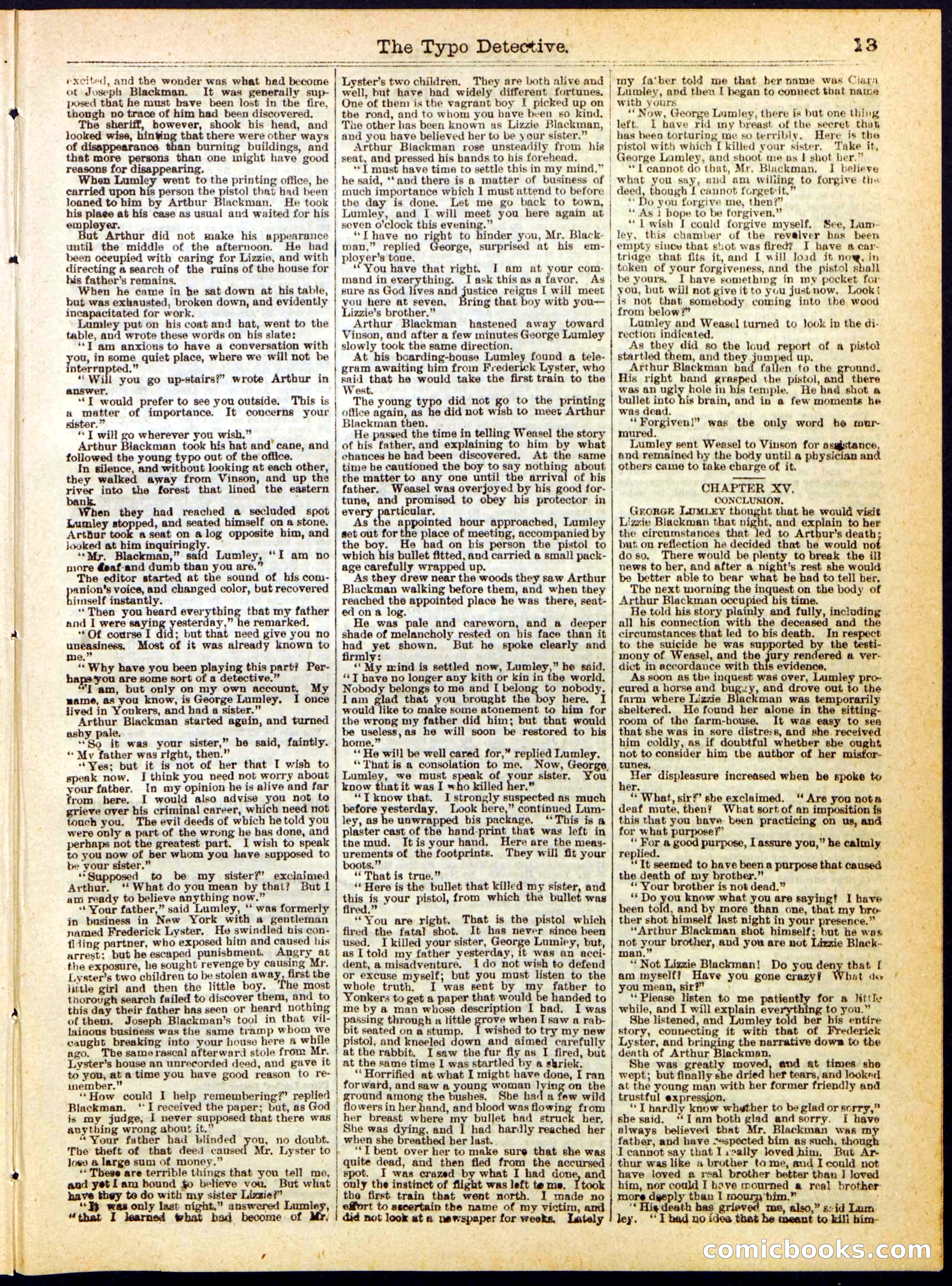
A restored page from Pulp Fiction, 1882. Page through the whole issue in the reader above.
📄 Transcribed text from this page (OCR, searchable)
Machine-transcribed from the original scan — historical spelling and the odd misread are preserved.
| iv ‘ \ ) : ) : | —— - es eee eet meee ee ens — me ee Gee eee + excited], and the wonder was what bed become ot Joseph Blackman. It was generally sup- posed that he must bave been lost in the fire, though no trace of him had been discovered. The sheriff, however, shook his head, and looked wise, hinting that there were other ways of disappearance than burning buildings, and that more persons than one might have good reasons for disappearing. When Lumley went to the printing office, he carried upon his person the pistol that bad been loaned to him by Arthur Blackman. He took his plaee at his case as usual and waited for his em pleyer. ut Arthur did not make his appearance until the middle of the afternoon. He had been oceupied with caring for Lizzie, and with directing a search of the ruins of the house for his father’s remains. When he came in he sat down at his table, but was exhausted, broken down, and evidently incapacitated for work. Lumley put on his coat and hat, went to the | table, and wrote these words on his slate: oe a | The Typo Detective, ee tee - we + ee ee ee oe ee — OO ee a ee RTE 8 OEE Tr ee i ops Ce tt Ae SR mY Ht one - Lyster’s two children. They are both alive and | my fa’‘ber told me that her name was Clara well, but have had widely different fortunes. One of them is the vagrant boy I picked up on tbe road, and to whom you bave been so kind, The other has been known as Lizzie Blackman, and you have believed her to be your sister.” Arthur Blackman rose unsteadily from his seat, and pressed his bands to bis forehead. ‘Tl must have time to settle this in my mind,” he said, ‘‘and there is a matter of business of much importance which | must attend to before the day is done. Let me go back to town, Lumley, and I will meet you here again at seven o’clock this evening.” *“T have no right to iiodes you, Mr. Black. man,” replied George, surprised at bis em- ployer’s tone, ‘You have that right. mand in everything. I ask this as a favor, J am at your com- | sure as God lives and justice reigns I will meet you here at seven, izzie’s brother.” Arthur Blackman hastened away toward Vinson, and after a few minutes George Lumley ring that boy witb you-- ‘‘T am anxious to have a conversation with | slowly took the same direction. ou, in some quiet place, where we will not be interrupted.” “Will you go up-stairs?” wrote Arthur in answer. “I would prefer to see you outside. a matter of importance. It concerns your sister.” ‘*T will go wherever you wish,” Arthur Blackman took his hat and’ cane, and followed the young typo out of the office. In silence, and without looking at each other, they walked away from Vinson, and up the river into the forest that lined the eastern nk. When they had reached a secluded spot Lumley stopped, and seated himself on a stone. Arthur dk: a seat on alog opposite him, and jooked at bim nee me hag ‘‘Mr. Blackman,” said Lumley, “I am no more eaf-and dumb than you are.” The editor started at the sound of his com- »anion’s voice, and changed color, but recovered Sineslt instantly. “Then you heard everything that my father and I were saying yesterday,” he remarked. “Of course I did; but that need give you no uneasiness. Most of it was already known to me.’ ‘‘ Why have you been playing this part? Per- haps ‘you are some sort of a detective.” ‘I am, but only on my own account. My name, as you know, is George Lumley. I once jived in Youkers, and had a sister.” Arthur Blackman started agein, and turned ashy pale. : ‘So it was your sister,” he said, faintly. ‘* Mv father was right, then.” ‘Yes: but it is not of her that I wish to speak now. I think you need not worry about your father. In my opinion he is alive and far rom here. I would also advise you not to grieve over his criminal career, which need not touch you. The evil deeds of which he told you were only a part of the wrong he bas done, and perhaps not the greatest part. I wish to speak to you now of ber whom you have supposed to be your sister.” ‘“Supposed to be my sister?’ exclaimed Arthur. ‘‘ What do you mean by that? But l am ready to believe Fj eee now.” ‘‘ Your father,” said Lumley, “‘ was formerly in business in New York with a gentleman named Frederick Lyster, He swindled bis con- filing partner, who exposed him and caused his arrest: but be escaped punisbment. Angry at the exposure, he sought revenge by causing Mr. Lyster’s two children to be stolen omays first the isttle girl and then the little boy. he most thorough search failed to discover them, and to this day their father bas seen or heard nothing of them. Joseph Blackman’s tool in that vil- lainous business was the same tramp whom we caugbt breaking into your house here a while ago. The samerascal afterward stole from Mr. Lyster’s house an unrecorded deed, and gave it to you, ata time you have good reason to re- inember.” ‘‘How could I help remembering?” replied Blackman. ‘I received the paper; but, as is my judge, | never supposed that there was anything wrong about it.” “Your father bad blinded The theft of that deed caus lows a large sum of money.” ‘* These are terrible things that you tell me, and yet Lam bound fo believe vou. But what have they te do with my sister Lizzie?” “J was only last night.” answered 4 “that I learned what bad become of My, ou, no doubt. Mr. Lyster to This is | | & | <a es ett tt tt CL LL CC CL LL LL LL LL LL LL St i ' ! At his boarding-bouse Lumley found a tele- ram awaiting bim from Frederick Lyster, who — that he would take the first train to the yest. The young t did not go to the printing office gata Ri 6 did not wish to meet Arthur Blackman then. He passed the time in telling Weasel the story of his father, and explaining to him by what chances he had been discovered. At the same time he cautioned the boy to say nothing about the matter to any one until the arrival of his father. Weasel was overjoyed by his good for- tune, and promised to obey his protector in every particular. As the -eene hour approached, Lumley set out for the place of meeting, accompanied by the boy. He had on bis person the pistol to which his bullet fitted, and carried a smal! pack- age carefully wrapped up. As they drew near the woods they saw Arthur Blackman walking before them, and when they reached the appointed place he was there, seat- ed on a log. He was pale and careworn, and a deeper shade of melancholy rested on his face than it roe yet shown. But he spoke clearly and mly: ‘My mind is settled now, Lumley,” he said. ‘‘T bave no longer any kith or kin in the world, Nobody belongs to me and [ belong to nobody. lam glad that you brought the boy here, I would like to make some atonement to him for the wrong my father did bim; but that would be useless,as he will soon be restored to bis home.” ‘* He will be well cared for,” replied Lumley. “That is a consolation to me. Now, George, Lumley, we must speak of your sister. You know that it was I who killed her.” ‘““T know that. I strongly suspected as much before yesterday, a he ere,” eonpined Lum- ley, as he unwrap is package, “This is a plaster cast of the hand-print that was left in the mud. Itis your hand, Here are the meas- urements of the footprints. They will fit your boots.” “That is true.” ‘‘ Here is the bullet that killed my sister, and this is your pistol, from which the bullet was fired.” “You are right. That is the pistol which fired the fatal shot. It has never since been used. I killed your sister, George Lumiey, but, as Ltold my father yesterday, it was an acci- dent, a misadventure. Ido not wish to defend or excuse myself; but you must listen to the whole truth, I was sent by my father to Yonkers to get a paper that would be handed to me by a man whose description I bad. I was pabsing through a little grove when I saw a rab- it seated on a stump. I wished to try my new pistol, and kneeled down and aimed carefully at the rabbit. Isaw the fur fly as I fired, but at the same time I was startled by a sbriek. ‘‘Horrified at what I might have done, I ran forward, and saw a young woman lying on the ground among the bushes. She had a few wild flowers in her hand, and blood was flowing from her breast where my bullet had struck her, She was dying, and I had hardly reached her when she breathed her last. ‘IT bent over her to make sure that she was quite dead, and then fled from the accursed spot. FI was crazed by what I had done, and only the instinct of fight was left tems. I took the first train that went north. I made no effort to ascertain the name of my victim, amd did not look ata newspaper for weeks, Lately | J cannot say that 1. cally leved him, Lumley, and then I hegan to connect that name witb yours ‘* Now, George Lumley, there is but one thing left. L have rid my breast of the seeret that has been torturing me so terriblv. Here is the pistol with which [ killed your sister. Take it, George Lomley, and shoot me as | shot ber.” ‘*T cannot do that, Mr. Blackman, I believe what you say, aud am wiliing to forgive the deed, though I cannot forgetrit.” 7 La you forgive me, then?” ‘** As ! hope to be forgiven.” ‘‘| wish I could forgive myself, See, Lum- ley, this chamber of the revelver bas been empty sinew that shot was fired? I have a car- tridge that fits it, and [ will load it now, in token of your forgiveness, and the pistol shall As , be yours. I have something in my pocket for you, but will not give it to you just now. Look? is not that somebody coming into the wood from below?” Lumley and Weasel turned to look in the di- rection indicated, As they did so the loud report of a pistol startled them, and they jumped up. Arthur Blackman bad fallen to the ground, His right band grasped the pistol, and there was an ugly hole in his temple. He had shot a bullet into his brain, and in a few moments he was dead. ‘*Forgiven!” was the only word he mar- mured. Lumley sent Weasel to Vinson for asgstance and remained by the botly until a physician an others came to take charge of it. CHAPTER XV, CONCLUSION, GrorGre LUMLEY thought that be would visit Lizzie Blackman that p the circumstances that led to Arthur's death: but on reflection he decided that he would no doso, There would be plenty to break the ill news to her, and after a night’s rest she would be better able to bear what he had to tell ber, The next morning the inquest on the body of Arthur Blackman occupied bis time. He told his story plainly and fully, including all his connection with the deceased and the circumstances that led to bis death. In respect to the suicide he was sup ee Ee - mony of Weasel, and the jury rendered a ver- dict in accordance with t dence, As soon as the inquest was over, Lamniey cured a horse and bugzy, and drove out the farm where Lizzie Blackman was temporarily sheltered, He found her alone in the sitting- room of the farm-house. It wag easy to see that she was in sore distress, and she received him coldly, as if doubtful whetber she ought not to consider him tbe author of her mine er i nue. — blend, sort et an imposition nis that you have on practicing o ¥ for what purpose?’ . - Wo a good purpose, I assure you,” he calmly replied. “It seemed to bave been a purpose that caused the death of my brotber.” ‘Your brother is not dead.” her, “ What, sir?’ she exclaimed. ‘ Are you in “Do you know what you are saying! I have | been told, and by more than one, that my bro- ther shot himself last night in your presence.” “Artbur Blackman shot himself; but he was not your brother, and you are not Lizzie Black- man, : ' “‘ Not Lizzie Blackman! Do you deny that [ am myself? Have you gone crasy! What they ou mean, sir?” ‘* Please listen to me patient while, and I will explain eve She listened, and Lumley story, connecting it with that of k Lyster, and bringing the narrative down to the death of Arthur Blackman, She was great! wept; but finally she dried her tears, and looked at the young man with her former friendly and trustful expression. “T hardly know whyther to be glad or sorry,” she said. “Iam both glad and sorry. I have always believed that Mr. Blackman was m fatber, and have sespected bim as such, tho to you.” thur was like « brother tome, and I could not have loved a real brother better than | loved him, nor could I beve mourned a real brother ers oi eg me urp'bim.” ‘* Hig death he grieved ms, also,” sid ley. “ T hed uo idee thes meant to kill t, and explain to her | displeasure increased when he spoke to for a Jittl: | told ber his entire Frederick © moved oot at times she vas But Ar | 4 “comicboo -' » ‘ J i et es Dg be —_