
Pulp Fiction, 1882 · page 11 of 16
Beadle's Half Dime Library No. 282 — page 11: what you’re looking at
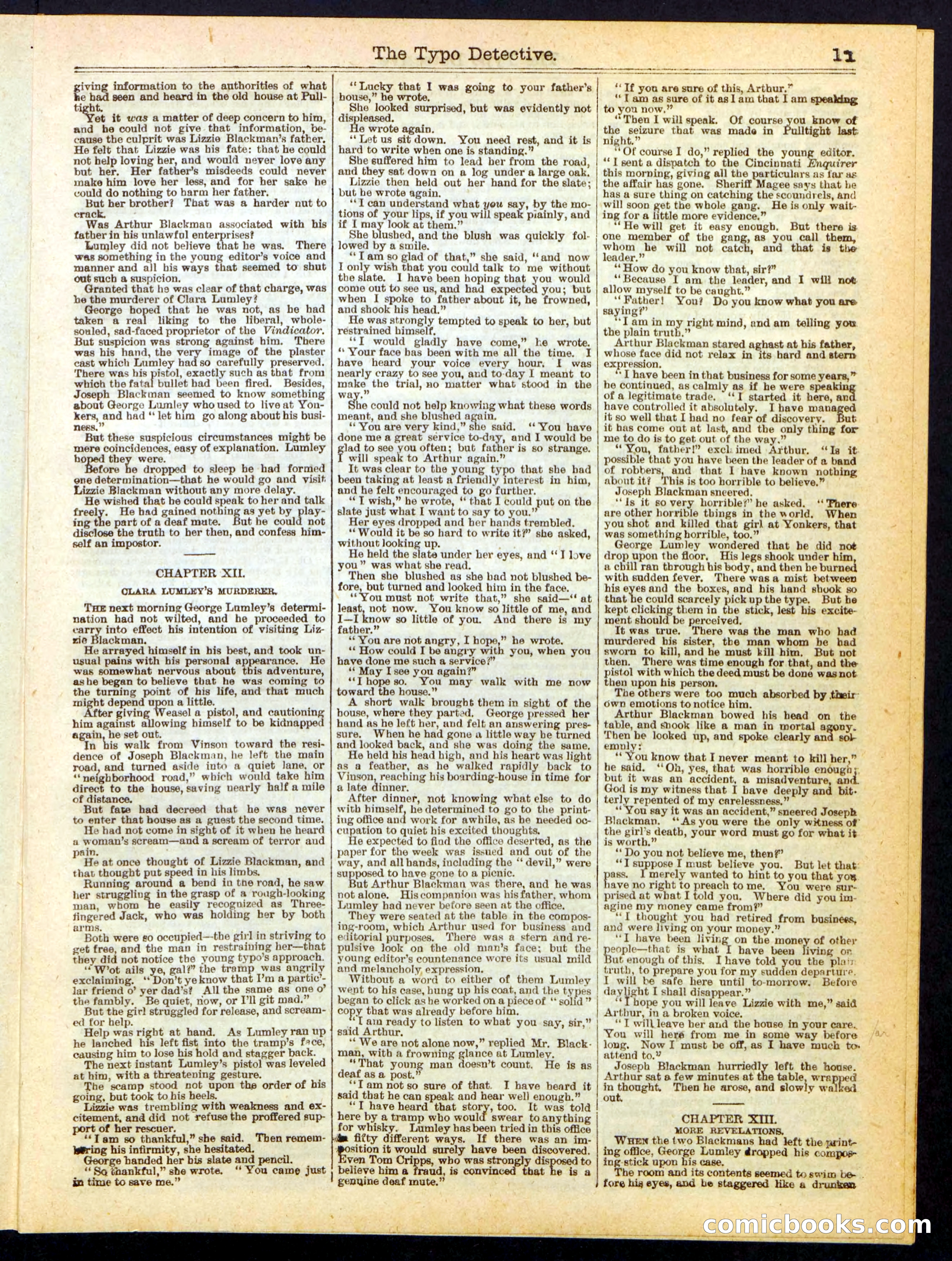
A restored page from Pulp Fiction, 1882. Page through the whole issue in the reader above.
📄 Transcribed text from this page (OCR, searchable)
Machine-transcribed from the original scan — historical spelling and the odd misread are preserved.
The Typo Detective. eee wo ee ee ‘‘Lucky that I was going to your father’s house,” he wrote, She looked surprised, but was evidently not displeased. 6 wrote again. ‘‘Let us sitdown. You need rest, and it is hard to write when one is standing.” She suffered him to lead ber from the road, and they sat down on a log under a large oak, Lizzie then held out her hand for the slate; but be wrote again. ‘**T can understand what you say, by the mo- tions of your lips, if you will speak piainly, and if | may look at them.” She blushed, and the blush was quickly fol- lowed by a smile. “Tam so glad of that,” she said, “and now I only wish that you could talk to me without the slate. I have been hoping that you would come out to see us, and had expected you; but when I spoke to father about it, he frowned, and shook his head.” He was strongly tempted to speak to her, but restrained himself, ‘*I would gladly have come,” he wrote. ‘Your face bas been with me all the time. I have heard your voice every hour, [ was nearly crazy to see you, and to-day | meant to make the trial, no matter what stood in the way,” he could not help knowing what these words meant, and she blushed again, ‘* You are very kind,” she said, ‘‘ You have done me a great service to-day, and I would be lad to see you often; but father is so strange. i will speak to Arthur again.” It was clear to the young typo that she had been taking at least a friendly interest in him, and he felt encouraged to go further. ‘“* I wish,” he wrote, ‘‘ that I could put on the slate just what I want to say to you.” Her eyes dropped and ber hands trembled. ‘“ Would it be so hard to write it?’ she asked, without looking up. é He held the slate under her eyes, and “I love you” was what she read. Then she blushed as she bad not blushed be- fore, but turned and looked him in the face. ‘You must not write that,” she said—‘“ at least, not now. You know so little of me, and I—I know so little of you. And there is my father.” ‘You are not angry, I hope,” he wrote. ** How could I be angry with you, when you have done me such a service?” ‘* May [see you again?” ‘*T hope so. You may walk with me now toward the house.” A short walk broughé them in sight of the house, where they parted, George pressed her hand as he left her, and felt an answering pres- sure. When he had gone a little way be turned and looked back, and she was doing the same, He held his head high, and his heart was light as a feather, as he walked rapidly back to Vinson, reaching his boarding-house in time for a late dinner. After dinner, not knowing what else to do witb himself, he determined to go to the print- ing office and work for awhile, as be needed oc- cupation to quiet his excited thoughts. He expected to find the office deserted, as the paper for the week was issued and out of the way, and all hands, including the “ devil,” were supposed to have gone to a picnic. ut Arthur Blackman was there, and he was not alone. Hiscompanion was his father, whom Lumley had never before seen at the office. They were seated at the table in the compos- ing-room, which Arthur used for business and editorial purposes. There was a stern and re- pulsive look on the old man’s face; but the | young editor’s countenance wore its usual mild | and melancholy, expression, Without a word to either of them Lumley went to his case, hung up his coat, and the types ! began to click as he worked on a piece of “ solid” copy that was already before him, ‘I am ready to listen to what you say, sir,” said Arthur. ‘* We are not alone now,” replied Mr. Black- man, with a frowning glance at Lumley. “That young man doesn’t count. He is as | deaf as a post.” **T am not so sure of that. I have heard it said that he can k and hear well enough.” “T have heard that story, too. It was told here by a tramp who would swear to anything for whisky. Lumley hasbeen tried in this office mm fifty different ways. If there was an im- giving information to the authorities of what he bad seen and heard in the old house at Pull- tight. et it was a matter of deep concern to him, and he could not give that information, be- cause the culprit was Lizzie Blackman’s father. He felt that Lizzie was his fate: that he could not help loving her, and would never love any but her. Her father’s misdeeds could never make him love her less, and for her sake he could do nothing to harm her father. But her brother? That was a harder nut to erack, Was Arthur Blackman associated with his father in his unlawful enterprises? Lumley did not believe that he was. There was something in the young editor’s voice and manner and all bis ways that seemed to shut out such a suspicion. Granted that he was clear of that charge, was he the murderer of Clara Lumley? George hoped that he was not, as he had taken a real liking to the liberal, whole- souled, sad-faced proprietor of the Vindicator. But suspicion was strong against him. There was his hand, the ve image of the plaster cast which Lumley had so carefully preserved. There was his pistol, exactly such as that from which the fatal bullet had been fired. Besides, Joseph Blackman seemed to know something about George Lumley who used to live at Yon- kers, and had ‘‘ let him go along about his busi- ness,” : But these suspicious circumstances might be mere coincidences, easy of explanation. Lumley ho they were. fore be dropped to sleep be had formed ene determination—that he would go and yisif Lizzie Blackman without any more delay. He wished that he could speak to her and talk freely. He had gained sae as yet by eo, ing the part of a deaf mute. But he could not disclose the truth to her then, and confess him- self an impostor. A EEE CHAPTER XIL. CLARA LUMLEY’S MURDERER, THe next morning George Lumley’s determi- nation had not wilted, and he proceeded to earry into effect his intention of visiting Liz- zié Blackman. He arrayed himself in his best, and took un- usual pains with his personal appearance. He was somewhat nervous about this adventure, ashe began to believe that he was coming to the turning point of his life, and that much might depend upon a little. Atter giving Weasel a pistol, and cautioning him against allowing himself to be kidnapped again, he set out. ; In his walk from Vinson toward the resi- dence of Joseph Blackman, he left the main road, and turned aside into a quiet Jane, or ‘neighborhood road,” which would take him direct to the house, saving nearly half a mile of distance. But fate had decreed that he was _ never to enter that bouse as a guest the second time. He had not come in sight of it when he heard a woman’s scream—and a scream of terror and pain. | He at once thought of Lizzie Blackman, and that thought put speed in his limbs. Running around a bend in the road, he saw her struggling in the grasp of a rough-looking man, whorm the easily recognized as Three- fingered Jack, who was holding her by both arms. rae f Both were #0 occupied—the girl in striving to get free, and the man in restraining her—that they did not notice the young typo’s approach. “Wot ails ye, gal?’ the tramp was angrily exclaiming. ‘‘ Don’t ye know that I’m a partic : lar friend o’ yer dad’s? All the same as one 0 the fambly. Be quiet, now, or I'll git mad.’ But the gir! struggled for release, and scream- ed for help. Help was right at hand. As Lumley ran up he lanched his left fist into the tramp’s f*ce, causing him to lose his hold and stagger back. The next instant Lumley’s pistol was leveled at him, with a threatening gesture. , The scamp stood not upon the order of bis going, but took to his heels. Lizzie was trembling with weakness and ex- citement, and did not refuse the proffered sup- port of her rescuer. 4 ‘Tam so thankful,” she said. Then remem- } ering his infirmity, she hesita position it would surely have been discovered. George handed her bis slate and pencil. ven Tom Cripps, who was rh dis to “ Sq thankful,” she wrote. ‘‘ You came just believe him a fraud, is convinced that he is a im time to save me.” genuine deaf mute.” * iz —_ ee 8 ne eee 8 ee mere or ee eee —— ee 2 tree os *‘Tf you are sure of this, Arthur,” ‘““{ am as sure of it as 1 am that I am speaking to you now,” “Then I will speak. Of course you know of a seizure that was made in Itight last: night. ‘Of course I do,” replied the young editor. “‘T sent a dispatch to the Cincinnati yh oy this morning, giving all the particulars as far as the affair has gone. Sheriff Magee says that he has a sure thing on catching the scoundrels, and will soon get the whole gang. He is only wait- ing for a little more evidence.” “He will get it easy enough. But there is one member of the gang, as you Call them, whom he will not catch, and that is the leader.” ‘“ How do you know that, sir?” ‘Because I am the leader, and I will not allow myself to be caught.” ‘Father! You? Do you know what you are saying?’ ‘Iam in my right mind, and am telling you the plain truth.” Arthur Blackman stared aghast at bis father, whose face did not relax in its hard and stern expression, ‘IT have been in that business for some years,” he continued, as calmly as if he were rae. of a legitimate trade. ‘I started it here, an have controlled it absolutely. I have managed it so well that I had no fear of discovery. But it has come out at last, and the only thing for me to do is to get out of the way.” “You, father!” excl imed Arthur. “Ig it possible that you have been the leader of a band of robbers, and that I have known nothing about it? This is too horrible to believe.” Joseph Blackman sneered, ‘‘Is it so very horrible” he asked. ‘ Phere. are other horrible things in the world. When you shot and killed that girl at Yonkers, that was something horrible, too.” George Lumley wondered that he did not drop upon the floor, His legs shook under him a chill ran through bis body, and then he burned with sudden fever, There wasa mist between his eyes and the boxes, and his hand shvok so that he could scarcely pick up the type. But he kept clicking them in the stick, lest his excite- ment should be perceived, It was true. There was the man who had murdered bis sister, the man whom he had sworn to kill, and he must kill him, But not then. There was time enough for that, and the pistol with which the deed must be done was not. then upon his person, The others were too much absorbed by their’ own emotions to notice him. Arthur Blackman bowed his head on the table, and shook like a man in mortal agony. ite he looked up, and spoke clearly and sol- emnly: : ‘You know that I never meant to kill her,” he said. ‘Oh, yes, that was horrible enough y, but it was an accident, a misadventure, an God is my witness that I bave deeply and bit- terly repented of my carelessness,” “You say it was an accident,” sneered Joseph Blackman, ‘As you were the only witness of the girl’s death, your word must go for what it is worth.” ** Do you not believe me, then?” ; “I suppose I must believe you. But let that: ass. I merely wanted to hint to you that you. ave no right to preach tome. You were sur- prised at what I told you. Where did you im- agine my money came from?” “I thought you had retired from businées, and were living on your money.” “T have been tee on the money of other eople—that is what I have been living or 3ut enough of this. Ihave told you the plais: truth, to prepare you for my sudden departure. I will be safe here until to-morrow. Before dayYght [ shall disappear.” ‘‘IT hope you will leave Lizzie with me,” said Arthur, in a broken voice. ‘TI will leave her and the house in your care. You will heré from me in some way before long. Now I must be off, as I have much to. attend to.” Joseph Blackman hurriedly left the house. Arthur sat a few minutes at the table be ad in deli Then he arose, and slowly w led ou CHAPTER XII MORE REVELATIONS, ee the tere ee had ae abe javint- office, e Lumle pos tri atick suon Bi-dada, pee’? _— he room and its contents seemed to swim be . fore hig eyes, and be staggered like a drunken "EO < m ‘ eS ed - . en <