
Pulp Fiction, 1878 · page 14 of 20
Beadle's Half Dime Library, No. 25 — page 14: what you’re looking at
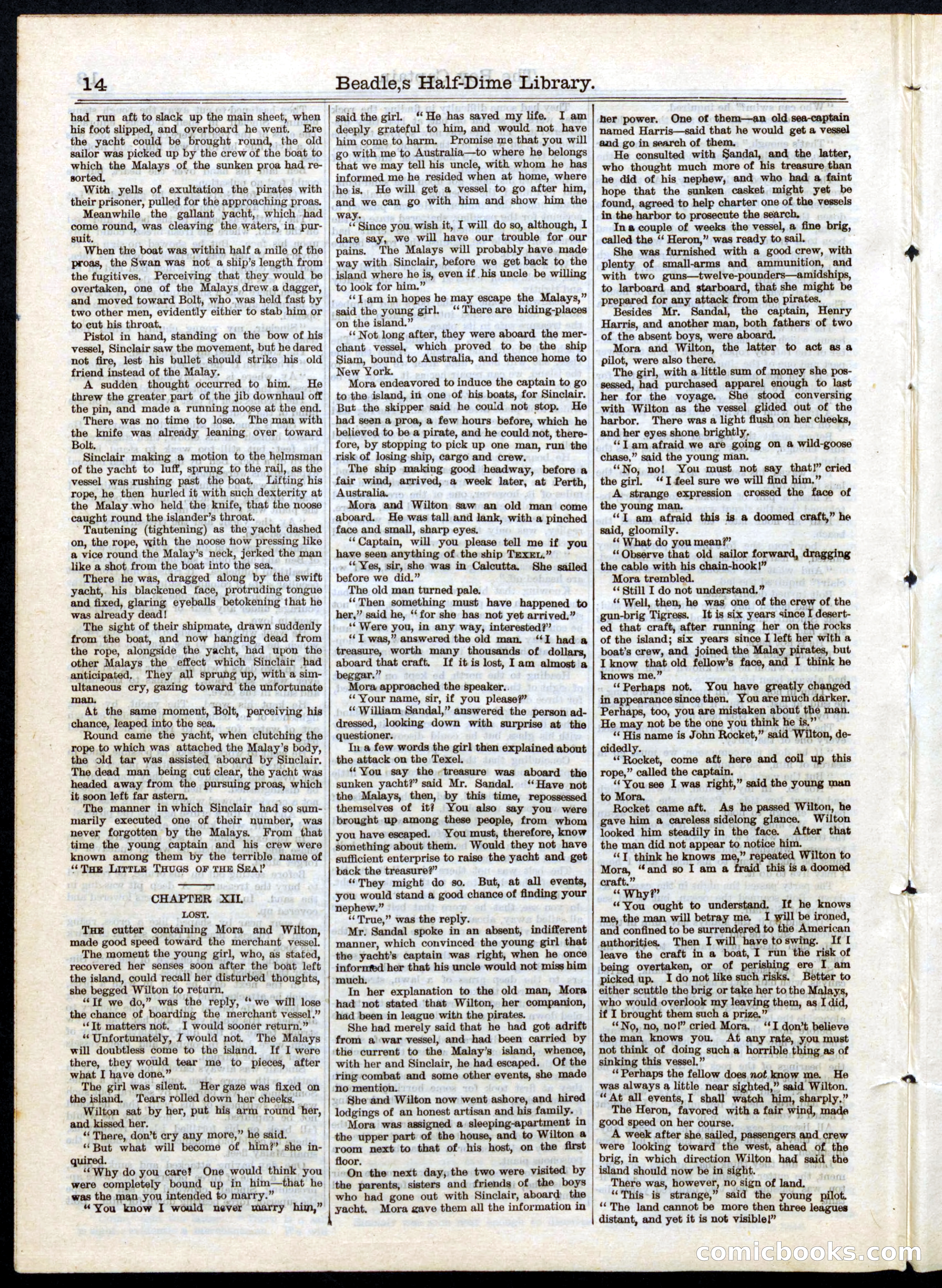
A restored page from Pulp Fiction, 1878. Page through the whole issue in the reader above.
📄 Transcribed text from this page (OCR, searchable)
Machine-transcribed from the original scan — historical spelling and the odd misread are preserved.
Se ee ee ee —, ™ - -—--——-—- — a 14. had run aft to slack up the main sheet, when his foot slipped, and overboard he went, Ere the yacht could be brought round, the old sailor was picked up by the crew of the boat to which the Malays of the sunken proa had re- sorted, With. yells of exultation the pirates with their prisoner, pulled for the approaching proas. Meanwhile the gallant yacht, which had come round, was cleaying the waters, in pur- suit, When the boat was within half a mile of the proas, the Swan was not a ship’s length from the fugitives. Perceiving that they would be overtaken, one of the Malays drew a dagger, and moved toward Bolt, who was held fast by two other men, evidently either to stab him or to cut his throat, Pistol in hand, standing on the bow of his vessel, Sinclair saw the movement, buf he dared not fire, lest his bullet should strike his. old friend instead of the Malay. A sudden thought occurred to him. He threw the greater part of the jib downhaul off the pin, and made a running noose at the end. There was no time to lose. The man with the knife was already leaning over toward Bolt, Sinclair making a motion to the helmsman of the yacht to luff, sprung to the rail, as the vessel was rushing past the boat. Lifting his rope, he then hurled it with such dexterity at the Malay who held the knife, that the noose caught round the islander’s throat. Tautening (tightening) as the yacht dashed on, the rope, with the noose how pressing like a vice round the Malay’s neck, jerked the man like a shot from the boat into the sea, There he was, dragged along by the swift yacht, his blackened face, protruding tongue and fixed, glaring eyeballs betokening that he was already dead! The sight of their shipmate, drawn suddenly from the boat, and now hanging dead from the rope, alongside the yacht, had upon the other Malays the effect which Sinclair had anticipated, They all sprung up, with a sim- ultaneous cry, gazing toward the unfortunate man, At the same moment, Bolt, perceiving his chance, leaped into the sea, Round came the yacht, when clutching the rope to which was attached the Malay’s body, the old tar was assisted aboard by Sinclair. The dead man being cut clear, the yacht was headed away from the pursuing proas, which it soon left far astern, The manner in which Sinclair had so sum- marily executed one of their number, was never forgotten by the Malays. From that time the young captain and his crew were known among them by the terrible name of “Toe LITTLE THUGS OF THE SEA!’ CHAPTER XII. LOST. Tue cutter containing Mora and Wilton, made good speed toward the merchant vessel. The moment the young girl, who, as stated, recovered her senses soon after the boat left the island, could recall her disturbed thoughts, she begged Wilton to return, “Tf we do,” was the reply, “* we will lose the chance of boarding the merchant vessel.” ‘*Tt matters not. I would sooner return.” “Unfortunately, J would not. The Malays will doubtless come to the island. If I were there, they would tear me to pieces, after what I have done.” The girl was silent. Her gaze was fixed on the island, Tears rolled down her cheeks. | Wilton sat by her, put his arm round her, and kissed her. “There, don’t cry any more,” he said. ‘But what will become of him?” she in- quired. ‘‘Why do you care? One would think you were completely bound up in him—that he was the man you intended to marry.” “You know I would never marry him,” Beadle,s Half-Dime Library. said the girl. “ He has saved my life, I am deeply. grateful to him, and would not have him come to harm. Promise me that you will go with me to Australia—to where he belongs that we may tell his uncle, with whom he has informed me he resided when at home, where he is, He will get a vessel to go after him, and we can go with him and show him the way. ‘‘ Since you wish it, I will do so, although, I dare say, we will have our trouble for our pains. The Malays will probably have made way with Sinclair, before we get back to the island where he is, even if his uncle be willing to look for him.” ‘‘T am in hopes he may escape the Malays,” said the young girl. ‘‘ There are hiding-places on the island.” ‘¢‘ Not long after, they were aboard the mer- chant vessel, which proved to be the ship Siam, bound to Australia, and thence home to New York. Mora endeavored to induce the captain to go to the island, in one of his boats, for Sinclair. But the skipper said he could not stop. He had seen a proa, a few hours before, which he believed to be a pirate, and he could not, there- fore, by stopping to pick up one man, run the risk of losing ship, cargo and crew. The ship making good headway, before a fair wind, arrived, a week later, at Perth, Australia. Mora and Wilton saw an old man come aboard. He was tall and lank, with a pinched face and small, sharp eyes. ‘Captain, will you please tell me if you have seen anything of the ship Texrn.” ‘“* Yes, sir, she was in Calcutta. She sailed before we did.” The old man turned pale. “‘Then something must have happened to her,” said he, “for she bas not yet arrived.” ‘‘ Were you, in any way, interested?” ‘1 was,” answered the old man. “I had a treasure, worth many thousands of dollars, aboard that craft. If itis lost, lam almost a beggar. ” Mora approached the speaker.. ‘Your name, sir, if you please?’ *‘ William Sandal,” answered the person ad- dressed, looking down with surprise at the questioner. In a few words the girl then explained about the attack on the Texel. “You say the -treasure was aboard the sunken yacht?” said Mr. Sandal. ‘Have not the Malays, then, by this time, repossessed themselves of it? You also say you were brought up among these people, from whom you have escaped. You must, therefore, know something about them. Would they not have sufficient enterprise to raise the yacht and get back the treasure?” “They might do so. But, at all events, you would stand a good chance of finding your nephew.” “True,” was the reply. Mr. Sandal spoke in an absent, indifferent manner, which convinced the young girl that the yacht’s captain was right, when he once informfed her that his uncle would not miss him much, In her explanation to the old man, Mora had not stated that Wilton, her companion, had been in league with the pirates. She had merely said that he had got adrift from a’ war vessel, and had been carried by the current to the Malay’s island, whence, with her and Sinclair, he had escaped. Of the ring combat and some other events, she made no mention. She and Wilton now went ashore, and hired lodgings of an honest artisan and his family. Mora was assigned a sleeping-apartment in the upper part of the house, and to Wilton a room next to that of his host, on the first floor. On the next day, the two were visited by the parents, sisters and friends of the boys who had gone out with Sinclair, aboard the yacht. Mora gave them all the information in her power. One of them—an old sea-captain named Harris—said that he would get a vessel and go in search of them. He consulted with Sandal, and the latter, who thought much more of his treasure than he did of his nephew, and who had a faint hope that the sunken caskeb might yet be found, agreed to help charter one of the vessels in the harbor to prosecute the search, Ina couple of weeks the vessel, a fine brig, called the ‘‘ Heron,” was ready to sail. She was furnished with a good crew, with plenty of small-arms and ammunition, and with two guns—twelve-pounders—amidships, to larboard and starboard, that she might be prepared for any attack from the pirates. Besides Mr. Sandal, the captain, Henry Harris, and another man, both fathers of two of the absent boys, were aboard. Mora and Wilton, the latter to act asa pilot, were also there. The girl, with a little sum of money she pos- sessed, had purchased apparel enough to last her for the voyage. She stood conversing with Wilton as the vessel glided out of the harbor. There was a light flush on her cheeks, and her eyes shone brightly. ‘‘T am afraid we are going on a wild-goose chase,” said the young man. “No, no! You must not say that!” cried the girl. ‘I feel sure we will find him.” A strange expression crossed the face of the young man. “T am afraid this is a doomed craft,” he said, gloomily. ‘‘ What do you mean?” “Observe that old sailor forward, dragging the cable with his chain-hook!” se Mora trembled. ‘« Still I do not understand,” ‘‘ Well, then, he was one of the crew of the gun-brig Tigress. It is six years since I desert- ed that craft, after running her on the rocks of the island; six years since I left her with a boat’s crew, and joined the Malay pirates, but I know that old fellow’s face, and I think he knows me.” ‘Perhaps not. You have greatly ch in appearance since then. You are much darker. Perhaps, too, you are mistaken about the man. He may not be the one you think he is,” ‘His name is John Rocket,” said Wilton, de- cidedly. ‘Rocket, come aft here and coil up this rope,” called the captain. ‘‘You see I was right,” said the young man to Mora, Rocket came aft. As he passed Wilton, he gave him a careless sidelong glance. Wilton looked him steadily in the face. After that the man did not appear to notice him. ‘“‘T think he knows me,” repeated Wilton to Mora, “and so I am a fraid this is a doomed craft.” “ Why?” “You ought to understand, If he knows me, the man will betray me, I will be ironed, and confined to be surrendered to the American authorities. Then I will have toswing. If I leave the craft in a boat, I run the risk of being overtaken, or of ishing ere I am icked up. I do not like such risks. Better to either scuttle the brig or take her to the Malays, who would overlook my leaving them, as I did, if I brought them such a prize.” gree ma.nek cried Mora, ‘I don’t believe 6 man ws you. At rate, you must not think of doing sucha hovrible ting as of sinking this vessel.” “Perhaps the fellow does not know me. He was always a little near sighted,” said Wilton. “At all events, I shall watch him, sharply.” The Heron, favored with a fair wind, made good speed on her course. =" A week after she sailed, passengers and crew were looking toward the west, ahead of the brig, in which direction Wilton had said the island should now be in sight. There was, however, no sign of land. : “This is strange,” said the young pilot. “The land cannot be more then three leagues distant, and yet it is not visible)” e€oim IOO <S) (E