
Pulp Fiction, 1878 · page 13 of 20
Beadle's Half Dime Library, No. 25 — page 13: what you’re looking at
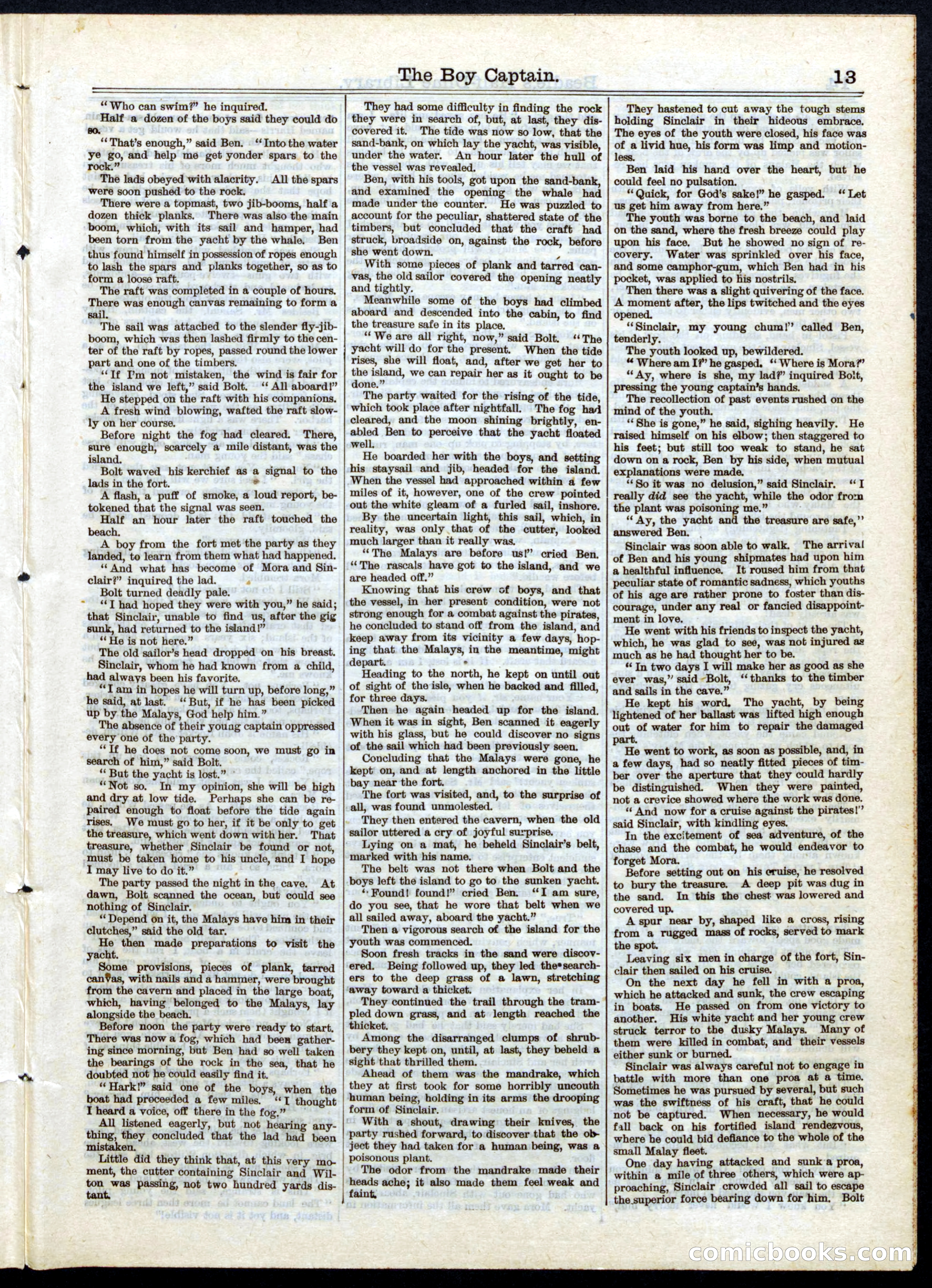
A restored page from Pulp Fiction, 1878. Page through the whole issue in the reader above.
📄 Transcribed text from this page (OCR, searchable)
Machine-transcribed from the original scan — historical spelling and the odd misread are preserved.
ee The Boy Captain. 13 SSS Sn rr stnapneetemenmernmremaneeeaeeeeeeee “Who can swim?” he inquired. Half a dozen of the boys said they could do 80. “‘That’s enough,” said Ben. ‘Into the water ye go, and help me get yonder spars to the rock. ” The lads obeyed with alacrity. All the spars were soon pushed to the rock. There were a topmast, two jib-booms, half a dozen thick planks. There was also the main boom, which, with its sail and hamper, had been torn from the yacht by the whale. Ben thus found himself in possession of ropes enough to lash the spars and planks together, so as to form a loose raft. The raft was completed in a couple of hours, There was enough canvas remaining to form a sail. The sail was attached to the slender fly-jib- boom, which was then lashed firmly to the cen- ter of the raft by ropes, passed round the lower part and one of the timbers. “If [’'m not mistaken, the wind is fair for the island we left,” said Bolt. ‘* All aboard!” He stepped on the raft with his companions. A fresh wind blowing, wafted the raft slow- ly on her course. Before night the fog had cleared. There, sure enough, scarcely a mile distant, was the island. Bolt waved his kerchief as a signal to the lads in the fort. af A flash, a puff of smoke, a loud report, be- tokened that the signal was seen. Half an hour later the raft touched the beach. A boy from the fort met the party as they landed, to learn from them what had happened. ‘“‘And what has become of Mora and Sin- clair?” inquired the lad. a Bolt turned deadly pale. ‘*T had hoped they were with you,” he said; that Sinclair, unable to find us, after the gig had returned to the island!” “He is not here.” The old sailor’s head dropped on his breast. Sinclair, whom he had known from a child, had always been his favorite. “‘T am in hopes he will turn up, before long,” he said, at last. “ But, if he has been picked up by the Malays, God help him.” The absence of their young captain oppressed every one of the party. “If he does not come soon, we must go in search of him,” said Bolt. “ But the yacht is lost.” © “Not so. In my opinion, she will be high and dry at low tide. Perhaps she can be re- paired enough to float before the tide again rises. We must go to her, if it be only to get | the treasure, which went down with her. That treasure, whether Sinclair be found or not, must be taken home to his uncle, and I hope I may live to do it.” ’ The party passed the night in the cave. At dawn, Bolt scanned the ocean, but could see nothing of Sinclair. “Depend on it, the Malays have him in their clutches,” said the old tar. He then made preparations to visit the yacht. Some provisions, pieces of plank, tarred can¥as, with nails and a hammer, were brought from the cavern and placed in the large boat, which, having belonged to the Malays, lay alongside the beach. Before noon the party were ready to start. There was now a fog, which had been gather- ing since morning, but Ben had so well taken the bearings of the rock in the sea, that he doubted not he could easily find it. “Hark!” said one of the boys, when the boat had proceeded a few miles. ‘T thought I heard a voice, off there in the fog.” All listened eagerly, but not hearing any- pre ty concluded that the lad had been n. Little did they think that, at this very mo- ment, the cutter containing Sinclair and Wil- oe passing, not two hundred yards dis- They had some difficulty in finding the rock they were in search of, but, at last, they dis- covered it. The tide was now so low, that the sand-bank, on which lay the yacht, was visible, under the water. An hour later the hull of the vessel was revealed. Ben, with his tools, got upon the sand-bank, and examined the opening the whale had made under the counter. He was puzzled to account for the peculiar, shattered state of the timbers, but concluded that the craft had struck, broadside on, against the rock, before she went down. _ With some pieces of plank and tarred can- vas, the old sailor covered the opening neatly and tightly. Meanwhile some of the boys had climbed aboard and descended into the cabin, to find the treasure safe in its place. “We are all right, now,” said Bolt. ‘The yacht will do for the present. When the tide rises, she will float, and, after we get her to oe island, we can repair her as it ought to be one.’ ; The party waited for the rising of the tide, which took place after nightfall. The fog had cleared, and the moon shining brightly, en- abled Ben to perceive that the yacht floated well. He boarded her with the boys, and setting his staysail and jib, headed for the island. When the vessel had approached within a few miles of it, however, one of the crew pointed out the white gleam of a furled sail, inshore. By the uncertain light, this sail, which, in reality, was only that of the cutter, looked much larger than it really was. ‘The Malays are before us!’’ cried Ben. “The rascals have got to the island, and we are headed off.” Knowing that his crew of boys, and that the vessel, in her present condition, were not strong enough for a combat against the pirates, he concluded to stand off from the island, and keep away from its vicinity a few days, hop- ing that the Malays, in the meantime, might depart. ° Heading to the north, he kept on until out of sight of the isle, when he backed and filled, for three days. Then he again headed up for the island. When it was in sight, Ben scanned it eagerly with his glass, but he could discover no signs of the sail which had been previously seen. Concluding that the Malays were gone, he kept on, and at length anchored in the little bay near the fort. The fort was visited, and, to the surprise of all, was found unmolested. They then entered the cavern, when the old sailor uttered a cry of joyful surprise. Lying on a mat, he beheld Sinclair’s belt, marked with his name. The belt was not there when Bolt and the boys left the island to go to the sunken yacht. ‘Found! found!” cried Ben. “I am sure, do you see, that he wore that belt when we all sailed away, aboard the yacht.” Then a vigorous search of the island for the youth was commenced. Soon fresh tracks in the sand were discov- ered. Being followed up, they led the*search- ers to the deep grass of a lawn, stretching away toward a thicket. They continued the trail through the tram- pled down grass, and at length reached the thicket. Among the disarranged clumps of shrub- bery they kept on, until, at last, they beheld a sight that thrilled them. Ahead of them was the mandrake, which they at first took for some horribly uncouth human being, holding in its arms the drooping form of Sinclair. With a shout, drawing their knives, the party rushed forward, to discover that the ob ject they had taken for a human being, was a poisonous plant. The odor from the mandrake made their a ache; it also made them feel weak and aint, They hastened to cut away the tough stems holding Sinclair in their hideous embrace. The eyes of the youth were closed, his face was of a livid hue, his form was limp and motion- less. Ben laid his hand over the heart, but he could feel no pulsation. *“Qaick, for God’s sake!” he gasped. us get him away from here.” The youth was borne to the beach, and laid on the sand, where the fresh breeze could play upon his face. But he showed no sign of re- covery. Water was sprinkled over his face, and some camphor-gum, which Ben had in his pocket, was applied to his nostrils. Then there was a slight quivering of the face. A moment after, the lips twitched and the eyes opened. “Sinclair, my young chum!’ called Ben, tenderly. The youth looked up, bewildered. “ Where am I?” he gasped, ‘‘ Where is Mora?” “‘Ay, where is she, my lad?” inquired Bolt, pressing the young captain’s hands. The recollection of past events rushed on the mind of the youth. “She is gone,” he said, sighing heavily. He raised himself on his elbow; then staggered to his feet; but still too weak to stand, he sat down on a rock, Ben by his side, when mutual explanations were made, “So it was no delusion,” said Sinclair. ‘I really did see the yacht, while the odor from the plant was rege | me.” “ Ay, the yacht and the treasure are safe,’’ answered Ben. | Sinclair was soon able to walk. The arrival of Ben and his young shipmates had upon him a healthful influence. It roused him from that peculiar state of romantic sadness, which youths of his age are rather prone to foster than dis- courage, under any real or fancied disappoint- ment in love. He went with his friends to inspect the yacht, which, he was glad to see, was not injured as much as he had thought her to be. ‘In two days I will make her as good as she ever was,” said Bolt, ‘thanks to the timber and sails in the cave.” He kept his word, The yacht, by being lightened of her ballast was lifted high enough out of water for him to repair the damaged “Let He went to work, as soon as possible, and, in a few days, had so neatly fitted pieces of tim- ber over the aperture that they could hardly be distinguished. When they were painted, not a crevice showed where the work was done. ‘And now for a cruise against the pirates!’’ said Sinclair, with kindling eyes. In the excitement of sea adventure, of the chase and the combat, he would endeavor to forget Mora. Before setting out on his eruise, he resolved to bury the treasure. A deep pit was dug in the sand. In this the chest was lowered and covered up. A spur near by, shaped like a cross, rising from a rugged mass of rocks, served to mark the spot. Leaving six men in charge of the fort, Sin- clair then sailed on his cruise. On the next day he fell in with a proa, which he attacked and sunk, the crew escaping in boats. He passed on from one victory to another. His white yacht and her young crew struck terror to the dusky Malays. Many of them were killed in combat, and their vessels either sunk or burned. Sinclair was always careful not to engage in battle with more than one proa at a time. Sometimes he was pursued by several, but such was the swiftness of his craft, that he could not be captured. When necessary, he would fall back on his fortified island rendezvous, where he could bid defiance to the whole of the small Malay fleet. One day having attacked and sunk’a proa, within a mile of three others, which were ap- proaching, Sinclair crowded all sail to escape the superior force bearing down for him, Bolt COMME DOO KES (G (E() — ———— ee eee et ee en gees may 6. na in Bn, 6 > Se ad mi