
Pulp Fiction, 1878 · page 15 of 20
Beadle's Half Dime Library, No. 25 — page 15: what you’re looking at
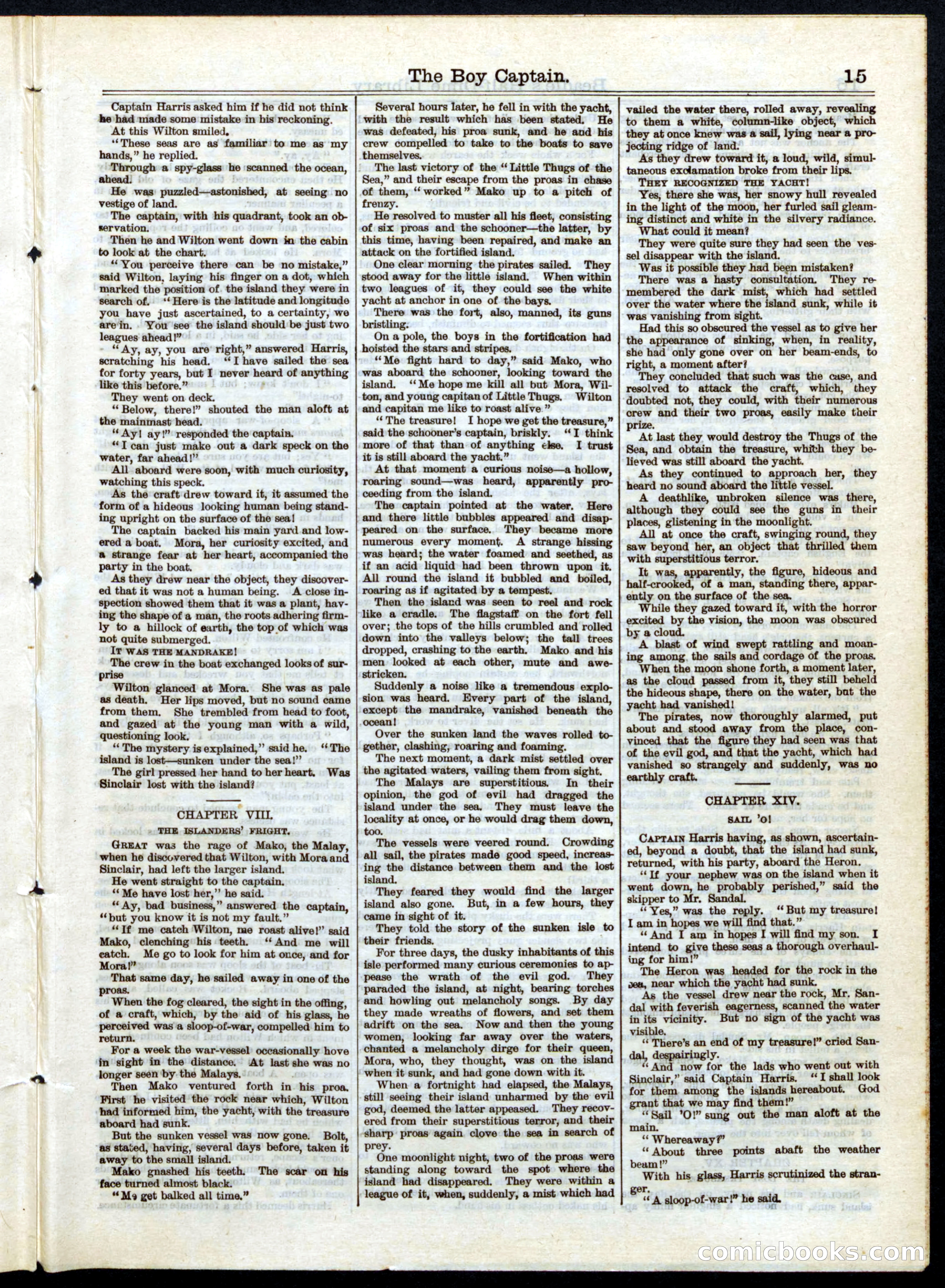
A restored page from Pulp Fiction, 1878. Page through the whole issue in the reader above.
📄 Transcribed text from this page (OCR, searchable)
Machine-transcribed from the original scan — historical spelling and the odd misread are preserved.
The Boy Captain. 15 Captain Harris asked him if he did not think he had made some mistake in his reckoning. At this Wilton smiled, ‘‘These seas are as familiar to me as my hands,” he replied. Through a spy-glass he scanned the | ocean, He was puzzled—astonished, at seeing no vestige of land. The captain, with his quadrant, took an ob- servation. Then he and Wilton went down in the cabin to look at the chart. “You perceive there can be no mistake,” said Wilton, laying his finger on a dot, which marked the position of. the island they were in search of. ‘‘ Here is the latitude and longitude you have just ascertained, to a certainty, we are'in. You see the island should be just two leagues ahead!” “Ay, ay, you are right,” answered Harris, scratching his head. “I have sailed the sea for forty years, but I never heard of anything like this before.” , They went on deck. “Below, there!” shouted the man aloft at the mainmast head. **Ayl ay!” responded the captain. “IT can just make out a dark speck on the water, far ahead!” All aboard were soon, with much curiosity, watching this speck. As the craft drew toward it, it assumed the form of a hideous looking human being stand- ing upright on the surface of the sea! The captain backed his main yard and low- ered a boat. Mora, her curiosity excited, and a strange fear at her heart, accompanied the party in the boat. As they drew near the object, they discover- ed that it was not a human being. A close in- spection showed them that it was a plant, hav- ing the shape of a man, the roots adhering firm- ly to a hillock of earth, the top of which was not quite submerged. IT WAS THE MANDRAKE! ~— crew in the boat exchanged looks of sur- prise Wilton glanced at Mora. She was as pale as death. Her lips moved, but no sound came from them. She trembled from head to foot, and gazed at the young man with a wild, questioning look. “The mystery is explained,’’ said he. island is lost—sunken under the sea!”’ The girl pressed her hand to her heart. Was Sinclair lost with the island? ‘*The CHAPTER VIIL THE ISLANDERS’ FRIGHT, GREAT was the rage of Mako, the Malay, when he discovered that Wilton, with Mora and Sinclair, had left the larger island. He went straight to the captain. ** Me have lost her,” he said. “‘ Ay, bad business,” answered the captain, “but you know it is not my fault,” “Tf me catch Wilton, me roast alive!” said Mako, clenching his teeth, ‘‘And me will eatch. Me go to look for him at once, and for Mora!” That same day, he sailed away in one of the proas, When the fog cleared, the sight in the offing, of a craft, which, by the aid of his glass, he perceived was a sloop-of-war, compelled him to return. For a week the war-vessel occasionally hove in sight in the distance. At last she was no longer seen by the Malays. — | Then Mako ventured forth in his proa, First he visited the rock near which, Wilton had informed him, the yacht, with the treasure aboard had sunk. But the sunken vessel was now gone. Bolt, as stated, having, several days before, taken it away to the small island. Mako gnashed his teeth. The scar on his face turned almost black. “Mo get balked all time,” Several hours later, he fell in with the yacht, with the result which has been stated. He was defeated, his proa sunk, and he and his crew compelled to take to the boats to save themselves. The last victory of the “‘ Little Thugs of the Sea,” and their escape from the proas in chase of them, ‘‘ worked” Mako up to a pitch of frenzy. He resolved to muster all his fleet, co of six proas and the schooner—the latter, by this time, having been repaired, and make an attack on the fortified island. One clear morning the pirates sailed. They stood away for the little island. When within two leagues of it, they could see the white yacht at anchor in one of the bays. There was the fort, also, manned, its guns On a pole, the boys in the fortification had hoisted the stars and stripes. “Me fight hard to day,” said Mako, who was aboard the schooner, looking toward the island. ‘*‘Me hope me kill all but Mora, Wil- ton, and young capitan of Little Thugs. Wilton and capitan me like to roast alive ” “‘The treasure! I hope we get the treasure,” said the schooner’s captain, briskly. “I think more of that than of anything ele, I trust it is still aboard the yacht.” At that moment a curious noise—a hollow, roaring sound—was heard, apparently pro- ceeding from the island. The captain pointed at the water. Here and there little bubbles appeared and disap- peared on the surface. They became more numerous every moment. A strange hissing was heard; the water foamed and seethed, as if an acid liquid had been thrown upon it. All round the island it bubbled and boiled, roaring as if agitated by a tempest. Then the island was seen to reel and rock like a cradle. The flagstaff on the fort fell over; the tops of the hills crumbled and rolled down into the valleys below; the tall trees dropped, crashing to the earth. Mako and his men looked at each other, mute and awe- stricken. Suddenly a noise like a tremendous explo- sion was heard. Every part of the island, except the mandrake, vanished beneath the ocean! Over the sunken land the waves rolled to- gether, clashing, roaring and foaming. The next moment, a dark mist settled over the agitated waters, vailing them from sight. The Malays are superstitious. In their opinion, the god of evil had dragged the island under the sea. They must leave the locality at once, or he would drag them down, too The vessels were veered round. Crowding all sail, the pirates made good speed, increas- ing the distance between them and the lost island. They feared they would find the larger island also gone. But, in a few hours, they came in sight of it. They told the story of the sunken isle to their friends. For three days, the dusky inhabitants of this isle performed many curious ceremonies to ap- pease the wrath of the evil god. They paraded the island, at night, bearing torches and howling out melancholy songs. By day they made wreaths of flowers, and set them adrift on the sea. Now and then the young women, looking far away over the waters, chanted a melancholy dirge for their queen, Mora, who, they thought, was on the island when it sunk, and had gone down with it. When a fortnight had elapsed, the Malays, still seeing their island unharmed by the evil god, deemed the latter appeased. They recov- ered from their superstitious terror, and their sharp proas again clove the sea in search of prey. One moonlight night, two of the proas were standing along toward the spot where the island had peared. They were within a league of it, when, suddenly, a mist which had vailed the water there, rolled away, revealing to them a white, column-like object, which they at once knew was a sail, lying near a pro- jecting ridge of land. As they drew toward it, a loud, wild, simul- taneous exclamation broke from their lips. THEY RECOGNIZED THE YACHT! Yes, there she was, her snowy hull revealed in the light of the moon, her furled sail gleam- ing distinct and white in the silvery radiance. What could it mean? They were quite sure they had seen the ves- sel disappear with the island. Was it possible they had been mistaken? There was a hasty consultation. They re- membered the dark mist, which had settled over the water where the island sunk, while it was vanishing from sight. Had this so obscured the vessel as to give her the appearance of sinking, when, in reality, she had only gone over on her beam-ends, to right, a moment after? They concluded that such was the case, and resolved to attack the craft, which, they doubted not, they could, with their numerous crew and their two proas, easily make their prize. At last they would destroy the Thugs of the Sea, and obtain the whith they be- lieved was still aboard the yacht. As they continued to approach her, they heard no sound aboard the little vessel. A deathlike, unbroken silence was there, although they could see the guns in their places, glistening in the moonlight. All at once the craft, swinging round, they saw beyond her, an object that thrilled them with superstitious terror. It was, apparently, the figure, hideous and half-crooked, of a man, standing there, appar- ently on the surface of the sea. While they gazed toward it, with the horror excited by the vision, the moon was obscured by a cloud. A blast of wind swept rattling and moan- ing among, the sails and cordage of the proas. When the moon shone forth, a moment later, as the cloud passed from it, they still beheld the hideous shape, there on the water, but the yacht had vanished! The pirates, now thoroughly alarmed, put about and stood away from the place, con- vinced that the figure they had seen was that of the evil god, and that the yacht, which had vanished so strangely and suddenly, was no earthly craft. CHAPTER XIV. SAIL ’o! CAPTAIN Harris having, as shown, ascertain- ed, beyond a doubt, that the island had sunk, returned, with his party, aboard the Heron. ‘‘If your nephew was on the island when it went down, he probably perished,” said the skipper to Mr. Sandal. “Yes,” was the reply. ‘“ But my treasure! I am in hopes we will find that.” ‘‘ And I am in hopes I will find my son. I intend to give these seas a thorough overhaul- ing for him!” The Heron was headed for the rock in the yea, near which the yacht had sunk. As the vessel drew near the rock, Mr. San- dal with feverish eagerness, scanned the water in its vicinity. But no sign of the yacht was visible, ‘“ There’s an end of my treasure!” cried San- doepnine y- a Pe now for the lads who went out with Sinclair,” said Captain Harris. “I shall look for them among the islands hereabout. God grant that we may find them!” “Sail ’O!” sung out the man aloft at the “« Whereaway?”’ “ About three points abaft the weather beam!” With his glass, Harris scrutinized the stran- ger. ‘¢ A sloop-of-war!” he said. EGOMIGcboo 1€OM,